
Thursday, Aug 20, 2026 // Buy Bob a Coffee // Ghostwire
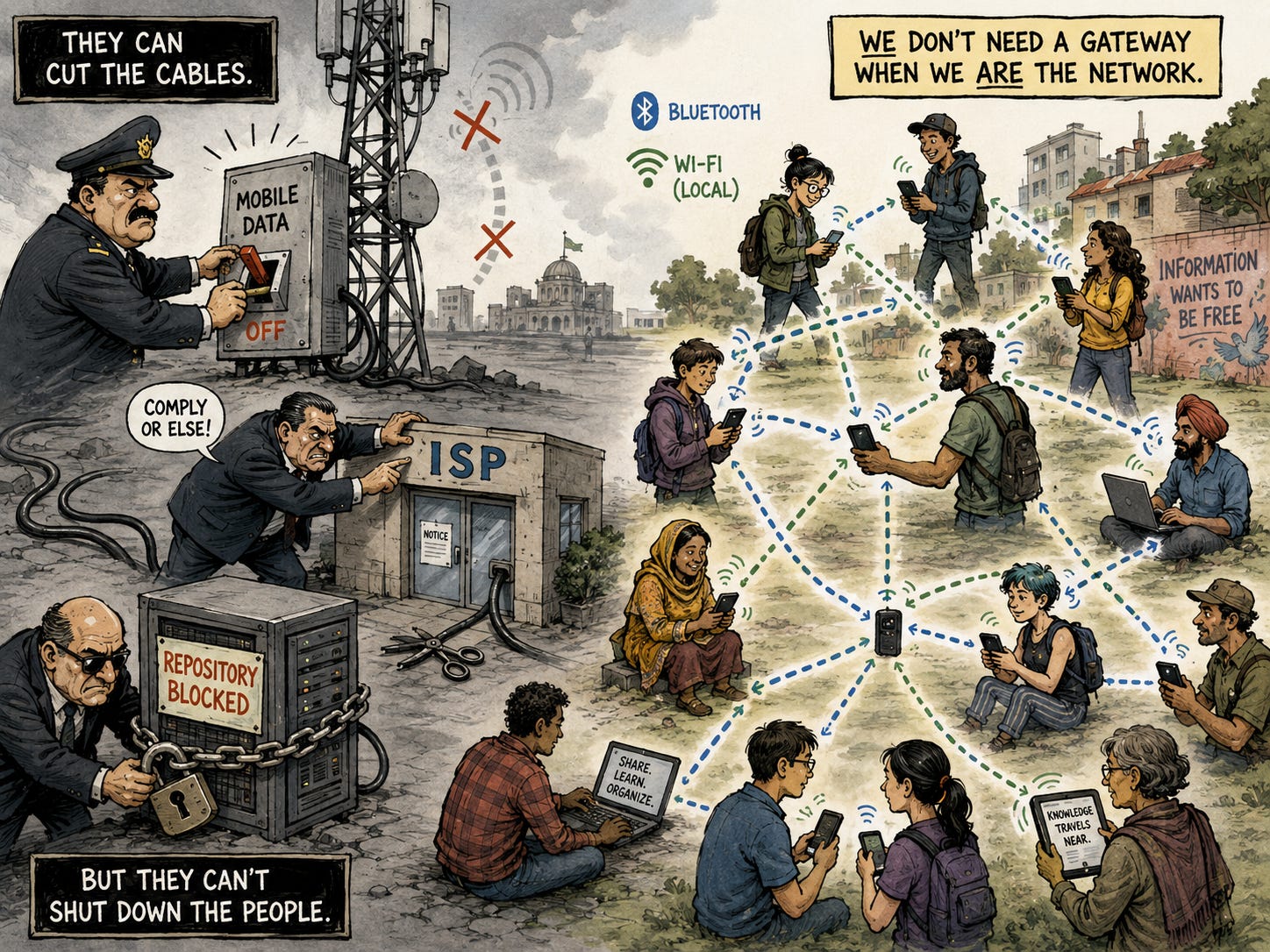
Bottom Line Up Front (BLUF): A July 2026 mobile Internet shutdown around Delhi’s Jantar Mantar protest disrupted payments, navigation, app-based transport, and online communications, but protesters adapted by using Bluetooth- and peer-to-peer messaging tools such as Bitchat, Bridgefy, and Briar. The episode shows that shutting down conventional telecom access does not necessarily eliminate communications; it can instead push users toward decentralized, device-to-device networks that are harder to block or intercept through traditional infrastructure controls.
Analyst Comments: Authorities can disable mobile data, pressure an ISP, or block access to a repository, but those measures do not inherently stop nearby devices from exchanging messages over Bluetooth or WiFi. That matters because mesh-based tools change the control points available to both governments and defenders. Conventional interception and disruption generally rely on centralized infrastructure—carriers, ISPs, servers, or DNS. Peer-to-peer systems reduce dependence on those choke points by turning user devices into part of the communications path.
READ THE STORY: Internet Society Pulse
Bottom Line Up Front (BLUF): A new White House directive reportedly instructs the Department of Homeland Security to create a program allowing vetted private companies to conduct government-approved offensive cyber operations against designated Cyber-Enabled Transnational Crime Organizations (CE-TCOs). The program would permit private firms to perform cyber surveillance and disruptive “cyber effects” operations against foreign criminal groups, marking a significant expansion of offensive cyber authorities beyond traditional government operators. Participating companies would require government vetting, pre-approval for individual operations, and a $1 million performance bond.
Analyst Comments: Based on the reporting, companies would operate inside a government-controlled program, with proposed operations reviewed by the Departments of Justice and Homeland Security before execution. That distinction matters because uncontrolled private retaliation has long raised legal, attribution, escalation, and collateral-damage concerns. The rationale is easy to understand: federal cyber capacity is finite, while ransomware groups, fraud networks, scam compounds, and other cybercriminal organizations operate at a scale traditional law enforcement struggles to match. Risky Business argues that the FBI can only pursue the highest-priority criminal groups, while NSA and U.S. Cyber Command have different mission sets. Private operators could therefore add capacity against criminal infrastructure that might otherwise remain uncontested.
READ THE STORY: Risky Biz
Bottom Line Up Front (BLUF): U.S. cybersecurity agencies are warning of an active campaign targeting Siemens S7 programmable logic controllers (PLCs), with attackers reportedly using AI-assisted Python scripts disguised as industrial monitoring tools. According to GBHackers’ summary of a joint NSA, CISA, FBI, Department of Energy, and EPA advisory, adversaries are leveraging public technical documentation, known vulnerabilities, and industrial automation libraries such as python-snap7 to communicate with exposed PLCs over S7comm. Critical manufacturing, energy, water, chemical, food and agriculture, and commercial facilities are identified as potentially at risk.
Analyst Comments: The AI angle is important, but the underlying problem is familiar: internet-exposed industrial control systems, weak segmentation, outdated firmware, and insufficient authentication. AI does not create access to a Siemens PLC by itself. What it can do is reduce the time and expertise needed to assemble existing documentation, protocol libraries, and exploit logic into usable reconnaissance or manipulation tooling. That lowers the barrier for less experienced operators. A threat actor no longer needs deep familiarity with Siemens environments to build scripts that enumerate controllers, read data blocks, inspect configuration information, or interact with ladder logic. Open-source libraries such as Snap7 already abstract much of the protocol complexity; AI-assisted development can make weaponizing those capabilities faster.
READ THE STORY: GBhackers
Bottom Line Up Front (BLUF): T-Mobile reportedly identified suspicious activity on routing infrastructure at a California data center that matched indicators associated with the China-linked Salt Typhoon campaign. Rather than relying solely on remote remediation, engineers physically disconnected the affected router from the network. T-Mobile maintains that the intrusion remained confined to edge routing infrastructure and that attackers did not access customer calls, text messages, voicemails, or other sensitive customer data.
Analyst Comments: The physical disconnection makes for a good headline, but the more important point is what it says about incident containment. If defenders believe a network device itself may be compromised, removing its connectivity can be safer than trusting software-level remediation on potentially hostile infrastructure. Salt Typhoon has repeatedly demonstrated why telecom networks are high-value espionage targets. Routers and other network-edge systems can provide visibility into traffic flows and potentially serve as stepping stones toward more sensitive systems. Catching reconnaissance activity before an attacker establishes deeper persistence materially changes the outcome of an intrusion.
READ THE STORY: TMO news
Bottom Line Up Front (BLUF): Aeternum malware operators are abusing Polygon smart contracts as a decentralized dead-drop resolver to dynamically rotate command-and-control (C2) domains. Rather than hard-coding a single hostname, infected systems query public Polygon JSON-RPC endpoints for smart-contract data that tells them where to connect next. The design gives operators a resilient control plane that is harder to disrupt through conventional domain seizures, hosting takedowns, or sinkholing.
Analyst Comments: Polygon RPC infrastructure is public, redundant, and legitimate, which means defenders cannot simply remove one server and expect the malware to lose access to its control channel. If one RPC endpoint is blocked, the loader can query another while retrieving the same contract state. The strongest capability is the operators’ ability to update C2 destinations on-chain without rebuilding or redistributing the malware. Aeternum samples reportedly query a getDomain() routine associated with selector 0xb68d1809, while an administrative updateDomain() function using selector 0xb249cd2d allows the controlling wallet to overwrite the stored C2 value. In practice, that means defenders can seize or block an exposed domain, and the attacker can simply publish a replacement to the contract.
READ THE STORY: GBhackers
Bottom Line Up Front (BLUF): Security researcher Denis Makrushin warns that AI-assisted development environments become especially dangerous when three conditions converge: an agent can access sensitive data, ingest untrusted content, and interact with external systems. This “lethal trifecta” creates a path from prompt injection or poisoned context to credential theft, malicious code changes, and data exfiltration. The article points to incidents involving Nx, GitLab Duo, GitHub Copilot, RAG systems, and MCP-connected tooling as evidence that agent security failures are moving from theoretical prompt abuse into infrastructure-level risk.
Analyst Comments: Once an agent can read repositories, secrets, tickets, internal documents, and runtime context—and then invoke tools that modify code, launch pipelines, or communicate externally—a successful prompt injection can become an execution chain rather than a chatbot failure. The Nx “s1ngularity” incident is a strong illustration of that transition. According to the article, attackers exploited a GitHub Actions shell-injection flaw to obtain publishing credentials and distribute malicious Nx packages. The resulting payload then attempted to invoke locally installed Claude, Gemini, and Amazon Q command-line tools to build an inventory of secrets before exfiltrating the data. The underlying supply-chain compromise was conventional; abusing local AI tools as part of post-compromise activity was the new wrinkle.
READ THE STORY: Xa6p
Bottom Line Up Front (BLUF): A software engineer reportedly came close to installing a malicious dependency after an AI coding agent recommended a legitimate-sounding package that had only recently appeared online. Softjourn avoided the compromise because its developers manually verify AI-recommended software before installation. The incident highlights the growing risk of “slopsquatting”—attackers registering package names that AI models are known or expected to hallucinate, then waiting for developers or autonomous agents to install them.
Analyst Comments: This is dependency confusion with an AI-native twist. The attacker does not necessarily need to compromise a popular package, typosquat a well-known library, or breach a maintainer account. Instead, they can exploit the model itself as the discovery mechanism: if an LLM repeatedly invents a plausible package name, an attacker can register that name and wait for someone to trust the recommendation. That becomes significantly more dangerous as coding agents gain permission to resolve dependencies, modify manifests, execute package managers, and commit changes without explicit human review. What is currently a bad recommendation can become an automated supply-chain compromise if the agent has enough authority to install the dependency itself.
READ THE STORY: The Register
Bottom Line Up Front (BLUF): Security researchers created a fake decentralized-finance startup and hired three individuals they assess were North Korean IT workers, giving the team a rare inside view of how DPRK-linked operatives pass remote hiring checks and establish legitimate access inside Western companies. The suspected workers used inconsistent identity documents, VPN infrastructure, AI-assisted job tools, and remote-access software while operating inside researcher-controlled virtual machines. The campaign highlights a persistent insider-access problem: these actors do not need to exploit a vulnerability if an organization hires them and grants them credentials, source-code access, and trusted employee status.
Analyst Comments: The most important point is that the suspected operatives entered through normal recruiting workflows, passed interviews, signed contracts, and received authorized access. Once inside, their activity could resemble that of any legitimate remote developer unless defenders are specifically looking for identity inconsistencies, unusual access patterns, or infrastructure associated with DPRK IT-worker operations. The onboarding indicators are especially useful for defenders. Researchers observed mismatched states across claimed residences, driver’s licenses, and banking information; one submitted identity image reportedly contained signs of Google Gemini processing and a SynthID watermark. Another used a legitimate Social Security number with unrelated banking details. These are not definitive attribution signals individually, but taken together they reinforce the value of repeated identity verification rather than treating pre-employment checks as a one-time control.
READ THE STORY: THN
FROM THE MEDIA: This is the story of Christina Chapman, a suburban TikTok creator who ran a covert “laptop farm” from her Arizona home. The scheme became a gateway for North Korean IT operatives who infiltrated US companies and, according to the Justice Department, funneled millions of dollars to the North Korean government.
FROM THE MEDIA: North Korea has built a secret workforce inside American companies. Using stolen identities, AI tools and U.S. accomplices, its operatives have cheated their way into remote jobs in an effort to earn money for Kim Jong Un’s regime. The FBI says there are likely thousands of them applying for jobs across America and hundreds of millions of dollars have been funneled back to the regime.
The selected stories cover a broad range of cyber threats and are intended to help readers frame key publicly discussed threats and improve overall situational awareness. InfoDom Securities does not endorse any third-party claims made in its original material or related links on its sites; the opinions expressed by third parties are theirs alone. For further questions, don’t hesitate to get in touch with InfoDom Securities at dominanceinformation@gmail.com.
No posts
Comments
Nothing yet. Say the first thing.
Sign in to join the conversation.