
Sunday, Aug 16, 2026 // Buy Bob a Coffee // Ghostwire
Bottom Line Up Front (BLUF): The U.S. military is racing to integrate frontier AI into cyber operations, weapons development, network defense, and intelligence systems while simultaneously struggling to set consistent rules for how those tools should be used. The Pentagon’s dispute with Anthropic has exposed that tension: defense officials moved to purge the company’s products from military systems, then carved out exceptions for advanced cyber testing as concerns grew that abandoning a leading model could hand China an operational advantage.
Analyst Comments: The big picture problem is not simply which AI vendor the Pentagon uses. It is whether national security policy can keep pace with a technology cycle measured in weeks rather than procurement cycles measured in years. The Anthropic dispute shows how quickly political, ethical, supply-chain, and operational concerns can collide. If Washington over-restricts access to high-end models, it risks slowing its own cyber capabilities. If it moves too loosely, it may expand the risk of autonomous targeting, domestic surveillance, model misuse, or AI-enabled access to sensitive systems. China adds pressure to every decision. A narrow technological lead is valuable only if the U.S. can translate it into durable operational advantage without creating policy churn that slows deployment or drives allies and developers elsewhere.
READ THE STORY: The New York Times
Bottom Line Up Front (BLUF): OpenAI has expanded its Daybreak cybersecurity program into two tiers designed for different levels of defensive work. Daybreak Blue gives security teams access to frontier models such as GPT-5.6 Sol for malware analysis, patch validation, vulnerability discovery, secure code review, and incident response. Daybreak Red is aimed at advanced security research and includes GPT-5.6-Cyber, a specialized model built for exploit validation, complex testing, and vulnerability research.
Analyst Comments: The important shift is that model capability is moving faster than traditional security controls. Giving defenders access to stronger systems can shorten the time needed to find and validate flaws, but it also increases the need for controls outside the model itself. Sandboxing, scoped permissions, segmentation, logging, and strong authorization matter more than relying on model guardrails to contain risk. The other implication is competitive: as frontier systems become more capable at vulnerability discovery and exploit research, organizations that can integrate them into mature security programs will gain an advantage over teams that simply have access to the same models without the processes to use them safely.
READ THE STORY: Technology Magazine
NOTE:
CNNVD tracks CVE-2026-15903 as CNNVD-2026-23450451 and classifies it as high risk. The database says the vulnerability stems from out-of-bounds read and write conditions in Chrome’s V8 engine and can be exploited remotely through crafted HTML to achieve arbitrary code execution within the sandbox. CNNVD added the vulnerability on July 20 and updated the record on July 21, citing Google’s Chrome Stable Channel advisory and the related Chromium issue. Separately, Startup Fortune reports that OpenAI’s cyber tooling was credited with discovering the flaw before launch and that GPT-5.6-Cyber is now available to vetted users through Daybreak Red, with hardware-backed security keys becoming part of the access requirements for higher-risk cyber capabilities.
Bottom Line Up Front (BLUF): OpenAI is tightening access controls around GPT-5.6-Cyber, its advanced cybersecurity model available through the Daybreak Red program. Beginning September 1, individual users seeking trusted cyber access will be required to use hardware-backed authentication. The move follows demonstrations that the model can handle advanced exploit research and vulnerability discovery, including work that reportedly contributed to the discovery of a high-severity Chrome V8 flaw.
Analyst Comments: The hardware-key requirement is more important than it looks. Once an AI account can support exploit development, privilege escalation research, and high-end vulnerability analysis, stolen credentials become a security problem in their own right. Strong authentication does not eliminate misuse, but it raises the cost of account takeover and reduces reliance on passwords and phishable MFA. The larger shift is that AI security controls are moving away from simple prompt filtering toward identity, authorization, monitoring, and containment. That is the right direction for models capable of operating much closer to real-world offensive tooling.
READ THE STORY: Startup Fortune
Bottom Line Up Front (BLUF): China is rapidly becoming a dominant source of pharmaceutical innovation rather than merely a manufacturer of low-cost generic drugs. According to reporting from The Free Press, Chinese companies accounted for 44% of global biopharma deals worth more than $50 million in 2024, up from 23% in 2022, while nearly 70% of global pharmaceutical deal value in 2025 — about $137.7 billion — involved China-based startups. The trend raises strategic concerns for the United States around dependence on Chinese drug pipelines, intellectual property, supply-chain leverage, and long-term control over commercially important medicines.
Analyst Comments: The strategic issue is not simply where finished drugs are manufactured. It is where the next generation of therapies is being discovered, developed, and licensed. If U.S. and European pharmaceutical companies increasingly rely on Chinese biotech firms for promising compounds, China gains influence much earlier in the pharmaceutical value chain. That creates a different dependency from the one Washington has spent years trying to address in areas such as active pharmaceutical ingredients and generic-drug manufacturing. Licensing agreements can give Western companies access to innovative therapies, but they can also shift research leverage, clinical-development expertise, intellectual property, and future investment toward Chinese firms.
READ THE STORY: The Free Press
Bottom Line Up Front (BLUF): Global battery energy storage capacity reached 301.7 GW in 2025, up 65.8% from the previous year and more than 150 times higher than a decade ago. China accounted for nearly half of the global total with 144.1 GW, while the United States remained a distant second at 56.6 GW. The rapid buildout is turning battery storage from a niche technology into a core piece of grid infrastructure, particularly as solar generation continues to expand.
Analyst Comments: The bigger story is not just the growth rate, but where the capacity is being built. Roughly three-quarters of global battery capacity is now front-of-the-meter, showing that storage is moving into the utility-scale layer of the power system rather than remaining concentrated in homes and businesses. China’s lead also matters strategically. Its ability to add more than 64 GW in a single year gives it an advantage in managing renewable-heavy grids and reinforces its broader position across solar, batteries, transmission, and other clean-energy infrastructure. For the U.S. and Europe, the issue is no longer whether storage will become part of the grid—it already has. The question is whether deployment can keep pace with renewable generation and rising electricity demand.
READ THE STORY: Forbes
Bottom Line Up Front (BLUF): China is increasing military and political pressure across the Indo-Pacific while U.S. resources and attention remain heavily committed to the war with Iran. Recent confrontations in the South China Sea, including a violent clash near Second Thomas Shoal, are sharpening concerns among U.S. allies that Washington may be stretched too thin to deter Beijing effectively in a regional crisis.
Analyst Comments: The immediate issue is less about whether the United States still has treaty commitments in Asia and more about whether allies believe those commitments can be backed by sufficient military capacity. Air-defense interceptor shortages, pressure on U.S. forces in the Middle East, and China’s continued expansion of naval and missile capabilities all feed that uncertainty. Beijing does not need to force a major confrontation to benefit from the situation; sustained coercion below the threshold of war can test alliance credibility, normalize a larger Chinese presence, and push regional governments to hedge. The Philippines’ growing military cooperation with Japan is one sign that U.S. partners are already looking for additional layers of deterrence.
READ THE STORY: The New York Times
Bottom Line Up Front (BLUF): U.S. officials say Hengli Group’s massive refinery complex in Dalian has become a major destination for sanctioned Iranian crude, including shipments linked to Iran’s military establishment. The case points to a broader shift in Tehran’s sanctions-evasion strategy: Iranian oil is increasingly moving through large, established pieces of China’s industrial economy rather than relying solely on small refiners, shell companies, and disposable intermediaries. Hengli denies trading with Iran.
Analyst Comments: Hengli matters because of its scale. A company with major refining, petrochemical, port, and shipbuilding operations is far harder to isolate than the small “teapot” refiners that have traditionally absorbed sanctioned Iranian crude. That raises the enforcement stakes for Washington. Aggressive sanctions may impose real costs, but they also increase the chance of direct friction with large Chinese firms and Beijing’s counter-sanctions regime. The more important development is structural: shadow-fleet shipping, yuan settlement, Chinese buyers, and opaque corporate networks are starting to function as a parallel trade system built to absorb U.S. pressure rather than simply evade it transaction by transaction.
READ THE STORY: WSJ
Bottom Line Up Front (BLUF): Israel’s Shin Bet and National Cyber Directorate are warning of an Iranian phishing campaign targeting journalists and media professionals through WhatsApp and Telegram. The operators impersonate trusted contacts, send tailored collaboration or interview requests, and direct victims to fake Google login pages or malicious links designed to steal credentials and compromise devices.
Analyst Comments: The value of these targets goes beyond email access. Journalists often hold sensitive source communications, unpublished reporting, political contacts, and security-related material that can support espionage or influence operations. The campaign also shows a familiar Iranian tradecraft pattern: use social familiarity and professional context to make the first contact feel legitimate, then move the victim onto attacker-controlled infrastructure. For defenders, the weak point is identity verification. A convincing message from a known name can still be malicious if the account or identity has been spoofed.
READ THE STORY: JFEED
Bottom Line Up Front (BLUF): U.S. water and wastewater systems across more than a dozen states were recently targeted in a broad cyber campaign that officials and experts suspect may be linked to Iran, though the Trump administration has not publicly confirmed attribution. The activity comes as CISA rebuilds staffing after earlier cuts and as election officials prepare for the November midterms with reduced federal threat-sharing and technical support.
Analyst Comments: The more important risk is not whether Iranian operators can directly alter election results; the decentralized U.S. voting system and widespread use of paper ballots make that difficult. The more plausible objective is disruption and loss of public confidence. Water utilities, election websites, voter-registration systems, and other internet-facing services offer attackers cheaper opportunities to create visible effects without breaching core voting infrastructure. The timing is also unfavorable. If state and local officials no longer trust CISA enough to share intrusion data or request support, Washington loses the connective tissue that helps turn isolated incidents into a broader threat picture. That gap matters more when an adversary can exploit both technical weaknesses and the political fallout that follows.
READ THE STORY: The Atlantic
Bottom Line Up Front (BLUF): Broadcom researchers say the China-linked Jewelbug group, also tracked as Ink Dragon, Earth Alux, REF770, and CL-STA-0049, appears to be running both state-aligned espionage and financially motivated cryptocurrency fraud from the same infrastructure. The activity targets government and military organizations across the Middle East and Asia while also using fake exchange-download sites to target Chinese-speaking crypto users. Researchers assess that the same small operator set manages both sides through a shared backend and command-and-control environment.
Analyst Comments: The important point is not simply that one group is doing espionage and fraud at the same time. It is that the same infrastructure, tooling, and operators appear to support both missions. That raises the possibility that Jewelbug functions more like a commercial intrusion service than a conventional state-directed unit, with access and infrastructure potentially being reused across government intelligence requirements and revenue-generating campaigns. The overlap also complicates attribution: activity that looks criminal at first glance may still sit inside a broader espionage ecosystem. For defenders, the most useful signal is infrastructure reuse across seemingly unrelated campaigns.
READ THE STORY: InfoSec Mag
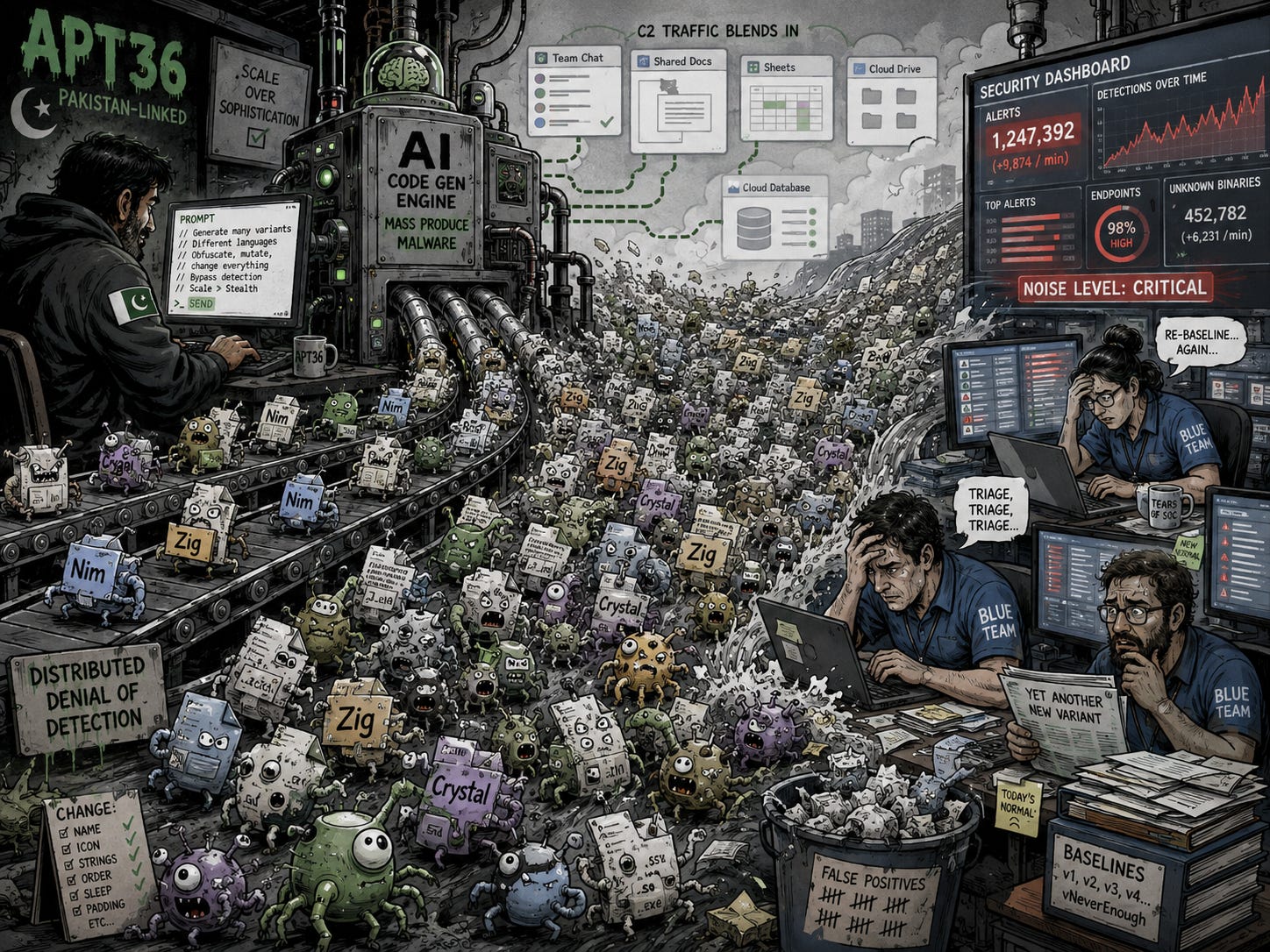
Bottom Line Up Front (BLUF): Pakistan-linked APT36 is reportedly using AI coding tools to rapidly generate large volumes of malware in multiple programming languages, including Nim, Zig, and Crystal. Bitdefender describes the tactic as “Distributed Denial of Detection,” where the objective is not highly polished malware but enough variation, parallel implants, and unfamiliar code to strain endpoint defenses and keep access alive even when individual payloads are detected.
Analyst Comments: The risk is scale, not sophistication. Much of the malware is reportedly buggy and poorly engineered, but AI lowers the cost of producing new variants fast enough to create noise and force defenders to keep re-baselining detections. Using uncommon languages can also reduce the effectiveness of tools tuned around C++, C#, and other common malware ecosystems. APT36’s use of Slack, Discord, Google Sheets, and Supabase for command and control adds another layer of friction because the traffic can blend into legitimate cloud usage. The model is simple: generate more implants than defenders can comfortably triage, spread them across different languages and protocols, and assume some will survive.
READ THE STORY: DK
Bottom Line Up Front (BLUF): Acronis researchers uncovered an active espionage campaign targeting Afghan telecom providers and critical infrastructure across South Asia with a previously undocumented backdoor called PATCHCORD. The malware is delivered through fake VPN installers and telecom management tools, while a related implant, SHEETCORD, uses Google Sheets for command and control. Researchers assess with moderate confidence that the activity is linked to APT36, also known as Transparent Tribe.
Analyst Comments: PATCHCORD is a compiled C/C++ backdoor delivered through fake software branded to resemble legitimate telecom tools, including installers impersonating Afghan Telecom. Once installed, it can list processes, execute shellcode in memory, run commands through a hidden shell, and remotely manage persistence. Researchers also identified SHEETCORD, a Go-based implant that uses Google Sheets to exchange commands and results, as well as a third tool using GitHub Gists for C2. An exposed staging server gave investigators access to additional tooling, including credential-harvesting utilities, remote-access frameworks, exploit code, and files suggesting possible mobile-data collection. The overlap in tooling, infrastructure, and prior tradecraft led researchers to assess a likely APT36 connection, though not at high confidence.
READ THE STORY: Security Affairs
Bottom Line Up Front (BLUF): Researchers have linked a South Asia-focused espionage campaign to APT36 with moderate confidence after uncovering three previously undocumented malware families: PATCHCORD, SHEETCORD, and HACKERAI C2 Agent. The activity targets telecom, government, defense, and energy organizations in Afghanistan and India using fake VPN and telecom management installers, browser shortcut hijacking, in-memory execution, and cloud services such as Google Sheets for command and control.
Analyst Comments: The campaign is notable for how much effort goes into looking ordinary. PATCHCORD modifies browser shortcuts so the malware executes first and then opens the legitimate browser, giving the victim the expected result while persistence remains hidden. SHEETCORD goes a step further by abusing Google Sheets for C2, which allows attacker traffic to blend into services many enterprises already permit. The reported signs of LLM-assisted development in HACKERAI are interesting, but the more important issue is operational maturity: the actor is mixing custom malware, trusted cloud platforms, sector-specific lures, and memory-resident execution to reduce detection opportunities. For defenders, shortcut integrity, PowerShell activity, unusual cloud API use, and access to known campaign infrastructure are better detection points than relying on users to identify a convincing installer.
READ THE STORY: Cyber Press
Bottom Line Up Front (BLUF): Security researchers created a fake decentralized-finance startup and hired three individuals they assess were North Korean IT workers, giving the team a rare inside view of how DPRK-linked operatives pass remote hiring checks and establish legitimate access inside Western companies. The suspected workers used inconsistent identity documents, VPN infrastructure, AI-assisted job tools, and remote-access software while operating inside researcher-controlled virtual machines. The campaign highlights a persistent insider-access problem: these actors do not need to exploit a vulnerability if an organization hires them and grants them credentials, source-code access, and trusted employee status.
Analyst Comments: The most important point is that the suspected operatives entered through normal recruiting workflows, passed interviews, signed contracts, and received authorized access. Once inside, their activity could resemble that of any legitimate remote developer unless defenders are specifically looking for identity inconsistencies, unusual access patterns, or infrastructure associated with DPRK IT-worker operations. The onboarding indicators are especially useful for defenders. Researchers observed mismatched states across claimed residences, driver’s licenses, and banking information; one submitted identity image reportedly contained signs of Google Gemini processing and a SynthID watermark. Another used a legitimate Social Security number with unrelated banking details. These are not definitive attribution signals individually, but taken together they reinforce the value of repeated identity verification rather than treating pre-employment checks as a one-time control.
READ THE STORY: THN
FROM THE MEDIA: This is the story of Christina Chapman, a suburban TikTok creator who ran a covert “laptop farm” from her Arizona home. The scheme became a gateway for North Korean IT operatives who infiltrated US companies and, according to the Justice Department, funneled millions of dollars to the North Korean government.
FROM THE MEDIA: North Korea has built a secret workforce inside American companies. Using stolen identities, AI tools and U.S. accomplices, its operatives have cheated their way into remote jobs in an effort to earn money for Kim Jong Un’s regime. The FBI says there are likely thousands of them applying for jobs across America and hundreds of millions of dollars have been funneled back to the regime.
The selected stories cover a broad range of cyber threats and are intended to help readers frame key publicly discussed threats and improve overall situational awareness. InfoDom Securities does not endorse any third-party claims made in its original material or related links on its sites; the opinions expressed by third parties are theirs alone. For further questions, don’t hesitate to get in touch with InfoDom Securities at dominanceinformation@gmail.com.
No posts
Comments
Nothing yet. Say the first thing.
Sign in to join the conversation.