
Presumably every American reader has been following the Reflecting Pool fiasco. I know I have some international readers (hi!), so to summarize the story briefly, there is a large pool on the Washington Mall that reflects both the Washington Monument and the Lincoln Memorial. For decades, however, it has been plagued with aesthetic issues including leakage from cracks in the concrete and summertime algae blooms. (It’s not often that I cite Chemical & Engineering News in this Substack, but they have a good explanation of the algae). With characteristic modesty, Trump declared that he alone was able to fix the Reflecting Pool, and he would have it all beautified in time for the nation’s 250th birthday celebration on July 4, 2026 (NYT gift link to long story about these events). Trump tapped a guy who had managed one of his golf clubs to get the job done, and he hired a contractor to apply stuff called Rhino 5000, in a shade marketed as “American flag blue,” as an interior coating. At the time this was happening, I read a fantastic thread on Bluesky explaining why Rhino 5000 was exactly the wrong solution. (The first post said: “HAHAHAhaha! they’re making the world’s biggest synthetic scum pond!!!” Seriously, I recommend reading the whole thing.) The Bluesky thread accurately forecast all of what was to come:
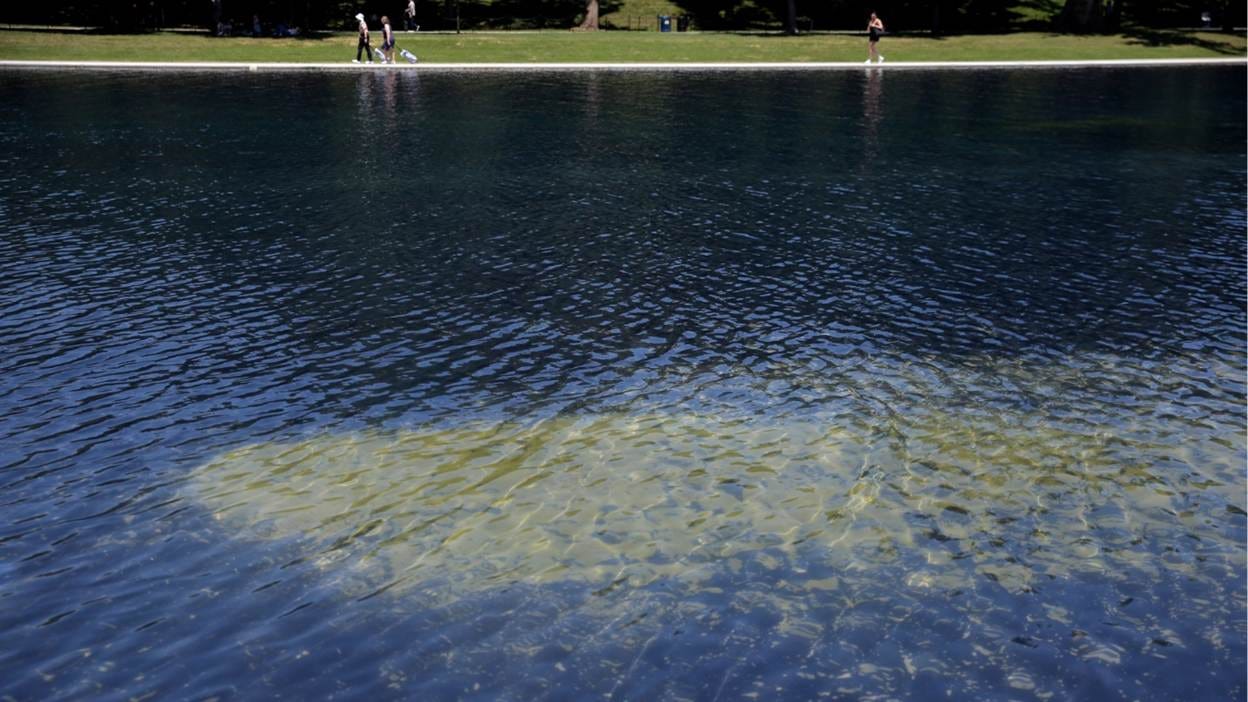
Trump flipped out, and blamed the peeling liner and algae bloom on vandals, writing on social media: “It was purposefully and criminally done, and somebody had to work very hard, probably in the dark of night.” The Park Police and Department of the Interior did not provide any evidence backing up this claim, notwithstanding the presence of law enforcement officers and security cameras that would have recorded any incidents of vandalism. Nevertheless, the U.S. Attorney’s Office for the District of Columbia, headed by U.S. Attorney Jeanine Pirro, a longtime Trump loyalist and former Fox News talking head (memorably parodied by Cecily Strong on SNL as perennially drunk on wine from a box), obtained indictments against several alleged vandals. The most notorious was against David Hearn (inevitably described in reporting as a former U.S. Olympic athlete), for felony destruction of property. Pirro proudly announced the indictment, saying:
After months of renovations ordered by President Trump to prepare our capital for America’s 250th anniversary—including the restoration of more than 50 parks, 48 monuments, and 22 fountains—these deliberate acts of destruction set back real progress and violate the law,” said U.S. Attorney Pirro. “Vandalism at treasured places like the Reflecting Pool is an affront to our shared history and the dignity of our national heritage. These monuments belong to all of us, and we will protect them—and hold accountable those who seek to deface or diminish them.”
At the time Hearn stated that he was on a bike ride when he stopped and reached into the pool to examine a piece of peeling coating, and immediately let go of the liner when told to do so by a park worker.
You might think I would be talking about Pirro’s violations of a couple of provisions of the D.C. Rules of Professional Conduct (although Pirro is admitted to practice in New York, the conduct in question was in connection with a matter before a tribunal in the District, so the D.C. Rules apply, per D.C. Rule 8.5(b)(1)):
The prosecutor in a criminal case shall not . . . [f]ile in court or maintain a charge that the prosecutor knows is not supported by probable cause (D.C. Rule 3.8(b)).
The prosecutor in a criminal case shall not . . . [e]xcept for statements which are necessary to inform the public of the nature and extent of the prosecutor’s action and which serve a legitimate law enforcement purpose, make extrajudicial comments which serve to heighten condemnation of the accused (D.C. Rule 3.8(f)).
That ground has already been covered in a disciplinary complaint, filed by Lawyers Defending American Democracy, with the Third Department Grievance Committee in New York. I’m much more interested in Pirro’s recent decision – entirely justified – to dismiss the charges and the way she did so, by filing a motion that threw the Department of the Interior under the bus. This is what I mean by doing the right thing in the wrong way, as I’ll explain below.
I’m also not talking about – because I have no idea about this – why in the world she, Jeanine Pirro, not some idealized lawyer, dismissed this prosecution. The Justice Department in the second Trump Administration has a long track record of plowing forward with barely tenable or outright frivolous prosecutions, from “Sandwich Guy,” who was acquitted of assaulting a federal officer with a Subway sandwich, to the pending prosecution of James Comey for allegedly making a threat of violence against Trump for posting a photograph of seashells spelling out “86-47.” The closest thing Donald Trump has to a religion is his commitment to the lesson he learned from his guru, Roy Cohn, to never back down, and never admit a mistake, because it makes you look weak. (Trump’s lack of concern that if you follow this playbook without exception, it might make you look crazy, is something I don’t understand.) Trump, not surprisingly, he did not take well to Pirro’s dismissal of the charges against Hearn, and told reporters that Pirro had “choked” and “folded like an umbrella.” He urged her to “revisit” the decision to drop charges and has not ruled out firing her. Pirro has known Trump for decades and could have seen this coming from a mile away. So I have no idea what’s behind her decision to dismiss the prosecution. Should a prosecutor have dismissed these charges, or not brought them in the first place? Of course. But we’re not talking about a normally functioning Justice Department here.
What I am interested in, however, which I haven’t seen discussed elsewhere, is the manner in which Pirro sought dismissal. This raises tricky principles and procedures that lawyers sometimes forget about when seeking relief from the court. This is closely related to a recent ABA ethics opinion, Formal Opinion 25-519, which I’ll talk about below.
Under Rule 48 of the Federal Rules of Criminal Procedure, the government may dismiss a prosecution at any time before trial, with leave of the court. The U.S. Attorney’s Office in the District of Columbia is unusual in that it also prosecutes cases in D.C. courts (analogous to state courts) for ordinary state-court-type offenses. The indictment of Hearn was obtained before a D.C. grand jury and was pending in D.C. Superior Court, but the applicable D.C. criminal procedure rule is the same as the federal rule.
Under these rules, the government doesn’t have to make much of a showing to obtain leave of the court to dismiss a prosecution, but it does have to give some reason. As an illustration, consider the DOJ’s dismissal of the prosecution against Stewart Rhodes, the founder of the right-wing paramilitary group the Oath Keepers, for seditious conspiracy for his role in the January 6 riot. The government initially moved to dismiss, stating only that it had “determined in its prosecutorial discretion that dismissal of this criminal case is in the interests of justice.” The district court said . . . um, yeah, we’re going to need a bit more than that, so the government made a supplemental filing that “detailed the long procedural history of this case; expressed the government’s view of the proper standard of review; and offered various grounds for the government’s decision to seek dismissal. Citing Supreme Court and D.C. Circuit caselaw, the district court said that the “with leave of court” language of Fed. R. Crim. P. 48 vests some discretion with the court. The government may not make a “merely conclusory statement” that dismissal is in the public interest but must provide a statement of reasons and an underlying factual basis for dismissal.
The court then summarized the considerations that inform its discretion to grant leave to dismiss a prosecution (citations omitted):
First, “[t]he Executive’s primacy in criminal charging decisions is long settled.” Second, “[f]ew subjects are less adapted to judicial review than the exercise by the Executive of his discretion in deciding . . . whether to dismiss a proceeding once brought.” And third, “the presumption of regularity” applies to “prosecutorial decisions and, in the absence of clear evidence to the contrary, courts presume that [prosecutors] have properly discharged their official duties” (Order at 11).
The court noted that the government “does not say that the charges were legally deficient or that the evidence presented is insufficient to sustain Defendants’ convictions . . .. It confesses to no prosecutorial misconduct, nor does it assert any denial or compromise of a defendant’s rights” (Order at 11-12). The negative framing here logically implies that these would be good reasons to give in support of a motion to dismiss. Even absent a confession of prosecutorial misconduct or lack of evidence to sustain the charges, however, courts really should not second-guess charging decisions, including decisions to dismiss charges:
Ultimately, though, this judicial officer’s mere difference of opinion is of no moment. Courts lack the authority “to deny a prosecutor’s Rule 48(a) motion to dismiss charges based on a disagreement with the prosecution’s exercise of its charging authority.” This court does strongly disagree. But that alone is not a valid basis to deny the motion. The court must give way to the primacy of the Executive Branch in making charging decisions (Order at 14).
The court concluded, with great reluctance, that it had no choice but to accept the government’s proffered reasons for dismissal.
In light of these principles, Pirro could have submitted a relatively barebones motion, saying something like “upon further review of the evidence, our office has concluded that it is insufficient to support prosecution.” Any trial judge would have granted that motion without a moment’s hesitation, particularly given the publicity over the lack of any evidence offered by the administration to back up its claim that damage to the Reflecting Pool was caused by vandals.
Is that what Pirro did? Noooooo. Instead, she used the occasion of the motion to dismiss to go HAM on the United States Park Police, the National Park Service, their parent agency the Department of the Interior, and the contractor that was hired to do the work. The TL;DR version of the order is, “they lied to us.” The Park Police and the Department of the Interior initially told the U.S. Attorney’s Office that damage to the reflecting pool had been caused by vandals, and this conclusion was supported by testimony from Park Service employees who said they observed Hearn tugging at a large section of pool liner. On that basis, prosecutors obtained an indictment: “Armed only with DOI’s representations that defendant caused more than $10,000 of damage to the Reflecting Pool, USAO-DC presented evidence to a District of Columbia Superior Court grand jury, which on July 2, 2026, returned an indictment . . ..” (Motion, p. 6)
Query: What was the rush? Shouldn’t they have waited for the additional information about to be described in the motion before going to the grand jury? Yes, of course! But remember, this was something Trump was obsessing about and, thanks to Pam Bondi and Todd Blanche, any semblance of DOJ independence from the White House is a thing of the past. Well, this is what happens when the Justice Department loses its independence and becomes a sock puppet of Donald Trump.
The motion goes on to set out, in remarkable detail, all of the ways in which the initial case made by Trump and the Department of the Interior fell apart: After a defense expert inspected the pool and found the whole thing damaged, Jeanine Pirro once again visited the site (that’s weird, by the way – the actual U.S. Attorney does not generally visit the sceneJaa of petty property crimes) and “immediately noticed extensive damage throughout the now-drained pool” (p. 6). Documents obtained by the U.S. Attorney’s Office from the Interior Department revealed evidence of a “rushed and flawed installation process,” repeated failure of the lining, and “extensive peeling of the lining throughout the Reflecting Pool.” The motion continues with a litany of details about what type of Rhino coatings were sprayed by the contractor on what dates, with what results, backed up with photographs. Why is this in here? Surely to throw the Interior Department under the bus. Trump needed someone to blame for the prosecution falling apart, and Pirro was making sure it damn sure wouldn’t be her. (Didn’t work, of course, but that’s the only way to explain the pages and pages of detailed account of the botched job with the pool liner.)
Starting on p. 18 of 20 you get the part that would normally be in a Rule 48(a) motion to dismiss. First is a citation to the Justice Manual, which goes beyond the requirement of D.C. Rule 3.8(b) that a prosecutor maintain a charge only where there is probable cause, and provides that
a prosecutor may commence or recommend federal prosecution only if he/she believes that the person will more likely than not be found guilty beyond a reasonable doubt by an unbiased trier of fact and that the conviction will be upheld on appeal.
[/record scratch] Wait a second! We’re following the Justice Manual now? I’ve written about the DOJ’s likely non-compliance with the lower requirements of Rule 3.8 in connection with Lindsey Halligan’s first indictment of James Comey. The Justice Manual standard is considerably more demanding. Do the prosecutors on the Comey seashells case know this?
Anyway, look at how the motion characterizes the U.S. Attorney’s Office’s dealing with the Interior Department – this is really remarkable:
[T]he information subsequently demanded by USAO disclosed by DOI – which was not known to the prosecutors or the grand jury before the return of the indictment – strongly suggest that a rushed and botched installation by AIC, the primary contractor, led to the damage to the lining of the Reflecting Pool. It was not until USAO-DC repeatedly reached out to DOI dozens and dozens of times that DOI slowly started trickling information to USAO-DC. Had DOI been forthcoming with the information clearly in its possession, the government would not have sought a grand jury indictment (Motion, p. 18).
To be clear, dismissing a prosecution when evidence comes to light showing that the defendant is not guilty of the offense is clearly the right thing to do. What is not the right thing to do – and this sets up the last point I want to make – is to tee off on the “client” (more on that in a second) using language like “slowly started trickling information” to the prosecutors, and insinuating that the truth would not have been forthcoming absent “dozens and dozens” of requests by prosecutors.
There are times when a lawyer needs to seek court approval for some course of action that is required by the rules of professional conduct. The Hearn prosecution is clearly one of those. D.C. Rule 3.8(b) and, I guess in this case the Justice Manual, require prosecutors to move to dismiss the charges. The Supreme Court and D.C. Circuit caselaw discussed in the Oath Keepers case show that the motion cannot be based on mere conclusory allegations. There has to be some factual basis upon which the court can exercise its discretion in granting or denying the motion (although the Oath Keepers case shows that it will almost always be granted).
A recent ABA ethics opinion, Formal Op. 25-519 (Dec. 3, 2025), reminds lawyers that when they make such a request – in that case, moving to withdraw from a representation under the mandatory provisions of Rule 1.16(a) or the permissive provisions of Rule 1.16(b) – they are still bound by the rule of confidentiality. Rule 1.6 is a bit non-standard in D.C. It provides:
(a) Except when permitted under paragraph (c), (d), or (e), a lawyer shall not knowingly:
(1) reveal a confidence or secret of the lawyer’s client;
(2) use a confidence or secret of the lawyer’s client to the disadvantage of the client;
(3) use a confidence or secret of the lawyer’s client for the advantage of the lawyer or of a third person.
(b) “Confidence” refers to information protected by the attorney-client privilege under applicable law, and “secret” refers to other information gained in the professional relationship that the client has requested be held inviolate, or the disclosure of which would be embarrassing, or would be likely to be detrimental, to the client. ‘Secret’ generally does not refer to legal knowledge or legal research, to knowledge the lawyer has obtained about the regulatory environment in which a client operates, or to information that is generally known in the local community or in the trade, field, or profession to which the information relates.
It is pretty clear, however, that all of the information disclosed in Pirro’s Rule 48(a) motion would be a “secret” as defined in D.C. Rule 1.6(b). It would likely be embarrassing to the Interior Department, and possibly to the U.S. government, if disclosed. It certainly seems to have caused a great deal of embarrassment to Trump and to Doug Burgum, the Secretary of the Interior. (The Model Rules version of Rule 1.6 is much broader, by the way: It refers to all “information relating to representation” of a client.)
But wait a second – those aren’t “clients” of the U.S. Attorney’s Office, are they? Kathleen Clark, a legal ethics scholar who specializes in government lawyers’ responsibilities, has written that, depending on context, the client of a government lawyer has been said to be (1) the “public interest”; (2) the public at large (i.e. the People of the United States); (3) the entire government; (4) the branch of government employing the lawyer; (5) the particular agency employing the lawyer; or (6) a particular government official. Maybe DOI and Doug Burgum are not Pirro’s clients, so they have no beef if she disclosed information that would be embarrassing to them. (AIC, the contractor, is certainly not a client of the U.S. Attorney’s Office.) Professor Clark, however, states the conventional wisdom that, by statute, the client of a federal prosecutor is the Executive Branch as a whole.
The upshot of the ABA opinion is that, a lawyer seeking court approval for some action permitted or required by the rules of professional conduct or other law must comply with the rule of confidentiality in making a motion or other request. Here is what the opinion says, using the broader language of Model Rule 1.6, but it would be applicable to the narrower scope of confidential information under the D.C. rule as well:
Given the breadth of the information protected by Rule 1.6(a), it is difficult, and often impossible, for a lawyer to explain the basis for seeking to withdraw without disclosing some “information relating to the representation.” . . . Rule 1.6 applies to the disclosure of confidential information to the court no less than to others outside the client-lawyer relationship. Consequently, for some matters, merely citing a relevant provision of Rule 1.16(a) [the mandatory withdrawal rule] may constitute an implicit disclosure of “information relating to the representation.” Providing a fuller explanation will result in an explicit and more extensive disclosure and may be harmful to the client.
That last sentence describes exactly what Pirro’s office did in the Hearn prosecution. It went way beyond the minimum disclosure required for the court to determine whether to grant the motion to dismiss the prosecution.
What should a lawyer do when caught between the strict rule of confidentiality and a court’s demand for fuller disclosure? Based on a review of judicial decisions, the opinion suggests a few alternatives, including submitting the information to the court for in camera review or under seal to the extent necessary to support the motion, or await an order from the court to disclose. There is a long history in the profession of cutsie little explanations for a motion to withdraw, like telling the court that “a necessary party, Mr. Green, cannot be located,” as code for, “I’m not getting paid.” (That would, of course, still count as a disclosure of confidential information.) Importantly, however, neither the confidentiality rule nor the rule on mandatory withdrawal from representation supports an implicit exception to the duty of confidentiality. The ABA opinion concludes with a very helpful multi-step approach to seeking court permission to withdraw while complying with the rule of confidentiality.
I’m in a very strange position here, given all the facts and circumstances of the Hearn prosecution: Pirro and the U.S. Attorney’s Office did the right thing by moving to dismiss the prosecution. In a normal administration that would be a normal occurrence, hardly worth noting, but in Trump 2.0, with federal prosecutors having adopted Trump’s never-back-down attitude, it may be useful to catch government lawyers occasionally doing the right thing. Here, however, Pirro and her office did the right thing in a spectacularly wrong manner. All of that gratuitous disclosure is not only political backstabbing (which may be fair game in this administration) but also a violation of the duties of confidentiality of all of these lawyers, under the D.C. Rules.
One lesson that may clearly be learned is that a less rushed prosecution would have avoided all of this follow-on schmozzle. Trump was clearly pushing for the Reflecting Pool work to be completed by the Fourth of July, has no patience for process or expertise in general, and so leaned on his pool guy to find a cheap and available contractor. When the pool coating started coming up in chunks, he couldn’t handle the truth (that he had screwed up), so started looking around for someone to blame. Having fixed the blame on “vandals,” he tasked DOJ lawyers, whom he thinks about as “his” lawyers, with obtaining high profile convictions. If Pirro had started out with an ounce of independence and integrity, and waited for a full factual investigation before seeking an indictment, none of this would have happened. But this is what happens when a presidential administration undercuts the core value of prosecutorial independence.
No posts
Comments
Nothing yet. Say the first thing.
Sign in to join the conversation.