
The D.C. Circuit Court of Appeals heard oral arguments on May 18, 2026, in the appeal by the Justice Department of the injunctions entered against Trump’s executive orders targeting law firms he was mad at, either for hiring lawyers who had worked on Jack Smith’s Special Counsel investigation, for representing causes his administration had declared anathema, or for engaging in the all-purpose and ill-defined boogeyman conduct of “DEI.”
I’ve written about the executive orders a lot (see the list in my 2025 year-end post) – maybe too much – and also wrote about the unexpected withdrawal and immediate un-withdrawal of the government’s appeal from the district court orders. Probably no one wants to read yet another post about the unconstitutional nature of the EOs or the horrified reaction of the four district judges to them. But I was interested in what issues the D.C. Circuit would focus on in the appeal, particularly when the panel was announced to be Chief Judge Sri Srinivasan, Judge Cornelia Pillard, and Judge Neomi Rao – three smart judges, who by political inclinations might be expected to result in a 2-1 panel opinion affirming the injunctions. But Judge Rao is not always easy to predict, and the EOs are so blatantly unconstitutional, and also offensive in a way that lawyers and judges react particularly strongly to, so I wasn’t sure where she would come out.
Arguing for the law firms was conservative super-lawyer Paul Clement, who has carved out a high profile, and no doubt lucrative, niche of representing challengers to Trump administration policies who appreciate the Nixon-going-to-China appearance of the former Solicitor General in the George W. Bush administration challenging government actions on (basically legally conservative) principled grounds.
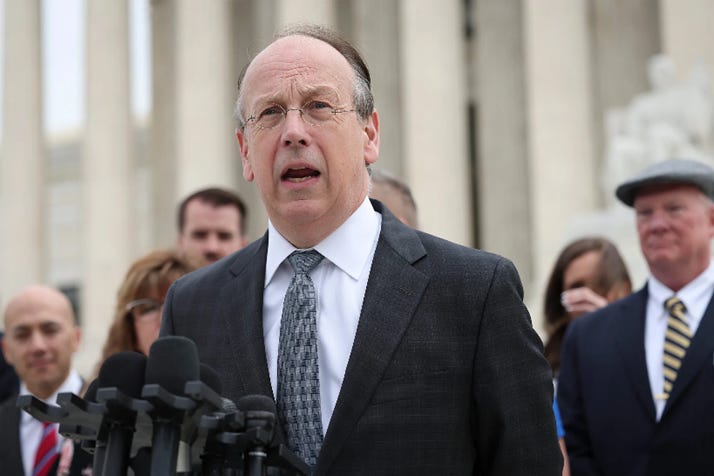
For example, Clement served as an amicus curiae to the district court considering the DOJ’s motion to dismiss the prosecution against former NYC Mayor Eric Adams, allegedly as part of a deal to secure his cooperation with the administration’s immigration enforcement efforts. (Remember this was the incident that led to the resignation of Danielle Sassoon and other conservative AUSAs from the office, another subject covered here.) So I was looking forward to listening to Clement wipe the floor with the DOJ’s lawyer, and I was not disappointed when he started out with a great line, that “the executive orders run afoul of the better part of the Bill of Rights.” But I’m not sure the firms needed Clement here, because the government’s arguments ran into trouble right from the get-go.
The Biggest Issue in the Government’s Argument
The most surprising thing about the oral argument, to someone who has followed the EO litigation from the filing of the initial complaints and TRO motions, is how much time and energy was spent on the justiciability of the denials of security clearances to firm lawyers. In fact, I’d estimate that a good 80% of the time spent by both Clement and Abhishek Kambli, arguing for the DOJ, was devoted to answering the panel’s questions about the justiciability of the security clearance denials, mostly to the exclusion of issues that were raised in the district court briefing and summary judgment decisions, such as (i) First Amendment retaliation under NRA v. Vullo; (ii) the relationship between the right to counsel and constitutional separation of powers under LSC v. Velazquez; (iii) the (to my mind totally bogus) argument that the EOs represented nothing more the presidential speech; (iv) the claim that the EOs were ultra vires; and (v) the vagueness of the idea of the “national interest,” a broader concept than national security, referred to in the EOs.
The denial of security clearances was one of the punitive parts of the EOs. After Section 1 of each order listed the myriad sins committed by the firms, the operative sections imposed penalties, including suspension of all security clearances held by firm personnel (Sec. 2); termination of government contracts of all clients of the firm (Sec. 3); and prohibition on access to government buildings or interactions with government employees by firm personnel, and a lifetime bar on employment by the government of former employees of the firm (Sec. 5). [As an example, see the Jenner EO.]
The district courts enjoined the operative provisions of the EOs, including the denials in Section 2 of security clearances for firm lawyers, noting that security clearances were held by some firm personnel in connection with their service as military reservists, and others had obtained them in order to defend clients in litigation that required access to classified information. Right out of the gate at the oral argument, the government challenged the justiciability of these security clearance denials under the very recent D.C. Circuit decision of Lee v. Garland, 120 F.4th 880 (D.C. Cir. 2024).
Following Department of Navy v. Egan, 484 U.S. 518 (1988), there are two strands in the reasoning of Lee v. Garland supporting the court’s conclusion that the denial of a security clearance in that case is not justiciable. The first is that courts lack the competence needed to second-guess the “difficult predictive judgments” underlying a decision to revoke a security clearance (120 F.4th at 886). The second is that courts have traditionally given deference to the Executive Branch in matters of national security (id.). Lee boiled down Egan to this holding:
[T]he decision whether to grant an employee a security clearance, ‘‘a sensitive and inherently discretionary judgment call, is committed by law to the appropriate agency of the Executive Branch.’’
The court also anchored the nonjusticiability holding in the political question doctrine, going through the six factors from Baker v. Carr, 369 U.S. 186, 217 (1962), and of course going all the way back to Marbury v. Madison. The Court in Baker listed six reasons – any one of which would be sufficient – to conclude that a question should be committed to one of the political branches and not resolved by the judiciary. A nonjusticiable political question is presented if:
[1] a textually demonstrable constitutional commitment of the issue to a coordinate political department; or [2] a lack of judicially discoverable and manageable standards for resolving it; or [3] the impossibility of deciding without an initial policy determination of a kind clearly for nonjudicial discretion; or [4] the impossibility of a court’s undertaking independent resolution without expressing lack of the respect due coordinate branches of government; or [5] an unusual need for unquestioning adherence to a political decision already made; or [6] the potentiality of embarrassment from multifarious pronouncements by various departments on one question.
The court said that the political question applies “perhaps most vigorously” to issues bearing on national security (124 F.4th at 889). I’m not sure I agree with that. I think the deference to the Executive in national security matters is different from the political question doctrine; they just happen to reinforce each other in this context. But no matter, because Lee rightly says that “the Supreme Court has always been reluctant to second-guess the Executive Branch on matters of national security – especially where Congress has not acted to restrict it.” (id.).1
But all of the supporting precedent in Lee involved individualized, discretionary determinations that a particular member of the armed forces or another security clearance holder was untrustworthy or there were reasons to doubt their loyalty to the United States. Sure, that kind of decision would be unreviewable by courts, for the first two reasons in the Baker factors.
In his portion of the argument, Clement zeroed in on the “inherently discretionary judgment call” language in Lee (quoting Egan), denying (quite plausibly) that there was any exercise of judgment going on in the across-the-board denial of security clearances to all employees of the four firms. Lee characterized the standards to be applied to the decision (Baker factor #2) as inherently specific to the particular holder of a security clearance (120 F.4th at 893):
Clearance decisions involve an assessment of intangible qualities such as ‘‘loyalty to the United States, strength of character, trustworthiness, honesty, reliability, discretion, and sound judgment.’’ And they involve ‘‘predictive judgment’’ about whether individuals are likely to divulge sensitive information ‘‘under compulsion of circumstances or for other reasons,’’ which is ‘‘an inexact science at best.’’
Clement also appealed to a distinction of Lee that Judge Bates relied upon in the summary judgment opinion in favor of Jenner & Block (which I think is the best reasoned of the four district court opinions):
In short, while the merits of any individual security clearance decision are unreviewable, courts may hear “constitutional claims arising from the clearance revocation process.”
Jenner & Block LLP v. U.S. Department of Justice, 784 F.Supp.3d 76 (2025) (quoting El-Ganayni v. U.S. Dep’t of Energy, 591 F.3d 176, 183 (3d Cir. 2010)). The process as a whole may be reviewable by a court, even if individualized, fact-sensitive, discretionary judgments are not. As Judge Bates reasoned, reviewing blanket suspensions of all Jenner employees’ clearances does not raise any of the policy concerns in Lee: The administration was not making any case-by-case predictive judgments about the trustworthiness of a clearance holder – in fact, it precluded those judgments altogether:
Jenner only asks this Court to question the special suspend-then-review process the order imposes on a categorical basis. Refusing to do so would equally bless blanket security-clearance suspensions for all Muslims, Catholics, or disabled people.
Judge Pillard picked up on this framing when she asked at the oral argument whether an order denying security clearances to all Catholics would be reviewable, and Clement called back to the language of the Jenner summary judgment opinion when he referred to the EO as a “bespoke process just for Jenner.” The government’s actions here are a “policy outside the usual process” and thus aren’t entitled to the deference normally given to the established process.
So the central question in the argument ended up being, was Section 2 in each of these EOs based on a merits determination (and is thus unreviewable)? The more judicial-process-y way of asking the question is, can a court look behind a facially sufficient basis for denying a security clearance. Chief Judge Srinivasan asked two variations on this question (my notes – this is not a verbatim transcript but I type fast so it’s pretty close):
Suppose the decisionmaker about security clearance announced that the decision has nothing to do with whether the person can be trusted to keep the nation’s secrets, but is completely extraneous to that. Suppose it has to do with the person’s speech – I find it distasteful, but I’m not worried about them keeping the nation’s secrets, I just don’t like it. Would your arguments be the same?
All of the decisions I’m aware of are under the auspices of an EO setting up the security clearance process. Under that architecture, the overriding and maybe conclusive assumption is that the decision was made for legitimate nat’l security purposes. Doctrine precludes looking behind that. BUT, if the actor admits that the decision is not based on any of these criteria, you’re not looking behind something that is facially sufficient.
In response, Kambli for the DOJ kept analogizing security clearance decisions to the pardon power, with the implication (which he was willing to own up to) that the only available remedy is political. When Judge Pillard asked him whether a court could review an order by a newly elected Democratic president that said no security clearances may be held by Republicans, Kambli said the only real remedy would be for Congress to pass a statute which the president would be bound by, notwithstanding his Article II authority. That seems like an ill-advised move to me, and Chief Judge Srinivasan jumped on him with the observation that there are plenty of areas in which the president’s power is textually committed to him by the Constitution, or at least flows from an idea of the President as Commander-in-Chief of the armed forces, but where courts nevertheless apply the 14th Amendment and other limitations.
Kambli was kind of a broken record on the justiciability argument, even in response to the question all legal ethics nerds were waiting for: What about Paul Weiss? Remember that Paul Weiss bent the knee to Trump immediately after the EO against it was entered. In exchange for the firm’s promise to devote $40 million worth of legal services to Trump-friendly so-called pro bono representation, the order was lifted in its entirety. That includes the denials in Section of security clearances. So, asked Judge Rao (the Trump appointee on the panel), where in the process of rescinding the Paul Weiss order was the individualized determination and discretionary judgment made by someone with the necessary expertise? That’s a great question, and Kambl of course knew it was coming, but didn’t have an answer beyond restating that the court had to make a threshold determination regarding the reviewability of the decision, and he didn’t think this decision is reviewable. To which Chief Judge Srinivasan followed up with a summary of the damning facts (again, my notes):
The Paul Weiss revocation was 7 days later. You can’t be contending that there was a determination that (1) none of the Paul Weiss lawyers are eligible for a security clearance, but then (2) 7 days later we’ve determined that everyone is eligible. It doesn’t purport to be based on a determination of trustworthiness.
To which Kambli responded that if the president believed that the trustworthiness and eligibility questions were resolved, then that’s his prerogative. That led to this exchange, testing whether there is any limiting principle to the reliance on presidential prerogative:
C.J. Srinivasan: What if the president said, “I don’t mistrust their ability to handle national security information – I just dislike them, and I don’t want security clearances extended to people or groups I don’t like” – same result?
Kambli: That type of abuse of power calls for a different constitutional remedy.
[Chirping crickets.]
Paul Clement for the Law Firms
Clement had a nice, tight reading of Lee that he kept returning to: The decision is based on a textual commitment of individualized, predictive judgment that a particular person is not trustworthy. He had to do some fancy footwork to deal with these questions from two judges:
Pillard: What about a presidential order saying “no government contracts may be awarded to anyone who has expressed support for terrorism or Hezbollah”? If president can make those kind of viewpoint distinctions [and also group-based determinations, going back to an earlier colloquy], why can’t the president make others?
Clement: A court can say some viewpoint discrimination in the context of national security are okay, but others are not, but in any case the determination has to bear on national security.
Rao: But that’s just what Lee says courts can’t consider.
Clement: Lee doesn’t go so far as to take out procedural challenges. . . . Lee doesn’t put off limits all the categorical determinations.
At which point C.J. Srinivasan bailed him out by asking the softball Paul Weiss question, nudging him to say that the decision had to be one pertaining to trustworthiness. Clement was smart enough to incorporate Judge Rao’s concern, and concede that some trustworthiness decision may be group-based. In this case, the decisions purported to be individualized and trust-based (which Clement would have to concede are permissible), but they’re really not. For example, one Perkins Coie lawyer was granted a security clearance based on the 13 factors considered in the usual process and a few weeks later it was taken away by the EO. To which Judge Pillard asked, how do we know the government isn’t going to come back and say that the president did the 13-factor analysis in his head for all these individual lawyers – he’s really good at it – and that’s exactly the type of decision we’re precluded by Lee from reviewing?
I was on the edge of my seat – that was a great question! – and Clement’s answer wasn’t entirely satisfying. He mostly appealed to the government having waived or at least not relied on the merits of the president’s determination:
It’s hard for that to be government position, because there’s no merits defense – they put all the eggs in the basket of justiciability. They’re not well positioned to say the president was a whiz with the 13 factors. Facially this is not what the EOs purport to do. They instantaneously suspend clearances organization-wide, but then say there will be an individualized process to restore. This is more on procedural side of the line.
That last highlighted line at the end is Clement’s do-or-die position. He reiterated in response to a question from Judge Rao about the district courts’ remedy of restoring security clearances:
Rao: How is this not looking behind the face of the revocation decision and looking at motive, which violates Lee?
Clement: The role for the judge is not to second-guess a security decision. But the government has not preserved the merits-based argument. With respect to Section 2 they put all the eggs in the basket of justicability. If they said this is a quick application of the 13 factors, they’d follow justiciability up with a merits defense. There are all sorts of contexts in which the court defers to the executive on national security, but provides a degree of judicial review.
Bottom Line
Eeehh, yikes? Does this mean Trump is just going to go back and recite that he has gone through the 13-factor test in his head? After all, he just got a “perfect” score on the “high difficulty” cognitive test he recently took. Anticipating this move, Clement said there’s no way to understand the EO episode as coherent whole and believe that these are individualized determinations:
The coherent whole doesn’t have anything to do with trust considerations or the 13 factors. If three Wilmer lawyers just happen to have lost their security clearances, we wouldn’t have the chilling effect, Paul Weiss offering to provide $40 million in free legal services, etc.
I approve of the additional dig at Paul Weiss, and toward the end of his time, Clement returned to the chilling effect created by the EOs:
Don’t forget the chilling effect it has on other firms. They’re sending a message: I can either have my security clearance or sue the Trump administration but I can’t do both. It’s important to have robust relief to address the chilling effect. This wasn’t done quietly but shouted from the rooftops, and the purpose of that was to get the firms to come and make deals with the government, and that doesn’t happen unless you have Section 1 loudly and proudly proclaiming the retaliatory purpose.
Constitutional law scholar Will Baude notes this problem in his paper, Abuse of Power in the Second Trump Administration, 23 U. St. Thomas L. J. (forthcoming 2026). He writes: ‘As another lawyer put the point to me, ‘you can get all the preliminary injunctions you want, but it isn’t going to make the head of the FTC pick up your phone call.’”
That’s right, but it took to the end of the oral argument before that framing became clear. It’s likely, of course, that all three of the judges are perfectly aware of the problem in these terms. They know what Trump was trying to do, and they’re also aware that he succeeded to some extent in getting 11 major law firms to bend the knee.
Here’s my prediction: Given the judges’ questioning, I think we get a 3-0 opinion written by the Chief Judge, getting Judge Rao on board, based on the narrowest possible exception to Lee permitting judicial review of security clearance decisions that are obviously defective as a matter of process – they’re not individualized and based on considerations of trustworthiness, but are not only group-based, but group-based in a way that doesn’t have any plausible connection to national security (to deal with Judge Pillard’s question about denial of clearances for supporters of Hezbollah). Justiciability of Section 2 of the orders was the only real sticky wicket in the argument, so the injunctions against the orders as a whole will be affirmed. But as Clement and Baude say, you can’t un-ring the bell completely. A lot of damage has been done already.
Thanks for reading Legal Ethics Stuff! Please subscribe or share if you’re interested in reading more.
Kambli made a memorable verbal slip-up at this point in the oral argument, when he stated that the President’s power had not been “circumcised” by Congress. Kambli was substituted as DOJ counsel for Richard Lawson, who had briefed and argued the cases in the district courts.
Comments
Nothing yet. Say the first thing.
Sign in to join the conversation.