
I just returned from Fairbanks, Alaska, where I attended a memorial service for the judge I clerked for in 1996-97, the Honorable Andrew J. Kleinfeld, U.S. Court of Appeals for the Ninth Circuit. Here’s a picture of me and my co-clerks with the judge, awaiting the finish of the Yukon Quest dogsled race. Yes, you watch a lot of dogsled racing while clerking in Fairbanks.
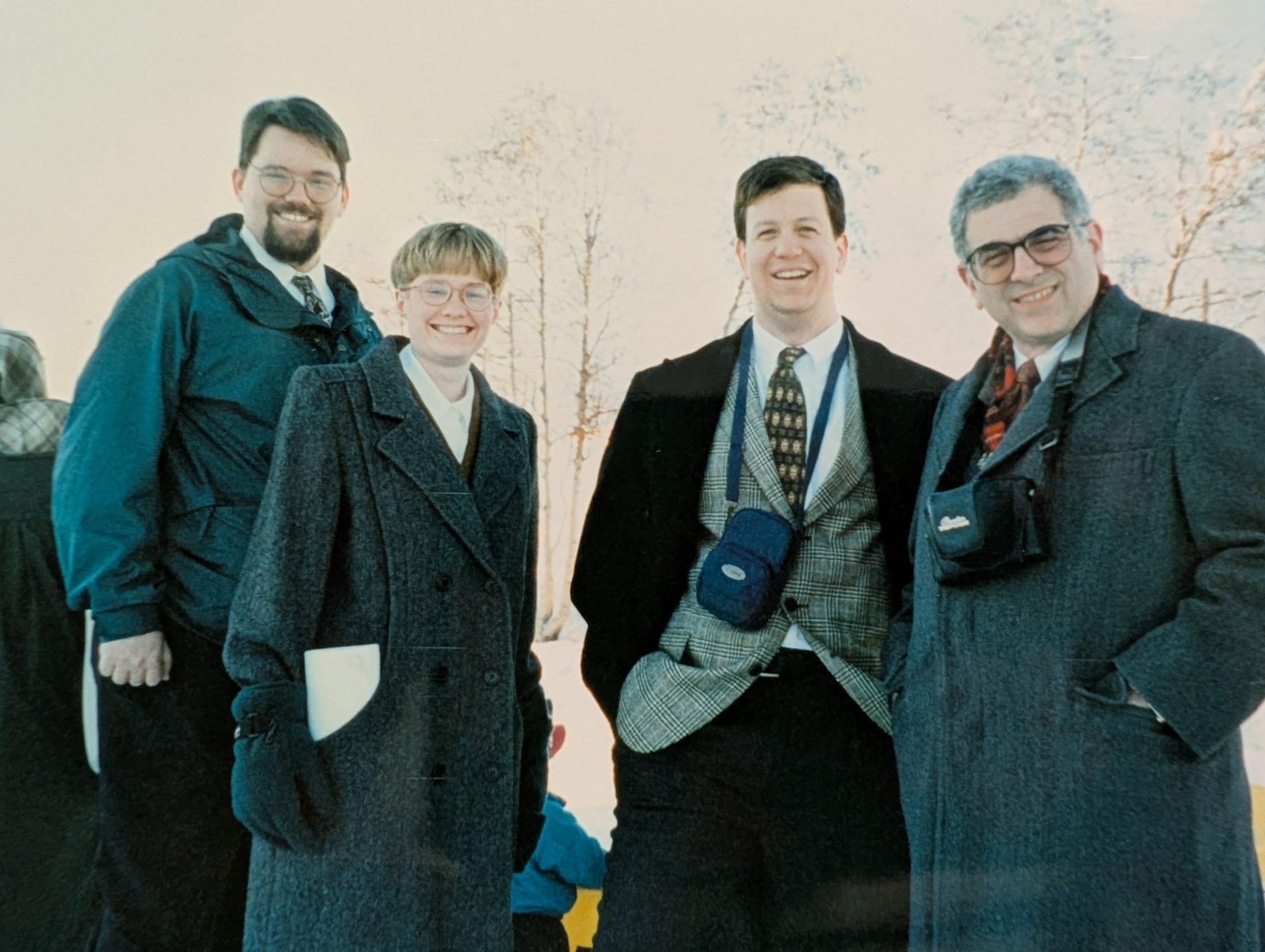
We’re also wearing suits and ties in Fairbanks in the winter because, well, that’s how the judge wanted it. We went to lunch three times a week with the judge at one of the downtown restaurants, and local lawyers used to laugh themselves silly at the spectacle of three law clerks in suits and Sorel boots trailing after the judge in minus-20 degree weather. Lawyers from the local bar, the Tanana Valley Bar Association, called us Andy’s ducklings, and loved roasting us at the Friday lunchtime meetings of the TVBA, which the judge also made us go to.
I could go on writing a tribute to Judge Kleinfeld, talking about the honor of clerking for him and telling more Alaska stories, but this is a legal ethics newsletter, so I will write instead about Judge Kleinfeld’s contributions to legal ethics. That sounds odd, I know, because he is not one of the judges who has produced significant scholarship in the field (like Marvin Frankel’s “Search for Truth” lecture, or Jack Weinstein’s work on ethics in mass tort litigation). But Judge Kleinfeld cared a lot about what lawyers do. As smart and astonishingly well-read as he was, he wasn’t really an “academic” judge, but one who was deeply practical and immersed in the day-to-day work of lawyers.
A lot of that, I think, came from a long career as a solo practitioner in a small city in the middle of nowhere, which became a boomtown when the Pipeline came through. Over many years as a small-town lawyer he represented every type of client in every type of case, from criminal defense to matrimonial to transactional and litigation matters for small businesses. All of us ducklings law clerks heard stories of the judge’s years in practice and picked up lessons about how we should be as lawyers. That’s a different path for influence than someone like Jack Weinstein had, and maybe it had less of an impact because there were only so many Kleinfeld clerks, but I’d like to think that all of us carry on his legacy in the way we approach the job of being a lawyer.
I’ve always enjoyed a quote from Oliver Wendell Holmes, Jr., that I learned from an article by David Luban. Holmes wrote to his friend Morris Cohen, “I don’t see why we shouldn’t do our job in the station in which we were born without waiting for an angel to assure us that it is the jobbest job in jobbdom.” (From the Holmes-Cohen Correspondence, 9 J. Hist. Ideas 3 (1948), cited in David Luban, “The Bad Man and the Good Lawyer: A Centennial Essay on Holmes’s The Path of the Law,” 72 NYU L. Rev. 1547, 1549 (1997)) I associate that quote with Judge Kleinfeld’s understanding of the ethical value in the job of being a lawyer. Lawyers help their clients learn what the law requires, and help them conform their conduct to the law. In an opinion I’ll talk about below, he quoted Massachusetts Supreme Court Justice Lemuel Shaw (who was the father in law of Herman Melville and the inspiration for Captain Vere in Billy Budd – I’m pretty sure I learned that from Judge Kleinfeld), who wrote in a case from 1833:
[S]o numerous and complex are the laws by which the rights and duties of citizens are governed, so important is it that they should be permitted to avail themselves of the superior skill and learning of those who are sanctioned by the law as its ministers and expounders, both in ascertaining their rights in the country, and maintaining them most safely in the courts . . . that the law has considered it the wisest policy to encourage and sanction this confidence, by requiring that on such facts the mouth of the attorney shall be forever sealed.
U.S. v. Chen, 99 F.3d 1495, 1501 (9th Cir. 1996). Ascertaining the rights of clients and maintaining them in the courts is a job, and even if it may not be the jobbest job in jobbdom, it’s an awfully important thing for the community.
Judge Kleinfeld loved being a judge, but sometimes I thought he missed being the guy in town who people came to with their problems, looking for his “superior skill and learning.” There is something humdrum and ordinary about that way of understanding the lawyer’s role, but also something magnificent about “sanctioning ministers and expounders of the law” and entrusting them with the responsibility of informing people about their rights and protecting them in courts. Elsewhere in the same opinion he quoted the Hart & Sacks Legal Process materials for something I have taught my students since I started as a law professor, which is that, living alongside others in a community is characterized by competing interests, and it is the role of the law to resolve them:
Lawyers are constantly called upon to tell people, in advance of action or developed controversy, what their duties are to other people and to the government, and what the duties of others are to them. . . . When people do not have duties, they have liberties. Counselling about the one is in some sense counselling about the other. . . . Even a man’s liberty of singing in the shower may come into question if a neighbor complains that it is a nuisance.
Chen, 99 F.3d at 1500. Looking back, I can see many of the roots of the position I would later defend in Lawyers and Fidelity to Law in conversations with Judge Kleinfeld about the moral value of the lawyer’s job. It is nicely captured in that passage from Hart & Sacks: It’s a good thing that a political community has a system of legal rights and duties that enable people to work out the boundaries between their respective claims of rights and duties. Legal ethics is not about pursuing justice, at least not directly. Rather, it is about mediating among competing views about justice. Even the view that it’s okay to sing in the shower may be contestable if a neighbor thinks it is a nuisance.
That’s not to say Judge Kleinfeld did not have an impact on the law through his published opinions. Tributes to his judicial legacy emphasize opinions like the reversal of excessive punitive damages in the Exxon Valdez oil spill case, 270 F.3d 1215 (9th Cir. 2001); the Court of Appeals decision in the “bong hits for Jesus” case, Morse v. Frederick, 439 F. 3d 1114 (9th Cir. 2006); and a powerful dissent in one of the big culture-war cases of the moment, Finley v. NEA, 100 F.3d 671 (9th Cir. 1996), which was reversed by the Supreme Court, essentially adopting Judge Kleinfeld’s reasoning.
The judge had a very unusual way of working with his clerks. We prepared bench memos, which were circulated to other judges on the panel in advance of oral argument. But we didn’t write draft opinions. After the oral argument, the judge would dictate a draft opinion, with lots of notes for the clerk assigned to the case (like “the defendant says X about the A v. B case, but that doesn’t make sense – doesn’t A v. B stand for Y?”). When we were done running down all the queries in the draft, it was time for the real writing process. Sitting side-by-side in his office, each of us had a monitor, but only judge had a keyboard, he would tinker and polish the opinion, stopping frequently to fire off questions like “where is that in the record?” or “do you buy the plaintiff’s distinction of that case?” You’d go flipping frantically through all the books of factual record and legal authorities we had made for the case and when you found the right pages, you and the judge would read together, him marking it up and asking more questions.
It was terrifying at first, but you learned to prepare thoroughly, came to enjoy the back-and-forth, and eventually realized something remarkable, which was the judge actually cared what we thought. He knew where he wanted to come out on the case, of course, but he wanted to get the details right and that’s what law clerks were useful for. It should go without saying that the judge only cared what we thought to the extent it mattered to getting the decision right – he was mostly uninterested in what we thought as a policy or ideological matter. Which leads to one of the profound things I learned as a Kleinfeld clerk, which I’ve returned to over the course of my career as a teacher and scholar: Judicial and lawyering craft matters.
I know that sounds naïve, but hear me out for a second. The judge and I had very different political starting points: He a legal conservative with a strong libertarian streak (no doubt enhanced by decades of living in Alaska, where the state motto should be changed from “North to the Future” to “Leave Me the Hell Alone!”), profoundly mistrustful of concentrated power of any sort, but particularly power exercised by the government, and committed to a Hayekian view of law as a means by which citizens can plan their affairs around the possibility of official sanctions and otherwise enjoy liberty to act as they see fit; and me as a bog-standard, center-left, Clinton-Gore Democrat who came of age professionally during the waning years of legal liberalism and the belief in the authority and capacity of courts to articulate individual rights. He told me later that he almost didn’t hire me, but we had a good interview and he decide to take a chance, in part because my writing sample talked about Karl Llewellyn and we had a great conversation about Llewellyn during lunch.1
Llewellyn is a major figure in American jurisprudence, less well known today than he should be. One of his contributions to legal theory was to try to bridge the gap between formalism and realism with a conception of judging as craft (this article by Brett Scharffs is an excellent overview). Craft is as much a matter as knowing-how as knowing-that. It is learned through immersion in a practice and consists to a significant extent of tacit principles that cannot be reduced to a set of formal rules. In The Common Law Tradition, Llewellyn wrote:
The rules not only fail to tell the full tale, taken literally they tell much of it wrong; and while words can set forth such facts and needs as ideals, craft-conscience, and morale, these things are bodied forth, they live and work, primarily in ways and attitudes which are much more and better felt and done than they are said.
Well-crafted legal decisions do not produce certainty but “reasonable regularity.” Craft is faithful to the past but also forward-looking, in that a craftsperson is concerned to make a product the best it can be.
At the time I interviewed for my clerkship, the legal world, or at least that part of the legal world that was concerned about ethics, was obsessed with Tony Kronman’s 1993 book, The Lost Lawyer. Kronman talked more about Aristotle and Weber than Llewellyn, but he had a similar insight: What lawyers contribute to society is to establish “reasonable regularity” in social ordering through the exercise of the paired virtues of sympathy and detachment, which can be interpreted as fiduciary loyalty to one’s client (sympathy) and a critical stance on the objectives of one’s client from the perspective of the common good (detachment). Harmonizing these perspectives is a matter of judgment or practical wisdom (phronesis), which is developed through years of practical engagement with the problems of political community.
My writing sample talked about Kronman’s indebtedness to Llewellyn’s idea of judging as craft, and Judge Kleinfeld seemed very receptive to that interpretation. What I didn’t know at the time is that his approach to judging was Llewellyn in action. In his view, appellate judges shouldn’t be aiming at making big social policy decisions but instead should be concerned with getting the law right, as applied to a particular case. Judicial craft is a middle ground between purely instrumental legal reasoning and highfalutin’ philosophizing of the type that was then in vogue, associated with scholars like Ronald Dworkin and Bruce Ackerman. Importantly, craft knowledge is communal. Getting a judicial decision right is a way of recovering the community’s best understanding of what rights and duties we have with respect to each other. Craft-based judging does not aim directly at the public good. In Judge Kleinfeld’s view, that’s an arrogant mistake, serving to aggrandize judicial power at the expense of ordinary people. Again, I think his conviction that this is true is due in part to many years of practicing in Fairbanks, which left him with deep affection for regular folks and an appreciation for how hard, and how important, their legal problems are.
Sitting next to Judge Kleinfeld, wrestling with the legal and factual record, and trying to get this decision right, as opposed to working from abstract principles like justice or equality, was one of the most important formative experiences of my career. Although I think Kronman’s ideal of the lawyer-statesman is too ambitious, the parts of The Lost Lawyer that emphasize the lawyer’s embeddedness in the concrete, practical problems of real people have always resonated with me, and I think a lot of that comes back to my experience as a Kleinfeld clerk.
Although most of the learning about ethics from my clerkship term was practical, Judge Kleinfeld contributed at least one great case to the legal ethics canon, which I had the privilege of working on as a law clerk. The case was an appeal from a district court order applying the crime-fraud exception to the attorney-client privilege. The defendant was a family import-export business that had cooked up a cute little tax scam. The company paid Customs duties based on the real cost of imported goods, but a family member prepared dummy invoices showing a higher cost. Why do that? Because the company’s reported income was based on the sale price of goods, minus their cost, so using the fake inflated Customs invoices allowed it to reduce its taxes. Pretty neat, eh?
Until one day the patriarch of the family business got nervous that Customs and the IRS might talk to each other and compare the reported cost of imported goods. So he did what concerned citizens should dd, and retained a law firm. He instructed the firm that the company had mistakenly underpaid Customs duties and wanted to file amended declarations and pay the additional duties, plus any penalties. From the point of view of the tax scam, this was still a good deal, because the additional Customs duties were way less than the amount they had saved on taxes. Importantly, the law firm was completely innocent of any knowledge of the scam side of things. As far as the lawyers in the firm knew, company employees had just made a mistake and now wanted to make it right.
Eventually the scheme came crashing down when the patriarch’s sister went to a Customs agent and blew the whistle. (The record suggests that she had tried to shake down her brother for millions of dollars but was rebuffed.) She gave the government a bunch of documents she had stolen from the company, which corroborated her story. Some of the documents contained attorney-client privileged communications. The prosecutor submitted all of these documents to the district court, seeking to invoke the crime-fraud exception to the privilege.
Judge Kleinfeld was, to put it mildly, not pleased with this. The Supreme Court, in United States v. Zolin, 491 U.S. 554 (1989), outlined a two-step procedure for “seeking to strip attorney-client communications of their privilege under the crime-fraud exception” (Chen, 99 F.3d at 1502). First, the party must submit unprivileged materials to establish “a factual basis adequate to support a good faith belief by a reasonable person that in camera review of the materials may reveal evidence to establish the claim that the crime-fraud exception applies.” Only then may the district court review privileged materials in camera and determine whether the client’s purpose in seeking legal assistance was to commit a crime or fraud. But the AUSA decided to shortcut this procedure:
In Zolin, the prosecutor thought that it was unduly cumbersome to approach the district court twice, first to make a showing that the judge should read the putatively privileged materials in order to decide whether the crime-fraud exception applied, and second to decide whether the exception applied. The Supreme Court decided that, cumbersome or not, that is what the prosecutor had to do. In the case at bar . . . as in Zolin, the United States Attorney had one view of what procedure is appropriate, and the Supreme Court of the United states had another.
Ouch! But like I said, Judge Kleinfeld was a libertarian and strongly resented a government agent deciding that legal procedures were optional. Fortunately the district court was wise to this move and expressly declined to rely on privileged materials when deciding whether to review the communications in camera.
I added Chen to the legal ethics casebook I co-edit. It’s a great teaching case that is almost a self-sufficient resource for teaching the attorney-client privilege. Some of the important points it makes:
An attorney need not share the client’s purpose, nor even know that the client’s purpose was to obtain assistance in committing a crime or fraud, for the crime-fraud exception to apply. Judge Kleinfeld was furious at the AUSA for gratuitously attempting to smear the reputation of the lawyers consulted by the company to prepare the amended Customs declarations: “[T]he Assistant United States Attorney argued that the differences between the initial and supplemental invoices was ‘substantial enough to put any reasonable professional on notice that this was, in all likelihood, a fraudulent scheme. . . . [The lawyer] countered the attack on her professional integrity by the Assistant United States Attorney and stated that the accountants ‘consistently said that the payments . . . were legitimately part of the cost of the goods sold for tax purposes” (99 F.3d at 1498-99). I watched him type this out; he really was mad.
Although lawyers may be involved in their clients’ business decisions in some way, the privilege presumptively applies to mixed business and legal advice. “If a person hires a lawyer for advice, there is a rebuttable presumption that the lawyer is hired ‘as such’ to give ‘legal advice,’ whether the subject of the advice is criminal or civil, business, tort, domestic relations, or anything else.” (99 F.3d at 1501) This passage has been cited for the principle that communications with an outside law firm, as opposed to in-house counsel, are presumptively privileged.
An ex-employee of a corporation (in this case, the sister who tried to shake down the company) does not have the authority to waive the privilege on behalf of the corporation. The power to waive the privilege belongs to current management, per a case I cite constantly in my PR class, CFTC v. Weintraub, 471 U.S. 343 (1985). As a corporate agent, the sister had a duty of confidentiality to the corporation and was not authorized to waive the privilege.
The opinion as a whole is a paean to the attorney-client privilege and also to the valuable role of lawyers in a society governed by the rule of law:
The attorney-client privilege is essential to preservation of liberty against a powerful government. People need lawyers to guide them through thickets of complex government requirements, and, to get useful advice, they have to be able to talk to their lawyers candidly without fear that what they say to their own lawyers will be transmitted to the government. . . . Th[e] valuable social service of counseling clients and bringing them into compliance with the law cannot be performed effectively if clients are scared to tell their lawyers what they are doing, for fear that their lawyers will be turned into government informants.
I was sitting right there, as the proverbial “elbow clerk,” when Judge Kleinfeld wrote that passage. Now, looking back on that experience, I can see how influential it was in the development of my views about the role of lawyers. More importantly, however, it served as guidance for practicing lawyers and a powerful reminder of the value of everyday legal counseling and advising.
Rest in peace, Judge. Thanks for everything you taught me and the rest of your ducklings, and for all you contributed to the profession in Alaska, the Ninth Circuit, and nationally.
He also told me that one of the highlights of our interview was that I ordered a beer with lunch. Just to be clear, you should never, ever do this. I don’t know what I was thinking, except that at the time I was a serious homebrewer, the menu had Alaskan Amber, which was then probably the best Düsseldorf-style Alt made in the United States, and I loved to brew Altbiers. I told the judge this at the time, and as he later told me, he decided I would probably be fun to hang out with on week-long oral argument calendars. Again, my strongest interviewing advice to prospective law clerks would be that this was an extremely bad idea, viewed ex ante. I was young and stupid at the time and got lucky. Life is like that sometimes. Alaskan Amber is still a great beer, by the way.
No posts
Comments
Nothing yet. Say the first thing.
Sign in to join the conversation.