
Just in time for the start of Todd Blanche’s Senate confirmation hearing, a district judge in Florida referred several lawyers for discipline in connection with their role in establishing a slush fund to be used to pay off Trump’s political allies (a/k/a victims of “lawfare” or “weaponization” by the Biden administration), allegedly in settlement of Trump’s litigation against the IRS. In my last post on Todd Blanche’s conflicts of interest, I identified three glaring problems with the lawsuit, which was based on the improper disclosure of Trump’s tax returns by Charles Littlejohn, an employee of a government contractor:
The action was untimely. 26 U.S.C. § 7431(d) requires that any claims be brought within 2 years of the date of discovery of the unauthorized disclosure, and Trump’s personal lawyer Alina Habba had mentioned Trump’s status as a victim of this “atrocity” at Littlejohn’s sentencing hearing on October 12, 2023. The lawsuit was filed on January 29, 2026.
The statute providing a private right of action against the United States for unauthorized disclosures by “any officer or employee of the United States.” 26 U.S.C. § 7431(a)(1). Actions against leakers who are not officers or employees of the United States may be brought only against the leaker. 26 U.S.C. § 7431(a)(2).
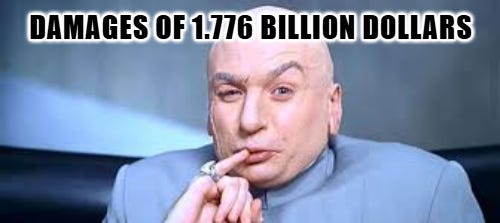
The statute provides for statutory damages of $1,000 per act of authorized disclosure or actual damages. 26 U.S.C. § 7431(c). However, it seems extremely unlikely (and that’s putting it mildly) that Trump would be able to show actual damages anywhere close to $1.776 billion, which as Gen X’er I can’t help hearing in a Dr. Evil voice.
The district judge does an excellent job setting out all of these defenses, and also makes the telling observation that a ton of parties sued Littlejohn, his employer (Booz Allen Hamilton, a big government contracting firm), the IRS, and the Treasury Department, and where the plaintiff’s name was not “Trump,” lo and behold the DOJ asserted all of these defenses vigorously (see pp. 4-5 of the order). The New York Times reported that the IRS lawyers had prepared a 25-page memo recommending defenses to Trump’s lawsuit (see p. 8 n.17 of the order).
In the Trump v. IRS litigation, however, the plaintiffs attempted to voluntarily dismiss the case after the establishment of the so-called “Anti-Weaponization Fund” (read it if you haven’t already – it’s pretty comical). The DOJ claimed that the dismissal deprived the district court of jurisdiction. The district court concluded that it retained jurisdiction over collateral matters including Rule 11 sanctions and contempt sanctions, for the kinda obvious reason that otherwise litigants who abused the judicial process could escape sanctions by dismissing their action. The court quoted one of the leading Supreme Court Rule 11 cases:
[A] voluntary dismissal does not eliminate the Rule 11 violation. Baseless filing puts the machinery of justice in motion, burdening courts and individuals alike with needless expense and delay. Even if the careless litigant quickly dismisses the action, the harm triggering Rule 11’s concerns has already occurred. Therefore, a litigant who violates Rule 11 merits sanctions even after a dismissal. Moreover, the imposition of such sanctions on abusive litigants is useful to deter such misconduct. If a litigant could purge his violation of Rule 11 merely by taking a dismissal, he would lose all incentive to stop, think and investigate more carefully before serving and filing papers.
Cooter & Gell v. Hartmarx Corp., 496 U.S. 384, 398 (1990).
There are lots of interesting issues in the court’s opinion, including its conclusion that there was never any case or controversy in the first place because the parties were not adverse. Neatly turning the administration’s recent victory in Trump v. Slaughter, 609 U.S. ___ (2026), against it, the court said, in effect, if you believe in the unitary executive theory, that means that the DOJ and IRS are under the control of the president, which Trump confirmed in a February 2025 executive order stating that all positions taken in litigation must be authorized by the president or the Attorney General (order at pp. 18-23). Thus, unlikely the private-party litigation against the IRS, the defendants were unable to advance any legal interpretation contrary to the plaintiffs (pp. 22-23). There was not only the possibility that Trump would interfere in the conduct of this litigation, but he had actual control over the DOJ (p. 26). The interests of the parties were “one and the same,” in contrast with the Keepseagle case incessantly cited by conservatives, which ended 10 years of contentious litigation (pp. 27-28).
But in keeping with the theme of this Substack, let’s look at the legal ethics issues for the lawyers involved.
The district court first talks about conflicts, which were the subject of the last post. TL;DR – I don’t think Florida Rule 1.11 (mis-cited as Rule 11.1) is the best vehicle for considering conflicts, even though Acting AG Todd Blanche and Associate AG Stanley Woodward, Jr., are current government lawyers who had represented Trump in his individual capacity while in private practice. Rule 1.11(d)(2)(A) provides:
A lawyer currently serving as a public officer or employee . . . shall not . . . participate in a matter in which the lawyer participated personally and substantially while in private practice or nongovernmental employment, unless the appropriate government agency gives its informed consent.
Blanche and Woodward, who signed the notice of dismissal, and thus are subject to Florida Rule 1.11, are both lawyers currently serving as public officers; they also both participated personally and substantially in the representation of Trump or his associates while in private practice, including in the Mar-a-Lago documents case and the January 6 insurrection case. However, Fla. Rule 1.11(e)(1) gives a very narrow definition of “matter” for the purposes of Rule 1.11(d)(2)(A). Matter means
any judicial or other proceeding, application, request for a ruling or other determination, contract, claim, controversy, investigation, charge, accusation, arrest, or other particular matter involving a specific party or parties.
Much to my agitation and frustration as a law-of-lawyering scholar, the judge just blows past that definition, writing:
The gravamen of the “settlement agreement” is to fund claims premised on events including those arising from, inter alia, the Mar-a-Lago Documents Case and the events of January 6, 2021. Indeed, these two cases have been referenced as quintessential Anti-Weaponization and Lawfare claims. Instead of either recusing because of their previous representations or vigorously defending this lawsuit as required to do so by DOJ policies and procedures, these lawyers agreed to a “settlement” involving a staggering amount of money potentially benefitting former clients (order pp. 33-34).
Okay, but Trump v. IRS is self-evidently not the same “judicial . . . proceeding . . . involving [the] specific party or parties” in the Documents Case or the January 6 case. The whole point of the narrow definition of “matter” in Rule 1.11(e) is to avoid creating a broad scope of disqualification for lawyers moving in and out of public office. The district court cuts off the quote from the comment to Fla. Rule 1.11 before getting to the relevant part:
[T]he rules governing lawyers presently or formerly employed by a government agency should not be so restrictive as to inhibit transfer of employment to and from the government. The government has a legitimate need to attract qualified lawyers as well as to maintain high ethical standards. Thus, a former government lawyer is disqualified only from particular matters in which the lawyer participated personally and substantially. The provisions for screening and waiver in subdivision (b) are necessary to prevent the disqualification rule from imposing too severe a deterrent against entering public service. The limitation of disqualification in subdivisions (a)(2) and (d)(2) to matters involving a specific party or parties, rather than extending disqualification to all substantive issues on which the lawyer worked, serves a similar function.
One of the reasons I dislike the term “legal ethics” to refer to the law of lawyering, and “ethics rules” to refer to the rules of professional conduct, is that it encourages judges to be loosey-goosey with the rules. Instead of interpreting them according to their express terms, they cherry-pick policy considerations and ignore inconvenient language, all in service of doing “ethics.” That’s really not the way this is supposed to work.
I still think there’s a conflict here, but it’s much better analyzed under Fla. Rule 1.7(a)(2). If the Florida Bar takes its job seriously upon referral of this matter from the district court (I know, fat chance of that), my last post about Todd Blanche has a roadmap for applying that rule. The judge makes interesting use of conflicts to bolster her conclusion that the parties’ interests were not adverse in this proceeding (pp. 34-37). But conflicts are only part of the story. The district judge’s order also talks about sanctions, under Fed. R. Civ. P. 11 and the court’s inherent authority, for abusing the judicial process.
Much of the reporting on this order quotes the judge’s conclusion that “this matter was brought for an improper purpose – to gain the imprimatur of judicial legitimacy for a ‘settlement’ that had no viable basis in law or fact” (order, p. 38). The language of “no basis in law or fact” suggests that Rule 11 sanctions may be in the offing. Rule 11 sanctions may be imposed either if a pleading or other paper is presented for an improper purpose (Rule 11(b)(1)) or the legal claims are not warranted by existing law or the factual contentions lack adequate evidentiary support (Rule 11(b)(2), (3)). There’s a split of authority on the relationship between these two prongs. The question is, if a pleading is adequately grounded in law and fact, but filed for an improper purpose, is it sanctionable? Some courts say yes, the prongs can be evaluated independently. For example, in a case I’ve taught and cited for many years, Whitehead v. Food Max of Mississippi, 332 F.3d 796 (5th Cir. 2003), a plaintiff obtained a $3.4 million judgment against a K-Mart store for failing to provide adequate security in a parking lot. After the judgment was final, the attorney for the plaintiffs obtained a writ of execution on the judgment. With a phalanx of media and U.S. Marshals in tow, the lawyer marched into the K-Mart and tried to execute on the judgment by seizing cash from the store registers. The Fifth Circuit affirmed the district court’s imposition of Rule 11 sanctions, holding that the attorney’s improper purpose – here, embarrassing K-Mart and promoting himself – could be a basis for sanctions even where the writ of execution was well-grounded in law and fact. “Although a district court is not [generally] to read an ulterior motive into a document ‘well grounded in fact and law’, it may do so in exceptional cases, such as this, where the improper purpose is objectively ascertainable.” 332 F.3d at 805.
I couldn’t find an 11th Circuit case specifically addressing this issue. For some reason the court “confine[d] its analysis to Rule 11’s improper purpose prong” (order, p. 40 n.60). I have no idea why it did that, since it seems awfully clear that there was also no objectively reasonable basis in law and fact for filing the complaint against the IRS in the first place, given the running of the statute of limitations and Littlejohn’s status as an employee of a government contractor. In several places the court cited a sanctions order from another S.D. Fla. judge in Trump v. Clinton, 653 F.Supp.3d 1198 (S.D. Fla. 2023), arising out of an Alina Habba-led grand conspiracy lawsuit against Hillary Clinton, the DNC, Perkins Coie, Marc Elias, and numerous other defendants, including RICO and a bunch of common law claims “arising from alleged malicious conspiracy to disseminate false and injurious information about former President and his campaign in hopes of destroying his life and his political career, as well as rigging presidential election in favor of opposing candidate.” That was an inherent-power ruling; Judge Middlebrooks explicitly found that Rule 11 is “not up to the task of confronting the litigation abuse involved here” (653 F.3d at 1210). It also involved both an improper purpose and lack of objectively reasonable legal and factual support.
But in any event, the court concluded that the record disclosed sufficient circumstantial evidence to warrant the inference of an improper purpose: “Plaintiffs acted in bad faith and for an improper purpose by ‘collusively filing a lawsuit with claims subject to multiple dispositive defenses solely to provide cover for a collusive settlement’” (p. 43). In its conclusion, the court wrote (p. 55):
The nature of the suit itself and the conduct of the Parties and counsel from its filing make plain that this was an attempt to use the Court to provide some legitimacy to an agreement to confer immunity to people and entities affiliated with the President and to earmark billions of dollars from American taxpayers to redress grievances not defined in the law.
The improper purpose prong was satisfied, but the court concluded that monetary sanctions are unavailable under Rule 11, because its show-cause order was not issued before voluntary dismissal of the lawsuit (p. 45, citing Fed. R. Civ. P. 11(c)(5)(B)). That seems odd, given the court’s earlier reasoning about not wanting to create an incentive for parties to dismiss a lawsuit before sanctions could be imposed. The court did find that its inherent power could be a basis for imposing monetary sanctions, including attorneys’ fees, but the only attorneys that incurred fees – counsel for the amici who filed briefs opposing the settlement – declined to seek reimbursement for their service to the court (p. 53). This left, as non-monetary sanctions, the following (p. 47):
Referral of one of the plaintiffs’ lawyers, Alejandro Brito, to the Florida Bar for possible discipline.
Denial of pro hac vice admission to the bar of the S.D. Fla. to another lawyer, Daniel Epstein.
A prohibition on referring to the slush fund as a “settlement.” I have no idea how that could be enforced if, let’s say, Todd Blanche uses that word at his confirmation hearing. Seems like a prior restraint for First Amendment purposes, and I have no idea what the sanction would be for violation. Holding him in contempt?
And, mailing a copy of the order to the State Bar of New York [sic – that’s a voluntary association; Todd Blanche’s admitting jurisdiction is the Appellate Division of the Supreme Court, First Department – what can I tell you, New York is weird], where Todd Blanche is admitted, and the District of Columbia Bar, where Stanley Woodward is admitted (p. 54). I don’t know why the judge didn’t use the language of “consideration, review, and determination as to whether any disciplinary action is appropriate in light of the findings and rulings made in this Order” that she used with reference to Alejandro Brito, but it seems clear that this was intended as a referral to the disciplinary authorities of these lawyers’ admitting jurisdictions. Cue the freakout by the DOJ, a roadmap for which we’ve seen in the Jeff Clark disciplinary proceeding.
Will this make any difference, either in tomorrow’s confirmation hearing for Blanche or in a disciplinary action down the road? I don’t know, but I will venture that it would be extremely unusual for a state disciplinary authority to impose sanctions for bad-faith litigation conduct. A lot of social media commentary (at least on left-leaning Bluesky) is longing for the threat of disbarment or other sanctions to have some effect in dissuading lawyers from abusing the law in the service of Donald Trump’s personal and political interests. The trouble is, disciplinary authorities generally leave the regulation of abusive litigation to the court supervising it. Judge Williams got her whack at these lawyers in the proceeding on the order to show cause; I would be surprised if a state regulator would commence and investigation and prosecution based solely on that conduct. I tend to think the same is true for conflicts, which are also generally punted by disciplinary authorities to the court supervising the litigation. Here I go being Debbie Downer again with the possibility of these lawyers getting disbarred.
Still, for critics of the administration who believe courts and state disciplinary authorities should be making a record of the misconduct by government lawyers, this order adds to the weight of evidence opposing Todd Blanche’s confirmation as Attorney General. Tune in tomorrow to see if it comes up in any of the questioning from Senators.
No posts
Comments
Nothing yet. Say the first thing.
Sign in to join the conversation.