
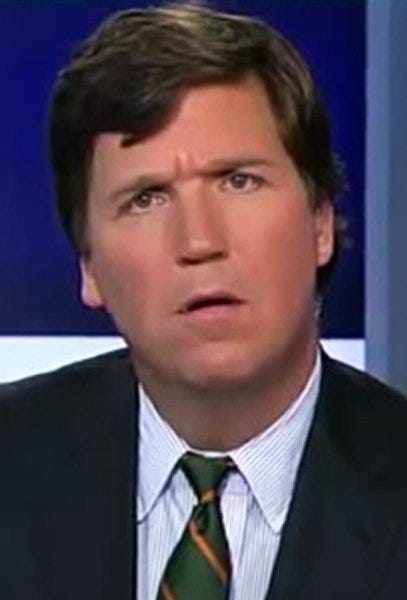
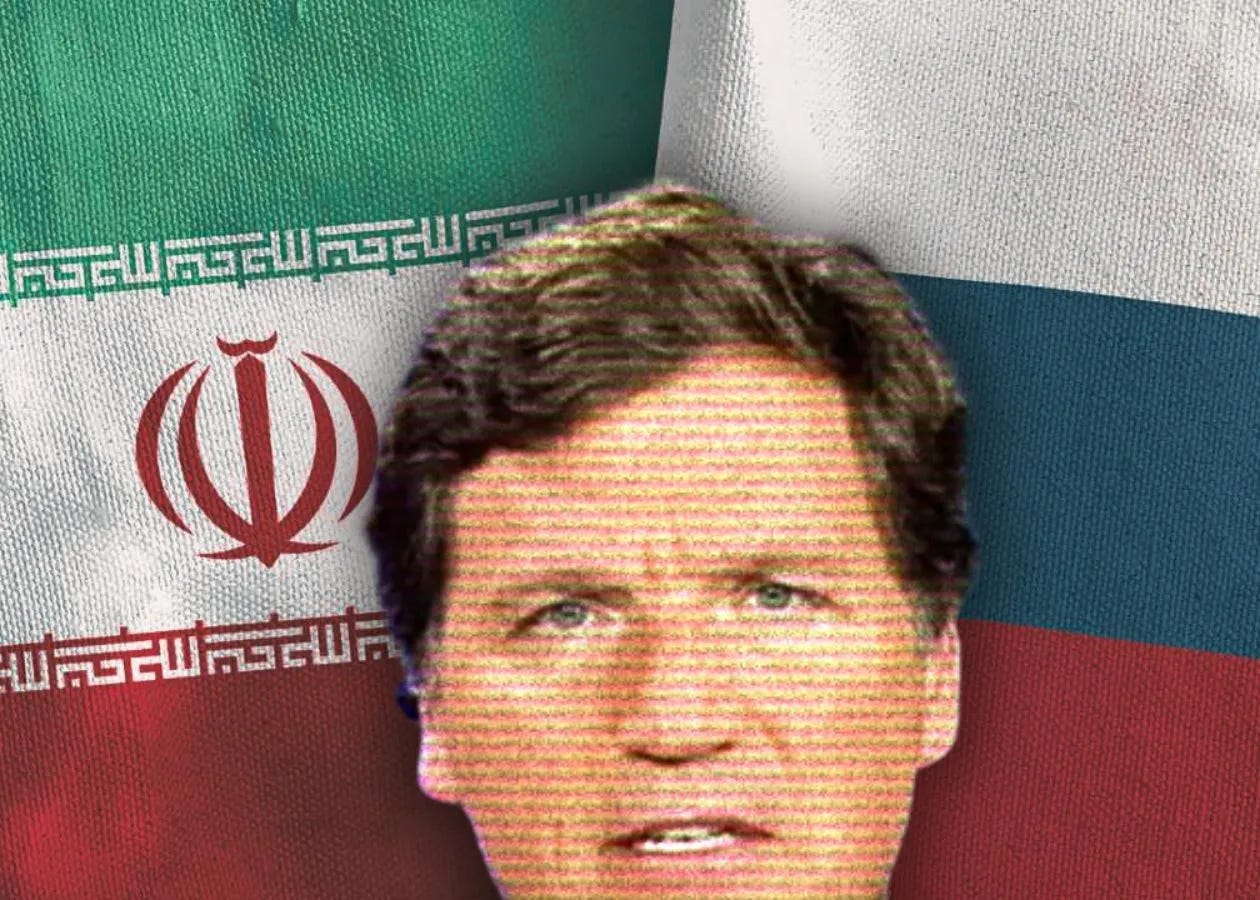
Tucker Carlson seems baffled by a historical record that doesn’t suit his narratives.
.
In a recent interview with Piers Morgan about the Iran war, Tucker Carlson delivered his familiar America First pitch while taking shots at Ben Shapiro, Mark Levin, Ted Cruz, and others who support the strikes against the Mullahs. The latest dispute erupted after President Donald Trump called on Iran to surrender “unconditionally,” a phrase that has echoed through the debate over the war.
.
I do not intend to weigh in on the war itself. I simply don’t know enough about it, and I suspect most people outside the planning rooms don’t either. Nor do I wish to insinuate myself into any internecine battle among once-allied conservative figures…a fight that no one outside the podcaster universe is even paying attention to. But when someone with Tucker Carlson’s reach invokes history to make his case, the history ought to be right.
.
Carlson responded to Trump’s language by declaring that “if there is one consistent lesson in history it is that ‘unconditional surrender’ means foreign troops get to rape your wife and daughter.”
.
That is a remarkable claim.
.
I will set aside the veiled insult to our troops—as if the First Marine Division has no more discipline than the Ottoman hordes in Constantinople or the Red Army in Berlin—and ask a simple question: which American history books, exactly, does Tucker read? (More on that in a moment actually).
.
The United States has compelled many enemies to surrender unconditionally, either explicitly or in practice. In 1777 and again in 1781 the Continental Army accepted the surrender of entire British armies at Saratoga and Yorktown. Thousands of British and German soldiers laid down their arms and went into captivity. Yet despite the bitterness of the war, there were no waves of revenge or atrocities. The prisoners were simply marched off and held in reasonably decent conditions for the remainder of the war.
.
The first American general to explicitly demand “unconditional surrender” was Ulysses S. Grant at Fort Donelson in 1862. This was Tennessee, conquered Southern soil, in the middle of a civil war. Yet nothing resembling Carlson’s grim scenario followed. There was occupation and resentment, but not barbarism.
.
Then came Appomattox. When Robert E. Lee surrendered the Army of Northern Virginia to Grant in 1865, the terms were modest but humane. Officers could keep their sidearms, and all could retain their horses. The Rebel prisoners could return to their homes unmolested if they swore loyalty to the Union. But make no mistake, the surrender was absolute; the Confederacy was at the mercy of the victorious army Carlson fears so much. Restraint prevailed again.
.
The phrase entered modern history in 1943 when Franklin Roosevelt unexpectedly demanded “unconditional surrender” at Casablanca, a policy that would define the final phase of the Second World War. Yet when Germany and Japan ultimately surrendered, the results again bore little resemblance to Carlson’s claim.
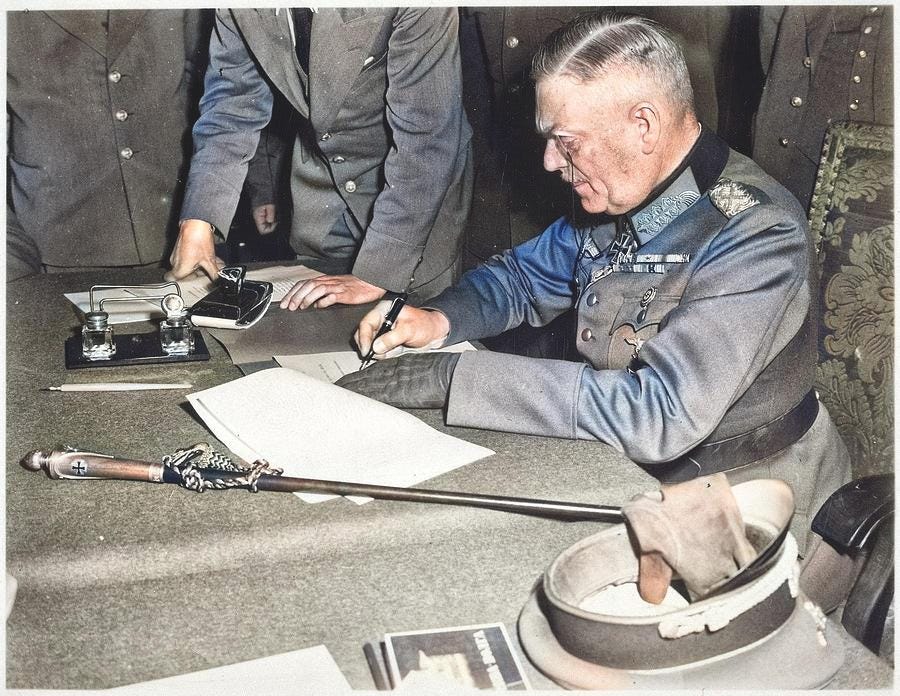
8 May 1945. Field Marshall Wilhelm Keitel signs Nazi Germany’s unconditional surrender.
.
Roughly two million American service personnel occupied defeated Germany and Japan after the war. Precise figures are difficult to pin down, but historians estimate that perhaps around 13,000 rapes occurred. That is 13,000 too many. But roughly 11,000 American servicemen were court-martialed for the crime, not given free rein. In percentage terms, the perpetrators represented a tiny fraction of those wearing the uniform of the United States. And this came at the end of a brutal global war fueled by years of hatred and exhaustion. Historically speaking, the discipline displayed by American occupation forces was unusual.
.
Indeed, as the Japanese delegation standing on the deck of the USS Missouri discovered—men who expected harsh retribution and were stunned by American magnanimity—there are far worse fates for a defeated enemy than surrendering unconditionally to the United States.
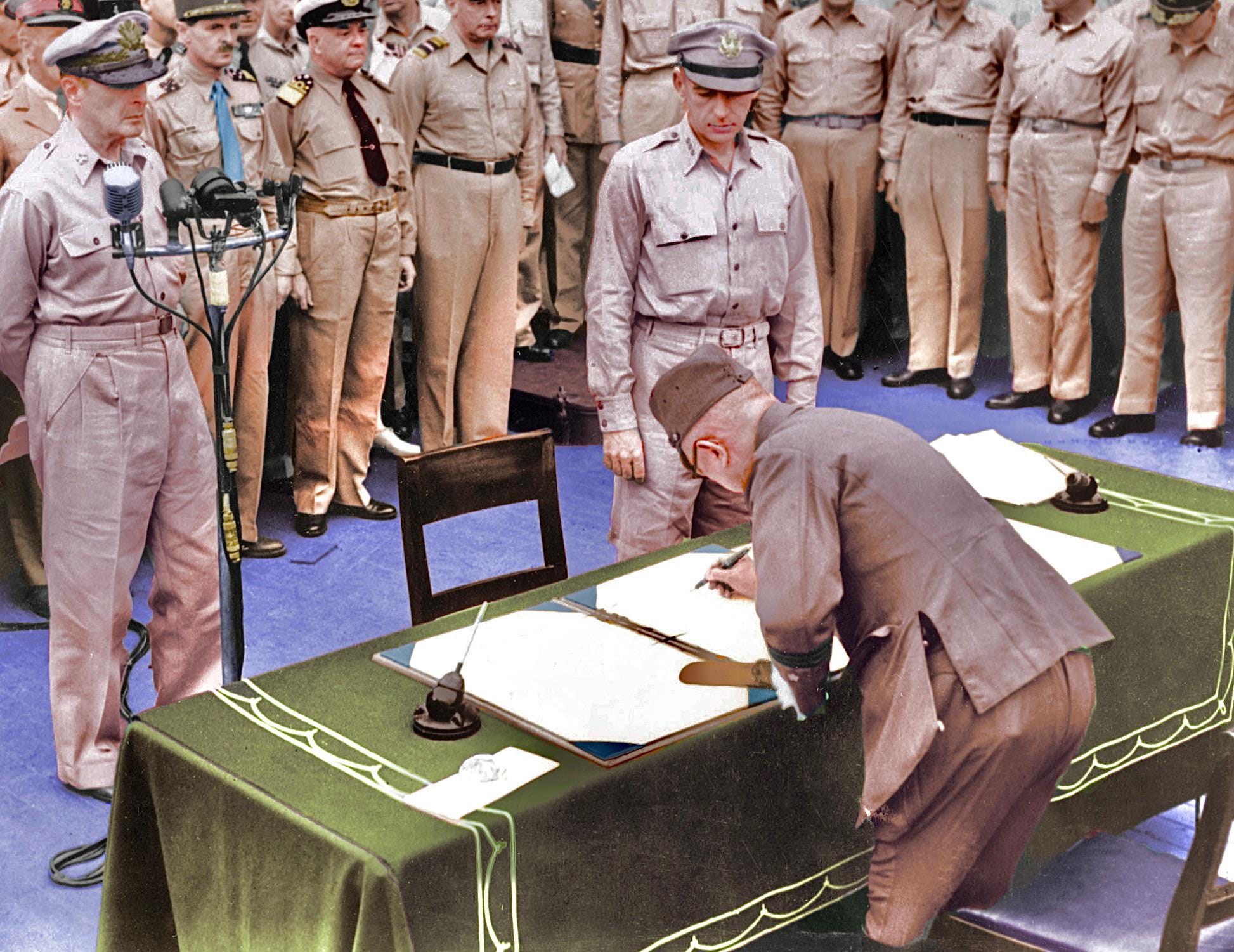
2 September 1945 on the quarterdeck of the battleship USS Missouri, Gen. Umezu Yoshijiro signs the unconditional surrender for the Imperial Japanese Armed Forces.
.
None of this means American troops were perfect. They were not. No serious person would claim otherwise. But Carlson did not say that crimes sometimes occur in war. He made a sweeping historical claim: that unconditional surrender means foreign troops [which in Iran would mean ours] get to rape your wife and daughter. The record simply does not support that claim.
.
I am not especially surprised Carlson would get the history this muddled, because this is the same man who described the borderline Hitler apologist Darryl Cooper as “the best and most honest popular historian.” He is anything but. Cooper’s version of the Nazi war in the East, for example, suggests the German high command merely failed to make adequate arrangements to feed and house the millions of civilians and prisoners swept up by the advancing Wehrmacht. Follow that interpretation far enough and mass death begins to sound less like policy than tragic clerical oversight.
.
According to Cooper, German officers sometimes concluded it might be “more humane to finish them off quickly now.” So the Nazis really killed civilians in a humanitarian desire to spare them the suffering of starvation? It’s as if he—and Carlson with him—have never heard of the Einsatzgruppen, Babi Yar, the Wannsee Conference, or the Hunger Plan designed to starve tens of millions of so-called subhumans. It is as if Hermann Göring never sneered that by the time Germany was through with them, the surviving Slavs would have to “eat Cossack saddles.”
.
Flexing more historical muscle, Carlson has also launched a peculiar jihad against Winston Churchill, whom he and Cooper increasingly portray as the real villain of the Second World War—not Hitler, Mussolini, Tojo, or Stalin.
.
Carlson claims Churchill “sold his country on a war using the idea that we must defend the territorial integrity of Poland.” Yet on 1 September 1939 Churchill was merely a member of Parliament and had been sidelined for years. Neville Chamberlain guaranteed Poland’s security and declared war on Germany. Churchill would not become prime minister for another eight months.
.
Another Carlson claim is that “four years later Churchill hands Poland to the Soviets.” Ignoring his flawed timeline—it was six years—the statement is prima facie absurd. Churchill did not hand Eastern Europe to Stalin, whose victorious 10 million-man Red Army was more than ready to fight for it. The decisive concessions came largely under Franklin Roosevelt, two months before his death and eager for Soviet help against Japan.
.
Carlson also notes that Churchill was “rejected by his own voters after the war,” implying Britons were unimpressed with his leadership. But Churchill, as many have put it, had been the perfect wartime leader but not necessarily the man to run the peace. And, of course, Tucker then fails to mention that once the Soviet threat became clearer, those same voters returned Churchill to Downing Street just six years later.
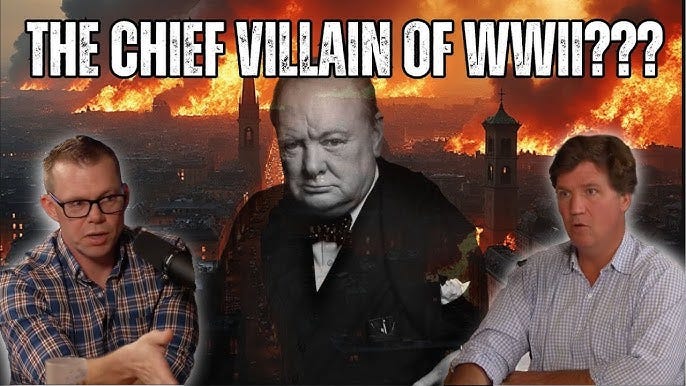
“Historian” Dave Cooper and Tucker discuss Winston Churchill…the true villain of World War II?
.
As for Tucker’s latest historical analysis, when Morgan pressed him to clarify his unconditional-surrender-equals-rape remark, the response was weak to say the least.
.
“Let me just say I almost never infer anything; I’m not a woman. I just say what I think. I play checkers not chess. I’m a pretty straightforward person, just ask my wife. So, if I thought US troops were going to rape Iranian women—which I don’t think—I’d just say so.”
.
Well, I’m not Norm Macdonald’s proverbial professor of logic down there at the ole University of Science, but what he said before sounds very much like inference to me.
.
Carlson then pivoted to an incident in which a bombing struck a girl’s school in Iran. He said he gives the US military the benefit of the doubt that it was an accident. Yet he could not resist adding with a smile, “Now, where did the targeting come from?”
.
With that line Carlson moved the discussion away from his own insinuation about American troops and toward a different insinuation altogether. When the US military makes a mistake, perhaps the real question is who was ultimately behind it. I wonder who he could mean? Does it start with I and end with L…again?
.
History can be complicated. But the record on this point is not. When the United States has compelled its enemies to surrender—even unconditionally—it has usually done so with far more restraint than Carlson’s caricature suggests.
.
If Tucker Carlson wants to lecture Americans about the lessons of history, the least he could do is learn a few of them first. After all, if he is this wrong about the meaning of unconditional surrender, this wrong about the basic chronology of Churchill’s career, and this willing to rely on a supposed historian who treats Nazi extermination policy like a bureaucratic mix-up, then one is entitled to wonder why we should trust his judgment about the present moment at all.
_____________________
Brad is a commodities fund manager, author, and columnist whose articles have appeared on the pages of The Wall Street Journal, NY Post, NY Daily News, Daily Wire, National Review, The Hill, The Federalist, Zerohedge, and other outlets. He is the author of three books. His next book, A War For Half The World: How the Real Struggle for the Future was Fought in the Pacific [Knox/Simon & Schuster], will be released in spring 2027.
Comments
Nothing yet. Say the first thing.
Sign in to join the conversation.