
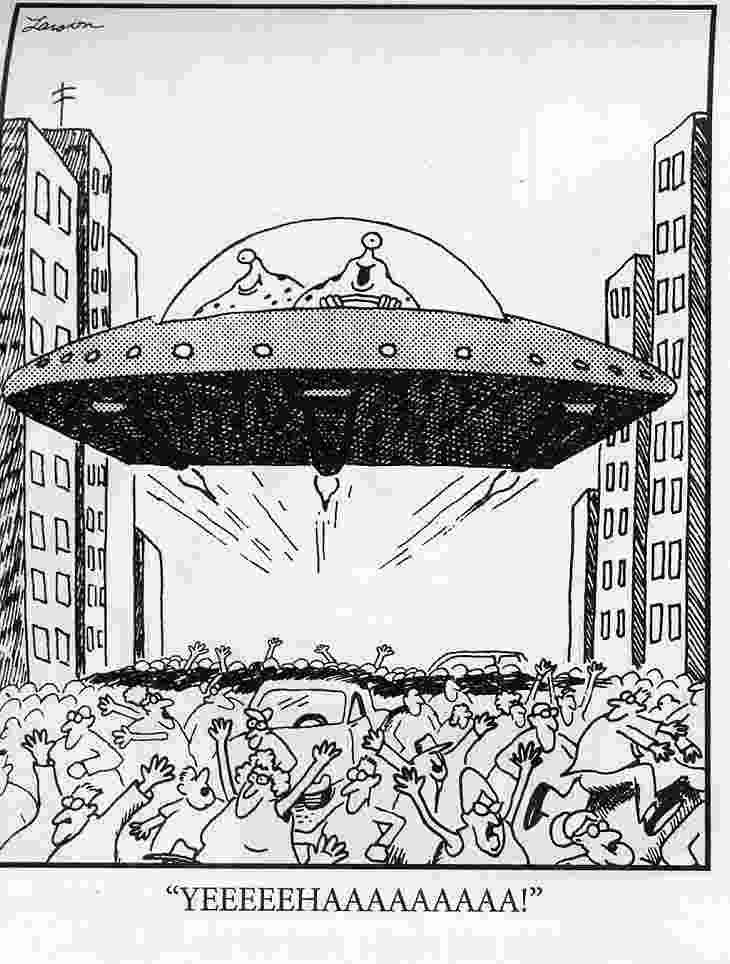
One of the more surprising—and surprisingly underreported—stories to emerge recently is the declassification of millions of pages related to so-called UAPs, or “unidentified anomalous phenomena.” The fourth tranche of documents was released in May, renewing speculation about the origins of these admittedly strange and seemingly inexplicable objects. Are they products of secret, highly advanced defense technology—much as observers of the B-2 bomber, before its existence became public, reported seeing mysterious “boomerang-shaped” craft in the sky? Or could their origins truly be extraterrestrial?
.
My initial thoughts tend to lean to the former, but I am wide open to entertaining the latter. (One discipline in trading is that you know what you don’t know, to sound Donald Rumsfeldian). If true, what fears should this provoke? What concerns? Personally, if these are craft—either drones sent from far away or spaceships piloted by little green men—we should all find this deeply disquieting.
.
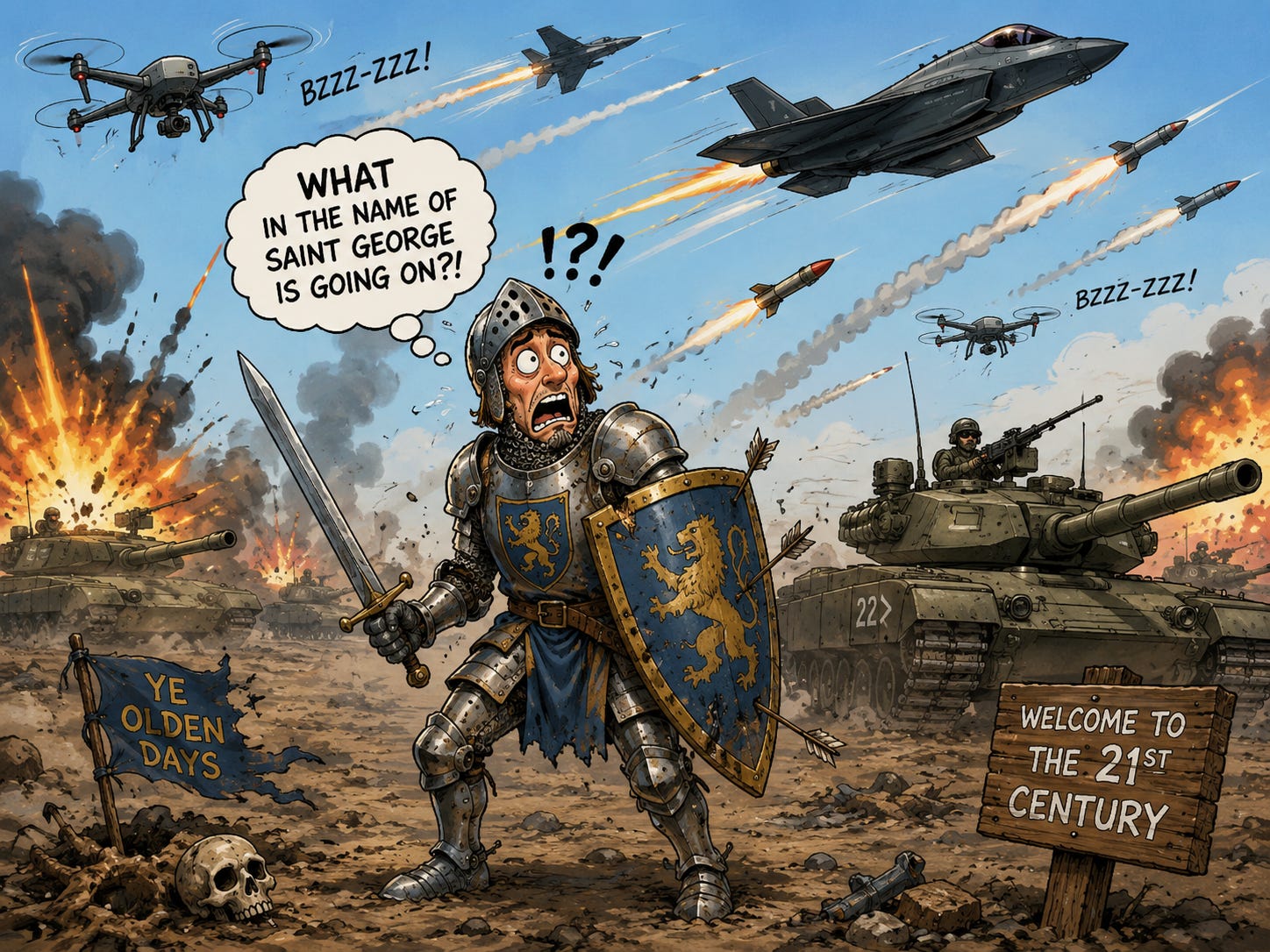
Here is something to chew on. If you had a time machine and traveled around periods in history, what would you find? Let’s say you’re a French knight in 732, and, after fighting at the Battle of Tours, you step into the device with all your chainmail, armor, shield, and sword. You pop out in 1415 to fight again at Agincourt. What you might notice is that in seven centuries weaponry really hasn’t changed very much. In fact, technology overall hasn’t advanced far, certainly not in any revolutionary way. One key reason for this lack of advancement is that, despite the reputation for constant warfare, the Medieval period was not a particularly violent time on a large nation-against-nation scale, albeit quite dangerous, miserable, filthy, and plague-infested by our standards.
.
You, brave knight, then climb back into the time machine and step out in France again…this time approximately 300 years later in 1712 at Denain. Although a strange and noisy projectile-hurling device called a musket is now in use, it’s primitive, inaccurate, and cumbersome. The weapons of choice on this battlefield are still of the bladed variety…bayonet, sword, pike, halberd, spontoon. Horses are still the main shock force and they are defended against by hedges of spear points in the form of bayonets and pikes. So even after a thousand years have passed from Tours, you’re still in the game.
.
After helping your future countrymen defeat the Austrians and Dutch, you hop back into the time machine once again and move forward another two centuries to 1916, wherein you emerge onto the Somme battlefield of World War One. But now things have changed dramatically. In fact, to your bewilderment, you feel as if you’re on the surface of another planet. Now what do you see? A world utterly transformed. Your armor and weapons are not only completely useless, but a hindrance. You are in a world of warbling artillery shells, rattling machine guns, rifles, steel helmets, clouds of mustard gas, armed flying machines, rumbling tanks, etc.
.
Terrified, you race back into your machine and are propelled forward yet again…this time barely 30 years later to 1945 and into the cockpit of an enormous B-29 bomber 30,000 feet over Japan. From here, after getting over the shock of flying, to your incomprehensible horror, you witness a single 128″x28″ apparatus vaporize an entire city right before your eyes. Should you be so bold as to travel forward just 81 years later into 2026 you will see a world awash in nuclear-tipped ICBMs, enormous submarines that can stay submerged and silent for months, supercarriers with flying machines screaming through the air 50 times faster than your trusty warhorse, radar, sonar, satellites, Kevlar, even more powerful tanks of all shapes, RPGs, night vision, kamikaze drones engaging in insect-like AI-directed swarm attacks, stealth aircraft, smart weapons, supercomputers, etc. You get the idea.
My point is this: technology grows at an exponential rate (think Moore’s Law). It just needs a catalyst. And as Oskar Schindler said, he was always missing one thing: “War.” The reason we went from the flimsy Wright Flyer in 1903 to the Mach 3 Lockheed SR-71 Blackbird less than 60 years later, to satellites, space stations, spaceborne telescopes, and reusable rocketry today, indeed the ability to destroy our planet many times over (let alone the advent of bioweapons), is because, nothing drives technological innovation like war. And the 20th Century was by far the most lethal and violent in history…so far. And the better at war you are (and perhaps more aggressive) the faster you develop new and improved stuff. Measure begets counter-measure, which begets counter-counter-measure spiraling onward and upward at a sinisterly accelerating rate.
.
So what would this say about an alien race, if they’ve in fact been dropping in on us, that is so technologically advanced that they have overcome the limitation of light speed itself—possibly taking advantage of curves, folds, and intersections in space-time—that they can traverse the unfathomable distance to come here? The distances of space are so vast they are difficult to comprehend. We can illustrate it this way. The nearest star to our Sun is Proxima Centauri; it’s roughly 4.25 light years away. That’s around 25 trillion miles. Now, if we were to shrink the Sun all the way down to the size of a golf ball, Proxima Centauri would be roughly the diameter of a BB. To stay true to scale to match the unfathomable empty space between them, if we stood in New York’s Central Park holding the golf ball, how far away would the person holding the Proxima Centauri BB have to stand to match the distance? Soldier Field, Chicago, or a little over 760 miles.
.
Put another way, the fastest manmade object ever built, the Parker Solar Probe, uses the sun’s gravity to propel to an astounding 430,000 mph. That’s New York to LA in 20 seconds. At that constant speed (assuming a gravity-assist was feasible in deep space, which it is not, but go with it) it would take 6,600 years to travel to our nearest star. For perspective, the oldest known civilization, Sumer in Mesopotamia, dates back 5,500 years. Put yet another way, this November an incredible milestone in cosmology will occur when the Voyager 1 space probe, which has been traveling at a more reasonable constant speed of 38,000 mph since 1977, will reach one light day distance from Earth. (Not year. Day.) Were it aimed at Proxima Centauri, it would take 75,000 years to arrive.
.
Furthermore, what would the aliens’ arrival here of all places say about their abilities to even locate us given our obscurity within the infinite expanse of the cosmos. A common illustration goes thusly: If our entire Solar System out to Neptune’s orbit, 5.6 billion miles diameter, was shrunk to the size of a quarter, the Milky Way galaxy would be the size of the contiguous United States…just to give you an idea of how hidden we truly are. And yet, somehow they have found us. So how advanced must they be?
.
In fact, the technology they would have to possess to get here would be so much farther ahead of our own that it is unfathomable. Maybe the best way to drive the point home is to compare us to a group of cave dwellers with clubs and primitive spear points being studied by a foreign power just over the horizon that fields F-22s, satellites, nuclear submarines, and ICBMs in its arsenal.
.
Call me a pessimist as well as a space nerd, but I have to think that a society so advanced—which implies a lot of experience at waging war if our own story is any guide—is a pretty hostile bunch, given that war has been the stimulus for our own technological advancement.
And yet…what have we done? In a spasm of naïve optimism, at least in my view, Carl Sagan and his crew have sent our probes into the void with not only a “Hey there, we exist” message in the form of a gold-plated record tacked onto the side of the Voyager probes, but added a “Oh and here’s exactly how to find us” guide. I guess the only consolation is that if they are so advanced, which implies civilizational longevity, and yet have survived without annihilating themselves, it could be a good sign. Maybe they got it out of their system already. After all, we’ve only had nukes for 81 years. We’re just at the very beginning of the post-global-total-destruction-capability phase. Should we last, it may be because we’ve improved as a species, with our morality catching up to our technology. Or maybe the aliens are merely the survivors (read: victors/conquerors), in some planetary cage match. The Spartans of their system, who, in the end, defeated their celestial Athenians and came out on top.
.
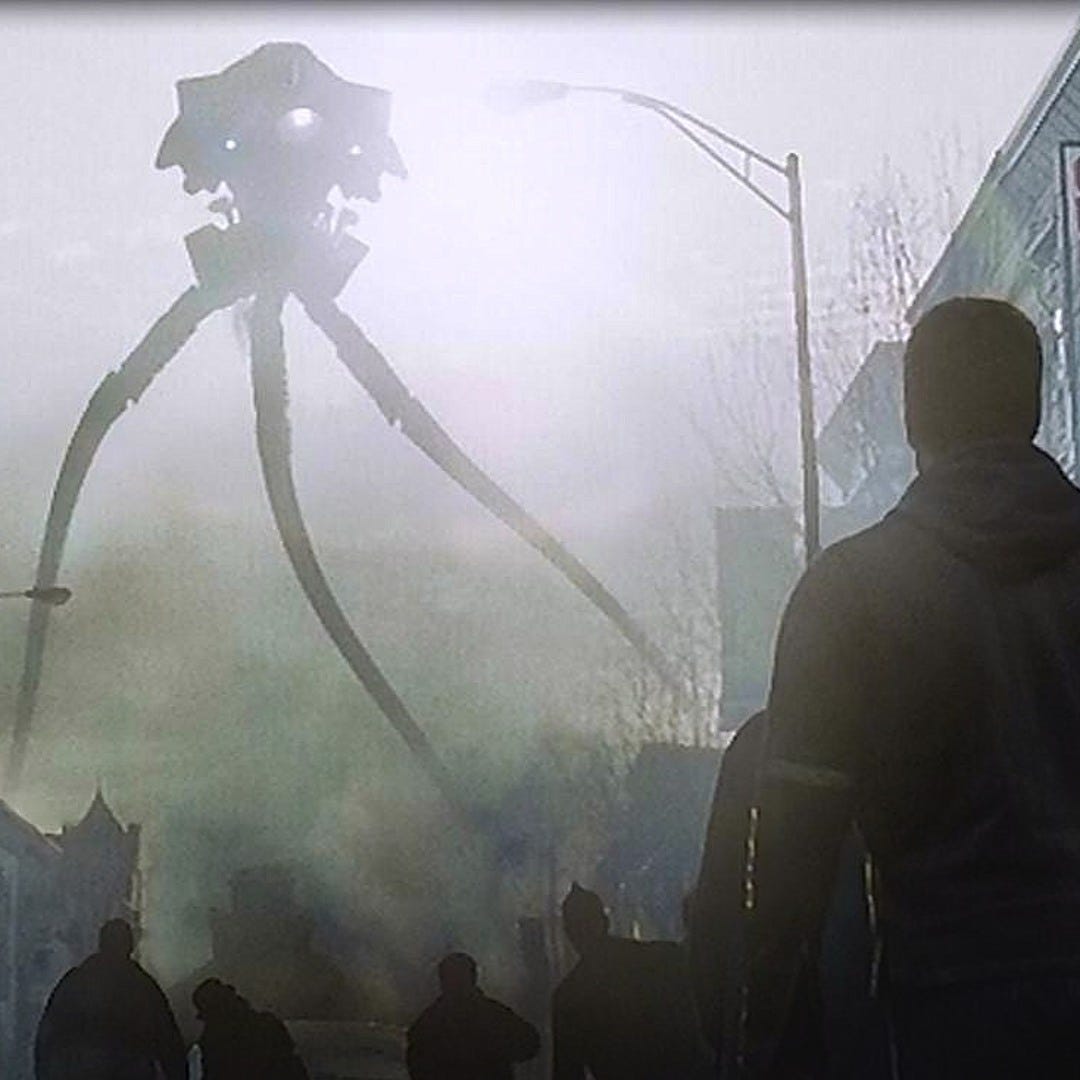
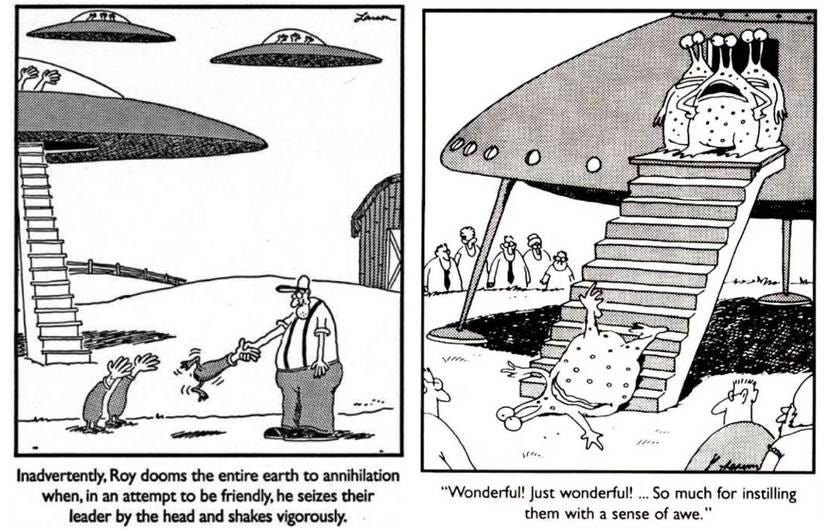
Either way, I’m thinking any serious close encounter with these guys would be more akin to Independence Day or War Of The Worlds than E.T. or Arrival. With that in mind, perhaps inviting them over for a play date, like beckoning a sadistic child wearing Timberlands and carrying a magnifying glass to visit our little anthill, wasn’t such a good idea.
______
Brad is a commodities fund manager, author, and columnist whose articles have appeared on the pages of The Wall Street Journal, NY Post, NY Daily News, The Daily Wire, National Review, The Hill, The Federalist, Zerohedge, and other outlets. He is the author of three books. His latest book, A War For Half The World: Why the Real Battle for the Future was Fought in the Pacific, will be released in February 2027.
No posts
Comments
Nothing yet. Say the first thing.
Sign in to join the conversation.