
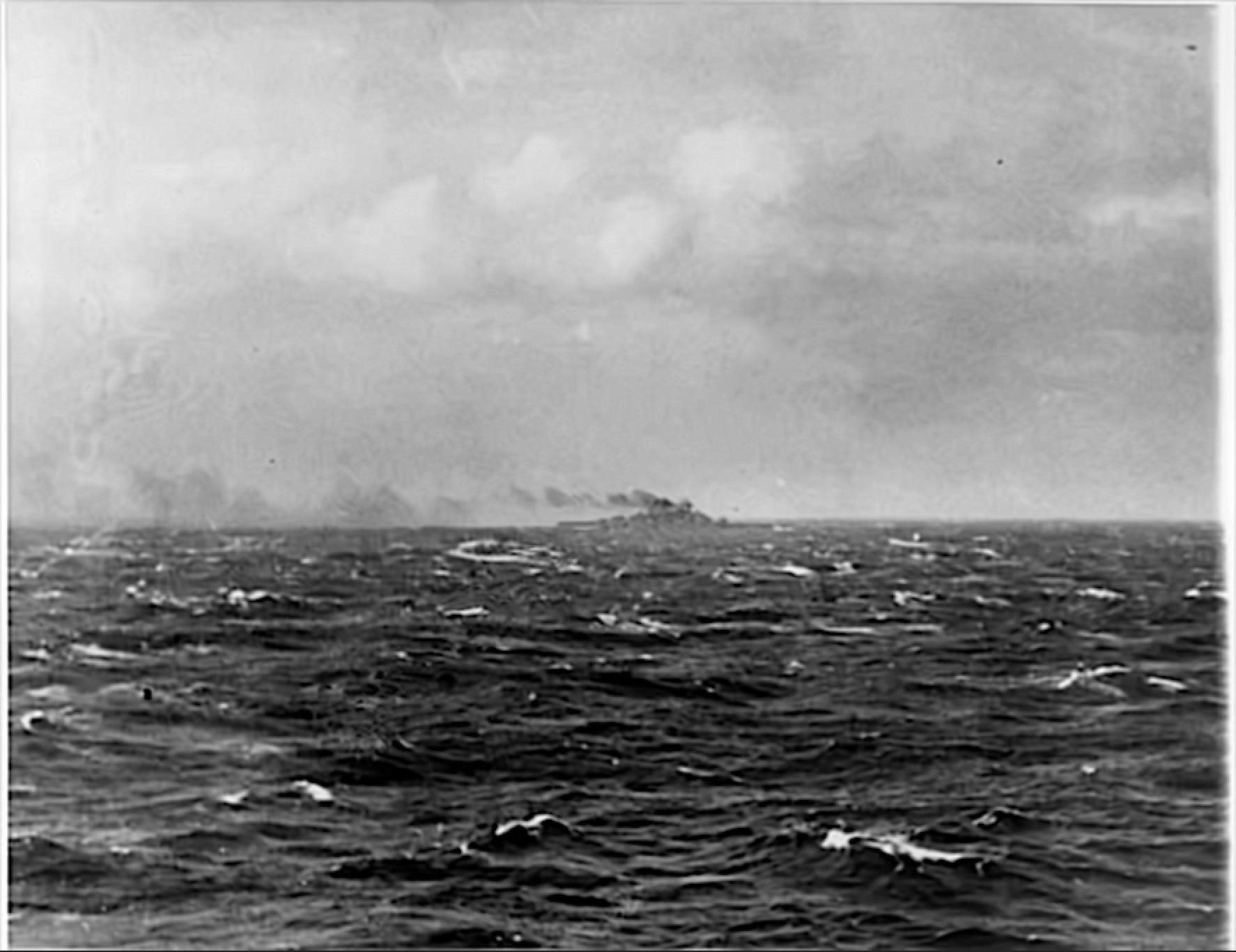
Last clear photo of Bismarck before surrounding British warships opened fire and shot her to pieces.
.
When the last of Ark Royal’s Swordfish plopped onto the tossing flight deck, their rain-soaked crews believed they’d scored no hits. At least none they could see. Yet something strange was happening. Bismarck had suddenly begun steering away from France. But why?
.
Watching the air attack from a healthy distance, Sheffield’s lookouts reported what may have been the most consequential torpedo hit of the war. One said: “There was a big column of water, briefly dull red, at [Bismarck’s] base near the stern.” One torpedo had, in fact, hit the ship. And for the Germans, it struck her in the worst possible place.
.
Though well-protected, trials revealed Bismarck did have an Achilles heel: she could not steer using propellers alone. Without her rudder, she was uncontrollable. And now the rudder was jammed, frozen in place by the stern torpedo blast while the battleship was maneuvering to evade the incoming attack. Locked into a twelve-degree turn to port, Bismarck began veering away from France in a helpless circle while damage-control crews repeatedly dove into flooded compartments trying to free the frozen rudder as if their lives depended on it—which they did.
.
Sub-Lt. Ludovic Kennedy, serving aboard destroyer HMS Tartar, remembered: “We didn’t know what happened…all we knew was [Bismarck] was steering in our direction. And there was a feeling of tremendous exultation…she’d been delivered into our hands.”
.
After hours of futile effort, it became grimly clear to Bismarck’s crew that her rudder could not be freed. Unable to steer, the situation was hopeless. Just 350 miles from Brest, a single torpedo from a puttering biplane nicknamed the “stringbag” had delivered Hitler’s mightiest warship to the Royal Navy. And they were out for blood.
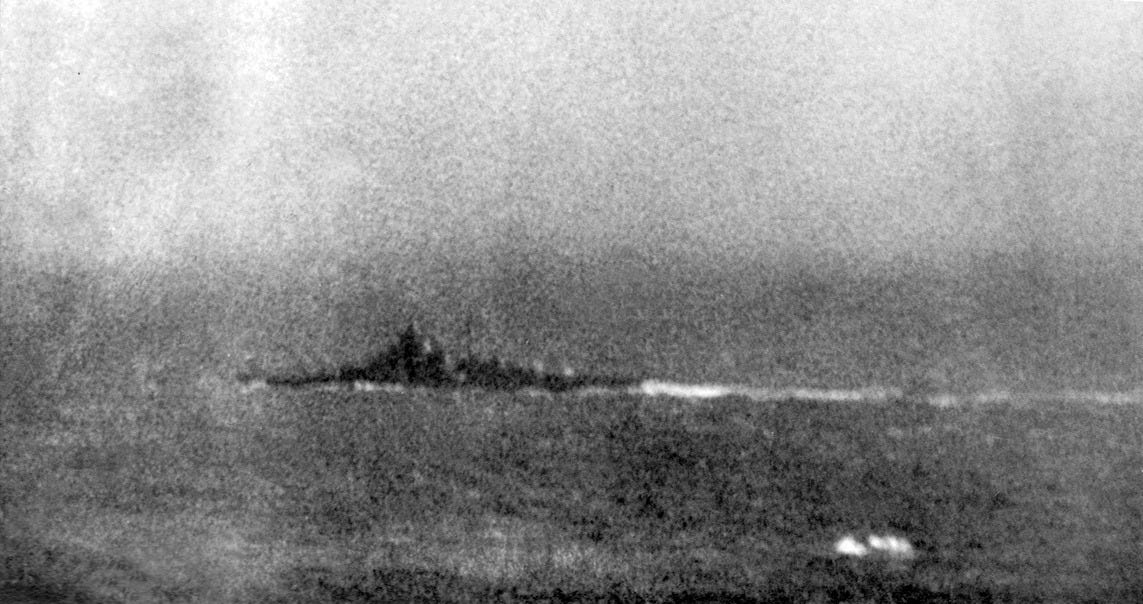
Bismarck sails through the night, her crew knowing full well that sunrise would bring their doom. Taken by a shadowing Swordfish of 818 Squadron.
.
Throughout the night of 26–27 May, Tovey’s converging forces closed in on their helplessly circling prey, who would be in range by sunrise. The German crew knew exactly what awaited them at dawn. The Royal Navy would surround their crippled ship like a firing squad and blast her to pieces. Tension aboard Bismarck was palpable. Many of the crew simply wanted it over with. They knew their time was up when Lindemann told the men to help themselves to anything in the stores.
.
Lütjens admitted as much when he radioed the fleet: SHIP UNMANUEVERABLE. WILL FIGHT TO THE LAST SHELL. LONG LIVE THE FÜHRER.
.
During the night, messages arrived from Berlin promising help, but the men knew otherwise. Another announced gunnery officer Adalbert Schneider was awarded the Knight’s Cross for sinking Hood. Then came Hitler’s own message, effectively delivering their eulogy:
.
ADOLF HITLER TO CREW OF BISMARCK: ALL GERMANY IS WITH YOU. WHAT CAN BE DONE WILL BE DONE. YOUR PERFORMANCE OF DUTY WILL STRENGTHEN OUR PEOPLE IN THE STRUGGLE FOR ITS DESTINY.
.
Addressing the crew, Lütjens echoed the Führer. “The German people are with you. We will fight until our gun barrels glow red-hot and the last shell has left the barrel. For us seamen, it is a question of victory or death!”
.
It was received in silence. If the admiral hoped to inspire the men, it had the opposite effect by confirming it really was over. Bismarck’s 2,282 men could do nothing now but await execution. One sailor muttered, “Let us think one more time about our home, our wives, our children,” before breaking down in tears.
.
Across Britain, over 1,400 other messages were arriving. In Ringwood, the parents of one sailor aboard Hood received the devastating telegram: REGRET TO REPORT THAT YOUR SON THOMAS JOSEPH BERNARD SAMMARS, BOY FIRST CLASS P/JX 182136 IS MISSING PRESUMED KILLED ON WAR SERVICE. Sammars was just sixteen years old.
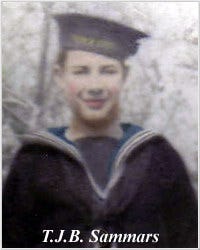
Thomas Sammars, at just sixteen he was the youngest member of Hood’s crew to die at the Denmark Strait.
.
At 8:43 a.m. on 27 May 1941, the British sighted the huge German battleship over the horizon. Tovey intended to close the range, bring his broadsides to bear, and systematically annihilate the crippled enemy. Remembering Hood, he ordered Renown to remain clear. Prince of Wales had already been dispatched home for repairs, her crew still unaware how decisive their earlier hits had been.
.
Leading the attack was King George V, supported by the 45,000-ton battleship Rodney. Though older and slower, Rodney mounted nine monstrous 16-inch guns, making her the most heavily armed ship present. Before battle, Rodney’s padre delivered a brief prayer that captured the mood of thousands of sailors on both sides: “Oh God, remember that we will be very busy today. And though we may forget you, please don’t forget us.”
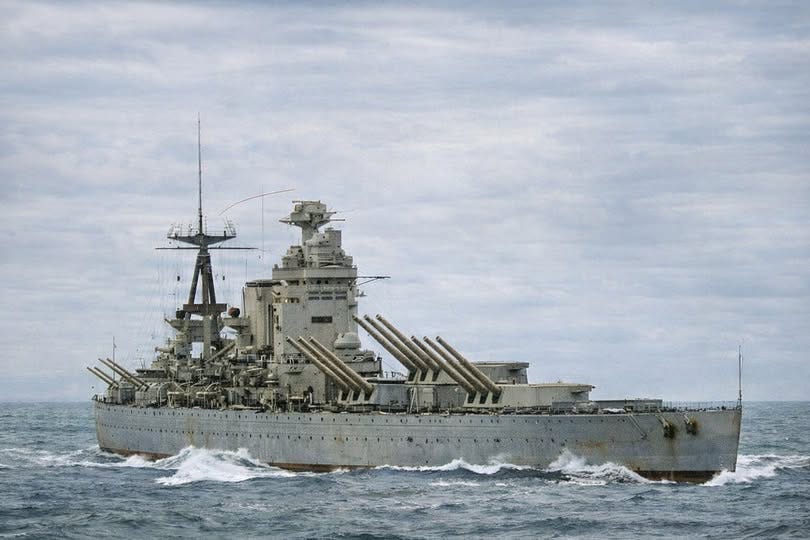
HMS Rodney. With nine 16-inch guns in three forward-positioned turrets, she was the most lethal battleship at Tovey’s disposal.
.
At 8:47 a.m. Bismarck came within range. Rodney swung her turrets toward the enemy and vanished in what one of her sailors described as “a sea of flame and pall of black smoke” as she unleashed two of her three forward 16-inch batteries. King George V followed with her own 14-inch salvos. Unable to steer, Bismarck was an easy target; the British quickly got the range. Soon a storm of shells tore through her superstructure, including one that obliterated the bridge, likely killing both Lütjens and Lindemann.
.
Bismarck returned fire, but her crews could not aim effectively due to the ship’s erratic movements and hits disabled her optics forcing her to fire blind. (Only one near miss against Rodney caused any damage at all.) By 9:30 a.m. all four main turrets had been knocked out and hundreds of men were dead, among them Germany’s newest Ritterkreuzer Schneider. Machinist Mate Karl-August Schuldt emerging from the inferno below decks later recalled the horror awaiting him topside: “The turrets were ripped open like a tulip. I could see inside. Everything was on fire. There were explosions. Twenty, thirty, fifty, a hundred dead, some of them without legs, without arms, without heads.” To Zimmermann, who’d already seen two men ripped in half by a shell right in front of him, the dead strewn across the deck resembled “butchered meat” more than people.
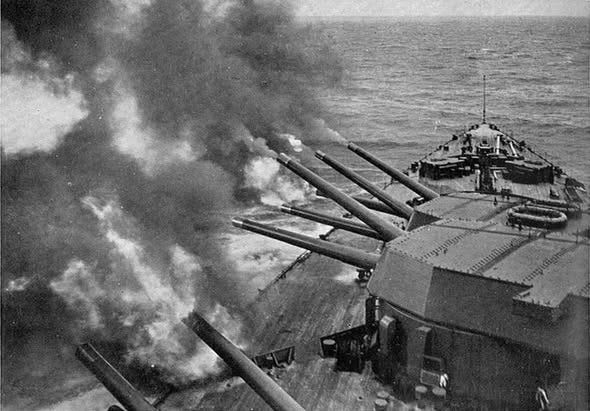
Guns from Rodney pummel Bismarck with salvo after unrelenting salvo.
.
With the German guns silenced, Rodney closed to point-blank range and hammered the helpless battleship again and again while King George V stayed farther off to rain plunging fire onto her decks. Norfolk and Dorsetshire closed in, adding their 8-inch guns to the destruction. By battle’s end, the British ships would fire more than 2,800 shells, scoring roughly 400 hits. Yet Bismarck remained afloat, absorbing repeated blows like an exhausted boxer who, though out on his feet, refuses to go down.
.
At 10:10 a.m. Tovey ordered cease fire. Bismarck lay dead in the water, witnesses describing her as “on fire from stem to stern.” British sailors watched German crewmen leaping overboard like ants fleeing a collapsing hill. It took three torpedoes from Dorsetshire to finally finish the shattered battleship, though German survivors claimed scuttling charges and opened sea valves had already doomed her. In the end, both sides claimed credit for sinking the Bismarck.
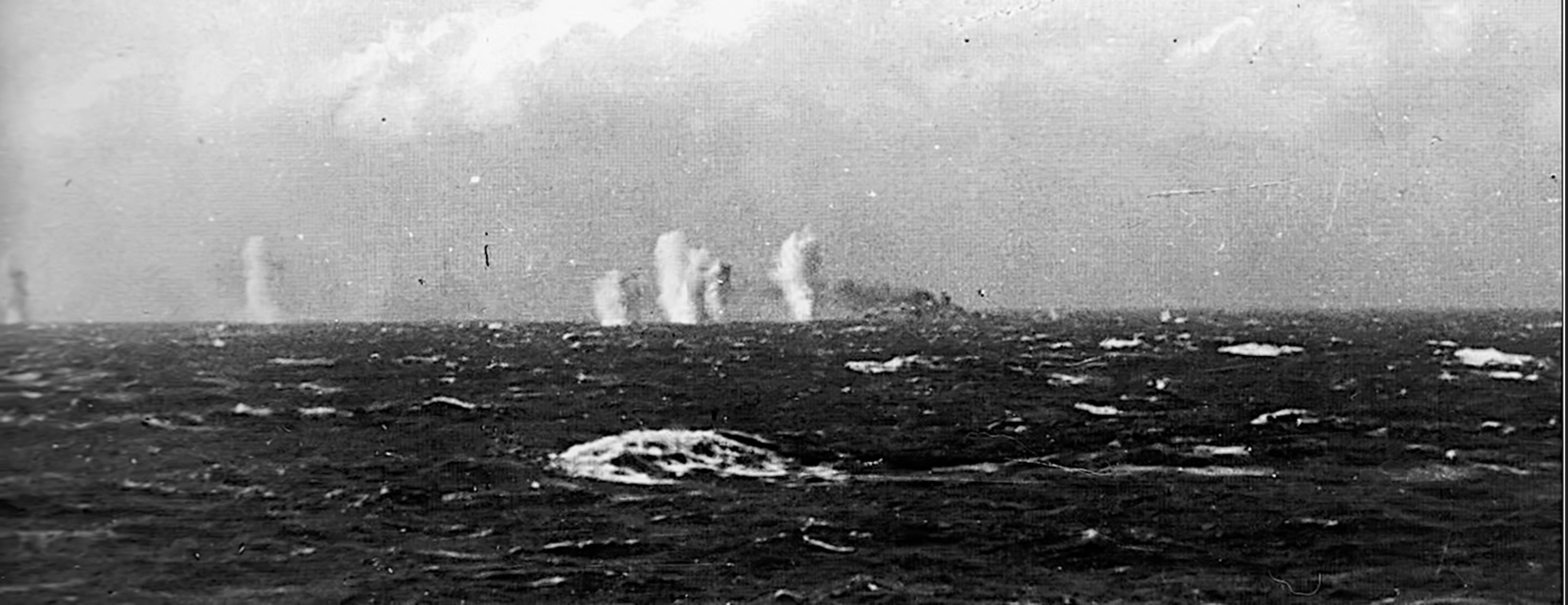
Bismarck surrounded by splashes from shells raining down on her while she is unable to avoid them. She would soon be a burning wreck. And flaming coffin.
.
At 10:35 a.m., less than two hours after the fight began, Germany’s greatest battleship rolled over and slipped beneath the waves, joining Hood and so many other wrecks at the pitch-black bottom of the Atlantic. Roughly 800 men escaped the sinking ship.
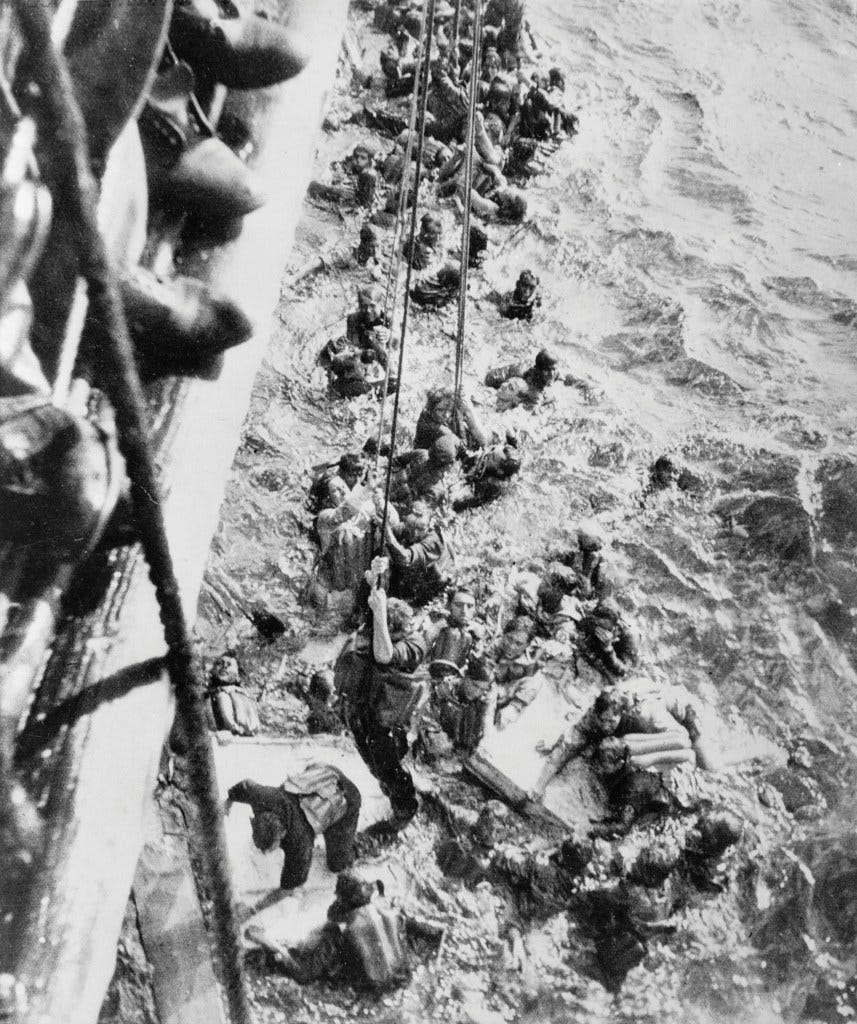
Bismarck’s survivors being rescued by Dorsetshire until a U-Boat scare drove them off, leaving hundreds to die alone in the icy Atlantic.
.
Although satisfied they’d avenged Hood and restored national honor, victory brought little joy to the British. A feeling of pity replaced hatred. Lt. Cmdr. William Crawford aboard Rodney later reflected: “A gallant ship had gone, and a lot of gallant people had gone, although they were our enemies.” The shivering and oil-soaked Germans clinging to wreckage in the frigid water were no longer mortal foes but fellow seamen in desperate need of rescue. Dorsetshire and the destroyer Maori cautiously entered the debris field and began hauling survivors aboard. Saved Germans would later express gratitude towards the British for their decent, even kind, treatment.
.
But then came the final tragedy. After rescuing 110 men, the British received reports of a nearby U-boat. They had no choice but to flee, leaving hundreds to die a lonely, torturous death in the middle of the open ocean. One captive died of his wounds, while German vessels later recovered five more survivors. Of a total compliment of 2,365 (including Lütjens’ staff), 2,251 Germans perished. Jack Austin, a Royal Marine aboard Rodney, contemplated the madness: “We lost a lot of good sailors on the Hood. But there were a lot of good sailors lost in the Bismarck or in the water afterwards. What a waste.”
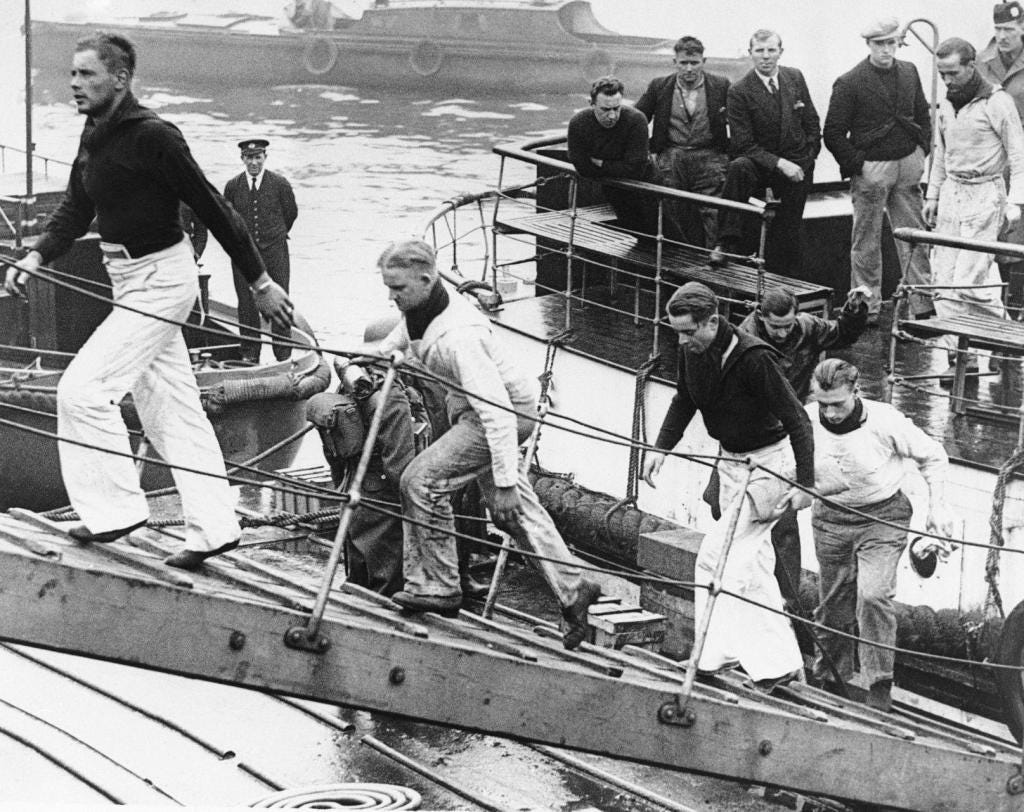
POWs from Bismarck unloaded in England. They would eventually spend the rest of the war in Canada…where they would be grateful for decent treatment from their British captors.
.
A waste, perhaps, but also a necessity. Had Bismarck been able to return to sea, especially if joined by raiders like Scharnhorst and Gneisenau already refitting at Brest, she could have ravaged Britain’s lifeline across the Atlantic. Bismarck had to be destroyed.
.
Yet the manner of her destruction carried even greater significance. Slow carrier aircraft had crippled Europe’s most formidable battleship and rendered her helpless before the guns arrived. The five-day running engagement over 1,700 miles of ocean marked the swansong of the big-gunned battlewagon. Just six months later Japanese carrier aircraft would devastate the American Pacific Fleet at Pearl Harbor. Three days after that, Prince of Wales and Repulse would be sunk off Malaya by land-based Japanese bombers, taking Capt. Leach to his watery grave. Even Tirpitz, Bismarck’s sister ship, would eventually succumb to air power. As would the largest battleships of them all, the 72,000-ton IJN Yamato and Musashi which would be commissioned a few months hence.
.
Thus did the destruction of Bismarck help close the curtain on one of the most iconic chapters in naval warfare. When one German survivor was hauled aboard Dorsetshire, he reportedly warned his captors with eerie foresight: “Today us. Tomorrow you.” Dorsetshire herself would indeed be sunk by Japanese carrier aircraft barely a year later. The age of naval air power had arrived. And though Bismarck’s brief reign of terror was over, a wider war at sea was just beginning.
![r/WarshipPorn - "The Sinking of Prince of Wales and Repulse", Oil Painting by Kenichi Nakamura, 1942. [1228 x 898]](https://substackcdn.com/image/fetch/$s_!-D93!,f_auto,q_auto:good,fl_progressive:steep/https%3A%2F%2Fsubstack-post-media.s3.amazonaws.com%2Fpublic%2Fimages%2Fb27d34eb-929a-4ba2-aa3b-bf3926331794_640x468.jpeg "r/WarshipPorn - "The Sinking of Prince of Wales and Repulse", Oil Painting by Kenichi Nakamura, 1942. [1228 x 898]")
On 10 December 1941, just three days after carrier-based Japanese planes sank three US battleships and damaged five at Pearl Harbor, land-based Japanese bombers sank the unescorted battleship Prince of Wales (killing Capt. Leach) and the battlecruiser Repulse off Malaya. Once again solidifying the passing of the torch from battleship to aircraft as the decisive naval weapons platform.
_____
Brad is a commodities fund manager, author, and columnist whose articles have appeared on the pages of The Wall Street Journal, NY Post, NY Daily News, The Daily Wire, National Review, The Hill, The Federalist, Zerohedge, and other outlets. He is the author of three books. His latest book, “A War For Half The World: Why the Real Battle for the Future was Fought in the Pacific”, will be released in spring 2027.
Comments
Nothing yet. Say the first thing.
Sign in to join the conversation.