
The artist and academic Charlie White used to have a journal called The Enemy. In 2014 he asked me to write something about art fairs. I was just a baby writer then. I’d published a handful of reviews in various magazines, and I’d conducted a few interviews. When Charlie asked me to write this piece, people were exhausted by the art fair circuit. They thought it couldn’t get worse. It got worse. My writing is (hopefully) better now, and today I try not to have strong opinions about anything. In 2014 I was very opinionated. I remember this piece being popular, stirring up conversation etc. It’s no longer online so I thought I’d share it here.
*The title was Charlie’s idea. I still don’t know what it means.
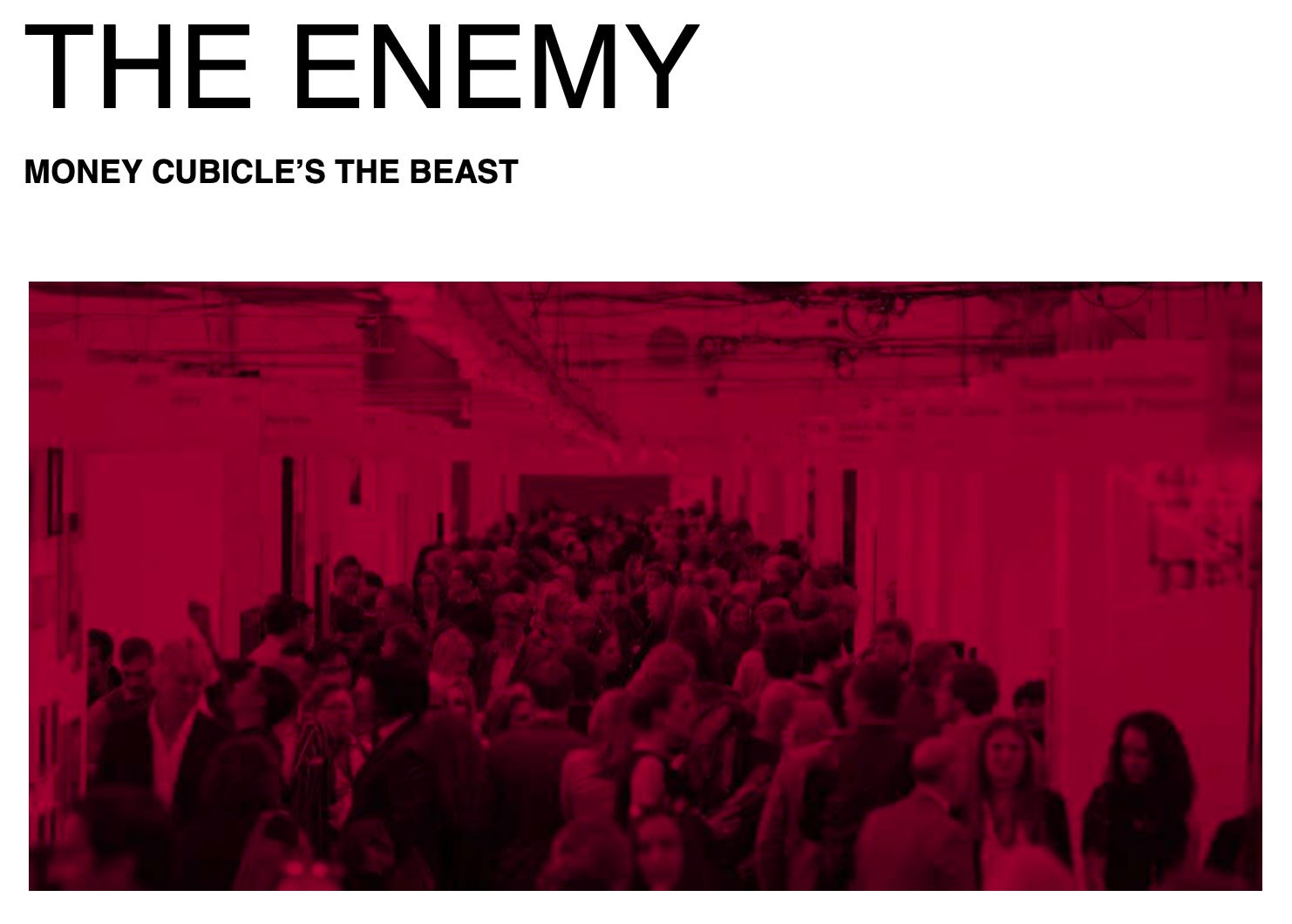
MONEY CUBICLE’S THE BEAST
Everyone complains about art fairs. Everyone goes to art fairs. Everyone says how awful they are. Everyone posts pictures from art fairs. Here’s a photograph; Miami, London, my fresh gear, now Basel, Madrid, oh these two always travel together and they look so great, New York, and New York again…
They are “killing art.”
I began showing my work regularly right around the time that fairs began to proliferate. At first they were not an issue, and I was able to mount exhibitions within the context of the gallery as well as have my works shown individually at the fair. The combined sales of these venues, with the latter feeling like an afterthought, was enough to sustain my practice. However, over time, the fairs grew, multiplied, and fanned out, becoming something completely different and powerful. It used to be that September in New York was the ideal month for a show. Over the years, September has become a problem because people are recovering from summer spending at Art Basel. October is maybe okay. November is no good because people are preparing to spend their money at Art Basel Miami and NADA in December. December is no good by default. The first three months of the New Year are now also blown because collectors are overspent from the December fairs, or waiting for The Armory or Frieze or Art Basel again in the spring. And of course the summer is traditionally still for vacation, childbirth, or rehab.
The dealers I’ve worked with have bemoaned the fairs unanimously. They’re expensive and make art look like cartons of cereal. At the same time they have no choice but to do them. They are like Boxing Day sale week for mall stores. It is not news to the people within art’s industrial complex that collectors essentially do not buy from gallery shows anymore. Still, it should be publically noted that the quiet contemplation of a single artist’s work within the white cube has been vanquished, and not by institutional critique, the eclipse of modernist aesthetics, or the actions and attitudes of artists who moved outside of the gallery to make their work, but by laziness and money. Mostly money, and money’s laziness.
By seeing every artist’s work in a small, carpeted booth in a shabby convention centre, with a lot of noise and no personal space, art has become utterly dehumanized. This is a bad time for art and for (most) artists. A very large percentage, a dominant percentage, of what gets shown, photographed, and collected is forgettable. However, this is nothing new, and to some extent, the work that eventually doesn’t hold up, draws our attention to what does. As in any other industry, we need exposure to poor product succeeding in order to see and recognize what the strengths are in the work that holds up.
For example, everyone is familiar with the work of Van Gogh and Monet, but few people are aware of the vast number of successful artists working and showing concurrent to them, outside of art historians and serious collectors. This vetting has been ongoing for every decade of the nineteenth and twentieth century—do the research, and you will be surrounded by a vast landscape of the forgotten present. The difference in this moment is that it all is happening so publicly, so instantaneously, so that the placement of “then” and “now” can transpire in a month’s time, sometimes even in a week, and at the fair, within a day.
That’s so last Saturday.
People talk about art fairs as being easier, mostly for collectors. However, art is not supposed to be easy, is it? Good art especially is notoriously difficult, correct? Could “Spiritual America” have hung in an art fair? Exactly. However, many young artists that are making a name for themselves in this new climate owe much of their success—as well as the form, scale, and content of their work—to a global circuit of VIP art fair makers and goers; their parties, tastes, and lifestyles. The privileged privileging the young artist, and the young artists offering a palatable product in return.
The idea that art fairs make art easier for collectors is based on a trio of assumptions. The first assumption is that these fairs are important and organized by serious, well informed, art educated professionals. The second is that, as a by-product of the first, only the very best galleries in the world are permitted to participate in these fairs. Third, this must mean that the most cutting edge, important and serious artists are to be seen at every booth. These assumptions may or may not be true. But what this triad does is create a sense of ease in the heart and wallet of the collector, who may not be as confident or prescient as say Herb and Dorothy Vogel, who bought difficult art, and kept it under paper in their ceiling so sunlight would not damage the work.
The Fair allows people who want to own art to actually enact the cliché of buying work that matches the sofa. If you have enough money and space, collectors today can walk around Art Basel, picking out things that they find pleasant, that function as ornament, but also must be loaded with meaning. Works from prestigious fairs are triply pre-vouched, and coming with a whispered promise of future wealth. There is nothing inherently wrong in buying work because it looks good, or buying work as an investment, in fact they are traditional reasons for doing so. There is little to nothing about the pandemic of art fairs that is harmful to collectors in any way whatsoever. The harm is always inflicted on artists, and on art.
Less than a handful of Canadian art galleries participate in the major art fairs. A booth at Frieze—if you are fortunate enough to be accepted—costs in the neighbourhood of nineteen thousand dollars. Further, you’ll need to rent lights, walls, chairs, desks, and in some cases, wireless access. All this, before shipping, travel, paying staff, and lodging. The director of a Canadian gallery that participates in these fairs described them to me simply as advertising. Traditionally, advertising can be bought with money, but in art it needs to be bought with money and prestige. In short, you are to consider yourself lucky to be able to advertise. Of course the elite stable of pedigree galleries, like Hauser and Wirth, Gagosian, Zwirner, and so on, can easily do this in any fair in the world, but for the mid-level and younger galleries, participation in art fairs is simply a way to keep their one living hand above the quicksand; a very costly gesture to ensure that people know you are still relevant, still alive.
People claim to want something to change, they just don’t want to have to be involved. The art world right now is a glamorous limb-strewn car crash on the highway; everyone slows down, appalled, taking photos, whispering and getting off. Perhaps there’s no need to burn down the art fair–if they follow Newton’s law of motion they’ll ultimately slow to a halt, encumbered by their own enormity. For example, Art Forum Berlin, once desirable and taken seriously, has disappeared. Art Chicago is gone. At one point there were perhaps a dozen fairs orbiting around Art Basel in Miami, and that number has diminished. Eventually people run out of money, their tolerance for suffering is fatigued. The artists who did well have stopped doing well, or stopped making work. Certain galleries may have realized the futility of participating and returned to the thing they initially were drawn to – running a gallery. There is something to be said for spurning the upper echelons of success and settling for being a regional player. With any frenzy, exhaustion always follows.
According to Artvista, there are 106 contemporary art fairs this year, an astonishing figure if you consider that these are only for contemporary art. Now consider the number of galleries required to facilitate this many fairs (210 at The Armoury, 305 at Basel, 215 at ARCO) and from there, the number of artists required to facilitate all these gallery rosters starts to reach into the thousands. The final tally is startling, but math does not offer us a true sense of what’s at stake—you need to physically stroll the aisles of any major fair to get a real sense what out of control looks like, sounds like, and spiritually feels like. A friend recently returned extremely depressed from a fair that he was included in, which makes perfect sense, because never before have artists been exposed to this much art commerce in one place, and never have they had to face the reality that what they made—not matter how considered, theorized, or politicised—was nothing more then an exotic purchase for the novice collector or a speculative purchase for the professional collector.
Artists cannot keep up production to match the number of fairs; galleries cannot keep up financially to participate. The heavy hitters will always be able to send out interns and employees all over the globe to maintain a presence within the circuit. It’s an endurance game. To open and maintain a gallery, for someone not born with money, already requires endurance. If Art Basel is the ocean, and Larry Gagosian is the gigantic whale leisurely following the current, then all these smaller galleries and fairs that swim along, eating the scraps, happy to accept the benefits of being cheaper and more accessible than Gagosian, will die from exhaustion. They necessarily have a shorter life span.
Comments
Nothing yet. Say the first thing.
Sign in to join the conversation.