
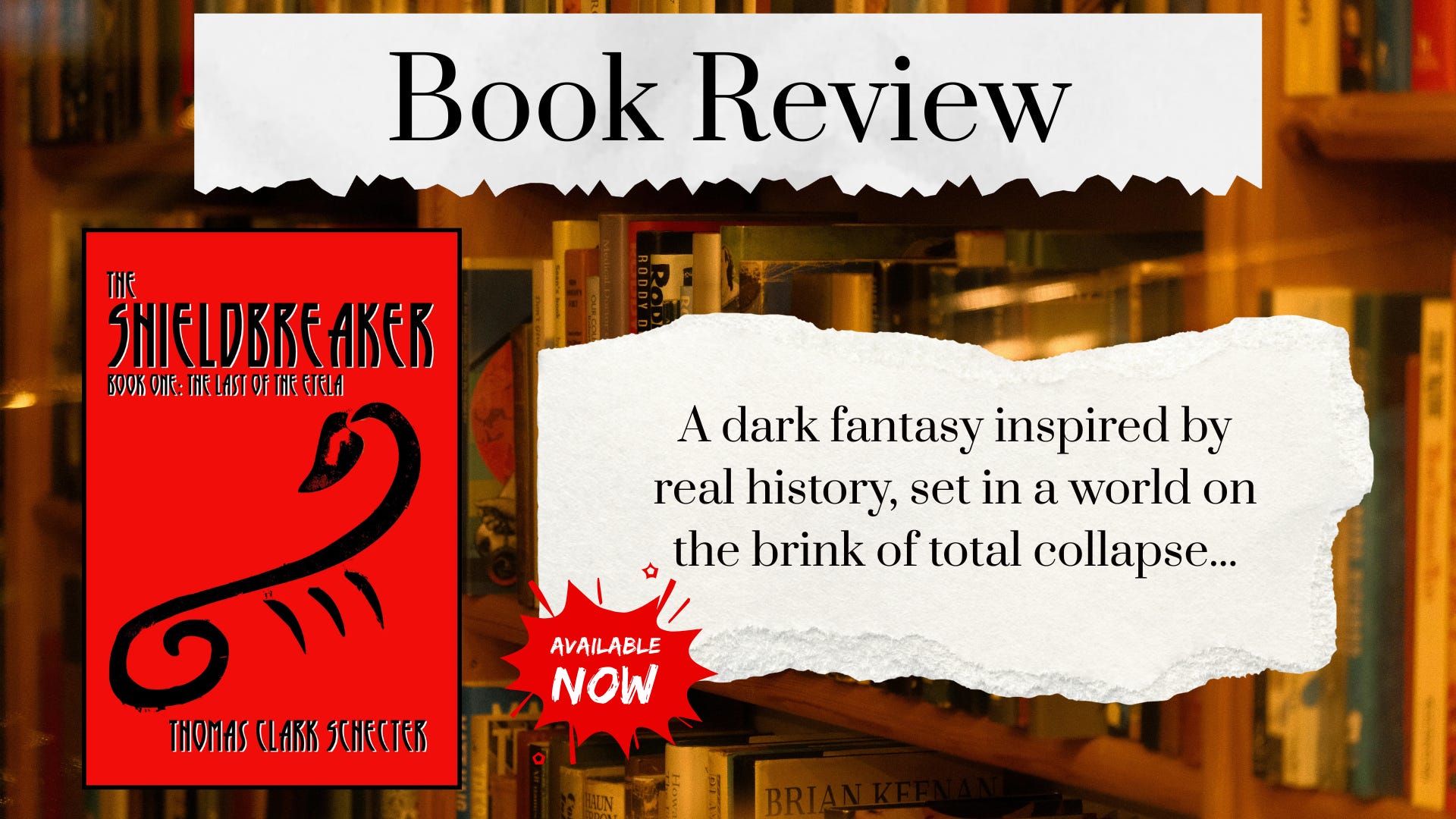
Since joining Substack, I have begun collecting a very specific body of work. The focus of this collection is, in fact, anthologies, books, and poetry collections created by fellow Substack authors.
Among this burgeoning collection of mine is a book by Thomas Clark Schecter called The Shieldbreaker, Book One: The Last of the Etela. The first in a series of dark fantasy novels set in a world on the brink. Should you dive into this world as well? Is this story right for you, dear reader? Join me as we find out.
The SHIELDBREAKER SAGA Paperback
Hit play on the audio file for a short breakdown of my thoughts on Book One of The Shieldbreaker Saga. Spoiler-free, of course, just like the rest of this review.
0:00
-1:44
Read on if you would like to dive deeper into my analysis of the full book, including my final recommendation!
The first book in The Shieldbreaker Saga hit shelves on July 14, 2025, and it came with a simple but powerful premise:
Nineteen-year-old Kareva battles against a seemingly invincible foe—and his own demons—in a last-ditch effort to save his people from extinction.
We enter a world inspired by real history, where the recent collapse of empires has given way to a power vacuum. A tribe of warriors known as the Pohyor have come from the north to forge a new empire. To those they meet, the choice is simple: submit or die.
One by one, the tribes of the Etela have been destroyed. Now, Kareva’s tribe, the Hodrir, are all that remain.
And, purposefully, this is dark fantasy rooted in realism. Schecter has said in prior interviews that he wanted this to be a world without magic or other common tenets of the fantasy genre.
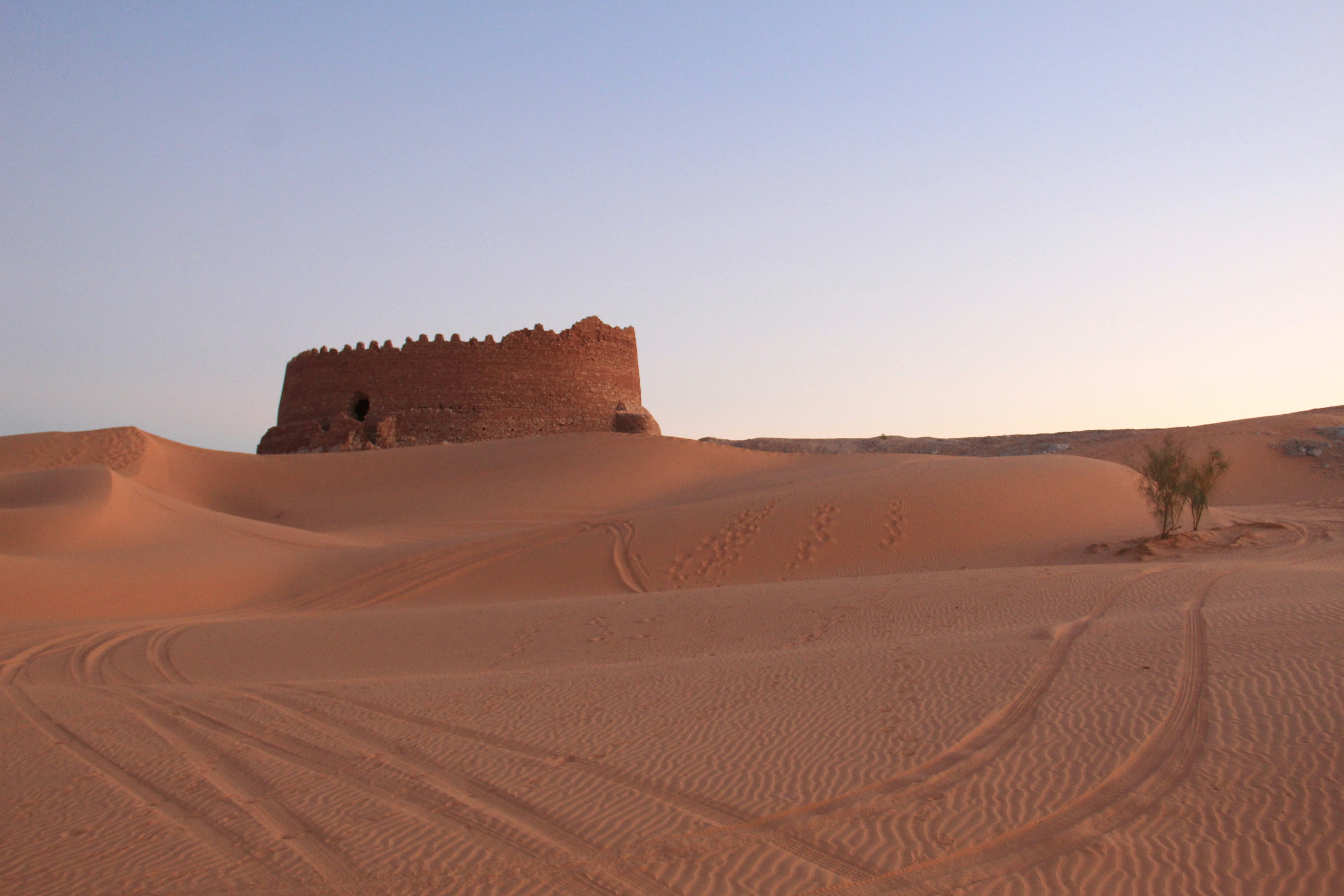
Instead, he sought to create a world inspired by a period of history rarely used by other authors: the collapse of the Eastern Roman and Persian empires in the 7th century, and the rise of Islam that came out of that power vacuum.
Immediately, we picture classic “last stand” moments throughout the history of the fantasy genre. Epic battles that decide the fate of entire worlds and civilizations. The difference here, of course, is that Tom isn’t just showing you one battle.
He’s showing you multiple wars, waged on multiple fronts, across distance and time. This is not a story that’s going to wrap things up neatly, and it’s all the stronger for it. This is war rooted in desperation, in flawed heroes, in blood, and betrayal.
It’s a story that is simultaneously grand and epic in scope, while also being focused and intimate. It uses a unique structure and an emphasis on character development to truly pull you into the world without the need for long stretches of worldbuilding or family-tree diagrams spanning generations.
In a world like this, teetering on the edge of oblivion, the present is all that matters.
Schecter takes a truly unique and inspired approach to the structure of this first book in The Shieldbreaker Saga. Each chapter is structured like an episode of a TV show, complete with the perspective switches and pacing that such a description would imply.
This is different from what most readers may expect. In many other books, you would expect there to be one POV per chapter, but here, Schecter invites pacing akin to the kind of show you’d spend an entire weekend binging on Netflix.
Events play out fast, and the story switches POVs when it needs to, to better frame and showcase them for the reader. And there’s no warning, either. One paragraph, you’re looking through the eyes of Kareva himself, and the next, you’re somewhere else.
Done without intention, this structure could easily devolve into narrative chaos. It could leave the reader excited, but confused. Thankfully, that’s not the case here. Schecter maintains full control over the story at every point, making it clear whose perspective you’re in and why you’re there.
The result is a story that combines breakneck pacing with a structure that keeps you on the edge of your seat across every single chapter. It’s truly impressive work.
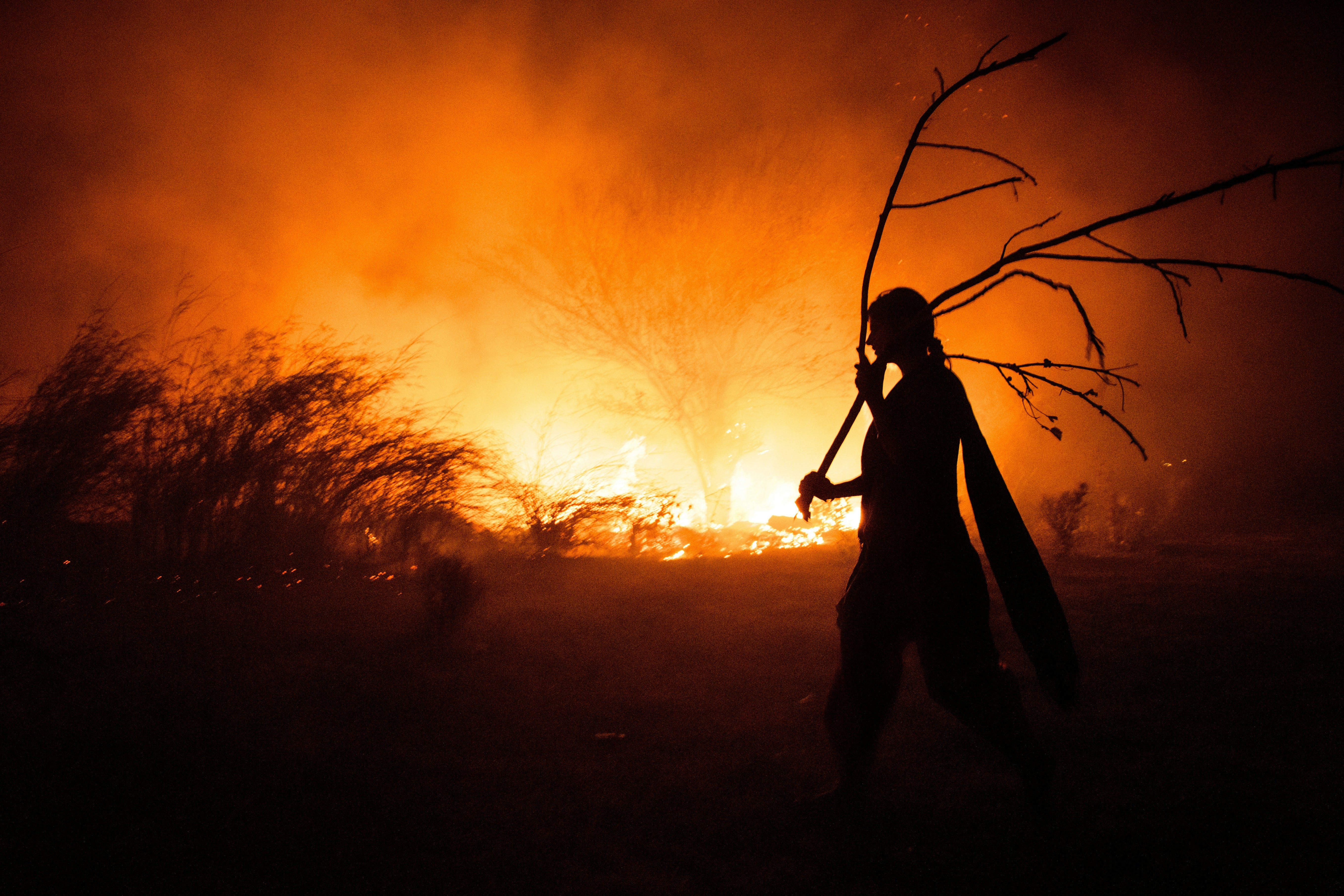
The characters in The Shieldbreaker Saga, Book One: The Last of the Etela are all facing their own internal conflicts, but what binds them together are the shared circumstances they find themselves in.
The desire to survive, to preserve one’s way of life, is something we can all relate to. Schecter uses this to create stakes from the moment you exit the prologue. And it’s this subtle mixture and balance of internal and external conflict that connects the reader to them.
When I first started reading, I found myself wishing for some sort of guide or appendix that allowed me to see how these characters were related. Family trees, tribal structure, and the like. My inner fantasy nerd craved and expected that kind of optional worldbuilding, but you won’t find it here.
And, surprisingly, you don’t really need it.
Given the stakes of the story, the state of the world, and the danger surrounding these characters, the last thing anyone is worried about is family trees and lineage beyond what tradition would dictate.
There’s still that respect for the chain of authority here, but it runs pretty short. Kareva, for example, becomes the leader of his tribe very early on in the book after his father’s passing.
And despite the circumstances, the others (mostly) respect the power shift. Everyone is trying to find the balance between tradition and necessity, but things like tribal structure and religion absolutely still play a role here.
It’s just that Schecter has smartly decided to keep the scope focused on the moment. We are inside these characters’ heads repeatedly over the course of a single chapter, let alone over the course of the book.
Like them, we are worried about how they’ll survive to the next sunrise. The traditional tenets of fantasy don’t apply here. At least, not in their entirety. It’s the same reason why you won’t find magic anywhere in the world of The Shieldbreaker Saga.
No one is coming to save them. No macguffin or spell can reverse the end of the world. This is their reality, and they have to face it. And, on top of this, they’re all bringing their own insecurities, baggage, and in some cases, personal demons to the battle as well.
To avoid spoilers, I’ll offer one example (and one of the most compelling). One of our protagonists, Kareva, suffers from pretty severe mental health issues, something far beyond the scope of medicine in a time period like this.
He’s haunted by the ghost of his dead brother, who was supposed to take the throne when his father passed. To him, that ghost is real, but to the reader, it could be easily interpreted as hallucinations due to deep-seated mental issues.
And Kareva wrestles with this while also being suddenly put in charge of his entire tribe. Everyone looks to him for answers and guidance, but within the first few chapters, doubts begin to form and old grudges rise to the surface within the ranks.
They say great characters are layered, nuanced, and most importantly: flawed. By that metric, Schecter offers up some of the best characters I’ve encountered in this genre of fantasy.
These are real people, struggling with real problems, facing very relatable circumstances. They simultaneously have everything and nothing to lose.
We have a compelling premise, rich characters, and stakes that would make any fantasy reader salivate with anticipation. The next logical question now becomes: how are the battles?
Because if we’re talking about the end of the world, there must surely be battles aplenty, right?
Yes. Absolutely.
As someone who loves reading battle scenes, but often struggles to write them, the action in The Shieldbreaker Saga, Book One: The Last of the Etela is some of the best I’ve read.
And I say that because Schecter absolutely nails the pacing and flow of these scenes. Whether it’s a large-scale conflict or a more focused one-on-one duel, the writing perfectly captures and choreographs each moment without dragging down the pacing.
I likened it to the rhythm of music in my recent interview with Tom Schecter here on Substack, but he said it was more a result of him being, quote, “an absolute goddamn lunatic about military history.”
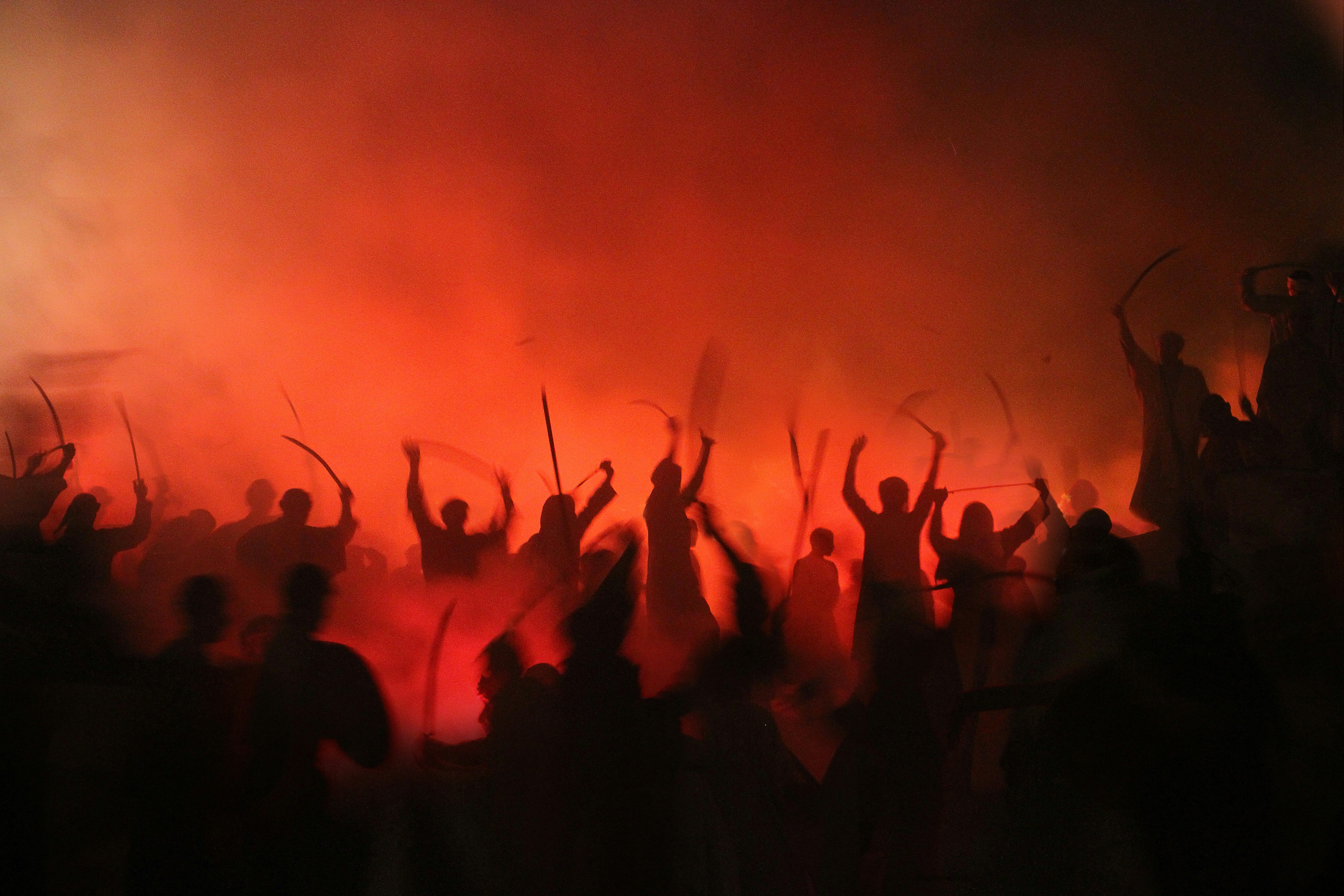
This book is packed with exceptionally well-written (and well-edited) battle scenes. And another key element here is that the battles don’t feel triumphant. They feel like true warfare.
These are nightmarish, terrifying, gut-wrenching scenarios with no clear outcome at the start. In these moments, we catch a glimpse of the souls burning within each character. The battlefield here is truly the great equalizer.
As the title implies, The Shieldbreaker Saga: Book One, The Last of the Etela is indeed the first book in a grand saga planned by author Thomas Clark Schecter. Book two has already been released in 2026 as well, but many more are planned.
There’s a clear goal as we get into book one of this saga, and it’s something realistic and attainable, though far from easy. This gives us what I believe is essential to a good story set in a fallen world: hope.
Schecter gives us hope as the reader. The characters, too, have hope they will live to see another day. They believe they can somehow survive against impossible odds, and as the plan comes together, you start to believe there may be a chance.
And it’s so easy as the writer to rush something like this. I know I myself have been guilty of it in some of my work. We want to reach that goal, feel that catharsis, and stand upon the pedestal of victory.
But Schecter’s saga is going to make us all earn it. I, for one, am here for the ride.
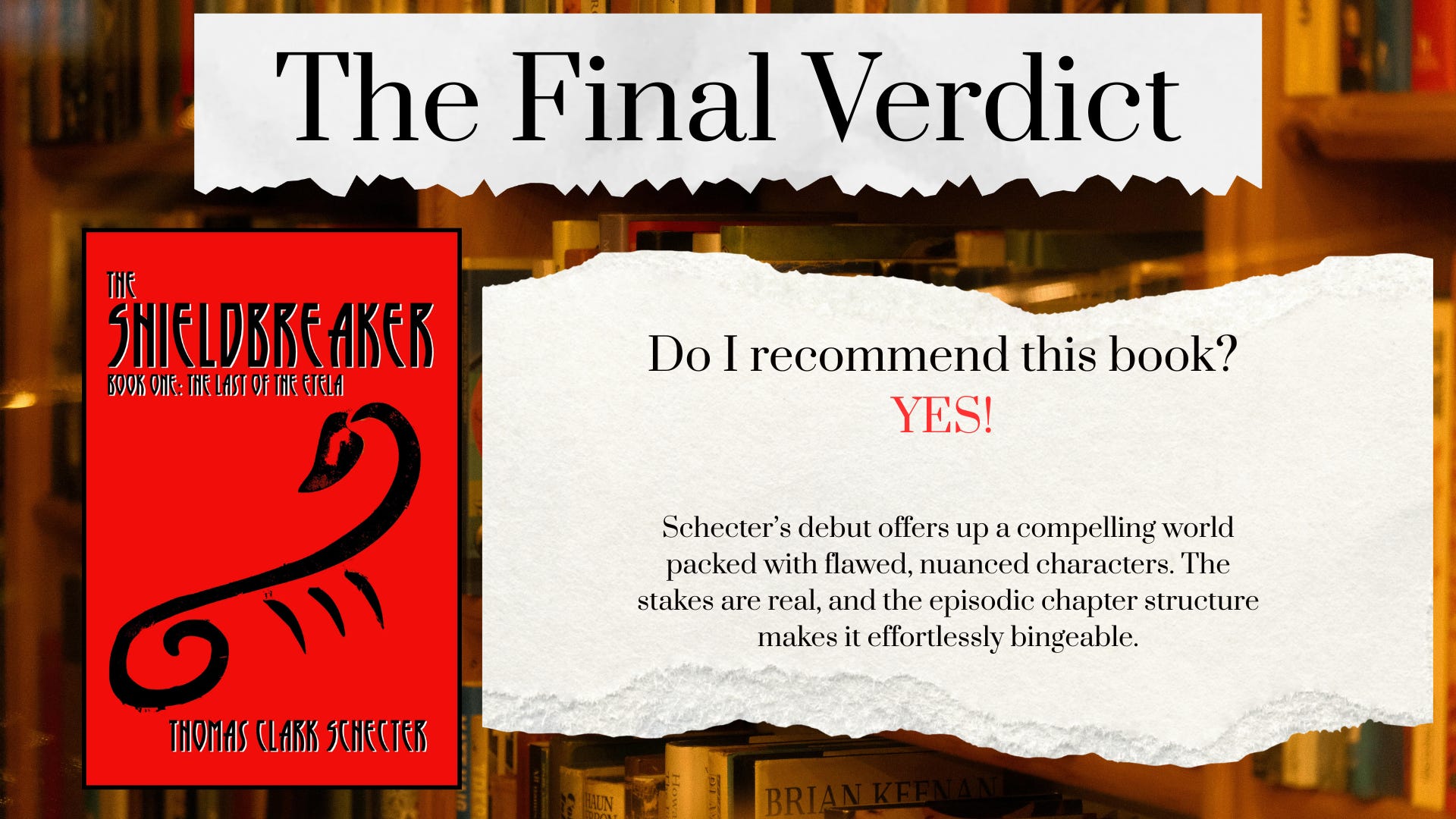
The SHIELDBREAKER SAGA Paperback
A track that I believe captures the spirit of THE SHIELDBREAKER SAGA.
No posts
Comments
Nothing yet. Say the first thing.
Sign in to join the conversation.