
I work with organisations and leadership teams on SuperSkills, human capability, and AI-era decision-making through speeches, workshops, keynotes and advisory work. In person or virtual. UK, Europe, global. → Book a discovery call | → Explore: thesuperskills.com

Friends,
I’m away this week, so this is a slightly different piece to my usual. I hope you enjoy it.
He kept his head down.
He sat behind the counter of a corner shop with a laptop propped up where you would expect a radio to be, and he watched lectures. Engineering of some kind. There was a man’s voice droning on about network connectivity that would have put me to sleep inside four minutes. It was like white noise, slightly too quiet, competing with the fridge.
I had never been in a corner shop like it. They usually have music, or talk radio, or nothing. This one had a lecturer.
The man behind the counter was skinny and unshaven, though not in a way that looked thought through, and I’d guess somewhere between his late twenties and mid-thirties. The shop smelled intensely of incense. To this day I cannot smell incense anywhere in the world without being taken back to that shop for a moment.
He never smiled. He was not rude and he was not cold. He was just never pleased to see anybody. He looked up only when somebody was standing in front of him, ready to pay. He would beep the items through, say two pounds sixty-eight, and type the number into the card machine, because the machine and the till were not connected. We would both watch the small screen while it made up its mind. Then he would say, “It’s gone through,” and his head would go back down before I had said thanks.
Two pounds sixty-eight was a packet of extra strong mints and a packet of Fisherman’s Friends.
Anyone who has spent time with me knows about this addiction of mine. I have always eaten sweets that burn. I have sent people to the US with specific instructions about which Altoids to bring back, not the ones you can get here, the cinnamon ones, maybe the ginger ones or some Red Hots. The shop sits on the road between my house and the station, so it sits on the route of every working day I had for years, and I went into that shop sometimes twice a week, on the way out or on the way back, and it was always the same two things.
I’m sure I did that a few hundred times. It may have been more.
I used to wonder how he studied in there. There was a bell on that door and it rang, probably once a minute during peak hours. Somebody wanted cigarettes, somebody wanted a lottery ticket, somebody wanted to top up their phone credit. I could not have held a paragraph in my head in that room, let alone an engineering module. He was getting through what was the equivalent of a degree at eleven interruptions an hour, and I have sat in silent offices with the door shut and produced less.
I was amazed by it and did not believe it could be sustained but I never said so.
This was back when I paid with a credit card rather than a phone, and when the statement still came through the door on paper.
Four or five lines of it a month, never more and never none. J MART, two pounds sixty-eight. J MART, two pounds sixty-eight. If you did not know, you would have lodged a fraudulent transaction with the bank, because it has exactly the look of a card being tested by somebody in another country with small repeated amounts.
I used to read down the page and there they were. Everything else on that statement changed month to month. Those lines never did. That is how the name got into me. It was printed in front of me dozens of times a year, in capitals, and it rhymed with Bart, and it sounded like Kmart, and at some point it stopped being a shop and became a man.
I called him Mart. Only ever in my head because I’m weird. Nobody else called him that and there was no evidence for it whatsoever. Martin was the name when I bothered to extend it, or Martin said with a French accent. There is no reason on earth it was either. He might have been J, or the son of J. He might have answered an advert, or come to it through a cousin of a cousin, some loose family tie, and stayed longer than he meant to. Mart actually means market, but I didn’t care. Mart was his name.
That was because I never asked him his name. I never asked what he was studying either, and that one is worse, because it seemed to matter to him. You do not put a lecture on in a shop unless some part of you wants to be someone who is studying rather than someone behind a counter. Perhaps that was another thing I invented about him.
He lifted his head and looked at me every time I walked in. That was the moment. It happened hundreds of times, and I spent all of them buying sweets. Like a secretive child.
He looked at me as a grown man who came in twice a week for sweets he probably should not have been eating.
There are people you know and there are people you see.
The second group is larger and you cannot name a single one of them. A woman is at the same corner as I reach it, coming the other way, and has been for years, and if she is late I know that I am late. There is a man who walks an enormous dog that is greyer than it used to be, and I have watched the dog age, and arch its back and said nothing to the man about it, though we have been watching each other’s mornings for probably twenty years. When I had a routine for the tube, on the platform there were a few of us standing in the same places, waiting for the same doors to stop in the same spots, and we nod, politely. That was it. Ten years of nodding.
Every one of them is at the centre of a life as big as mine. One of them is somebody’s son, one is somebody’s boss, one is a widower, one is the funniest person in an office I will never see. The woman at the corner is on her way somewhere that matters to her, every single time, and it has taken me until now to wonder where. We have been side by side for years, near enough to touch, and the whole of it is that we both keep turning up.
There are the ones sitting outside the station with a cup and a piece of cardboard, who say God bless you whether you give them anything or not. Some are there for weeks. Some are there for months. Then they are not there, and there is nobody you could ask, and you go to work.
There was no word for them, so I made one: the uncrossed. Your path crosses theirs, every day, sometimes for a decade. They never cross.
I counted mine once, on a journey into town, and stopped at eleven, because I did not like where the counting was going.
One day, one of them went missing.
There was a man who was always outside the station. Not begging. Just there, part of the furniture, talking to whoever would stop, and people did stop, and you would hear them laughing with him as you went past. Then he was gone, without notice, and after a week or so I noticed. There was nobody to mention it to. My wife would have said which man, and I would have said the one outside the station, and that would have been the end of it, because I had nothing else to give her.
Months later I was in a different part of London, nowhere near my station, and there he was in a Starbucks, waiting to be served.
My first thought was, what the hell are you doing here? Not relief. It was something closer to annoyance, as though he had been in the wrong place and owed me an explanation. The relief came a second later and it was enormous and it had nowhere to go. I did not say anything. Obviously I did not say anything. You cannot walk up to a man you have never spoken to and tell him you are glad he is not dead.
Then one day Mart was not there.
I thought nothing of it. People have days off. Somebody else was behind the counter, and he said the number, and I tapped my card, and I left.
The next time, he was not there either. I did not think about it on the walk home.
The time after that he was not there, and the time after that. The incense was the same. The shelves were the same. The laptop was gone.
Years before any of this, on our honeymoon in Sri Lanka, my wife and I kept up a correspondence with a local man we had come to know over three or four days, because we had said we would. Actual letters, on paper, with stamps, arriving weeks apart in handwriting you recognise before you have read a word. His name was Red. The letters continued for about eighteen months, and then on Boxing Day 2004 the sea went out along that coast and came back, and after that there were none. He died, or he lived and lost everything including a piece of paper with our address on it, or he lived and stopped writing, which also happens between two people who met on a beach and get on. We wrote once more to see if he was OK. I have had twenty-two years to choose between the three options and I have not managed to make that decision.
When somebody dies there is a structure waiting for you. There is a form of words, and a category you can put yourself in, and people who ask how you are holding up. A brother is allowed one kind of grief, a child another, a colleague another again. None of it is fair and some of it is cruel, but at least it tells you what you are allowed to feel.
For the uncrossed there is nothing.
Am I allowed to mourn a man whose name I never learned? For how long? Who would I tell? If he is dead, where would I have heard?
I would like to know that he is all right. That is all. I would like to know he is all right, and there is nobody I can ask.
He told me for years, out loud, through a laptop speaker, and I heard it as background noise.
I would recognise him tomorrow. Ten years on, in a crowd, from behind, I think I would know him by the shoulders. He would not know me at all. I was one of the people who came in, and there were hundreds of us, and we all wanted something small.
I have a person in me who does not have me in him. Somewhere along the way, I became one of his uncrossed.
There is an old credit card statement I never threw out, with his shop’s name on it, listed four or five times, and that is the only written record that the two of us were ever in a room together.
I do this with the dead as well. There is a man who comes towards me in a crowd sometimes and he is my friend’s father, who has been gone for years, and I have a second or two of him before the face resolves into somebody else’s. It happens with a mentor of mine who died during the pandemic, whom I still miss. It happens with a friend from university who I lost touch with, not to anything, just to time and the way addresses stop working. You get a moment of them. Then you get the correction.
Months after Mart stopped being there, I needed to ask.
I said, “What happened to the other guy?”
He said, “Gone.”
I said, “What do you mean, gone?”
He said, “He’s gone.”
Then he asked me whether I had seen the football, and who I supported, and said something about the rain. He was smiling. He had been smiling since his first week.
It was the longest conversation I had ever had in that shop, and I didn’t want any of it. I answered him. I looked at the screen. Two pounds sixty-eight. I waited for it to go through, and I left.
Mart stood three feet away from me, twice a week, for years, and never said a word beyond the price.
Neither did I. Apart from “Thanks”.
There is a version of this story where a man goes to collect his friend one morning, and knocks, and gets no answer, and stands on the step working out that the house is empty. What crosses his face is not disappointment. Gone is the good outcome. Gone means he went. That is the version I choose, because it is the one I can live with.
He was not my friend and he was not my acquaintance, and Mart was never his name, and I know that, and you know that.
J. Mart is still there, on the same road, between my house and the station. I have not been inside it in years. I stopped eating the mints, and the routine that had held for a decade ended without my noticing that it had, and now I walk past a door I used to open twice a week.
The other day I wanted mints again. Extra strong mints, Fisherman’s Friends and the indulgence extends now to Mentos. I bought them in a different shop, and it was nowhere near two pounds sixty-eight, and I held my phone to the machine, and it went through in a second, one beep and then another, no number typed in by hand, no words even mentioned.
He could still be behind that counter this morning. I have no way of knowing, and I am not going to go in and look, and if he is there, he has no idea that the man who came in for the sweets stopped coming.
I hope he made it. I hope he is an engineer somewhere, with people who know his name, and I hope the laptop went into a bag because he had stopped needing it in a shop.
And I hope I never see him again.
SuperSkills: The Seven Human Skills for the Age of AI is available globally. Because being human is all we have left.
Stay Curious - and don’t forget to be amazing,
Rahim Hirji Author, SuperSkills (Kogan Page, July 2026) | Keynote Speaker | Advisor
→ superskillsbook.com → thesuperskills.com → Book a discovery call
PS. If your organisation is thinking about AI and human capability, I keynote and advise on this.
Jamie: AI Note taker without a bot. You join the meeting. The Bot doesn’t.
Wispr Flow: Just dictate everything to your laptop and phone. Game Changer
Prompt Cowboy: Prompt Generator. Extract intelligence.
Manus: Best AI agent to do things for you. Agentise your intelligence.
Chat Hub: Multi-model intelligence
Claude Cowork: Delegate complex tasks to your friendly Claude Agent
Send me images of your copy of SuperSkills and I will include them here. Bonus point for creative locations, tourist spots, spotting of the book in the wild, in a book shop etc.
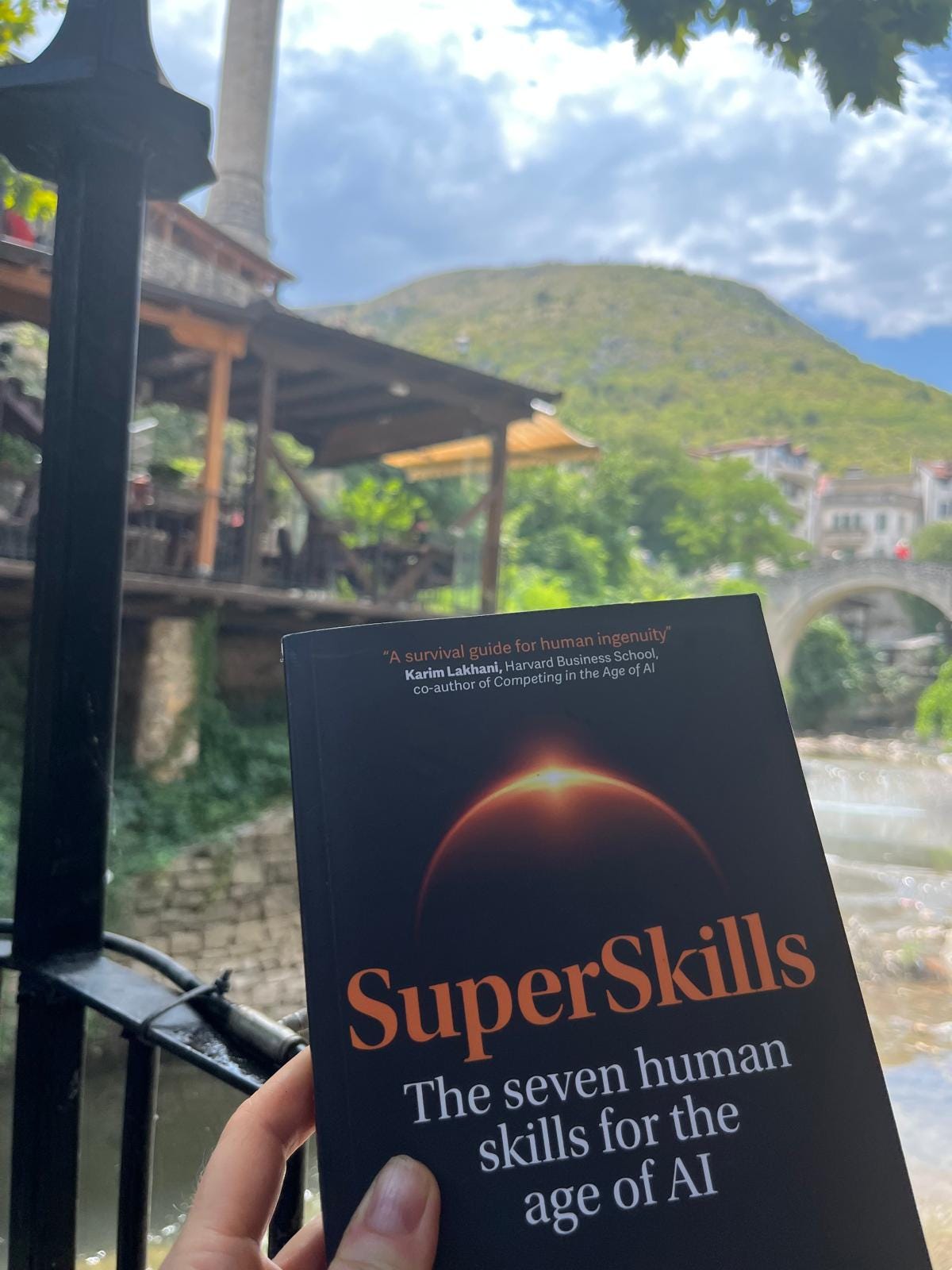
SuperSkills in Bosnia! Send me pictures in weird and wonderful places
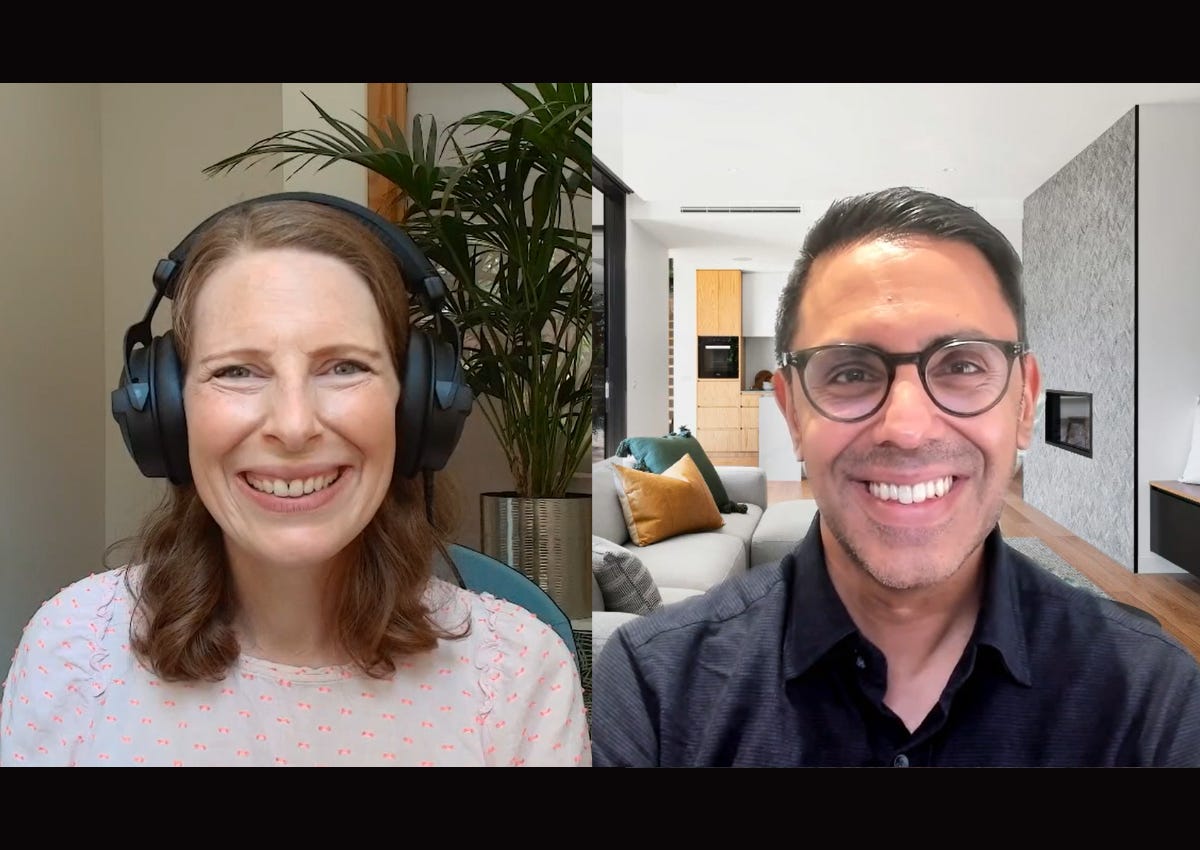
Talking SuperSkills with Victoria Rennoldson on Become a Global Leader.
Required Reading will Return.
If you enjoyed this, forward it to someone who’d find it useful. And if you haven’t yet, order SuperSkills at superskillsbook.com
Comments
Nothing yet. Say the first thing.
Sign in to join the conversation.