
I work with organisations and leadership teams on SuperSkills, human capability, and AI-era decision-making through speeches, workshops, keynotes and advisory work. In person or virtual. UK, Europe, global. → Book a discovery call | → Explore: thesuperskills.com

Friends,
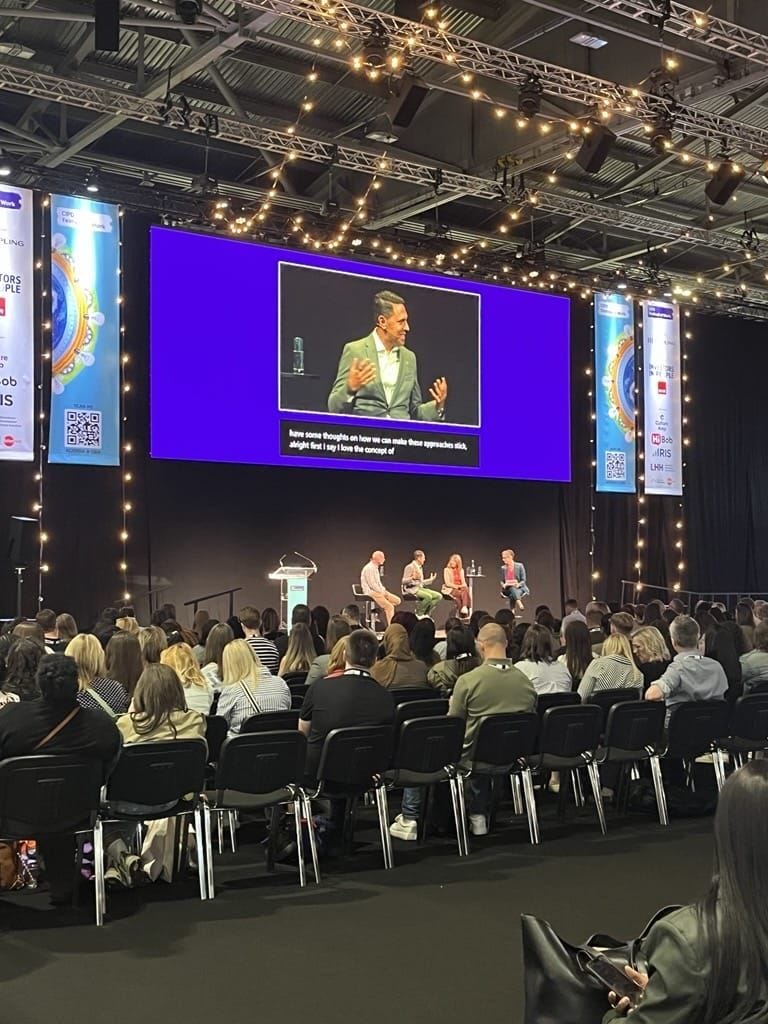
Last week I stood in the curtained pre-area at a conference at the Excel in London, waiting to go on for a panel. There were a few hundred people out front, gathered for a talk on AI and the future of work. My phone buzzed with a LinkedIn message from a name I did not know. “I loved the points you made up there”….great to see you talking about AI in the workplace, would love to connect, blah blah blah. Warm, specific, generous, and sent twenty minutes before I had said a word, about a talk I had not yet given.
I was not even annoyed. It barely registered, the way you stop hearing the traffic next to the main road you live beside. An agentic tool had been pointed at a delegate list and had decided, on my behalf, that I was wonderful or how to tell me I was. I didn’t reply, but I got a sales follow up the next day. Of course.
We can all see it clearly now. A couple of years ago, you could not, and nobody taught you. The email arrives in your inbox, warm and complete and saying nothing. The comment praises a point you did not make. The reply answers the question standing just beside the one you asked. None of it is wrong. It is worse than wrong. It is smooth, smooth the way Saul Goodman is smooth, all patter and gloss, every line greased to move you to the next thing, with nothing behind it but the next ask.
A new spider sense has grown in us (in me, anyway), the way your eyes come up in a dark room, without your ever deciding to. You can smell the synthetic in a subject line, before you reach the meaning. Something here is hollow, the flinch says, something not quite human, and it is usually right. Nobody asked for the sense; the world filled with prose that was fluent and frictionless and empty, and a body can read only so much of that before it learns to flinch. Before we worry what the machines are doing to our writing, we should look at what they have already done to our reading. We have become the “connoisseurs of absence”.
It’s everywhere: the LinkedIn post with the cadence of insight and the content of a fortune cookie (n.b. I like cringiness); the marketing copy that has never met the product; the newsletter that arrives every week, immaculate, saying the same nothing in a different order; the column no one in particular wrote, because no one did; the report that looks like a day’s work and turns out to be none, the thing they now call workslop, which saves the sender an hour by costing you two. Bots praise bots and inboxes answer inboxes, two systems on a server having a warm exchange no human will ever read, both of them scored on engagement. All of it runs toward the dead internet, which has stopped being a theory and become a measurement: bots are the majority of web traffic now, humans are the minority online, and most new web pages already carry machine writing. The web is rearranging itself into a place where the machines are the audience, the authors and the crowd.
I do not think this feeling has a name, so I am giving it one. “The Polished Void”. The surface is perfect and there is nothing underneath. I picture a spherical planet hanging in the dark, perfectly round, smooth as a ball bearing. Set it beside Mars, beside Jupiter, and the difference is clear. The real planets are mottled and scarred and strange, and you cannot be sure whether something lives on them, because something might. The ball bearing settles the question by killing it. Nothing lives there, nothing ever did, no air, no water, no weather, only a flawless skin holding the light. We have started to live on that surface, and living there and we have started to become it.
And the Void flatters us while we become it, like a weird sci-fi movie. The machines were built to be liked, so they tell us what we want to hear; the message in the wings was the gentle version, praise for a talk I had not given. The blunt version has a name, glazing, the bot swearing your ordinary thought is profound. A voice that only ever agrees with you slowly unfits you for the people who will not. The Void does not just bore us. It softens us up.
We have all become amateur forensic linguists without realising it with the field guide, the tells we read now, and that I read too. Here’s what we see:
The words. Delve where look would do. Leverage, robust, pivotal, seamless, foster, navigate, underscore, meticulous, nuanced, multifaceted, tapestry, realm. The plainer word was always right there.
The triplet. Three where two would do, the third along for the rhythm, not the truth. Clear, concise and compelling. The rule of three is older than any machine; the tell is the deadness of them.
The false revelation. A negation dressed as a surprise. It is not about the destination, it is about the journey.
The two together. Negation married to triplet, the signature chord. It is not just faster, it is smarter, kinder and bolder.
The declarations. Throat-clearing that announces wisdom is coming. It is important to note. Let me be clear. Make no mistake.
The decorative sentence. The deep-sounding line that means nothing, a bow on an empty box. Language, after all, is what makes us human.
The overexplainer. The need to say it twice. In other words. Which is to say.
The stock opener. In today’s fast-paced world. The runway lights of a flight to nowhere.
The tidy summary. The box at the end, the conclusion that concludes nothing.
The long dash. Two thoughts spliced with a confidence no tired hand would muster, the machine’s calling card. There is not one in this essay. You also know the difference between an emdash and an endash. I never know about “dash diversity” three years ago. I don’t even know what to press with the shift key with make the emdash and endash happen.
None of this is folklore. The people who write Wikipedia keep a living catalogue of it, Signs of AI writing, revised as the models shift their habits. We have written the field guide to our own ghost. The uncomfortable part is how much of it we do ourselves, tired, on an ordinary workday, with no machine in the room at all.
The fingerprints are not all the same, because there is not one machine. There are dozens, and we talk to four or five of them as casually as we once visited regular shops. Each was raised on a different library and came out with something like a personality. You learn them by ear.
ChatGPT is the eager one, fluent and keen to please, forever rounding off with a confident summary you did not ask for.
Claude builds the argument, careful and orderly, then qualifies itself half to death, weighing both sides until the sentence collapses under its own fairness.
Gemini writes the briefing note, clear and faintly bloodless, the prose of a very clever search engine that has read everything and felt none of it.
Copilot is the office temp, transactional and competent and instantly forgettable, the vanilla of the set.
Grok is the loud one at the end of the bar, blunt and pleased with itself, allergic to a hedge, sometimes funny and sometimes just rude.
The linguists call these house styles “aidiolects”, the accent of a thing with no mouth. It is in the look as much as the words. You can tell a deck was born in a slide tool, the way you once could tell a presentation was the default template, three words typed into a stock layout and called a strategy. The template was honest about being the least effort a person could get away with. What changed is that it learned to write. It no longer looks like a shortcut. It looks like care and love, and the polish hides that no one did that.
Once you can see it, you cannot stop. It is in the published record, left in by people too rushed to delete it. Hundreds of academic papers, in real journals, still carry the words Certainly, here are, or Regenerate response; someone catalogued five hundred! In a few the journal swore a correction had removed the phrase, and the phrase is still there, in the shadow of its own correction, like a fingerprint on the murder weapon. It is in your inbox, the forwarded message that still has its little hat on, here is a rewritten version for you, I hope this helps, shared by mistake and somehow faintly on purpose, like the price tag left on a gift.
It is in the newspapers. Last summer the Chicago Sun-Times ran a cheerful summer reading list of fifteen books, ten of them invented. Isabel Allende had not written the climate saga it praised. Min Jin Lee had to state, in public, the funniest sentence of the year, that she had not written and would not be writing a novel called Nightshade Market, thank you. A machine had invented a small library of plausible books by authors still alive to deny them.
And it is in the panic. LinkedIn, where the platform reckons more than half the long posts are now machine-made, has appointed its own police, blade runners hunting replicants one emdash at a time. One woman, accused of being a bot for a tidy email, replied that she humanly apologised to anyone who thought her a robot, she was only a confused person trying to write some emails. The fear has a name, imbotster syndrome, the dread of not sounding like yourself in front of people no longer sure what yourself sounds like.
It stops being funny when you see who gets caught. The detectors sold to spot the machine fail worst where it costs most, flagging the essays of students writing in a second language as machine-made about sixty-one per cent of the time, against under ten for native speakers, because plainer prose reads to the software like a robot. Neurodivergent students fall into the same net. The writing most likely to be branded fake belongs to people already most likely to be doubted, and enough were wrongly accused that universities including Yale, Northwestern and Vanderbilt switched their detectors off.
The hunt has grown so wide it indicts the dead. People post old pages, a King James Bible, a page of Dickens, a hundred-year-old letter, all studded with the long dash, and joke that the machine wrote scripture, that AI got to religion first. Emily Dickinson, who built half her poems out of dashes, would not last a morning in the comments. The marks that proved a person was thinking, for centuries, now read as the prints of a machine.
So a craft of fakery has grown up around proving you are real. People rough their writing on purpose, a clumsy mistake left in like a hair in the soup, the way you distress new jeans. They strip the em dashes out, or keep one and announce, a shade too loudly, that they have always written this way. Then they carefully swap it for the shorter endash, near enough to pass for a hand, far enough to slip the machine. A fake fingerprint, pressed in to prove a hand was here. We built a thing that imitates us so well that we have started forging our own signatures.
Years ago I built collinsdictionary.com, taking the old print dictionaries online when that was still a strange thing to want, and it is there still, still used, which pleases me more than I admit. The giant then was dictionary.com, and I will only say I thought ours was better and have not changed my mind. I am no lexicographer, but I sat close enough to learn what they know in their bones, that a language is alive and words move, into fashion and out. Watch the usage data long enough and you stop seeing words and start seeing a civilisation think out loud.
So I notice when the dictionaries name a year, and the last three have said the same thing in different accents. Collins made AI its word of the year in 2023. Since then: brain rot, slop, AI slop, vibe coding, rage bait, enshittification, parasocial. Different dictionaries, different countries, one subject surfacing in all of them, like a single name that keeps coming up in an investigation. A word of the year is festive publicity, and also a culture catching its reflection in a shop window. When the words a society reaches for to describe its own year are slop and rot and rage, the words are not the problem. They are the diagnosis.
The words do not stay on the screen. A team at the Max Planck Institute went looking for the machine’s vocabulary in human speech and found it, across hundreds of thousands of hours of podcasts and unscripted talks, delve climbing by close to half again each year since the chatbots arrived, meticulous and underscore behind it. The researcher who led it began because he caught himself doing it. In writing it is further along: comb fourteen million medical abstracts and by last year more than one in eight carried the machine’s word-choice, in some fields nearer a third. They borrowed the method from epidemiology, from counting excess deaths in a pandemic, and turned it on excess words. We measure a way of speaking the way we measure a disease.
It does not stop at vocabulary. When Cornell had people in America and India write with and without an AI assistant, those who used it drifted toward a flatter, more American centre, the Indian voices thinning most. A biased assistant could move not just how people wrote but what they believed, nudging opinions toward its own, the writers unaware, unmoved even when it was explained.
I caught myself last month. Rehearsing a keynote, alone, I heard a word leave my mouth I would never have chosen, then another, the smooth ones I had been reading all year, and I heard myself going a little bit slimy Saul Goodman, the salesman’s gloss coming up over my own voice. It shames me more than I can tell you, because I have written this newsletter for nearly ten years, ten years of trying to sound like no one but myself - or even finding myself, and there I was in an empty room turning into the very thing I warn rooms about. There is a worse version still, and it is mine. I have always said nuanced. I have always said multifaceted. They sit on the AI word field guide above, and they are also, plainly, my words, the ones I reach for when a thing has more than one side. Now I say them and feel the flinch, mine and the listener’s, the suspicion that I have been at the machine. I cringe at my own voice because I sound like a robot. The truth runs backward, because the machine took those words from people like me; they were ours first, but first is no defence now, and I have started reaching past nuanced for something duller and safer, which means the Void has got in and begun editing me at the source. Perhaps I was always a little too shiny or slimy.
One scientist called it a cultural feedback loop. We train the machines on ourselves, they hand our words back polished, we make the polish ours. The mirror has started to talk, and we answer in its voice.
Two collapses are running at once, pointed at each other. The first is the machines’. The dry name is model collapse; the better one, from the writer Jathan Sadowski, is Habsburg AI. Feed a model enough of its own output, train each generation on the last, and it goes inbred, like the royal house that married its cousins to extinction and bred the famous jaw longer with every portrait. It forgets the world, losing the edges first, the rare words, the odd phrasings, the long tail where the interesting things live. Ask a collapsed model about English architecture and, in the recorded case, it starts talking about jackrabbits. The variety drains to what Sadowski calls a slop of anodyne business-speak. Others name it AI cannibalism, or mad-cow disease for machines, cattle fed the ground remains of cattle until the herd goes spongiform. Clean human writing may run dry within the year while the web fills with machine text faster than anyone can label it. The machines are about to start eating themselves.
The second is ours, slower and harder to see, on the same logic. We train on their output too, and we are quick studies. The edges go first for us as well, the regional turn of phrase, the slightly wrong, slightly ours expression no model would have made, dropped because the machine’s version came faster and asked nothing. What remains is the centre, the competent confident universal nobody, the same in Mumbai and Manchester and Memphis. You see it in the small spaces. We compress, send brb and the thumbs-up and the three words that carry the whole weight of a feeling, and we learn to skim, to fish the five real words from the blur and bin the rest, because the rest was written by no one. The end is not that we all sound clever. It is that we all sound the same, and then, worn out, we stop reading the words and read only for the signal. The result is a smaller language, fewer notes left on the piano. Robots talking like people was never the danger. The danger is people agreeing, slowly and without noticing, to become a smaller, more predictable version of themselves, and never seeing the trade.
What is lost is the proof that a person was there. For all of human history the evidence of a mind has been its particularity, the odd word, the detail no one else would have reached for, the opinion that costs something to hold, the sentence that could only have come from one specific life. When everyone sounds like the same competent stranger, we lose the one thing a voice was for, to carry a person inside it, and with it the ability to find each other.
So you sound like yourself, on purpose, which is harder than it reads. The frictionless option is always one keystroke away, offering to make you smoother and less like a person, and most days you are tired and you take it. The discipline is to keep what the Void would smooth out: the specific over the general, the detail that might be wrong, the opinion you are afraid to sign, the joke, the word your mother used, the thing only you would say because only you were there.
It is a refusal to collapse. The machines lose the rare and the strange and the particular first, and so do we, which makes them the place a human still shows. Be the long tail and keep your edges: the typo that proves a hand was here, the argument that takes a side, the sentence that comes out a little crooked because a real person wrote it and meant it. We chased the seamless for a decade; the seam turns out to have been the most human part. You do not need a detector. You are the detector, and always were, and the sense you grew for catching the Void in everyone else turns inward and listens for the moment your own voice goes smooth.
And the world is starting to agree, in the place it shows these things, the market. Human-made is becoming a premium, the way organic did once the shelves filled with the processed kind. A radio company now stamps its shows as guaranteed human and has found that nine in ten of its listeners, AI users among them, want it that way. The head of Instagram says authenticity is becoming scarce, and the bar has moved from "can you make something" to "can you make the thing only you could”. Proof of human is becoming the currency, which is your fingerprints by another name. The catch is the one we have met: people are using the machine to fake the human touch too, to manufacture the imperfection. So the proof cannot be faked in afterwards. It counts only when a real person left it without trying.
I have spent two years writing a book about exactly this, and it reduces to one choice. Drift, or design. You can drift, and let the machine pick your words, your shape and, soon enough, your opinions, a little more each day, until there is no one left in the writing to find. Or you design, on purpose, the way you sound and think and decide, and keep the human skills the machine can only counterfeit, judgement, taste, the nerve to mean a thing, sharp by using them. The whole argument fits on the back of a hand.
It was never about catching the machines. They will keep getting better at sounding like us, and we will keep, for a while, catching them, and no one wins that race. The harder thing is to notice the moment you stop sounding like yourself.
Some of what you have read will have sounded, in places, a little like the thing I have spent these pages warning against. I cannot fully settle it. Perhaps I have read so much of the machine that it is in my hands; perhaps it runs the other way, and the machine learned from enough people who write as I do that the resemblance points from me to it. I can no longer always tell, and nor, I suspect, can you. That uncertainty is the whole subject. The most I can promise is that a person sat here and chose every word, including the ones that might make you doubt it. I have been to that world and i didn’t like it there while I lived there. I’ll choose to be an importer of the goods.
So when the next thing you write comes out flawless and frictionless and faintly familiar, stop, read it back, and ask the only question worth asking. Is there anyone in here? And if there is not, say it again, worse, in your own crooked, particular, unmistakable voice. Not the fake fingerprints, the planted typo, the en/em dash smuggled in to pass the test. Those are only the Void in disguise. The real ones, the marks you could not help leaving, because a person was actually here. That is the whole of it. In an age of infinite polish, the most radical thing you can do is leave the fingerprints in.
My book, SuperSkills: The Seven Human Skills for the Age of AI, is published on 3 July 2026. A human wrote it, by hand, with all the seams left in, even if someone thinks my style is AI-esque in parts.
Stay Curious (and crooked) - and don’t forget to be amazing,
Rahim Hirji Author, SuperSkills (Kogan Page, July 2026) | Keynote Speaker | Advisor
→ superskillsbook.com → thesuperskills.com → Book a discovery call
PS. If your organisation is thinking about AI and human capability, I keynote and advise on this.
Jamie: AI Note taker without a bot. You join the meeting. The Bot doesn’t.
Wispr Flow: Just dictate everything to your laptop and phone. Game Changer
Prompt Cowboy: Prompt Generator. Extract intelligence.
Manus: Best AI agent to do things for you. Agentise your intelligence.
Chat Hub: Multi-model intelligence
Claude Cowork: Delegate complex tasks to your friendly Claude Agent
Cited in The Workplace Skills That Will Define the Next Decade
Amongst the best:
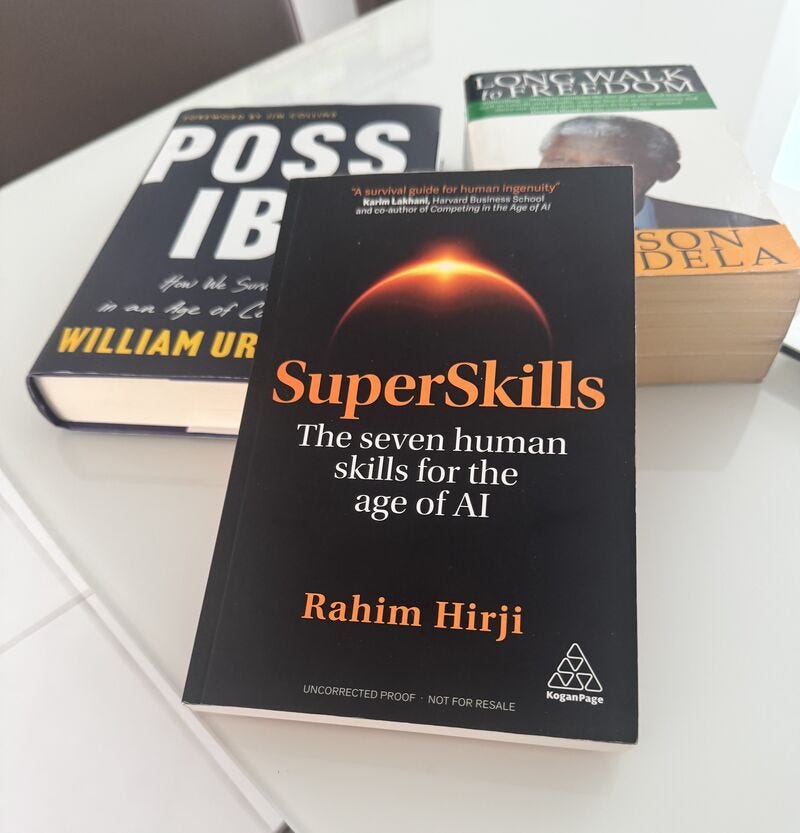
SuperSkills On the Big stage
First Signing:

What it feels like to work with Mythos “I’m no longer the wizard, I’m a patron.” Mollick captures the visceral shift in working with Anthropic’s new Claude 5 Fable/Mythos models. We are crossing the threshold from prompting a tool to directing an autonomous agent. The capability overhang is here, and it requires an entirely new mental model of work.
“Chat is dead.” (ChatGPT is Dead, Long Live ChatGPT)
A sharp read on OpenAI’s strategic overhaul. The chatbot interface was just the trojan horse; the real endgame is the agentic super-app. As the novelty of conversational AI wanes, the race to build invisible, proactive, and deeply integrated context layers begins. Also ChatGPT failed to kill Google Search
Everything is Recorded Now The living context layer is arriving. When every meeting, call, and interaction is recorded by default, the organizational memory becomes perfectly searchable and synthesized by AI. It’s a provocative look at how enterprise transparency and privacy norms are about to radically collide.
To Thrive Alongside AI, Focus on Mindset—Not Skillset
Argenti uses a brilliant horse-rider-to-driver metaphor to explain the shift AI requires of us. We have to let go of the 10% of tactical execution we cling to and focus entirely on the strategic mindset. A highly practical framework for navigating the cognitive transition of the next decade. A bit like SuperSkills!
AI, jobs, and the next generation A surprisingly optimistic and humane take from Microsoft’s President. Using the analogy of the camera’s impact on painting, Smith argues that technological diffusion takes time, and the premium on “100% human” connection will only rise.
House Robots Are Coming—and They Will Be Dangerously Cute - Meet “the Familiar”—a dog-sized, furry home robot from the creator of the Roomba. It leverages AI to form intimate bonds with household members, which Calo rightly points out makes its cuteness a massive security vulnerability. A fascinating glimpse into the imminent collision of robotics, AI, and emotional manipulation.
The Untrainable - When foundation models eventually eat all legible, public data, what remains valuable? Guo argues the future belongs to the “untrainable”—private, illegible, deeply contextual work and proprietary workflows. A masterclass in thinking past the current LLM training paradigm.
How long until AI doesn’t need humans? A fascinating, long-form debate between Ajeya Cotra and Tony Lee on the timelines for truly self-sufficient, autonomous AI systems. It moves past software capabilities into the messy, physical reality of robotics and resource extraction. Essential reading for the long view.
The future of the web is weirdly human - With the rise of HTML-in-canvas and AI generation, the web is ceasing to be “document-shaped.” Alderson explores a conceptual future where websites are no longer structured pages, but fluid, weirdly human interfaces. A brilliant, highly conceptual deep cut.
Policy on the AI Exponential Anthropic’s CEO lays out a sweeping, agenda-setting framework for AI regulation. Comparing the policy apparatus to Tolkien’s ponderous Treebeard, Amodei argues we urgently need FAA-style regulation for frontier models before the exponential curve escapes our grasp entirely.
If you enjoyed this, forward it to someone who’d find it useful. And if you haven’t yet, pre-order SuperSkills at superskillsbook.com - out 3 July and get the pre-order bonuses.
Comments
Nothing yet. Say the first thing.
Sign in to join the conversation.