
So what do nukes and sales have in common?
Simple. The Scientific method.
Here’s how you use the same process used to build nuclear bombs for your sales process
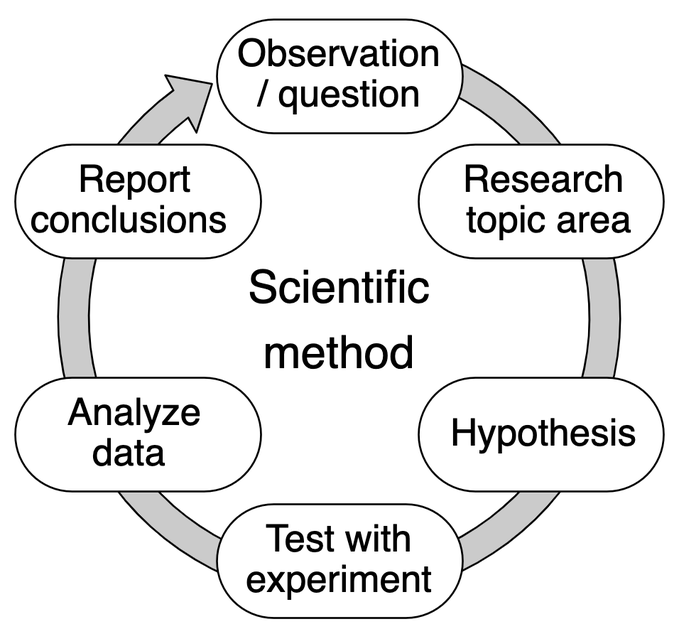
What's the Scientific Method?
The basic process involves making an observation/question, researching the topic, forming a hypothesis, conducting an experiment, and finally analyzing the results.
Observation/question - My cold emails aren’t performing well.
Research - I google "Why aren’t my cold emails performing well?" I come across @BowTiedSalesGuy and he says "Lead with their problems not your solution"
Hypothesis - I think my cold emails aren't performing well because I lead with how I solve their problems instead of leading with the problems they face.
Experiment - I'm going to craft an email and focus on leading with their problems instead of our solutions.
Analyze results - I see out of 200 emails sent saw an increase in reply rates from .5% to 1%. That's the basic gist of the scientific method and how it applies to sales. But that's missing something important; How do you conduct the experiment? That's where treating your experiments like scientific studies comes into play.
In a scientific study, you have dependent, independent & control variables. What's the difference between an independent vs a dependent vs a control variable?
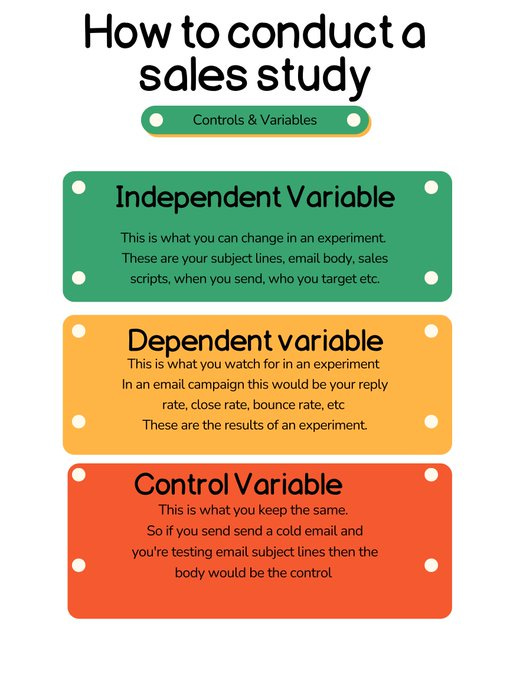
Independent variable = What you're changing
Dependent variable = What you're watching for aka the results
Control variable = What stays the same take this experiment for example:
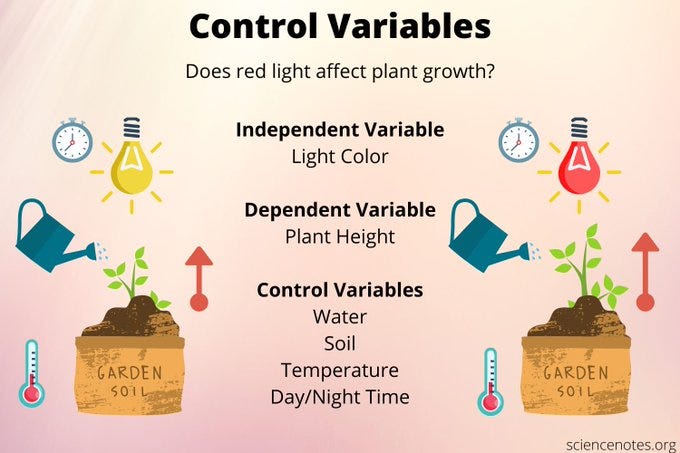
The independent variable we're testing for is > light/kelvin color (fun fact: plants flower around 2000-3000 kelvin and grow leafs/vegetation around 5000-6500 kelvin)
The Dependent variable we're measuring is: > Plant height
And the control variables are: > Water > Soil > Temperature > Day/Night Time
So from this experiment, we can concretely measure the impact light color/kelvin has on plant height.
This is a good experiment. Since we control for everything else we know exactly how light color impacts plant growth. If we added too many independent variables we wouldn't know the impact each variable has on plant growth.
let's get back to sales and our cold email experiment.
Here's what we're using for each variable:
Independent variable = Leading with the problem
Dependent variable = changes in the reply rate
Control variable = everything else.
This includes:
Subject line
introduction
Sending time
Who you send to
Your follow up
Email length
Email address/provider you're sending from
etc
The control is everything that's NOT the independent variable/variables.
Now you can test multiple variables at once. You just have to be smart about it. If you test too many at once you won't know what actually impacts your results.
So if we run the experiment above we'll know exactly how leading with the problem impacts the results.
Now most people don't run sales experiments like this. Most people change 7+ independent variables and never know what's actually impacting the results.
This is a recipe for disaster.
Since you never truly know what's impacting your results then you base your decisions on BAD data. Yes, BAD data.
You're just randomly guessing what works and building your ENTIRE sales strategy on BAD data.
Yes, you can get lucky. But would you rather be lucky or right?
Alright now that we know how to run a study let's dive into let's talk about cold email infrastructure and how it's f*cking up your sales process.

What If told you if you run the EXACT cold email experiment above and change absolutely nothing, it would still produce BAD data, would you believe me? Well, you don't have to. I'll tell you why it's bad.
So there's nothing wrong with the actual experiment. We only test for 1 variable. Great! Actually no. See we have an unknown variable. And if we don't control for it beforehand then the entire experiment will be inaccurate.
That variable is... Deliverability
Yes if we don't control for email deliverability our entire study will be inaccurate.
Why is that? Simple:
If we send our experiment to 500 leads and only 50 get delivered then our sample size is too small to conclusively say if it worked or not. Then it's not a sample size of 500. It's 50.
We need at least 250 for the results to be significant. In order to craft a good experiment we need a large enough sample size otherwise we're extrapolating information that might not be there.
Here's why 50 isn't enough:
Say out of those 50 that 20 of them aren’t working today
10 of them don't work at that company anymore
10 of them didn't check their email
10 of them actually read it.
So in reality you are drawing conclusions from 10 people.
How is that representative of the market/DM as a whole?
But it gets even worse: Say 7 of those people might be having a bad day. Or had someone call them the second they opened the email Or had a meeting in 10 min they had to prep for and wanted to reply to your email but simply forgot because their meeting ran over into another meeting. See what I mean?
There are too many things out of your control to concretely say whether our experiment was a success or not based on that tiny insignificant sample.
Your sh*t Cold Email Infrastructure introduced an extra variable.
That's why I created "Email Espionage" so you could actually know if your email campaigns are working or not. Tighten the feedback loop. Confidently make decisions. Crush your quota. Supercharge your sales career. Make your business EXPLODE. Get your emails seen.
I made it so you don't have to do anything thinking. Just simply follow my videos exactly as I show you. Anyone can do it. Shoot hand it to your VA and they could set it up with 0 instruction from you.
It's easy.
No posts
Comments
Nothing yet. Say the first thing.
Sign in to join the conversation.