
Here’s the truth. I can lay out the whole system and most people still won’t do it. Not because they’re lazy, because they’re missing the lens that makes the steps click. Every touchpoint in sales touches every other touchpoint. It’s a system, not a set of hacks. And systems don’t run in a vacuum, small upstream errors compound downstream. Butterfly effect stuff. Hundreds of hours lost. Qualified buyers missed. Real money left on the table.
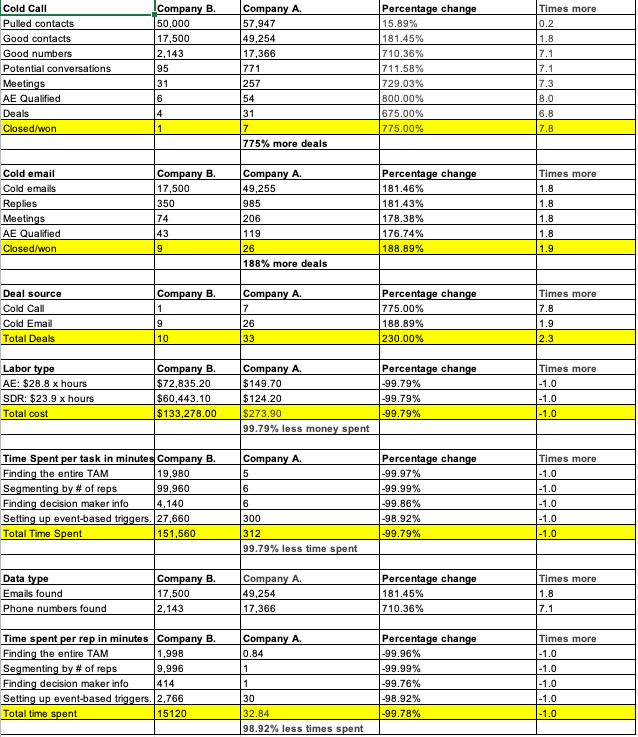
Company A has a solid process, clean handoffs, tight definitions, uses triggers to create timing
Company B converts, but it’s chaos under the hood, generic lists, tool sprawl, ad hoc targeting
Same headcount, same TAM. A outperforms B by a mile because A’s system points reps at the right moments and tells them what to say.
Yes, tools changed since I first wrote about this. But operations didn’t evolve with them. You get a bump from better tools, but users with the same lens apply them the same old way, result, under optimized, free money left sitting.
You’re looking at the numbers, but you’re not looking through them. And that’s a lens problem.

Quick primer no fluff. Your RAS is the brain’s relevance filter. It lives in the brainstem and decides what gets promoted to conscious attention and what gets ignored. You’re bombarded by signals, news, job posts, product updates, LinkedIn changes, CRM fields. The RAS shows you what you told it to care about. Not only what to care about but more importantly blocks out what you are trained not to care about. My RAS is a tuned to efficiency is an optimizations in sales processes. Yours is tuned to making sales handling objections and reaching out to prospects. You aren't necessarily focused on how to be more efficient in your sales process. Or if you are a founder that's reading this your focused on other things like running the business or managing employees etc. Spotting gaps in a sales process is a highly specialized skill set I’ve spent years honing.
If your goal stack is hit 200 sends per day, your RAS will light up on volume opportunities and hide nuanced buying signals
If your goal stack is find today’s 10 percent high probability accounts, your RAS starts surfacing trigger events and why now angles everywhere
Point. You can read the same dashboard as someone else and miss the opportunity sitting in plain sight, because your RAS was primed to look for the wrong thing.
Confirmation bias once you decide this ICP doesn’t buy, your RAS filters for evidence that you’re right. You stop seeing new pockets of demand
Inattentional blindness you stare at dashboards, yet miss that 3 priority accounts just posted a stack change that maps to your wedge
Goal mis priming measure activities, your RAS hunts for easy activities. Measure meetings by trigger, your RAS hunts for triggers
Translation. Without the right definitions and measurements, your biology optimizes for the wrong outcome.
So back to how I run building/optimizing outbound processes. Here’s the secret sauce (excluding my RAS perspective haha)
Collect intake details:
1–2 line company/product summary
ICP basics: industries, size/revenue bands, geos, exclusions
Buying-committee titles
Current tools (CRM, data, sequencing, dialer, LinkedIn)
Top 3 known triggers + why
Approved domains for signals (product, status, careers, press)
Deliverability/compliance notes (warmup, throttles, DKIM/SPF)
Calendar/booking link
Goal: A crisp definition that 90% of target accounts fit; guides list-building and scoring.
Inputs: Intake, past wins/losses, CRM reports (if available).
Steps
Define firmographics (industry, employee band, revenue band, geo, exclusions).
Define technographics (critical tools in/out; blockers).
Define trigger events (growth stage, funding, hiring motion).
Draft negative ICP (who we do NOT pursue + why).
Validate with X (10 or so depends on what data you have an how accurate it is) sample accounts; adjust until ≥9/10 fit.
Acceptance: Signed off by founder/AE/SDR; feeds Buyer Map & Trigger Matrix.
Goal: Multi-threading blueprint: who to contact, in what order, with what angle.
Inputs: ICP Map; list of buying-committee titles.
Steps
Identify roles: Economic buyer, Technical buyer, Champion, Blockers.
Map typical objectives/risks per role (why they care).
Define entry points (title + channel + trigger-aligned opener).
Sequence relationship paths (e.g., Champion → Tech Buyer → EB).
Acceptance: At least 2 viable paths to an DM; each role linked to a trigger-aligned opener.
Goal: Daily list of the 10% of accounts worth working today with ready-to-send angles.
Inputs: ICP & Buyer Map; approved signal domains; tool access.
Data to include: Trigger | Why it matters | Signal source | Automation | First-line angle | Priority (P1/P2/P3) | Owner. Work P1s daily; P2s fill gaps; P3s nurture. Keep per-vertical matrices.
Steps
Brainstorm top triggers (hiring, tool swap, product launch, funding, etc.).
For each trigger, define why it matters now (budget/urgency).
Add signal sources (careers, press, status page, product, LinkedIn, etc.).
Assign automation (manual, semi, or full) + owner. (if possible with tools)
Set priority (P1 must work daily; P2 gap filler; P3 nurture).
Write the first-line angle for each trigger.
Acceptance: Minimum 5 P1 triggers with sources + angles; 10 total triggers across P1–P3.
Goal: Capture → Enrich → Score → Route → Sequence → Track replies/meetings.
Fast-path architecture to mirror: Signals → Clay/Apollo/LinkedIn/Zoominfo/etc → Enrich (firmo/techo/owner) → Score & route to CRM with owner + next action → Sequences run → Replies/meetings tracked to KPI dashboard.
Steps
Capture: connect data pulls/parsers for each Trigger Matrix source.
Enrich: append firmographics/technographics/contact owner.
Score: translate ICP + P1 trigger into a lead score (binary P1 flag + additive points).
Route: push to CRM with owner + next action set; auto-create tasks.
Sequence: enroll with trigger-specific copy; log all touches.
Track: webhook/connector to KPI dashboard for replies & meetings.
Acceptance: A P1 trigger runs end-to-end from capture to booked meeting in a dry run.
Goal: Make improvement visible: meetings set, reply rate, time to first reply, touches/meeting, etc.
Steps
Define metric dictionary (exact formulas + data source for each KPI).
Implement a simple dashboard
Add filters (rep, trigger, sequence, vertical).
Create daily “P1 queue” view (today’s high-probability accounts).
Set weekly review: pattern analysis by trigger (which P1s convert?).
Acceptance: Live dashboard fed by sequences + CRM; weekly insight summary produced.
Goal: Make it run without you; enable founder roll-out later if they want org-wide adoption.
SOPs (one-pagers):
Daily P1 workflow (pull → personalize → send → log)
Adding a new trigger to the Matrix (fields, sources, angle, priority, owner)
Fixes: deliverability checklist; sequence QA; CRM routing issues
Weekly KPI review + action plan loop
Looms:
“How to work your P1s”
“Update the Trigger Matrix”
“Routing & tasks in the CRM”
“Reading the KPI dashboard”
Acceptance: All SOPs + Looms linked in one hub; new SDR can ramp in one day.
And that’s the high level of how I run engagements.
If you want to run an engagement with me just reach out to me via Twitter or email at Bowtiedsystems@gmail.com (if this gets spam i’ll remove my email)
Fair warning though I'm gonna be launching a new offer this weekend (hint its related to this article) and that's gonna be taking up a significant amount of my time so if you wanna get in reach out to me ASAP and you can put down a deposit to lock in some time.
Oh and if you haven’t already just buy my courses… You know you should do it. Just make the jump. And tell you what anyone that buys one of my courses will get 25% off future consulting as a favor for supporting me all these years. It’s only for people that buy the courses from this email/substack tho.
Use these links:
Linkedin sales navigator course: Click Here
Zoominfo course: Click here
Then if you buy both I have a special deal for you on my upcoming offer. But I’ll share that when its time.
Best of luck future presidents club members,
BTS
No posts
Comments
Nothing yet. Say the first thing.
Sign in to join the conversation.