
Hello Avatar! Welcome to another week of biotech analysis. Today’s commentary, as always on Thursday, focuses on the general market update. This week confirmed the playbook. Biotech can rally and capital can return quickly, but funding is flowing to companies with clean catalysts and tight execution. Secondaries continue to dominate the financing landscape, while IPO activity remains scarce. Investors are rewarding near-term proof and punishing duration risk. In this environment, cost of capital shapes trial design, and clock discipline matters as much as mechanism.
We are now publishing 7x per week according to the following cadence:
Mondays: Stocks
Tuesdays: Biotech
Wednesdays: Podcast
Thursdays: Markets
Fridays: News
Saturdays: Podcast
Sundays: Strategy
We are also publishing unique content on X - be sure to follow up if you are not already @BowTiedBiotech. And to check-out the archive of our work on X you can find it on our website at: BowtiedBiotech.subtack.com/x-articles.
SUBSCRIBE TO PODCAST HERE:
Please help spread the work by subscribing and hitting the share button if you are enjoying content!
Lots to cover this week, let's get started!

Macro Update
The macro backdrop has become relevant for biotech again for all the wrong reasons. Disruption around the Strait of Hormuz has pushed energy prices higher and revived concerns that inflation could prove stickier than markets were pricing only a few months ago. The direct impact of higher oil on most development-stage biotech companies is minimal. The indirect impact is not. If another energy shock keeps inflation elevated, it reduces the Fed’s ability to ease aggressively and keeps the risk-free rate high enough to remain a credible alternative to speculative equities.
That matters because pre-revenue biotech is effectively a long-duration asset class. The majority of value sits years in the future, behind multiple clinical readouts, regulatory decisions and usually at least one additional financing. Higher rates reduce the present value of those future cash flows, but the more important issue is the funding environment. When investors can earn attractive yields in cash and Treasuries, they have less incentive to underwrite binary clinical risk in companies that may still be several years away from generating revenue.

The pressure is most obvious at the weaker end of the sector. Companies with 12-24 months of runway, mediocre data and no obvious partnering leverage are still dependent on public markets being receptive when they eventually need capital. If rates stay elevated, those financings get harder, discounts widen and dilution becomes more punitive. A $300 million biotech burning $100 million per year can look adequately funded on paper, but one failed catalyst or delayed trial can quickly turn a manageable runway into a financing problem if the capital window closes.
This does not mean biotech cannot work in a higher-rate environment. Strong clinical data will still get funded and genuinely differentiated assets can still command strategic interest. It does mean the market is likely to remain less forgiving of weak balance sheets, marginal programs and stories that require investors to look five years out. The macro risk is therefore less about oil itself and more about whether another inflation shock keeps the cost of capital elevated long enough to expose the companies that were already relying on easier money to survive.
Introduction
This week, biotech financing deserves more attention than the usual cash runway check. Private capital is moving deeper into therapeutic development, funding individual programs and taking direct claims on future drug sales. That changes which assets reach Phase 3, how long companies can stay independent and what dilution really looks like. A share count can stay flat while a meaningful piece of the drug gets sold away. The overlooked signal sits inside the financing terms themselves. When a specialist group commits hundreds of millions after scientific diligence, that does not prove the drug works. It does show where sophisticated capital thinks the risk has fallen enough to price.
Biotech found another buyer
Something unusual happened in biotech while everyone watched obesity drugs, China licensing and the reopening of the IPO market.
A new class of drug developer got much bigger. It does not run discovery labs. It does not employ sales reps. In many cases it never owns the molecule. Yet it increasingly decides which Phase 3 programs receive hundreds of millions of dollars and which ones sit on the shelf. The names are familiar. Royalty Pharma. Blackstone Life Sciences. Hercules. Sagard. What changed is the size of the checks and how early these firms now enter the development process.
On August 12, 2026, Royalty Pharma agreed to provide Zealand Pharma $100 million in exchange for Zealand’s economics tied to rusfertide. A few months earlier, Blackstone committed up to $1.3 billion around Apogee Therapeutics and zumilokibart. That structure included up to $800 million through a synthetic royalty plus access to as much as $500 million of senior debt. Blackstone called it the largest royalty financing for a program that had not yet entered Phase 3.
This deserves more attention than it gets. Private capital has moved from financing biotech companies to financing individual therapeutic outcomes. That sounds like a small distinction. It changes a lot.
The molecule is becoming collateral
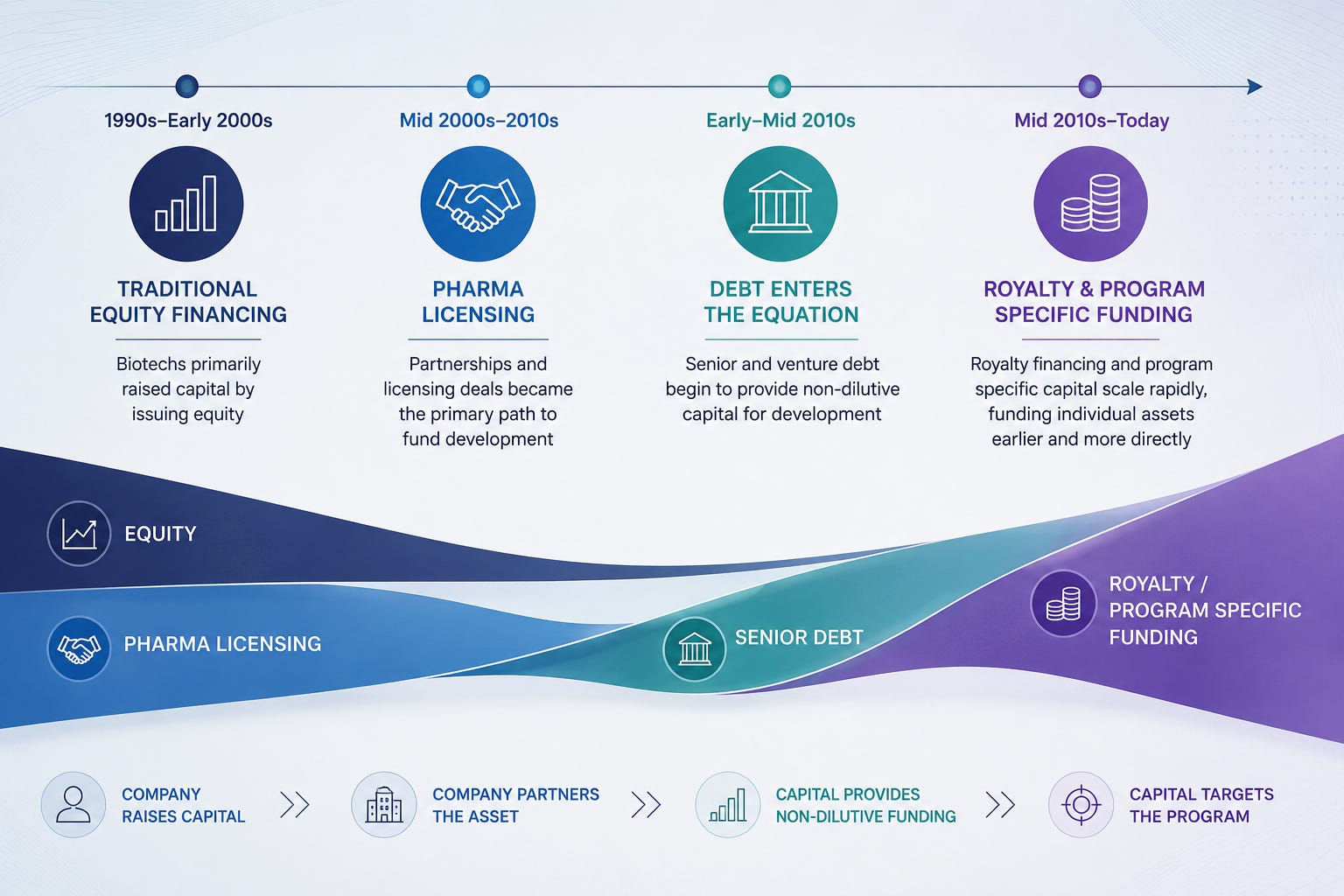
For most of biotech history, a development stage company had a fairly limited menu. Sell stock. Partner the asset. Sell the company. Occasionally add venture debt around the edges.
Those choices had obvious consequences. Equity diluted shareholders. A pharma partnership surrendered part of the economics and often part of the control. Debt was dangerous because a molecule with no revenue does not look like traditional collateral. A failed Phase 3 trial cannot be repossessed and sold like an apartment building.
That logic is changing because specialized capital providers learned how to underwrite the drug rather than the company. They model probability of approval, competitive positioning, intellectual property and future sales. Then they build a financial claim around those variables. Royalty Pharma provided Revolution Medicines with a financing package worth up to $2 billion in 2025. Up to $1.25 billion came through a synthetic royalty on daraxonrasib. Another $750 million came through senior secured debt. Royalty Pharma later described structures like this as an alternative to partnering the drug with large pharma.
That last point is where this becomes a therapeutic development story. A biotech with a good Phase 2 asset no longer has to choose between issuing a lot of equity and handing the program to Merck or Roche. A third option now exists. Keep the molecule. Keep development control. Sell part of the future cash flow to somebody with a very large balance sheet.
Private capital is becoming a translational filter
Scientists tend to think about translation as a biological problem. Does the target matter in humans. Does drug exposure reach the right tissue. Does the biomarker move. Does that change clinical outcomes.
Capital allocation sits one layer above those questions. A program can have interesting biology and still die because nobody wants to fund the next $400 million of development. That happens more often than biotech likes to admit.
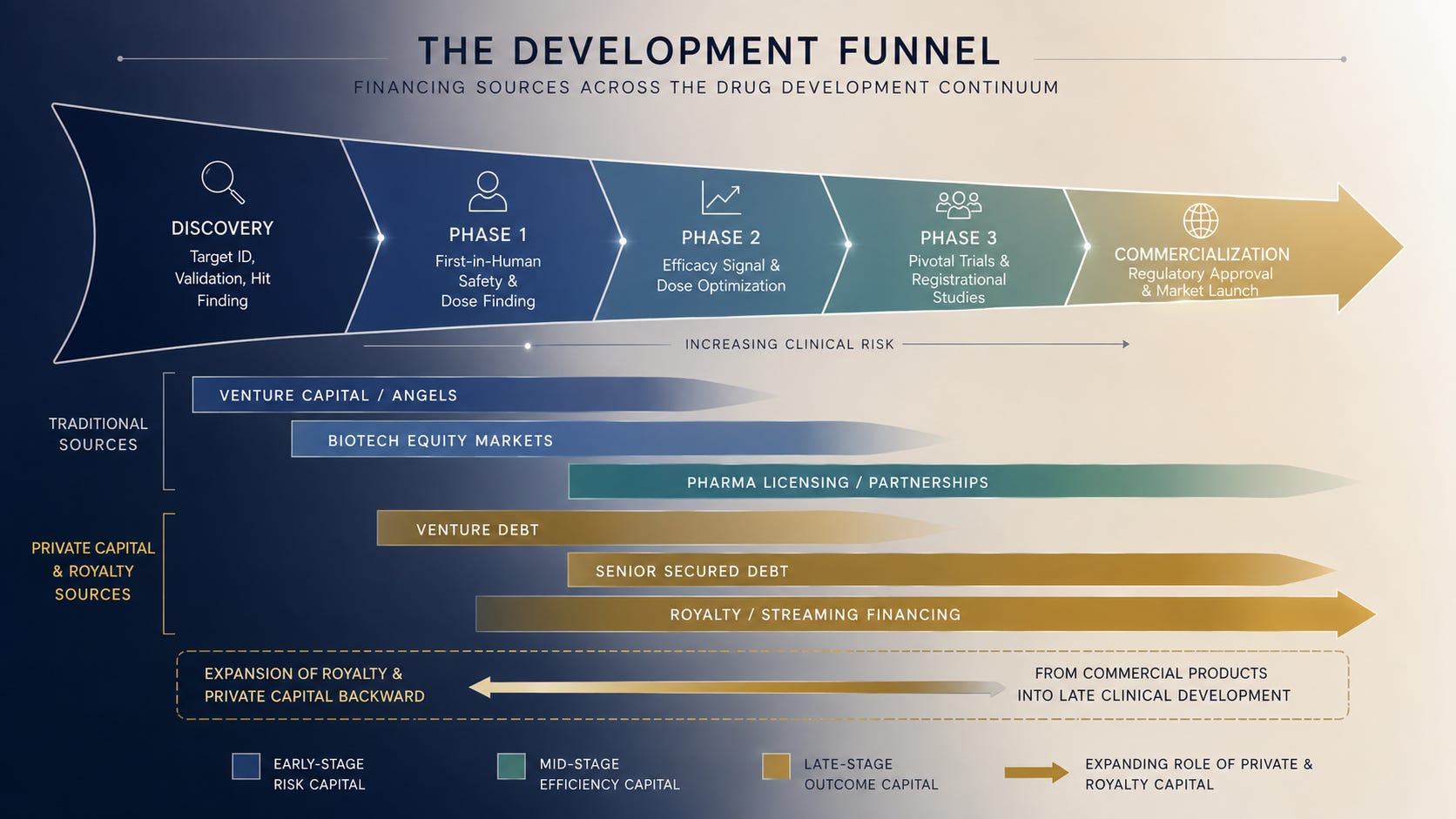
Private capital changes the filter. Blackstone says its life sciences business designs, funds and executes clinical trials, generally around late stage products. The firm closed a $6.3 billion life sciences fund in March 2026, almost 40 percent larger than its predecessor. This is no longer spare capital looking for yield. There is enough dedicated money to influence what reaches Phase 3.
Think about the incentive this creates. A traditional biotech equity investor can buy a basket of companies and tolerate enormous variance. A specialized lender or royalty investor wants something different. It wants an asset with enough scientific de risking to model the downside, enough commercial upside to generate a return, and enough contractual protection to avoid paying for every failure along the way. That pushes capital toward a particular kind of therapeutic.
The drug increasingly needs to be scientifically interesting and financially underwritable.
Watch what gets funded
The best way to understand this market is to ignore what the lenders say and check what they actually buy.
Apogee is a useful example. Blackstone agreed to provide up to $800 million through a synthetic royalty tied to zumilokibart. The first $400 million of preapproval capital arrives through milestones. Apogee received $100 million at signing. Another $100 million depends on completion of Phase 3 enrollment. Another $200 million depends on positive Phase 3 data. Up to another $400 million becomes available following FDA approval. In return, Blackstone receives low to mid single digit royalties for 15 years on worldwide annual sales, with the royalty declining as sales rise and disappearing on annual sales above $8 billion.
That structure tells you what Blackstone cares about. It does not write an $800 million check on day one and hope the biology works. Capital unlocks as uncertainty disappears. Enrollment proves execution. Phase 3 data prove clinical value. Approval removes regulatory risk. Each step converts a speculative asset into something closer to a cash flowing security.
Royalty Pharma used the same basic logic with Teva. It committed $75 million toward a Phase 2b trial of the anti IL 15 antibody TEV 408 in vitiligo. If the Phase 2b data support further development, Royalty Pharma has the option to put another $425 million into the Phase 3 program. The financing therefore behaves almost like a giant option contract written on translational success.
That is the first idea I think investors are underestimating. The capital structure now contains information about the drug.
Financing terms are another clinical readout
Biotech investors spend hours interpreting hazard ratios and Kaplan Meier curves. Then a company announces a $300 million financing and everyone reads the headline.
That leaves information on the table.
Look at who controls the next tranche. Look at what milestone unlocks it. Look at whether the draw is mandatory or optional. Look at what happens after weak data. A financing agreement negotiated by a group that employs physicians, scientists and specialized healthcare investors represents another underwriting decision. It does not prove the drug works. Lenders get things wrong too. But when sophisticated capital accepts product specific risk at scale, the structure tells you what type of uncertainty the lender believes remains.
The opposite matters more. A company can advertise a $500 million facility when only $50 million is actually available today. The remaining $450 million can sit behind clinical milestones, approval requirements or investment committee discretion. Investors then quote the headline number when calculating runway. That is sloppy. Undrawn capital that disappears after bad data is not runway. It is a conditional reward for success.
This gives you a simple addition to biotech diligence. Treat financing milestones like secondary endpoints. Read them.
The phrase non dilutive needs a warning label
Companies love calling these transactions non dilutive.
Technically, they are right. A royalty financing does not necessarily increase the share count. Your ownership percentage stays the same.
Your ownership of the drug economics does not.
Apogee agreed to pay Blackstone a low to mid single digit royalty for 15 years on worldwide zumilokibart sales in exchange for up to $800 million of synthetic royalty funding. Take a simple assumption. Use a 4 percent royalty and assume the drug eventually generates $4 billion of annual sales. That implies $160 million of annual royalty payments before considering the actual tiered structure. Five years at that level equals $800 million of payments. Ten years equals $1.6 billion. Those numbers are undiscounted and deliberately crude. The point is not to estimate Blackstone’s return. The point is that avoiding share dilution does not make capital free.
The same issue appears after approval. Nuvation Bio received $150 million from Sagard after FDA approval of IBTROZI. Sagard receives 5.5 percent of annual U.S. net sales up to $600 million and 3 percent between $600 million and $1 billion. Nuvation keeps sales above $1 billion. The payment obligation stops after Sagard reaches specified return thresholds ranging from 1.6 times the original investment through mid 2031 to 2 times later in the agreement. Nuvation also gave Sagard security interests tied to U.S. receivables and relevant intellectual property.
That looks very different from issuing common stock. It is also not free money.
The hidden dilution happens inside the asset
Equity investors usually calculate dilution with the share count. Therapeutic investors increasingly need another calculation.
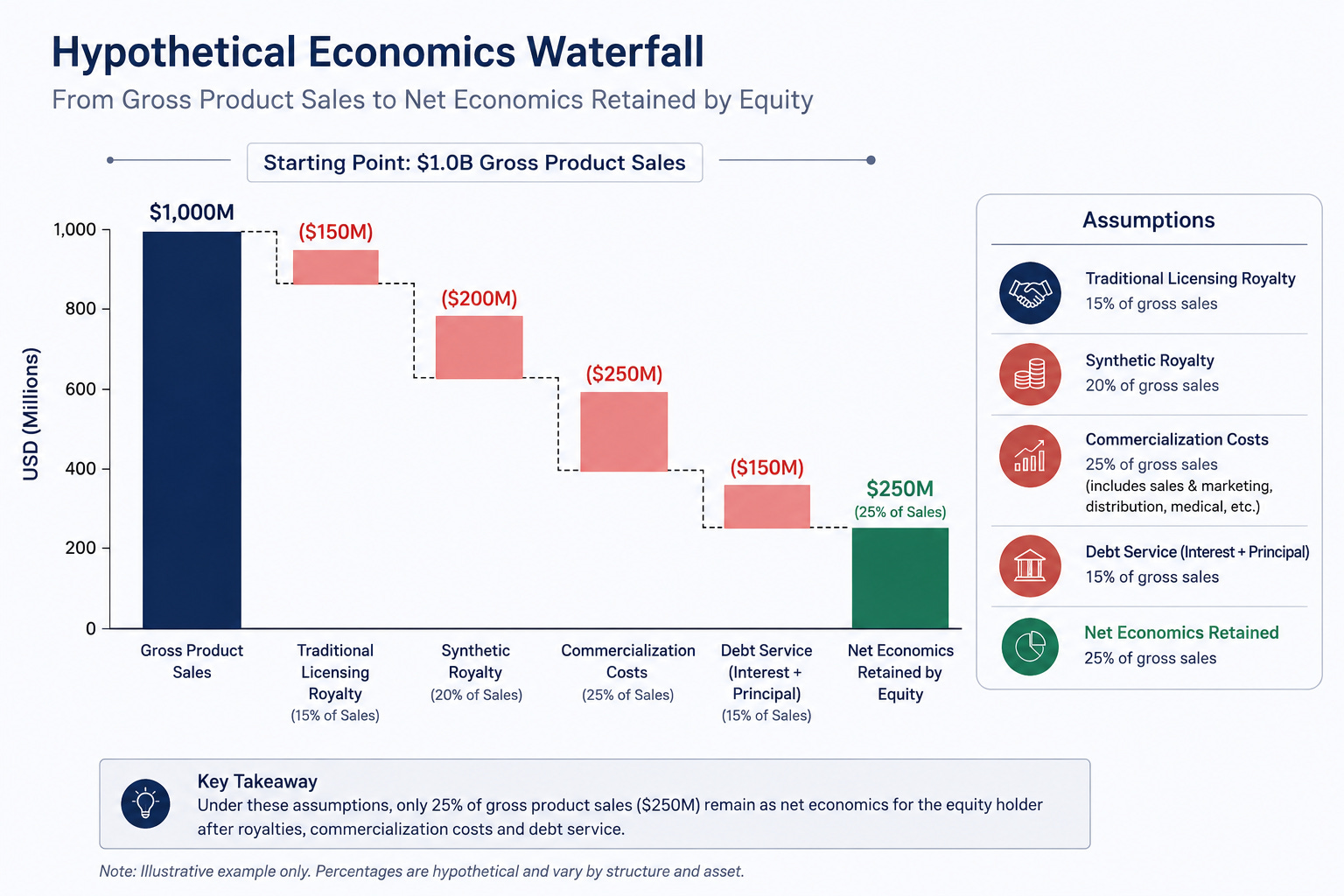
Start with the drug’s future operating economics. Subtract royalties owed to licensors. Subtract commercial milestones. Subtract synthetic royalties. Then account for senior debt and any mandatory repayment claims. What remains belongs to equity.
That sounds obvious. In practice, biotech valuation models often stop halfway through the exercise. Investors model peak sales, apply a revenue multiple, subtract ordinary debt and call the remainder equity value. That approach gets progressively worse as the financing stack becomes more complicated.
Nuvation shows why. During the first quarter of 2026, the carrying value of its Sagard revenue interest liability increased from approximately $155.4 million to $159.8 million. Nuvation made $864,000 of payments during the quarter, but recorded roughly $5.1 million of noncash interest expense plus issuance cost amortization. The liability grew even while the company paid it down because accounting reflects the expected economics of the future royalty stream.
Read that again. The company received $150 million. The liability later sat above $159 million after payments had already started.
That is financial dilution hiding outside the share count.
This changes which drugs look financeable
Here is the part scientists should care about.
Private capital does not treat every therapeutic modality equally. The ideal asset for this market has a legible path from clinical data to revenue. That means clear endpoints. Strong intellectual property. A commercial market large enough to support royalties. A development program where risk falls sharply after a known event.
A drug with a clean Phase 2 signal in a large immunology indication fits that model well. So does a targeted oncology program where molecular selection creates a defined patient group and response data appear early. Apogee and Revolution Medicines make sense through that lens. A private investor can construct a probability tree around enrollment, clinical data, approval and commercial uptake.
Now consider a platform company working on a novel delivery technology where manufacturing remains uncertain, biomarkers are poorly validated and the first meaningful efficacy endpoint sits four years away. There is far less to underwrite. The capital provider has to absorb biology risk and duration risk at the same time. That asset remains much more dependent on equity or a strategic partner.
This creates a financing premium for translational legibility. We usually discuss biomarkers and clean endpoints as ways to improve probability of technical success. They increasingly improve access to capital too.
Trial design starts to affect the balance sheet
This is where the feedback loop gets interesting.
If milestone based funding becomes a larger source of development capital, trial design gains a second customer. The first customer remains the regulator. The second becomes the capital provider.
A trial that produces a decisive intermediate event has more financing value than one that leaves the main uncertainty unresolved for three years. A validated surrogate endpoint now has financial utility on top of clinical utility. So does rapid enrollment. So does a population enriched by a predictive biomarker. Each one creates a point where a lender or royalty investor can reassess risk and release another tranche.
You can see the mechanism directly in Apogee’s financing. Funding attaches to Phase 3 enrollment, positive data and approval. Royalty Pharma’s Teva agreement first funds Phase 2b, then gives Royalty Pharma an option on the Phase 3 program after seeing the results. These contracts convert clinical milestones into capital formation events.
I expect development teams to start thinking about this earlier. Not because scientists suddenly work for lenders. Because a development plan that creates clean de risking points gets financed more efficiently.
The first indication now carries financing value
This has another implication that gets less attention.
Companies often debate which indication to develop first based on probability of success, speed and market size. Private capital adds another variable. Which indication creates the best financing bridge into the rest of the pipeline.
Imagine the same molecule works in two diseases. Disease A has a modest market but a short trial and an objective endpoint. Disease B has a much larger commercial opportunity but requires a long trial with noisy clinical outcomes.
Historically, management may choose Disease A to establish proof of concept, then raise equity to fund Disease B. Under the emerging model, success in Disease A can do more. It can make the future cash flows of the molecule financeable. The company can then sell a small piece of those economics and fund Disease B without issuing as much stock.
That turns indication sequencing into capital strategy.
The first indication becomes a financing asset.
This favors molecules with multiple shots on goal
A multi indication therapeutic has always carried option value. Private capital makes that option easier to monetize before all of it is proven.
The reason is simple. A lender does not necessarily need every indication to work. It needs enough aggregate future economics to support the investment. A molecule with one validated indication and several credible expansion opportunities creates a larger pool of potential cash flows than a single use asset.
That helps explain why large immunology programs fit these structures so well. Once a mechanism works in one autoimmune disease, developers can test adjacent indications. The first successful program reduces uncertainty around safety, dosing, manufacturing and commercial infrastructure. The later programs become incremental bets rather than completely new businesses.
But investors need to be careful here. The same logic that makes the molecule financeable can transfer a lot of upside away from equity. A low single digit royalty sounds harmless when you model one indication. Apply it across several large indications for 15 years and the check gets much larger.
The better the drug becomes, the more expensive some forms of non dilutive financing become.
Pharma now has competition before the acquisition
This may be the biggest strategic shift.
Historically, one of large pharma’s structural advantages was its balance sheet. A biotech could discover a good molecule but eventually face a wall. Phase 3 trials cost money. Manufacturing costs money. Commercial launches cost even more. Pharma could solve the funding problem in exchange for economics or control.
Specialized private capital weakens that advantage.
Royalty Pharma has openly framed late stage funding as an alternative to a large pharma partnership. Revolution Medicines provides the clearest example. The company secured up to $2 billion while retaining the ability to continue developing and commercializing daraxonrasib itself.
That changes the negotiating table. A biotech that needs money has poor leverage. A biotech with $1 billion of committed program financing can tell pharma to pay more or leave.
This creates a strange outcome. More private credit can make biotech less financially dependent while making successful assets more expensive for pharma to acquire.
Expect pharma to move earlier
If late stage assets gain access to billions of dollars outside traditional pharma partnerships, buyers lose one of their best negotiating tools.
That pushes acquisition pressure earlier in development.
A pharma company evaluating a strong Phase 2 asset now has to think about what happens if it waits. The biotech can complete Phase 3 using private capital, preserve ownership and arrive after approval with much more negotiating leverage. The buyer then pays for substantially less clinical risk and substantially more enterprise value.
The obvious response is to buy earlier when uncertainty remains high but the financing alternatives have not yet fully opened.
I expect this to widen the gap between two types of biotech M&A. Some buyers will move earlier and accept more development risk. Others will wait for approval and pay much more for certainty. The comfortable middle where pharma waits until Phase 2, funds Phase 3 through a partnership and captures a large fraction of the upside gets harder when another capital provider offers the biotech a competing check without asking for control.
That is good for strong assets. Weak assets do not get the same luxury.
Capital becomes another form of peer review
There is a provocative way to think about all of this.
Biotech already has several layers of validation. Academic peer review evaluates the science. Regulators evaluate the evidence. Public investors price expectations. Pharma business development teams conduct strategic diligence.
Specialized life sciences capital is becoming another layer.
Blackstone says its life sciences team includes more than 20 physicians or PhDs and reports an 86 percent Phase 3 success rate across its stated life sciences track record as of June 30, 2026. Those figures come from Blackstone and deserve the usual skepticism around self reported portfolio statistics. Still, the staffing model matters. These firms are building scientific underwriting teams because therapeutic risk cannot be assessed from a credit spreadsheet alone.
That creates something the market has not fully learned how to use yet. Financing counterparties themselves become signals.
A generic bank lending against corporate cash is not telling you much about a molecule. A specialist committing several hundred million dollars against product specific economics after scientific diligence is telling you more.
Do not confuse that with validation. Treat it as another data point.
The lender learns every time somebody else fails
There is another advantage here that is easy to miss.
A biotech management team sees its own program in extraordinary detail. A specialized capital provider sees dozens of programs across companies, modalities and therapeutic areas.
That creates a cross sectional information advantage.
A royalty investor evaluating an autoimmune program can compare assumptions on trial duration, launch curves, competitive response and pricing across many transactions. It sees which management teams miss timelines. It sees which commercial forecasts break after launch. It sees how often apparent best in class profiles survive contact with Phase 3.
Over time, that dataset has value beyond lending.
This is where I think the industry goes next. The best private capital platforms stop looking like lenders and start looking like distributed pharmaceutical companies without internal discovery. They outsource the invention to biotech, avoid owning most operating infrastructure, then deploy capital when enough biological uncertainty has disappeared.
They own financial claims instead of compounds.
That model has a bias
There is a downside.
Capital markets optimize for return. Translational medicine does not always cooperate.
Some therapeutics generate enormous social value but poor financial characteristics. Small populations can work when pricing is high and development is compact. Other programs require long follow up, expensive manufacturing or difficult clinical endpoints. Preventive medicines can require large trials before the economic return becomes visible.
Those assets remain harder to finance through product level private capital.
This means more specialized funding does not automatically mean more innovation. It means more funding for innovation that fits the underwriting model.
That distinction matters.
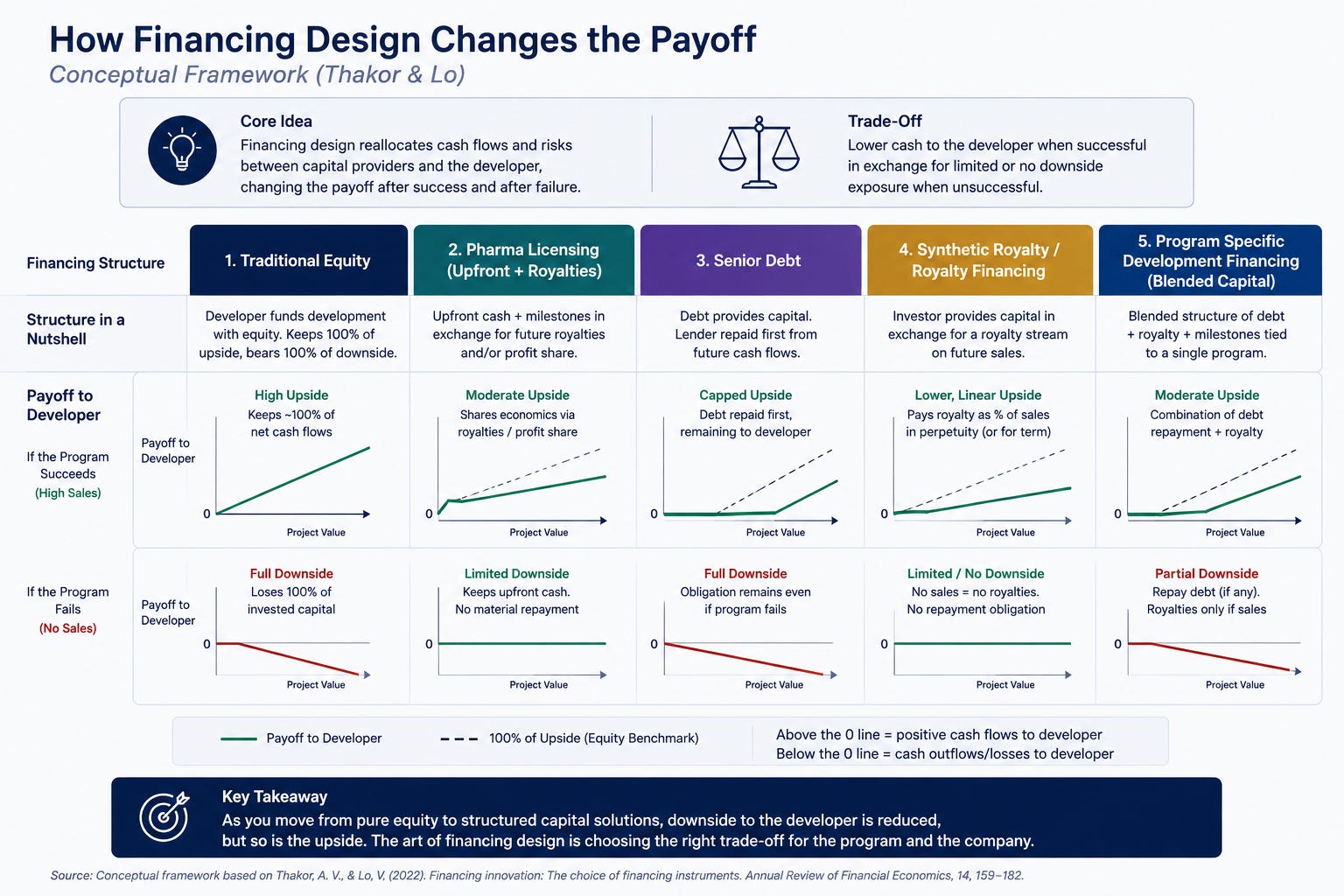
The 2024 work by Richard Thakor and Andrew Lo on financing design for drug development makes the broader point. Traditional equity financing can produce underinvestment in R&D, while alternative payoff structures can change incentives and reduce some of that underinvestment. Financial structure therefore affects what research gets pursued rather than merely determining who owns the company afterward.
Private capital is creating a new sorting mechanism
Private capital is starting to separate biotech into two groups. Strong late stage assets gain another source of funding and more negotiating leverage. The weak middle gets squeezed. The catch is that this capital comes with structure. Debt sits ahead of equity. Royalties carve away future product economics. Covenants restrict flexibility. Milestone based facilities often disappear when a program misses. That means investors need to stop treating headline cash and facility size as runway. Usable runway is what remains after covenants, interest, fixed payments and conditional tranches are stripped out. The same applies to valuation. Two companies can own similar drugs and produce very different returns for shareholders depending on how much of the future revenue stream has already been sold. A positive Phase 2 readout now does more than raise probability of approval. It can unlock hundreds of millions of dollars of lower dilution capital. Weak data do the opposite. They reduce clinical value and financing capacity at the same time.
The drug itself is becoming financeable
I think this pushes biotech toward program level financing where investors increasingly fund Drug A rather than Company A. Royalty backed notes, synthetic royalties and asset specific development facilities already let companies separate one therapeutic cash flow from the rest of the pipeline. Over time, the largest life sciences capital platforms start to look less like lenders and more like synthetic pharma companies. They will employ scientists to select programs, fund them once enough biological risk has disappeared and own contractual pieces of the upside without running discovery themselves. That gives good biotechs more power to stay independent and forces pharma to compete earlier for the best assets. For public investors, it also raises the bar. You need to understand the molecule, then read the financing contract closely enough to know how much of that molecule you actually own. Sometimes biology fails first. Increasingly, the balance sheet can decide what survives long before that happens.
Thank you for reading BowTiedBiotech. Help us grow our community & earn FREE subscription to BowtiedBiotech - sharing is caring!
CONCLUSION
Today, the bigger opportunity is to treat financing as part of the therapeutic readout. A strong Phase 2 result can increase value twice by raising the odds of approval and opening access to cheaper capital that preserves control. Weak data can do the reverse by hurting the asset and closing the financing window at the same time. That creates a feedback loop most biotech models still miss. The next generation of life sciences capital firms will look less like lenders and more like synthetic pharma companies, choosing which programs deserve funding once enough risk has cleared and then owning part of the upside. For investors and scientists, the practical takeaway is simple. Check the financing agreement with the same care you check the trial design. The contract increasingly tells you which assets can survive long enough to matter.
We are now publishing 7x per week according to the following cadence:
Mondays: Stocks
Tuesdays: Biotech
Wednesdays: Podcast
Thursdays: Markets
Fridays: News
Saturdays: Podcast
Sundays: Strategy
SUBSCRIBE TO PODCAST HERE:
Sundays and Mondays are under the paid umbrella, everything else is FREE. It is $11.99/month and we encourage you to support our efforts. It keeps us motivated to keep producing the hybrid science and business biotech focused content you will not find anywhere else all in the same place.
As a reminder, if looking to go deeper into the topics we cover check out our website BowTiedBiotech.com, or DM us on twitter, or email us: bowtiedbiotech@gmail.com
ABOUT BOWTIEDBIOTECH
As a reminder, the purpose of the BowTiedBiotech substack is two-fold. Primarily, we aim to provide our scientist audience the tools to build a biotech company and ultimately translate their ideas into medicines for patients. Secondarily, biotech investors may find this substack useful as we will be providing weekly market updates of the public AND private markets as well as heavily leveraging current financing events as teaching examples.
DISCLAIMER
None of this is to be deemed legal or financial advice of any kind. All updates are sourced from publicly available disclosures. Insights are *opinions* written by an anonymous cartoon/scientist/investor.
Comments
Nothing yet. Say the first thing.
Sign in to join the conversation.