
Hello Avatar! Welcome to another week of biotech analysis. Today’s commentary, as always on Thursday, focuses on the general market update. This week confirmed the playbook. Biotech can rally and capital can return quickly, but funding is flowing to companies with clean catalysts and tight execution. Secondaries continue to dominate the financing landscape, while IPO activity remains scarce. Investors are rewarding near-term proof and punishing duration risk. In this environment, cost of capital shapes trial design, and clock discipline matters as much as mechanism.
We are now publishing 7x per week according to the following cadence:
Mondays: Stocks
Tuesdays: Biotech
Wednesdays: Podcast
Thursdays: Markets
Fridays: News
Saturdays: Podcast
Sundays: Strategy
We are also publishing unique content on X - be sure to follow up if you are not already @BowTiedBiotech. And to check-out the archive of our work on X you can find it on our website at: BowtiedBiotech.subtack.com/x-articles.
SUBSCRIBE TO PODCAST HERE:
Please help spread the work by subscribing and hitting the share button if you are enjoying content!
Lots to cover this week, let's get started!

Macro Update
The latest macro problem is the renewed energy shock from the Middle East. Disruptions through the Strait of Hormuz, a route responsible for roughly one-fifth of global oil consumption, have tightened supply and forced the market to rely on spare production, weaker demand and inventory drawdowns. Those buffers are not unlimited, and even a negotiated reopening would not immediately normalize shipping, insurance or physical flows.
The larger issue is inflation. Higher energy prices feed directly into headline inflation and indirectly into transportation, manufacturing and consumer costs, reducing the likelihood of aggressive Federal Reserve cuts. If inflation remains elevated, the market has to price fewer cuts, a longer period of restrictive policy or even renewed tightening. That keeps Treasury yields and the cost of capital higher than speculative investors would prefer.

This matters for biotech because pre-revenue drug developers are long-duration assets. Most of their theoretical value sits in uncertain cash flows that may not arrive for five, seven or ten years, making those companies particularly sensitive to higher discount rates. The transmission mechanism is straightforward: oil disruption leads to higher inflation, higher inflation keeps rates elevated, and higher rates compress biotech valuations while making equity financings more punitive.
The practical distinction is balance sheet quality. A company with several years of cash and a credible near-term catalyst can survive a weak financing environment. A company with twelve months of runway, an expensive clinical program and no partnering leverage may be forced to raise into weakness. In that situation, the question is not only whether the drug works, but how much of the company existing shareholders will still own by the time the answer arrives.
Introduction
This week, we look at Europe’s drought through a lens most biotech investors ignore. Low river levels on the Rhine and Danube do more than raise shipping costs. They constrain chemical deliveries, cooling water, power generation, and the validated manufacturing systems that turn molecules into finished drugs. The risk sits several layers below the headline, which is why it remains underpriced.
The river is part of the factory
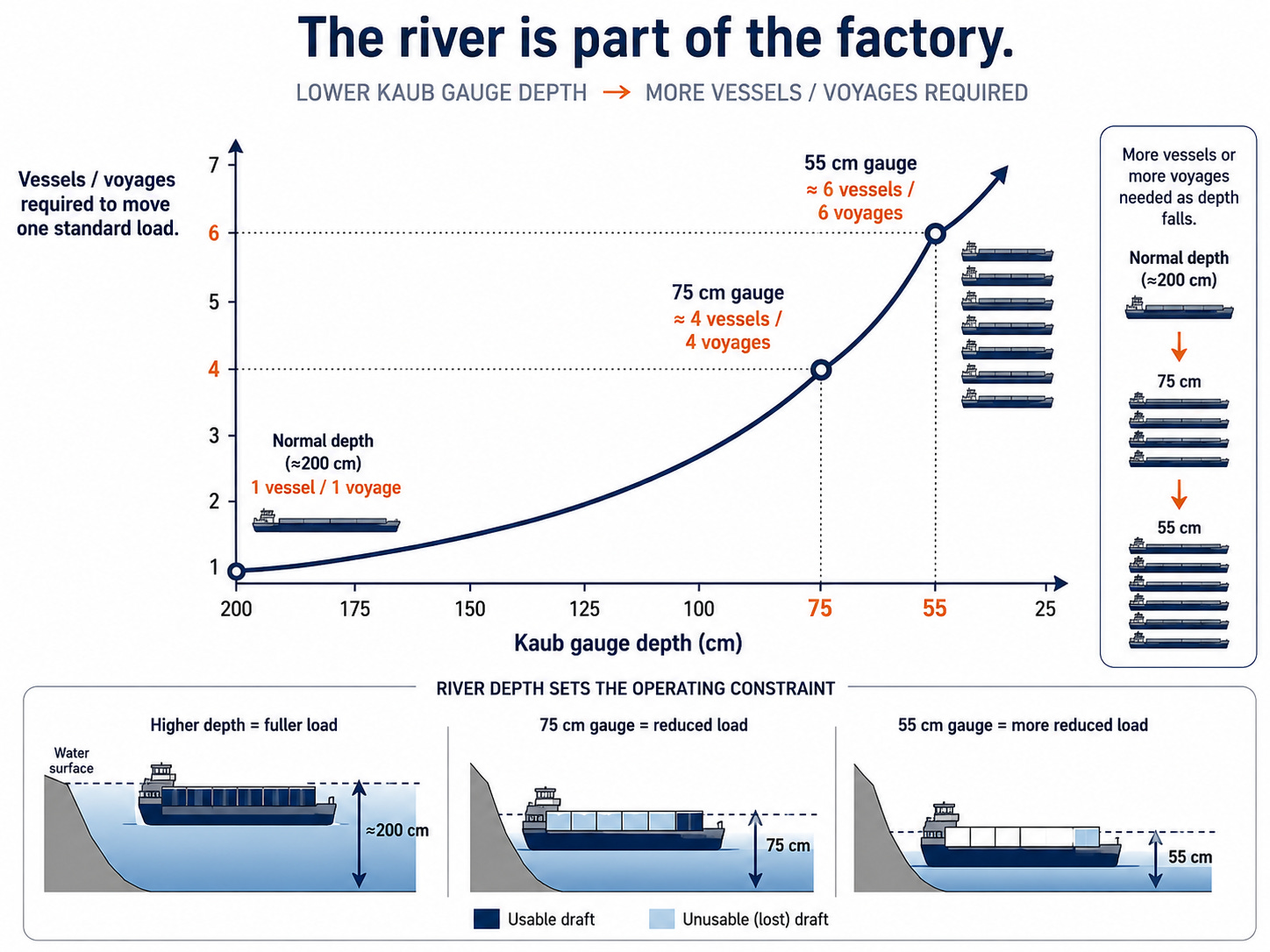
Europe’s drought looks like a shipping story until a drug plant misses a delivery. Then it becomes a manufacturing story. The Rhine and Danube connect ports, chemical clusters, refineries, power stations, and industrial plants across the continent. Barges move fuels, solvents, acids, gases, and bulk materials that do not fit neatly into the glossy version of pharmaceutical development. These inputs sit several layers below the finished vial. Lose one and the entire production schedule can stop.
Low water does not close a river in one clean step. It reduces the weight each vessel can carry. A route can remain technically open while its economics collapse. The Central Commission for the Navigation of the Rhine reports that a standard container vessel operating at a Kaub gauge depth of 75 centimeters loses about 75 percent of its loading capacity. Four vessels or four voyages then replace one normal movement. At 55 centimeters, six can be required. That is not a modest freight surcharge. It changes whether material arrives at all.
Pharma investors rarely model this layer. They model trial enrollment, regulatory timing, launch curves, and peak sales. Manufacturing risk usually appears as a vague paragraph near the back of a filing. That treatment made sense when water and transport capacity looked stable. It makes less sense now. The Danube Commission said in April 2026 that low water and hydrological volatility are actively reshaping shipping operations. The wording matters. Officials no longer describe this as an occasional disruption. They describe a new operating condition.
A drug can fail before the active ingredient enters the building
Biotech tends to think of manufacturing as the conversion of biological insight into a vial, syringe, or tablet. Real manufacturing starts further upstream. A plant needs process chemicals, cleaning agents, filters, resins, single use assemblies, glass, gases, packaging, and spare parts. It also needs energy and water. Many of those dependencies sit with suppliers that management does not directly control.
A manufacturer can carry extra active ingredient inventory. Carrying every upstream input is harder. Some materials have limited shelf lives. Some require hazardous storage. Others come from qualified suppliers that cannot be replaced without technical work and regulatory documentation. A late shipment of a low value material can therefore strand a high value batch. The financial asymmetry is ugly. A cheap missing component can delay millions of euros of product.
This is the first point most investors miss. Drought risk does not scale with the purchase price of the disrupted material. It scales with the value of the production step that material blocks. The relevant question is not how much a solvent or filter costs. Ask how much product cannot be released without it.
Pharma uses the river twice
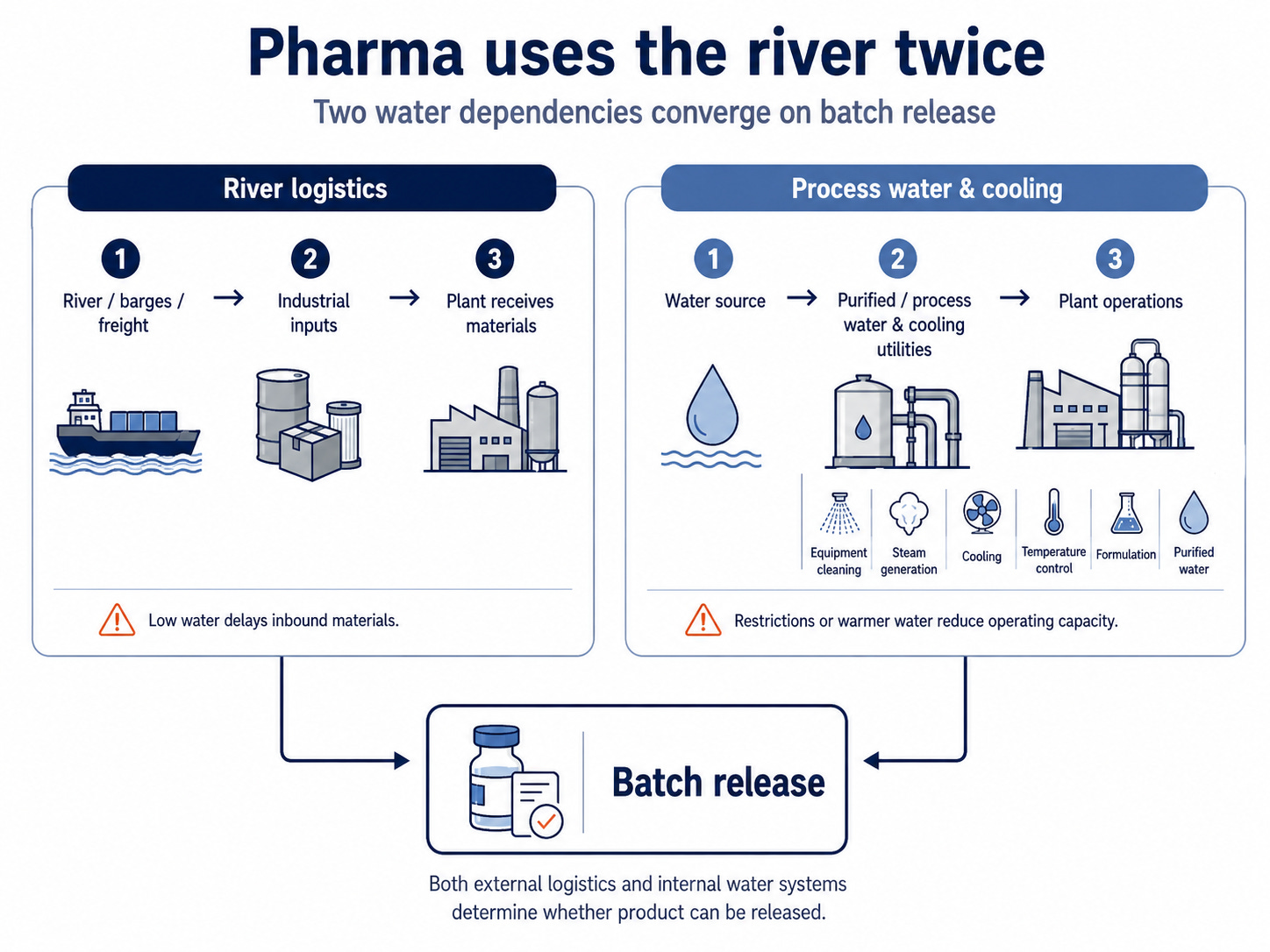
The industry depends on water in two separate systems. Rivers move freight. Water also enters the plant as an operating resource.
Drug manufacturing requires water for equipment cleaning, steam generation, cooling, temperature control, formulation, and production of purified water. The exact intensity varies by modality and site. Small molecule synthesis carries one profile. Sterile filling carries another. Biologics plants need extensive cleaning and controlled water systems. Cell culture facilities depend on stable utilities even when water does not remain in the final product.
These systems fail differently. A barge disruption delays inputs. A local water restriction limits operations inside the fence. Heat can also raise the temperature of available water and reduce cooling efficiency. The plant then faces a double hit. Less water arrives, and the remaining water performs less useful cooling work. Investors who model water as a utility expense miss the real exposure. Water acts more like permitted production capacity.
The dangerous plants are the integrated ones
Large integrated sites often look resilient because they produce several intermediates, share utilities, and move material internally. BASF describes Ludwigshafen as the world’s largest integrated chemical complex, with production, energy flows, and logistics linked across roughly ten square kilometers. That integration creates efficiency during normal operation. It also creates correlated failure when a common utility or logistics route tightens.
A highly integrated site behaves like a biological pathway with one essential enzyme. The system can route around small problems. It cannot route around a shared bottleneck. If river deliveries slow, energy supply tightens, or cooling capacity falls, several production chains feel the stress together. The resulting disruption can move downstream into excipients, reagents, pharmaceutical intermediates, and specialty chemicals.
This does not mean integrated sites are bad assets. They can prioritize critical production, shift material between units, and justify expensive resilience investments. Smaller plants often lack those options. The point is narrower. Integration hides concentration. Investors see dozens of production units. The river sees one customer.
Low water creates nonlinear costs
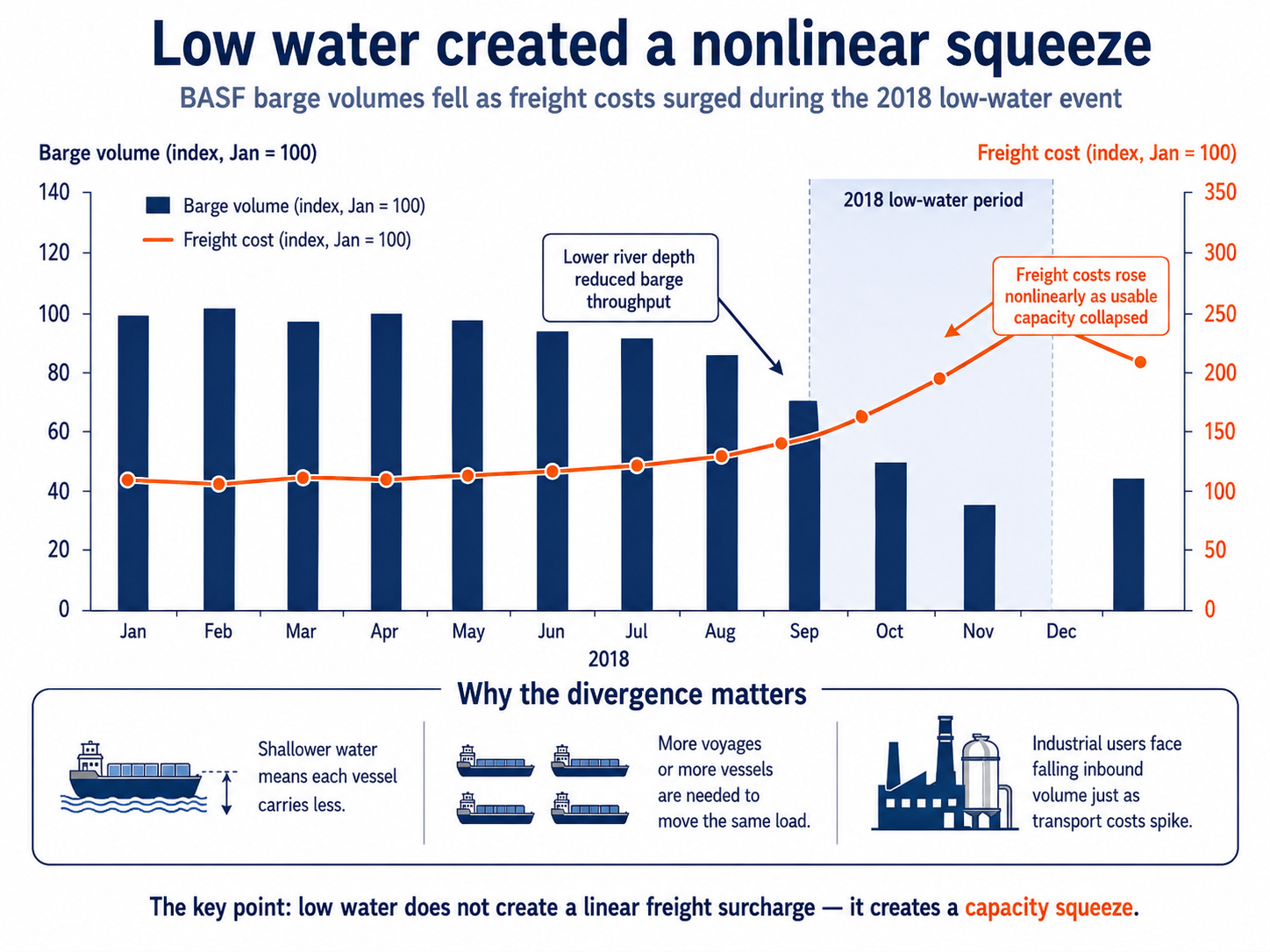
The mistake is to treat drought as a linear freight inflation problem. River depth falls by 20 percent, so freight cost rises by 20 percent. That is not how the system behaves.
Vessels lose loading capacity as draft restrictions tighten. More voyages become necessary. Suitable shallow draft vessels become scarce. Insurance and handling costs rise. Material shifts to rail or road, where capacity may already be committed. Ports accumulate inventory because outgoing transport cannot match incoming volumes. The CCNR notes that freight rates during low water can reach several times normal levels and that industrial users can face production losses when continuous processes have to slow or restart.
The most important effect occurs near the threshold where another shipment no longer fits. A plant can absorb a 10 percent freight increase. It cannot absorb a missing raw material during a validated campaign. Drought therefore creates step changes in risk. Everything looks fine until the production plan suddenly does not work.
Continuous manufacturing has a hidden weakness
Investors often treat continuous manufacturing as an answer to supply chain fragility. It can improve process control, reduce equipment footprint, and lower inventory between steps. Those advantages remain real. The weakness appears when upstream delivery becomes unreliable.
A continuous process depends on continuous input. It runs best when feedstocks, utilities, and downstream handling remain stable. A batch plant can sometimes pause between campaigns. A continuous chemical operation may incur significant cost when operators slow, stop, clean, and restart the system. The CCNR specifically identifies energy use and financial losses associated with changing output at continuous chemical and steel operations during low water.
This creates a design problem for pharmaceutical manufacturing. Leaner inventories improve working capital. They also reduce the buffer between logistics volatility and production downtime. The industry spent years removing slack. Climate volatility now gives that slack an option value.
The first opportunity sits in inventory intelligence
The obvious response is to hold more stock. That is expensive and often crude. The better response is to identify which materials deserve stock.
A useful resilience platform would map every production input by river dependence, supplier concentration, qualification time, storage constraints, and cost of failure. Most enterprise systems can show purchase orders. They do not calculate the therapeutic value at risk if a particular input arrives ten days late. That requires process knowledge, quality knowledge, and logistics data in one model.
The output should not be another dashboard. It should change buying behavior. A manufacturer should know which twenty materials justify six months of inventory and which two hundred can remain lean. It should know when low river forecasts require early orders. It should know when to reserve rail capacity before every industrial shipper reaches the same conclusion.
This sounds like supply chain software. The defensible version is closer to a digital twin of the validated manufacturing process. The model connects a missing input to specific batches, release dates, patient demand, and regulatory consequences. That is far harder to replace.
Weather forecasting becomes manufacturing control
Drug companies treat weather as an external event. They should treat it as an upstream process variable.
River levels can be monitored and forecast. So can precipitation, snowpack, soil moisture, water temperature, and power demand. A manufacturer that links these signals to procurement and production scheduling gains time. Time matters because emergency transport is expensive and sometimes unavailable.
The most useful prediction is not whether the Rhine will run low. Management needs to know when a specific plant loses enough inbound capacity to threaten a campaign. That requires local gauge data, vessel characteristics, contracted freight capacity, supplier location, and inventory on hand. A generic drought alert does little. A production specific risk score can trigger action.
The investor insight follows. The winning climate resilience company may not sell water equipment. It may sell decision time.
Water treatment becomes strategic infrastructure
Pharmaceutical water systems already operate under strict quality requirements. Companies produce purified water and water for injection through controlled treatment, storage, and distribution systems. Drought adds another objective. Plants must reduce withdrawal and increase reuse without compromising quality.
That is harder than installing a recycling unit. Water can carry chemical residues, microorganisms, cleaning agents, and active pharmaceutical ingredients. Reuse requires treatment matched to the intended application. Water recovered for cooling faces one standard. Water used in an early cleaning stage faces another. Water entering a critical process faces much tighter controls.
EFPIA guidance already treats manufacturing wastewater as a site specific risk problem. Manufacturers set discharge targets, control losses during cleaning and transfer, and add treatment when risk remains. The guidance shows why a simple reuse narrative fails. A plant cannot circulate every water stream back into production. It needs separation, monitoring, and validated treatment.
This creates room for companies that combine membranes, oxidation, sensors, and process validation. The hardware alone will commoditize. The valuable layer proves that reused water remains fit for a defined manufacturing purpose.
The best water technology may remove cleaning
A large share of pharmaceutical water demand comes from cleaning and changeover rather than the drug itself. That points toward a less obvious solution. Reduce the number of surfaces that need cleaning.
Single use bioreactors, disposable flow paths, closed transfer systems, and modular equipment can cut cleaning demand. They also create plastic waste, supplier dependence, and disposal costs. Nothing comes free. Still, in a water constrained region, the trade changes.
The next generation of manufacturing equipment should disclose water avoided per batch alongside yield and cycle time. A platform that cuts cleaning water by 40 percent but adds modest consumable cost can become valuable where withdrawal permits constrain expansion. The equipment sale then links directly to production capacity.
This is where therapeutic development decisions start to change. A company selecting a process today usually optimizes for yield, quality, cost, and speed. Water intensity will join that list. A process that looks slightly more expensive in a spreadsheet can become the only process that receives a permit or operates through a drought.
Modality choice will acquire a water price
Biotech investors treat modality as a question of biology and market fit. Manufacturing burden enters later. That sequence will become less comfortable.
A complex biologic, viral vector, or cell therapy can require more controlled space, cleaning, cooling, and utility support than a stable oral small molecule. Comparisons remain case specific. A poorly designed small molecule route can consume large quantities of solvent and water. A modern biologics plant can recover water efficiently. Still, the broad point holds. Modality determines the type of infrastructure a company must secure.
This will not cause developers to abandon a superior therapy because it uses more water. It will affect where the asset gets manufactured, how early process development starts, and which partner becomes credible. Two therapies with similar clinical profiles can carry very different infrastructure risk.
Investors should begin asking a blunt question. How many liters of qualified water does one commercial dose require. Most management teams will not know. That ignorance will age badly.
Process chemistry becomes an investable climate technology
Small molecule manufacturing often carries the largest opportunity for route redesign. Fewer synthetic steps mean fewer reactions, fewer separations, less cleaning, and less solvent recovery. Higher concentration reactions reduce vessel volume. Catalysis can replace stoichiometric reagents. Crystallization can sometimes eliminate chromatography.
Process chemists have always worked on these problems. Drought changes who cares. A 20 percent reduction in water use once looked like an environmental improvement. It can now determine whether a site expands.
This creates value in tools that improve route selection before a company locks the commercial process. Automated experimentation, reaction modeling, and continuous analytical systems can screen for routes with lower water and solvent demand. The useful metric is not environmental virtue. It is liters per gram of released active ingredient under a validated process.
The skepticism matters. Many green chemistry claims come from laboratory conditions that do not survive scale up. Investors should check whether the water calculation includes cleaning, workup, failed batches, and treatment. A process that saves water in the reactor but doubles purification demand did not solve the problem.
Biologics manufacturing will favor closed systems
Biologics plants need controlled environments because contamination can destroy a batch. Closed processing reduces exposure and can shrink the burden on surrounding cleanrooms. Smaller classified areas need less air handling, cooling, and cleaning.
This gives closed systems a second economic argument. Companies already buy them for contamination control and operational flexibility. Water and energy constraints increase the return. A modular closed line can also move more easily between sites than a large fixed facility.
The long term result should be more distributed manufacturing. Not fully local production of every drug. That sounds good in policy speeches and fails basic economics. The more plausible model uses several regional sites capable of running standardized processes. A drought then removes part of the network rather than the whole network.
The difficult part is regulatory comparability. Each additional site creates transfer work, validation, inspections, and ongoing quality oversight. The manufacturing platform that makes site replication boring will gain value. Boring is good here.
Existing capacity gains a drought premium .
The market often values contract manufacturers on utilization, backlog, and technical capability. Water security deserves a line in the model.
An existing facility with secure water rights, robust treatment, storage, several logistics routes, and proven drought procedures owns infrastructure that a new entrant cannot quickly reproduce. The moat does not appear in patents. It sits in permits, utility connections, qualified equipment, and local relationships.
Brownfield sites therefore gain relative value. A sponsor can build a shiny new plant, but it still needs power, water, discharge capacity, staff, and transport. The European Commission estimates a large annual investment gap for pollution control and water protection infrastructure across the European Union. Public funding is increasing, but capital alone does not remove permitting and construction time.
This does not mean every old plant deserves a premium. Old infrastructure can leak, waste water, and require expensive upgrades. Investors need site level diligence. The key is to distinguish legacy capacity from resilient capacity.
Resilient Capacity Becomes the Moat
Existing facilities with secure water rights, treatment capacity, storage, alternate transport routes, and qualified equipment will gain value. That advantage does not sit in a patent. It sits in permits, utility connections, site history, and the ability to keep running when newer plants cannot.
CDMOs with resilient infrastructure will charge more. Sponsors will pay because cheap capacity that fails during a pivotal campaign is not cheap. The same logic applies to suppliers. A qualified second source, an accepted alternate route, or a process that uses less water can become more valuable than another marginal improvement in headline yield.
The Opportunity Moves Into Process Design
The investable opportunity extends across manufacturing technology, logistics, and process development. Closed systems, lower water cleaning methods, better treatment, and real time monitoring can increase usable capacity without forcing a plant rebuild. Specialized logistics providers can also prequalify alternate routes for regulated materials before a drought hits.
Process chemists and biologics teams can redesign routes, formulations, and unit operations to reduce cleaning, cooling, and transport burden. The strongest products will not sell sustainability language. They will show more released drug per unit of constrained water and prove that performance under validated conditions.
Investors Need to Map Hidden Concentration
Investors should ask where the active ingredient, critical intermediates, and finished dose are made. They should ask how much critical inventory exists, which inputs depend on river transport, and who receives priority when capacity tightens. Country level diversification means little when several suppliers rely on the same river, chemical cluster, or utility system.
Single asset biotech companies face the greatest risk because one delayed batch can move a filing, force a financing, or break the catalyst timeline. Over time, water intensity will enter site selection, CDMO contracts, process development, and valuation. The market still treats water as a utility expense. It is becoming a production constraint.
Thank you for reading BowTiedBiotech. Help us grow our community & earn FREE subscription to BowtiedBiotech - sharing is caring!
CONCLUSION
Today, water still appears in most biotech models as a minor utility expense. That will change. As droughts become more frequent and industrial systems lose spare capacity, secure water access, alternate logistics, and resilient manufacturing infrastructure will shape which companies can deliver on time. The winners will treat water as production capacity. The losers will discover the bottleneck after the batch is already late.
We are now publishing 7x per week according to the following cadence:
Mondays: Stocks
Tuesdays: Biotech
Wednesdays: Podcast
Thursdays: Markets
Fridays: News
Saturdays: Podcast
Sundays: Strategy
SUBSCRIBE TO PODCAST HERE:
Sundays and Mondays are under the paid umbrella, everything else is FREE. It is $11.99/month and we encourage you to support our efforts. It keeps us motivated to keep producing the hybrid science and business biotech focused content you will not find anywhere else all in the same place.
As a reminder, if looking to go deeper into the topics we cover check out our website BowTiedBiotech.com, or DM us on twitter, or email us: bowtiedbiotech@gmail.com
ABOUT BOWTIEDBIOTECH
As a reminder, the purpose of the BowTiedBiotech substack is two-fold. Primarily, we aim to provide our scientist audience the tools to build a biotech company and ultimately translate their ideas into medicines for patients. Secondarily, biotech investors may find this substack useful as we will be providing weekly market updates of the public AND private markets as well as heavily leveraging current financing events as teaching examples.
DISCLAIMER
None of this is to be deemed legal or financial advice of any kind. All updates are sourced from publicly available disclosures. Insights are *opinions* written by an anonymous cartoon/scientist/investor.
Comments
Nothing yet. Say the first thing.
Sign in to join the conversation.