
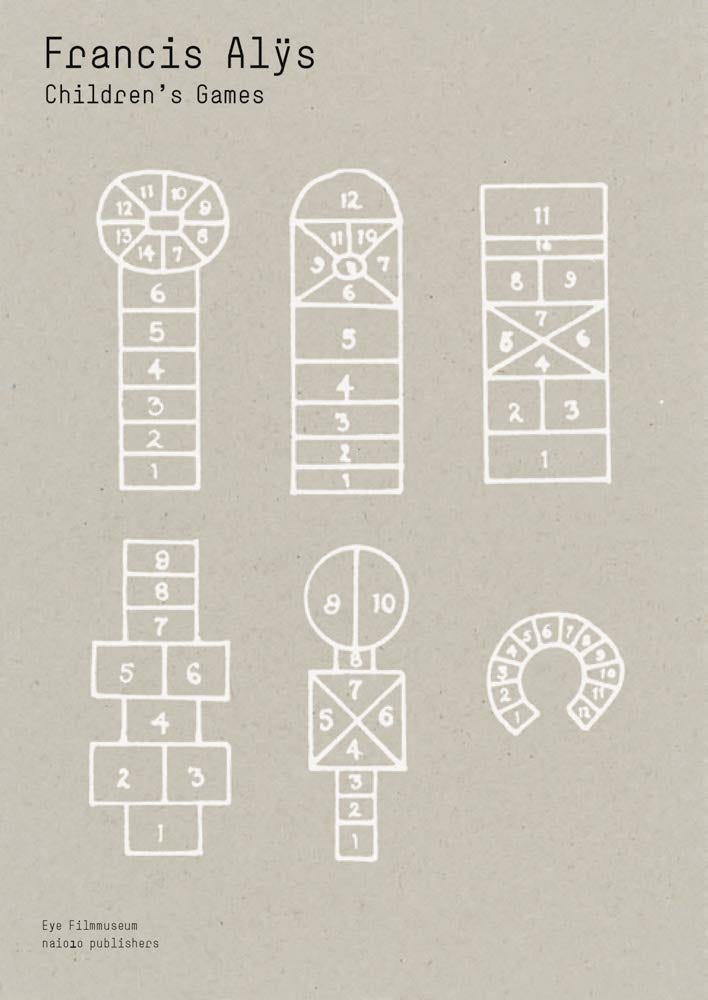
Francis Alÿs is a Belgian-born performance artist, photographer and video maker whose ongoing project, Children’s Games, has been exhibited in major art galleries across the world. Children’s Games comprises a multi-screen installation of short videos depicting children at play in different parts of the world, largely in urban settings, but also in areas of conflict, including refugee camps.
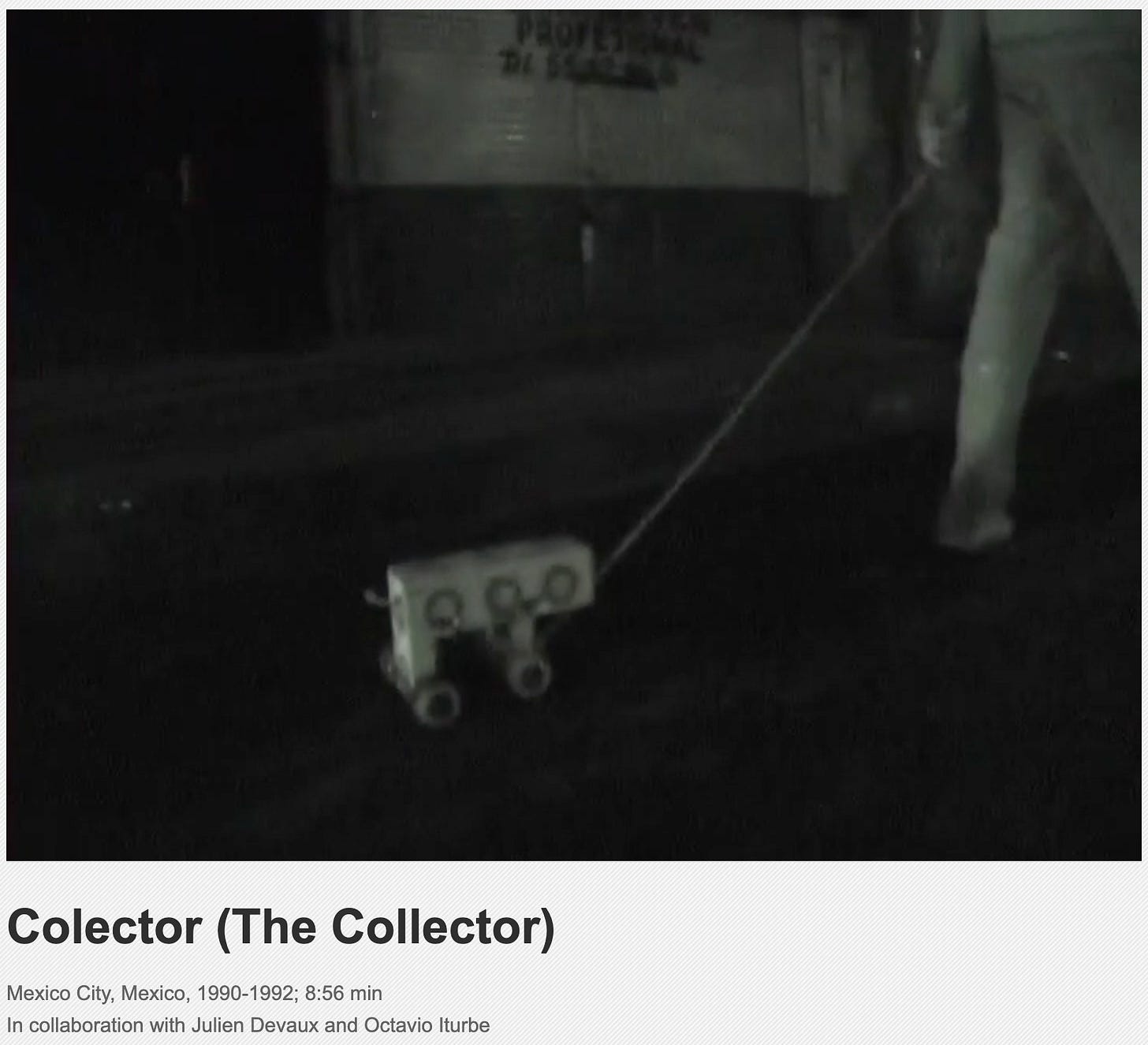
After training as an architect, Alÿs moved to Mexico City where, as a result of long walks in the city, he became interested in the urban life of street-sellers, beggars and rough sleepers. Out of this interest, between 1992 and 2004 he created a series of photographic projects, almost in the manner of a sociological or ethnographical study and, over the same period, he devised some very simple, public performance pieces linked to urban activities. For example, he placed white pillows into the frames of windows smashed by the earthquake which hit Mexico City in 1989. He pulled a magnetically-charged (toy) dog through the streets gathering bits of metal as they went. He offered his services in a city square, alongside artisans and handymen, as a tourist. These actions were documented respectively as Placing Pillows (1989), The Collector (1991) and Turista (1994). Alys has never been interested in grand artistic public works, but rather in the poetic possibility that arises from almost imperceptible interventions in the everyday reality of the city.
Thanks for reading! Subscribe for free:
The clearest statement of this was a performance called Paradox of Praxis: Sometimes Making Something Leads to Nothing (1997) where he pushed a large block of ice through the city for a number of hours until the block had entirely melted away. Such works, exploring the nature of the pointless, led to Alÿs being dubbed ‘the architect of the absurd’. However, although his work may be playful, it is far from frivolous. He has always been engaged in the politics of his subject matter. As he himself has said: “Sometimes doing something poetic can become political and sometimes doing something political can become poetic”. The political aspects of his work became more marked later as he travelled to a number of foreign locations, often such places as Afghanistan, Iraq and other centres of major conflict.
At the same time as making his own small-scale urban interventions, Alÿs was observing and recording children’s street games. Over the years these recordings have grown to become a significant archive and art project. There were a number of reasons why Alÿs, as an urban artist, was attracted to these games. Firstly, he recognised in them similarities with his own urban walking/performance art practices. Both performances and games were often done simply for their own sake, for the sheer pleasure and ‘pointlessness’ of them. The children’s games had to be accepted on their own terms and didn’t point to anything beyond themselves for their participants. At the same time, these activities were taken seriously. Performance and game are often bound by a simple set of rules. The rules have to be respected otherwise the game is no longer a game, and the performance art is no longer a piece of art. So the rules of both artwork and game create what is sometimes referred to as ‘the magic circle’ outside which participants are not allowed to step if they want to still be considered players. In Alÿs’s own words; ‘I realised the importance that children’s games had had as an inspiration not so much on the scripts but on the mechanics of my works: the absurd logic of very clear rules which did not have much sense in themselves. I am not very good at defining what it is that I am looking for, but it is crystal clear when I am out of bounds. Children’s games are like that: the moment you step out of the rules of the game, children will complain to you. Sometimes rules are not well defined, but there is a clear limit between being in or outside of a game’.
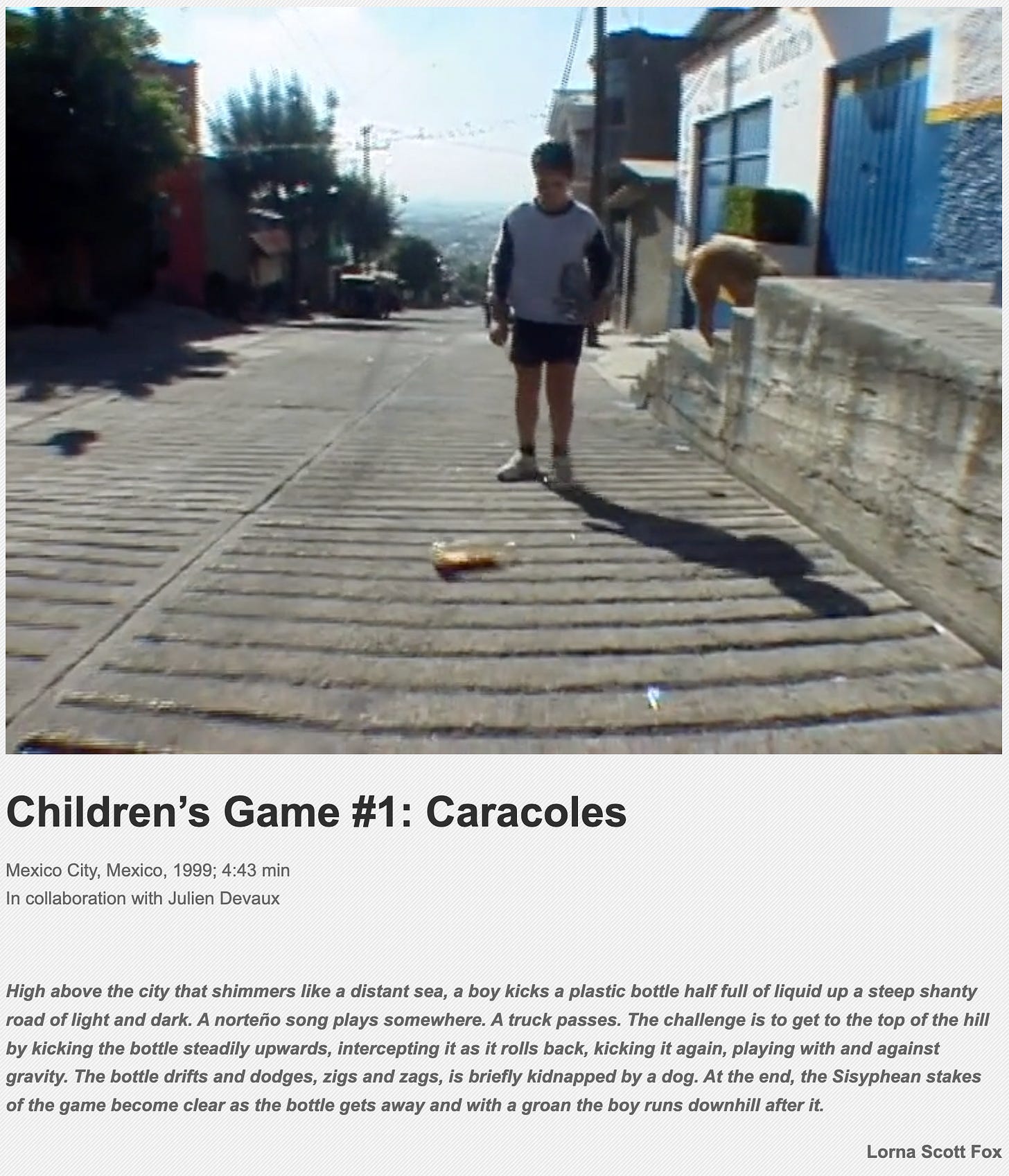
This connection between the games he recorded and the performances he made came to Alÿs in the light of a short video he had made of a boy kicking a half-empty cola bottle up a steep street in a Mexican town.
As the bottle rolled back down towards him, he kicked it again, and again, and again until he lost control of it. This resonated with Alÿs’s own exploration of resilience and failure, time and labour. He named this video Caracoles (Snails) 1991, and it retrospectively became the first in the ongoing series that constitutes Children’s Games.
A boy kicking an object down the street is also the opening sequence of the 1970 film, Bread and the Alley by Iranian director Abbas Kiarostami. This 10-minute film shot in black and white was an important influence on Alÿs’s own practice both as a performer and a video maker. And while we are considering Alÿs’s connections between children’s street games and his practice, it would be worth mentioning works by two other artists which resonate with Caracoles. The first is a piece entitled White Trash Curry Kick. In 2008 André Stitt, as part of Bedford Creative Arts, proposed kicking an empty curry carton up Bedford High Street wearing silver platform boots, (for which he was paid £12000 by the way). Unfortunately, the performance never took place. It was cancelled over concerns about crowd safety. The second work started life as a moment in a football game which was then transformed into a dance piece. In the 1978 World Cup, Scottish midfielder Archie Gemmill scored a brilliantly skilful goal against the Dutch. This goal has gone down in Scottish footballing history and in the wake of it, artist Alec Finlay noticed how children in streets, playgrounds and pitches across Scotland were replicating Gemmill’s goal in detail. Finlay, in turn, choreographed the player’s movements (without the ball) in and around the penalty area, the scoring of the goal and the wheeling away in celebration, into a dance piece using a scripting system called Labanotation, which means it can be endlessly replicated.
This brings us to Francis Alÿs’s Haram Football, video #19 of Children’s Games.
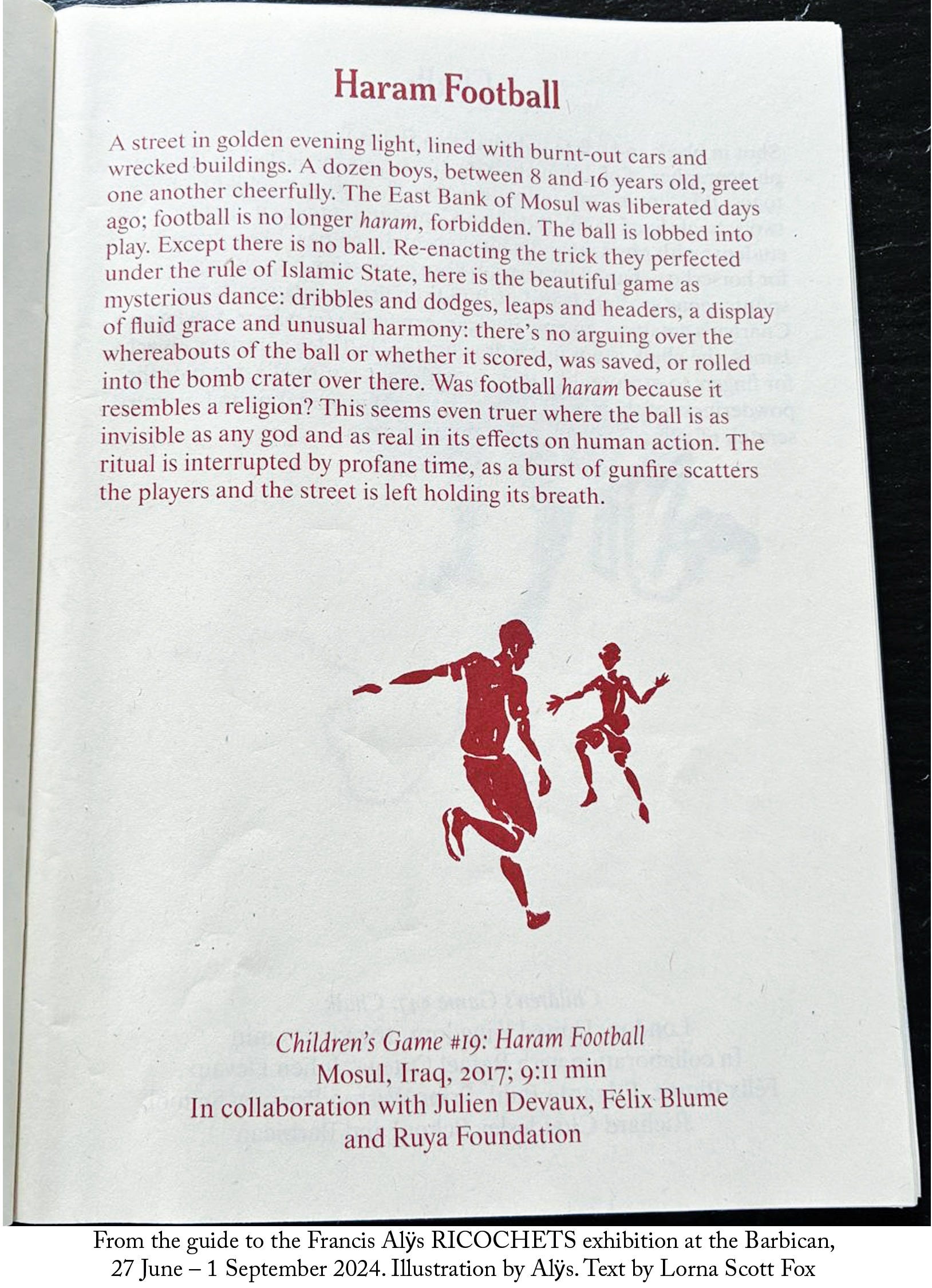
Haram Football, recorded in 2017, ends with the following chilling text scrolling slowly and silently across a black screen…

If Children’s Games arose from Alÿs’s practice as a performance artist, the project has since taken on another function. In effect, it is also an ethnographic exercise of recording games from around the world and creating an anthology or archive of them. In this respect, Children’s Games can be seen as an extension of the classic pioneering work of folklorists such as Iona and Peter Opie and their ground-breaking The Language and Lore of Schoolchildren (1959). The Opies’ book was an early exploration of British children’s games and the rhymes which accompanied them and is a cornerstone of the anthropology of childhood. Alÿs’s work has a slightly different impetus in that he is also concerned with conservation. It is clear that any of the games he records are in danger of disappearing forever. As opposed to Britain of the 1940s, when the Opies were doing their research, today’s children rarely play in the streets (too many cars), their play is much more supervised (parental anxiety over ‘stranger danger’), and much more of their play nowadays is solitary/online due to the digital revolution that has taken place in the last decades. Even in school playgrounds children are more likely to be seen standing alone, on their phones, playing video games, rather than skipping and singing together. Thus many of Alÿs’s examples are provided by children in contexts and situations far removed from the ‘privileged’ digital childhood of their western counterparts. Behind Alÿs’s work is an implicit critique of the damage to childhood itself that has been caused by this shift.
Early on, Alÿs was intrigued that games such as hopscotch, knucklebones (or jacks), ducks and drakes and hot hands - games that he had known as a child in Belgium - are to be found in different and unconnected cultures across the world. For Alÿs, this was an indication of a certain universality about such games, something which immediately raises questions about transmission. Where did a game like hopscotch first come to light? In one place or many? How did it travel? Along trade routes? Who were the ‘couriers’ that took it from one place to another?
Children’s Games emerges as a richly textured and varied work. Firstly, the collection of videos is material for gallery-based installations. Secondly, their subject matter links to central performance art concerns of Alÿs and others around play and ‘pointlessness’. The project as a whole makes a contribution to the burgeoning ethnography of childhood, and the individual video recordings constitute a visual archive of games in the process of possible extinction. And the politics of all this is not lost on Alÿs, especially where the symbolic action of a game can mirror real-life concerns. An example that Alÿs cites is watching children on the beach in Tangier, Morocco, playing ducks-and-drakes, making pebbles bounce across the sea until they sink. Across the Strait of Gibraltar lies Spain and Europe. In the artist’s imagination this game was poignantly linked to the plight of the immigrants he had been working with in Morocco whose simple desire was to skip and play across the sea towards the horizon and a new life, a journey which they knew could quite easily end in tragedy.
All films from the CHILDREN’S GAMES series are public domain and can be watched and downloaded for free at CHILDRENS GAMES
Thanks for reading!
Comments
Nothing yet. Say the first thing.
Sign in to join the conversation.