
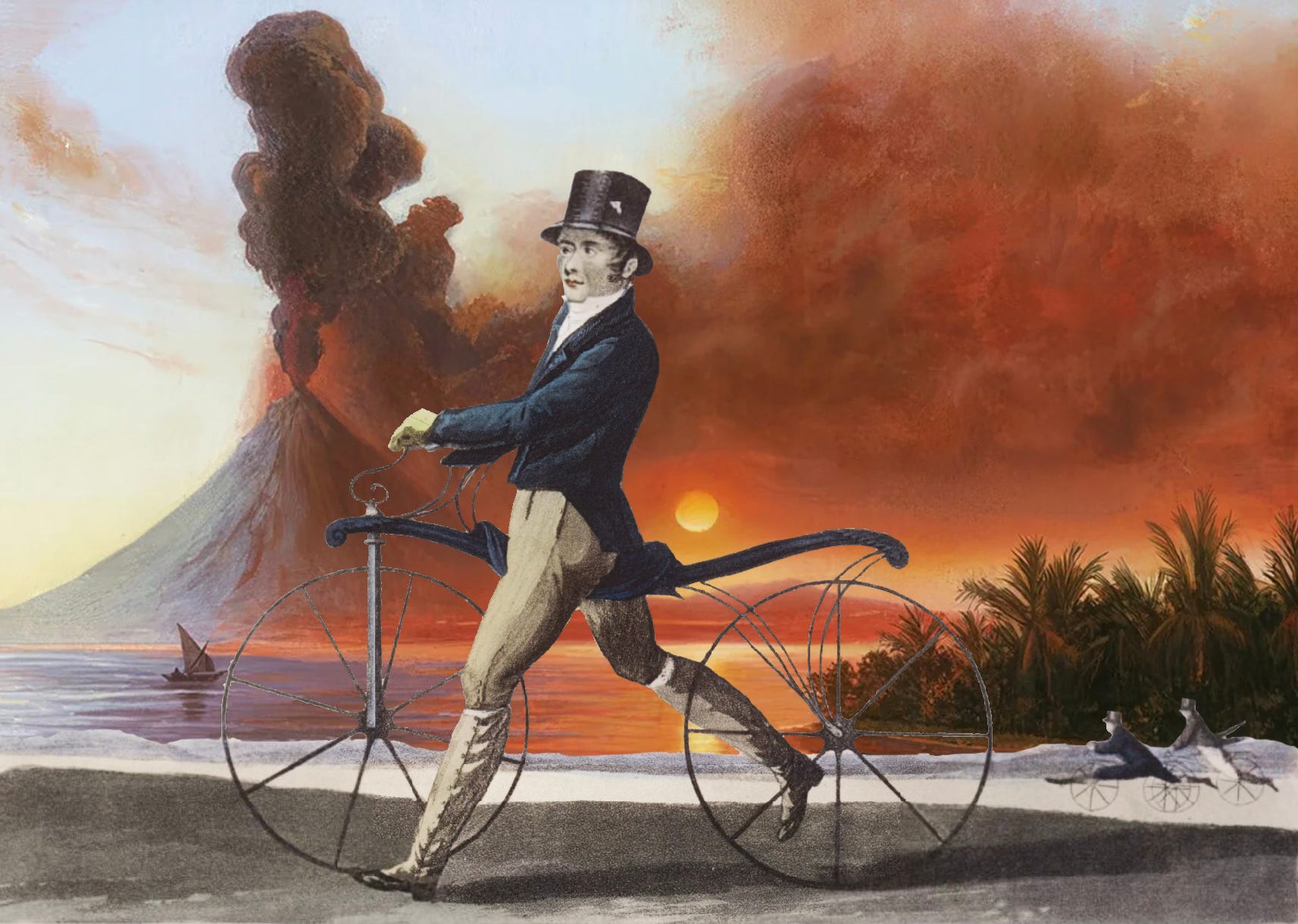
In the architectural antiques, salvage and curiosities business, you simply never know what’s going to turn up next. A local builder had saved a mysterious bit of wood from a site he was working on near Uxbridge – pulled it from the skip and brought it into the LASSCO’s shop where I work. He thought it was the frame of quite an early bicycle.
He was right, but neither of us at that stage realised what a rarity we were holding. The bike frame was disappointingly incomplete: a sinuous weathered oak bar, with a long saddle bolted to the dipped centre section, scrolled at the end, nicely carved, tell-tale straight forks for wheels and other truncated iron armatures.
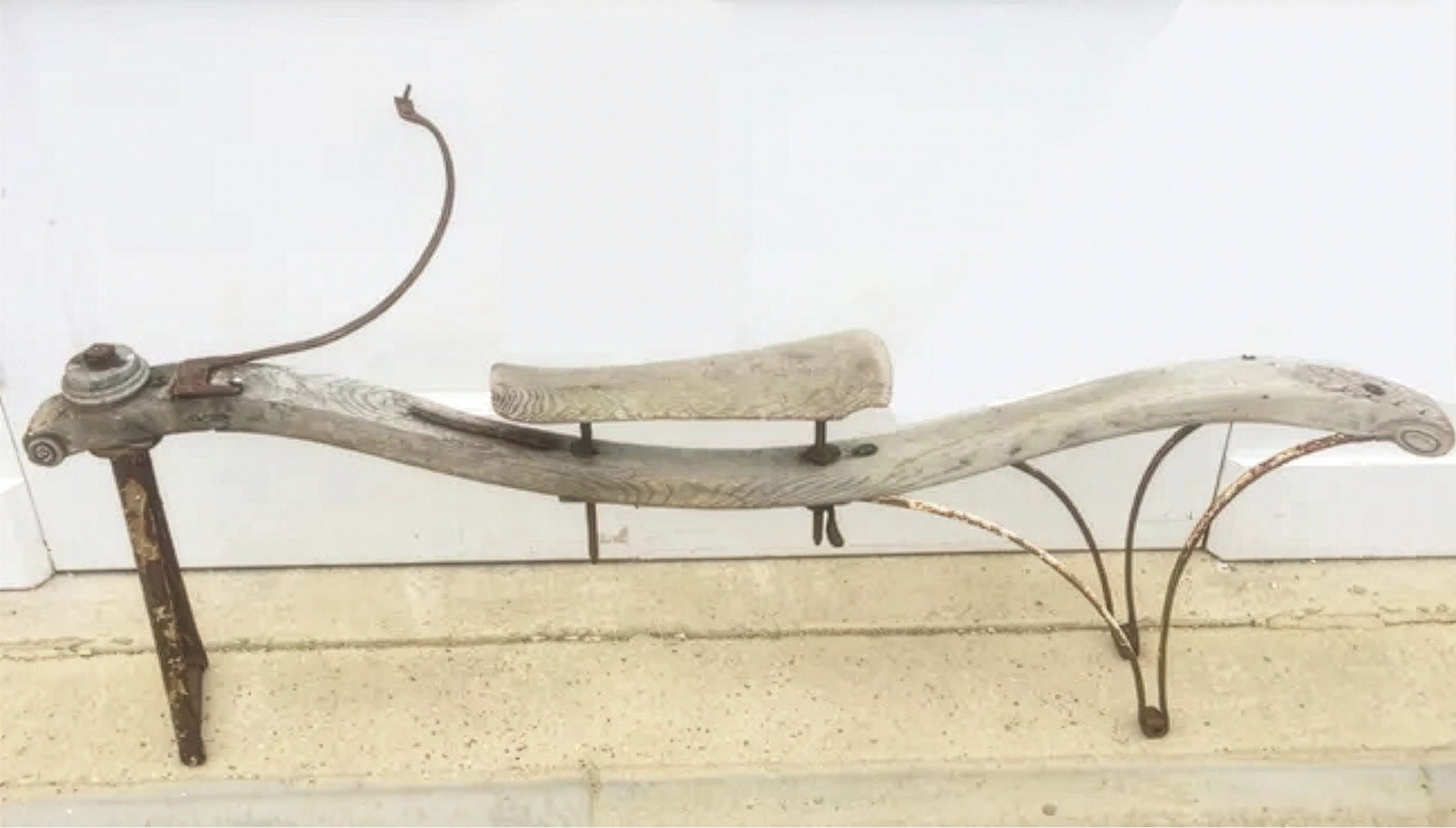
As we were to discover, it was the frame of one of the earliest bicycles ever made: designed and built by coachmaker Dennis Johnson (c.1760−1833) whose workshop was at 75 Long Acre, Covent Garden. He made it possibly as early as 1816 – what might be considered ‘Year 2’ of cycling, but probably not as late as 1819. His design was a re-interpretation of Baron Karl von Drais’ ‘Draisienne’, the velocipede that the German inventor (1785−1851) had brought to the world in 1815. It was the first time anyone had come up with the idea of setting two wheels in line, steering one and scooting ahead whilst balancing: cycling. Johnson’s was the more elegant machine – lighter, more flexible and stronger; his coachmaking skills were beautifully applied to this brand-new form of transport.
The ‘Hobby Horse’ or ‘Dandy Horse’, as Johnson’s ‘Curricle’ or ‘Pedestrian Accelerator’ became known, was a big hit on the pathways, parks and pavements of Regency London and many other cities – including Milan, New York and Calcutta; so much so that by 1820 all of these cities, and others, had banned the riding of them on pavements; they had become a dangerous nuisance.
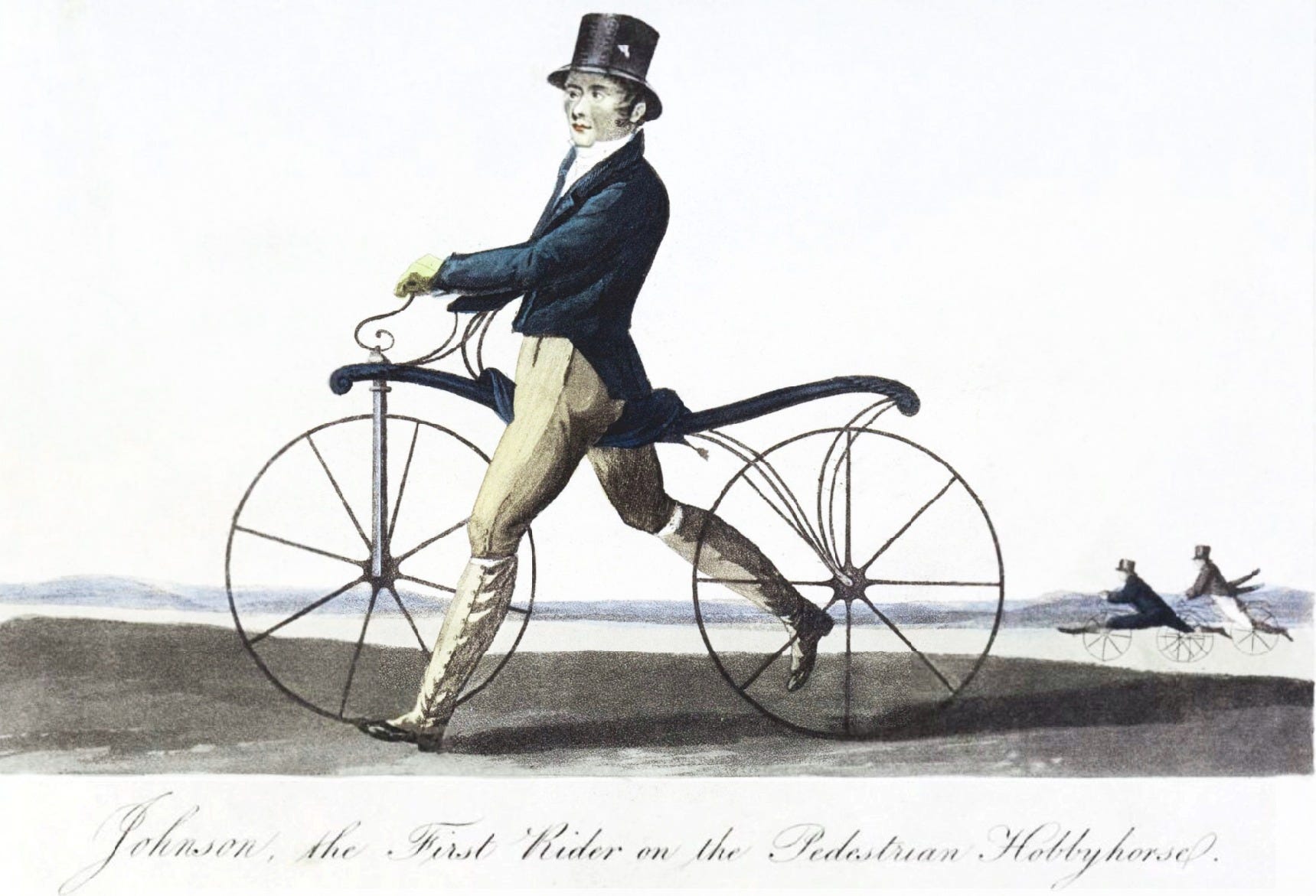
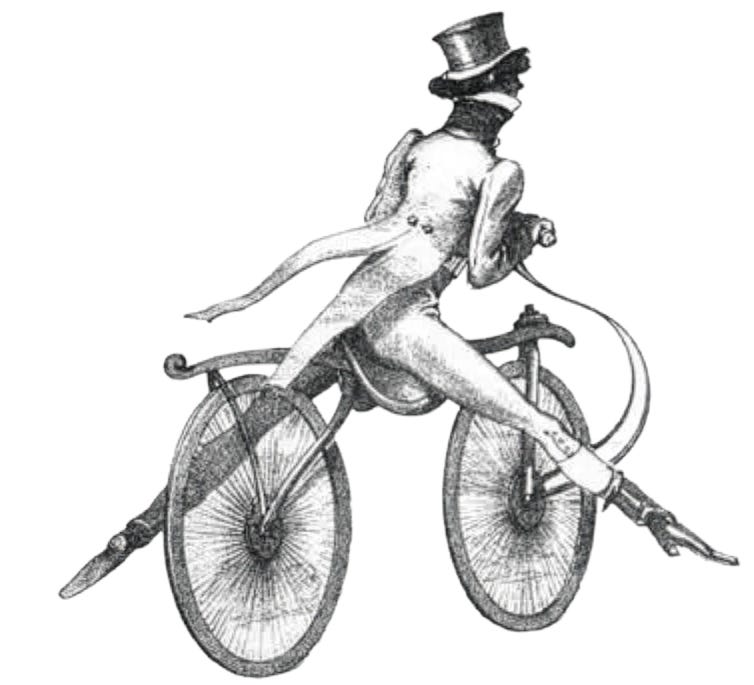
The Dandy Horses are best remembered through the prints by caricaturists who ridiculed the riders of them. One of the most published of these was Robert Cruikshank (an early adopter of the Dandy Horse himself, whose studio was a few doors away from Johnson’s Long Acre workshop). Cruikshank had come a cropper on Highgate Hill in a serious Dandy Horse collision with another rider – his publisher, Sidebotham. The latter was seriously hurt and later died from his injuries. However, in our initial search we could find barely any examples of original Johnson machines themselves, and certainly none that had come to market.
But we did find that the Pitt Rivers Museum in Oxford has one; and as the hunt continued for other comparisons, it was looking to be almost unique. We put the word out to collectors worldwide, but it was Glyn Stockdale, curator of the Penny Farthing Museum in Knutsford, who was particularly excited to hear of our discovery and rushed down from Cheshire immediately.
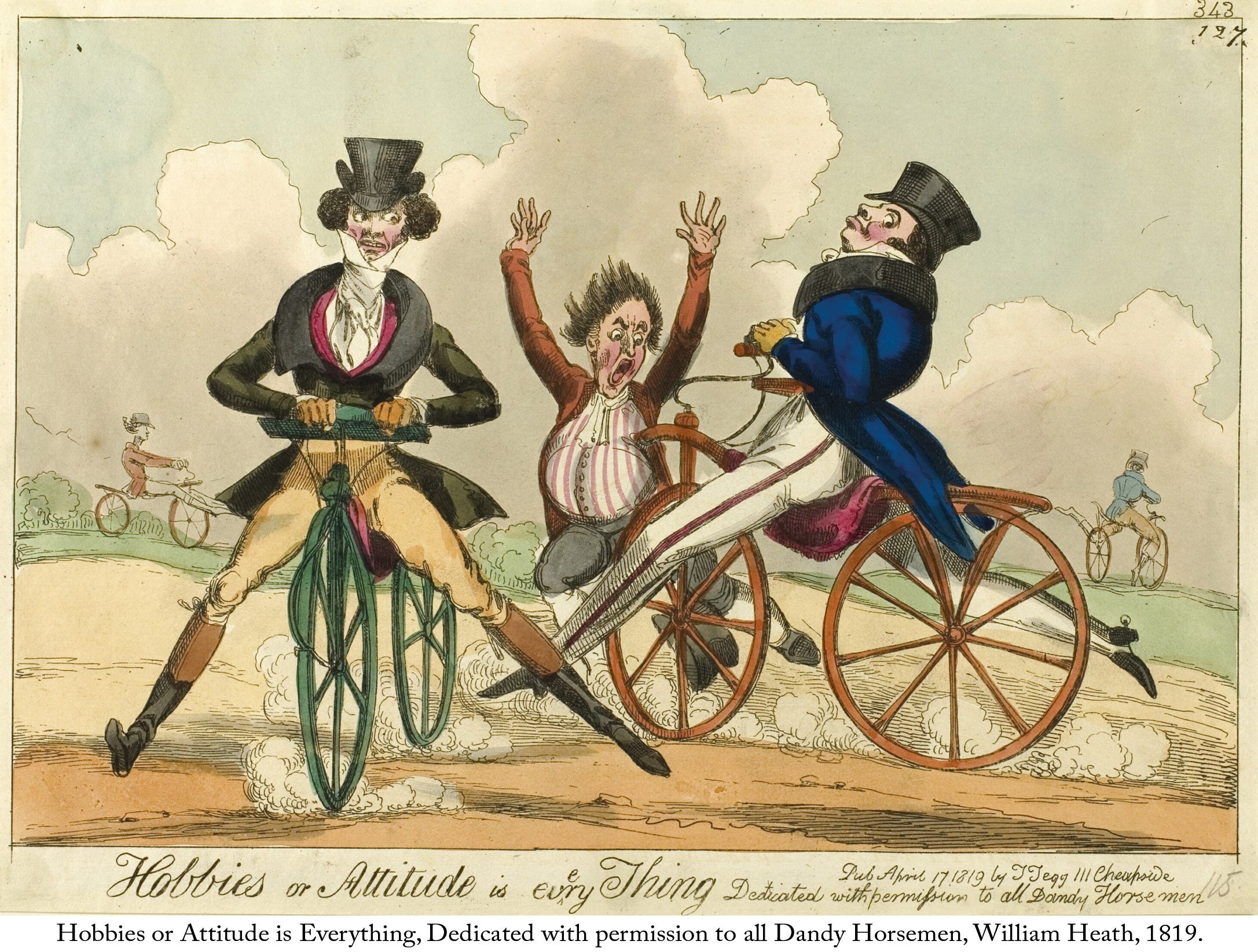
By 1820, when the ‘Dandies’, the toffs of London, Paris, Milan, New York and Calcutta, had tired of the Dandy Horse, the fad was quickly over. They had injured themselves, worn out their boots, broken the forks, blistered their bums and been laughed at. And as we know, they had been banned from the smooth city pavements – consigned to the cobbles. The Hobby Horses were binned, burned, broken up, sold – or despatched to the country estate where they were shoved in a barn somewhere. The craze was all but forgotten, and ‘cycling’ wasn’t to re-emerge for another few decades. Johnson’s ‘Pedestrian Accelerators’ and Von Drais’ ‘Draisiennes’ were considered anachronisms – explaining why they are so rare to find today…
“…the small output and the short season of popularity underlines that, had it not been for the publicity provided by the cartoonists, very little of the brief hobby-horse craze would be remembered today”
… says Nick Clayton in The Birth of the Bicycle. But this begs a question. If the Hobby Horse was seemingly redundant, other than for cavorting about the park, and impractical in the first place (yet without cranked pedals, chain drive or pneumatic tyres), then abandoned soon thereafter: why did the invention of the bicycle, some 5,500 years after the invention of the wheel, happen at all? And why did it happen when it did?
The catalyst, bizarrely, is found in a volcano in Indonesia: Mount Tambora. On 10 April 1815, Mount Tambora blew up. This volcanic explosion was off the scale; it remains the biggest in the last 10,000 years. The top third of the 3-mile-high mountain was jettisoned with a bang so loud that it was heard 600 miles away. Over 100,000 people of Java and the wider Dutch East Indies were killed in the initial event – with its accompanying shock-waves, pyroclastic flows, tsunamis and ash-falls. The ash fell a metre thick on islands even 100 miles away.
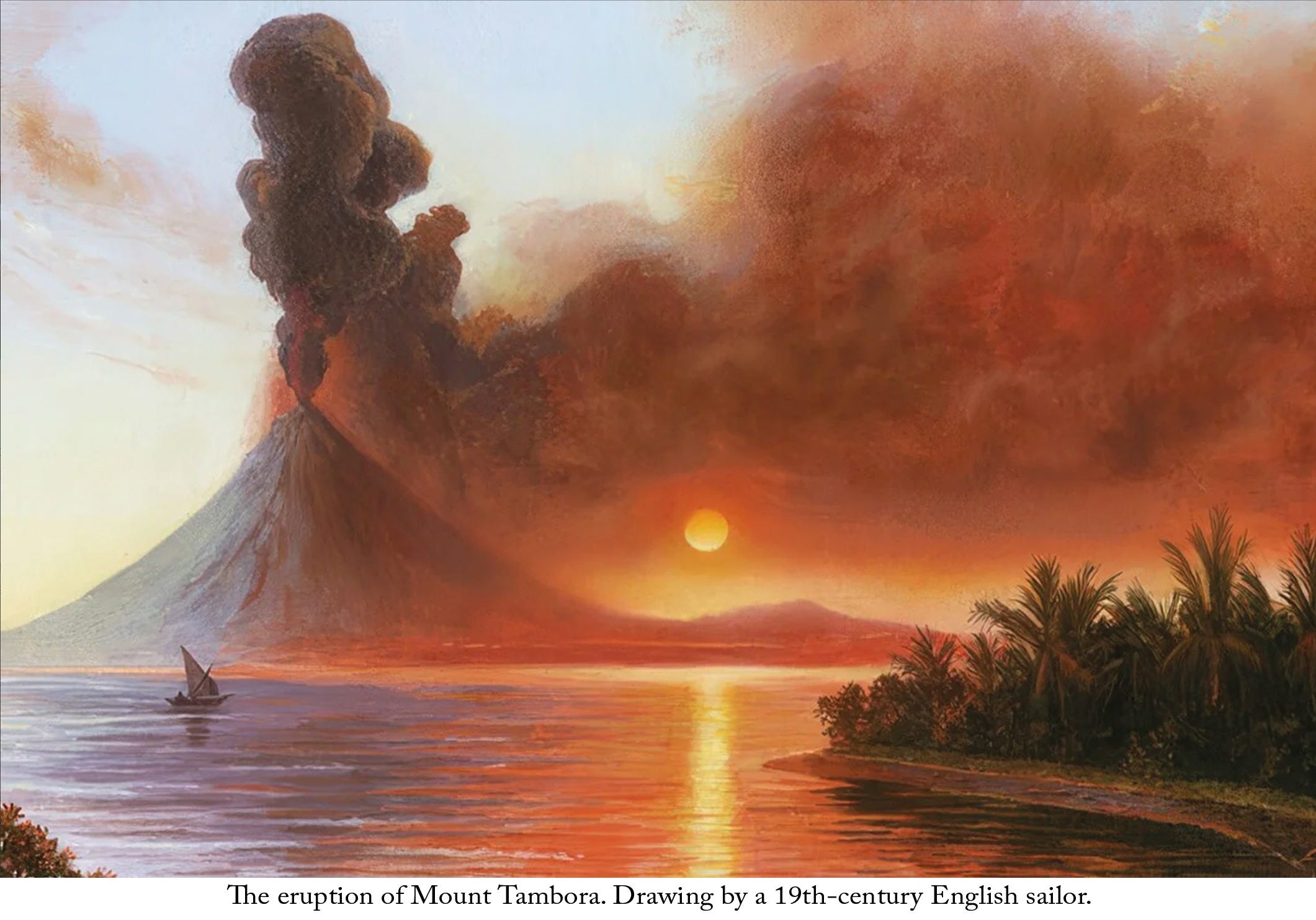
Some European travellers did variously witness, hear, see and suffer the initial eruption, and eventually reported the event when they returned home (the telegraph wasn’t invented until 1844). But what they didn’t know was that the force of the explosion sent 50 cubic kilometres of volcanic dust high into the stratosphere, an invisible cloud that was to spread across 1 million square kilometres of the Earth’s atmosphere. The cloud was to result in sudden and significant global climate change with devastating effects, but it has long been absent from history as an explanation for the catastrophic transformation in weather conditions of that time.
The ash cloud blocked the sun, or at least filtered it, cooling the planet. In Tambora, by Gillen D’Arcy Wood, the author analyses the evidence. His far-flung references include the dedro-analysis of old tree-rings in New Hampshire (showing a unique ‘zero growth’ in 1816), and the film of sulphurous dust only now extracted and recognised in deep layers of both Greenland and Antarctic ice-core samples corresponding to the Tambora years.
We shall get back to the birth of cycling shortly.
Within weeks of eruption in 1815, the Tambora dust cloud shaded the Bay of Bengal, where the monsoon was stalled. The seasons were thrown into reverse. Further east, in south-west China, the paddy fields were wiped out. Famine there, then cholera took hold.
The cloud drifted to Europe. The summer of 1816 never arrived. Crops failed. Alpine snows refused to melt. That June, Mary Shelley, holed up in Lord Byron’s grandiose Lake Geneva rented villa – under dark skies, wild electrical storms and endless rain – was inspired to compose Frankenstein. In England, J.M.W. Turner was enthralled by the lurid sunsets and tempests that the volcanic dust produced. In Ireland, the first major famine of the nineteenth century was to grip a desperate population as the unrelenting rain destroyed the potato and arable harvests of 1816 and 1817. Typhus followed. And on to the United States with a ‘summer’ of deep snow, violent storms, crop failure and starvation. The season became known as ‘The Summer that Never Happened’, the year as ‘Eighteen Hundred and Froze to Death’.
The German arable harvests of 1816 and 1817 were down by a catastrophic 75%. But they knew nothing of the volcanic cause of the climate change half a world away. They didn’t know when the biblical weather, or the hard times, might end. The price of both grain and oats rocketed; they were hungry and couldn’t feed their animals either. If horses could not be fed, they were sold or butchered. So the European horse stock, having just endured the Napoleonic wars, was severely depleted – the stables were rather empty.
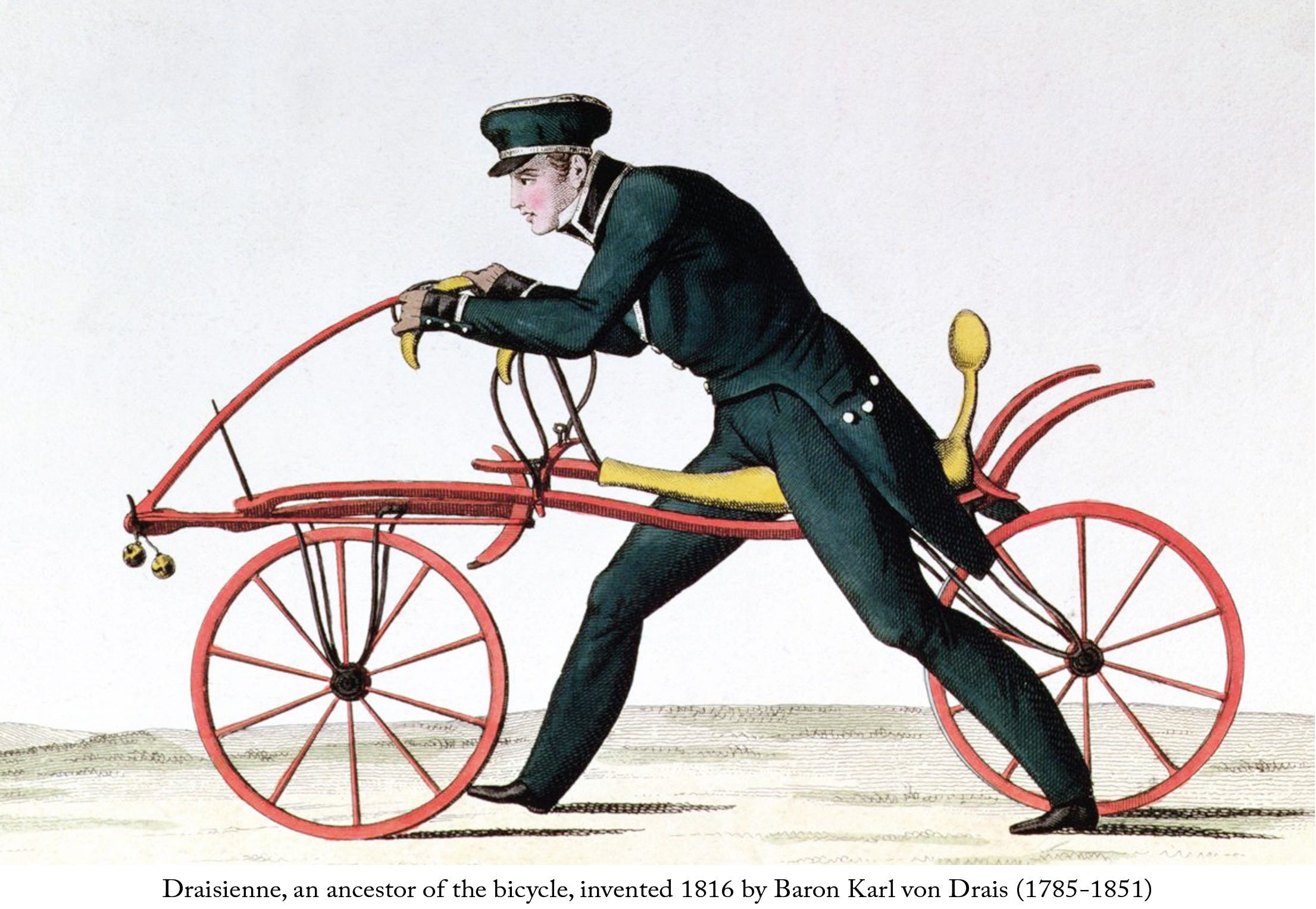
At last we’re there. Baron von Drais, son of a nobleman judge near Baden in Germany, with quite a catalogue of diverse inventions under his belt, had already set about devising horseless locomotion… the velocipede. Now was his great marketing moment. Necessity was, as usual, the mother of invention; and the catalyst for the take-up of this invention, potentially revolutionising transport, was climate change. It is a notion that today all sounds rather familiar.
Von Drais set out to prove the worth of his ‘Draisienne’ with a series of publicity stunts, there-and-backs in record time, first in Germany then Paris. News of this invention spread fast – to Bath and then to Dennis Johnson in Covent Garden. As a coachmaker, already used to having to contend with the terrible rutted, unmetalled roads, Johnson knew he could do better in terms of design and build.
He certainly caught the mood and offered ‘Curricle’ riding lessons in an indoor gallery near his workshop, as the rain beat down above. The surprising trick of balance, and the whiff of expensive, faddish, novelty – beloved of the Dandy – propelled his sales. His machines were beautifully made, smartly painted, and in time each one was numbered.
Ultimately, however, it was a short-lived experiment. By 1820 the ash cloud had dispersed, the climate warmed, the weather settled, the crop yields dramatically recovered, the price of oats and livestock came down, and the toffs got back on their horses.
***
When Glynn Stockdale got his hands on the LASSCO Hobby Horse, he didn’t hesitate; he flipped it over and scoured the underside of the crossbar looking for the incised number. Out came the magnifying glass: damn, nothing. Then he looked at the fixtures and fittings. Everything was right: the flared butterfly-nuts and hand-made thread of the rusted saddle adjusters, the pin-holes where the saddle upholstery was secured, traces of paint in the correct livery, iron armatures of the proper cross-section. All these pointed to an earlier Hobby Horse (Johnson had later improved on the early steering mechanism: the whippy curved rods descending to the front forks found here were, in time, replaced with a sturdier T-bar). Glynn concluded that we may have been looking at a very early model – even before Johnson patented his design in 1818 and started numbering them. Either way, he confirmed it was a Johnson Dandy Horse and he had to have it.
We arranged a second meeting, this time in Cheshire, in order to wrap up the deal. A tour of Glynn’s own extraordinary bicycle collection was included and then lunch at his restaurant in Knutsford where the Penny Farthing Museum collection is on display. We were surrounded by Ordinaries, Bone-shakers and Safety bicycles, hung in the rafters and lining the walls. And Glynn showed me the replica Johnson machine he had made from scratch, a few years previously. He had built this faithful copy after his discovery of another of Johnson’s rare originals in the basement of Tapley Hall, Cheshire.
“Hang on, you’ve previously found another?!” I asked, slightly deflated, “Given the craze was so short-lived and faddish, how many did Johnson make? And how many do you know to have survived?”
Glynn replied, “From the numbering we suspect he made at least 320 of them, but not too many more than that. Very few survive – I have kept records of each one that has. The one I discovered at Tapley Hall, numbered 100, was only the 11th known survivor. The one I just bought from you is the 12th to have turned up. It’s a very rare thing, but a shame that it’s so incomplete.”
As its new owner, he would embark on carefully restoring the LASSCO Hobby Horse too.
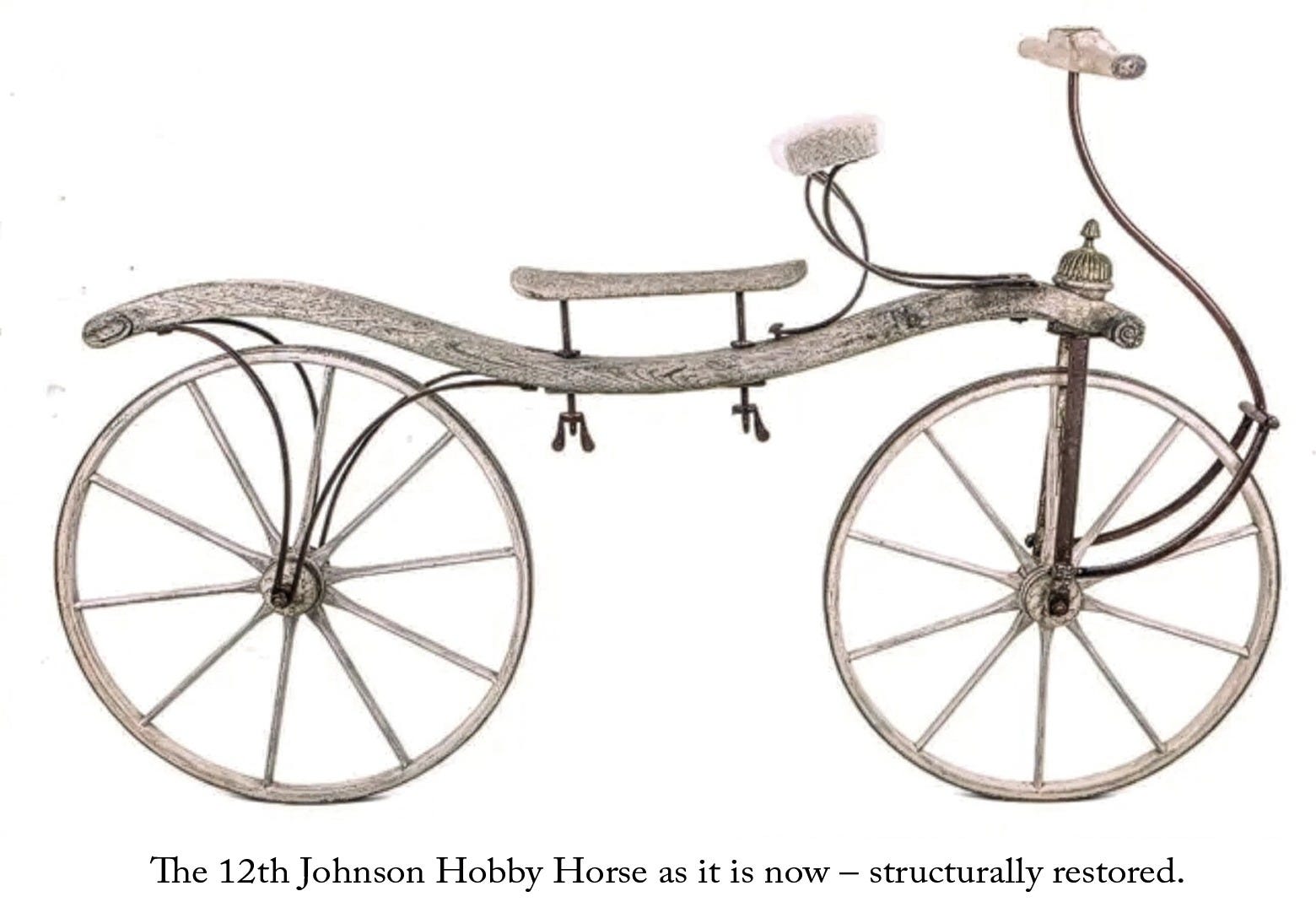
Glynn Stockdale’s completed restoration, now at the Penny Farthing Museum, was later featured in the Daily Telegraph in January 2018. He says, “I have been a bike enthusiast for 40 years and so to come across this really is the holy grail for me; it’s what you always dream of finding, let alone owning. This bike is a real survivor and it feels just fantastic to have come across [it] after all my years of collecting.”
***
Given the awful weather of 1816, it is perhaps not surprising that it was also the year when John Loudon McAdam first applied his new cambered road-building techniques and smooth surface to a muddy, pot-holed turnpike near Bristol. Perhaps if McAdam’s methods and materials had been adopted and improved upon more quickly, the Hobby Horse – with a much more comfortable ride on smoother tarmacadam-topped roads – would have persisted and developed into cycling more readily. If Mount Tambora in Indonesia had not caused a climate crisis, then the demand for horseless transport might never have received the boost it did.
We were delighted to have rescued this remnant of a peculiar twist of history and found it a new home in Cheshire – the star of the collection and a rare survivor from a climate disaster exactly 200 years ago.
No posts
Comments
Nothing yet. Say the first thing.
Sign in to join the conversation.