
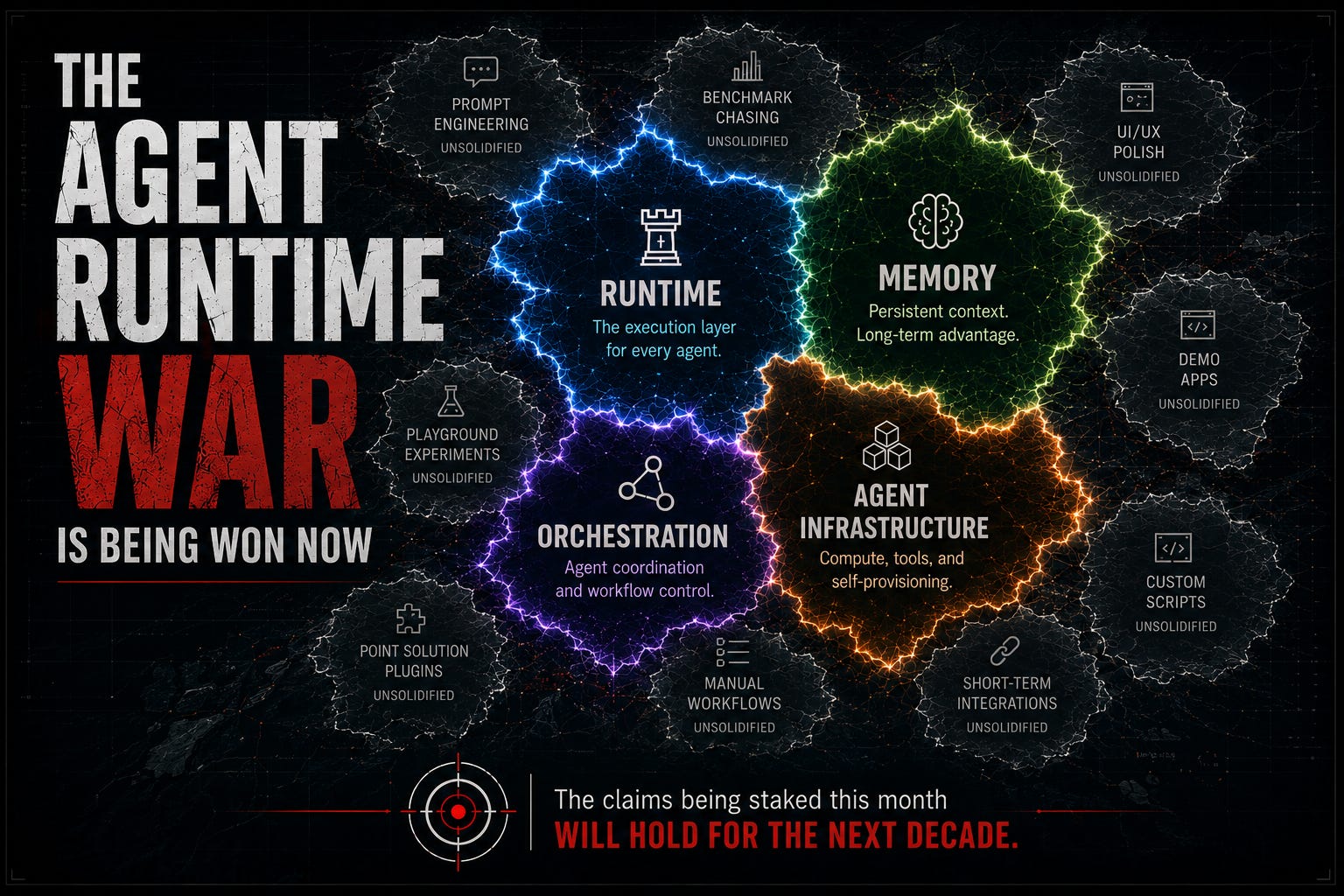
The decisive infrastructure layer in AI is no longer models but the runtime environment where agents execute, persist, and coordinate. The companies building persistent memory, agent-to-agent data protocols, cold-start latency optimization, and compute self-provisioning are looking beyond shipping developer conveniences and staking claims on the substrate that every agent workload will run on for the next decade.
Post-training and deployment architecture have replaced model capability as the primary competitive variable.
The base model race produced rough parity across the frontier, with differentiation happening in refinement pipelines, inference efficiency, and the scaffolding around the model
MoE routing overhead is getting kernel-level optimization
Open-weight models from outside the Western competitive frame are reaching GPT-class benchmarks on shorter development cycles.
The "which model wins" question is being displaced by "who owns the stack the model runs on," and those are very different competitive moats.
For enterprises building on top of AI right now, the strategic error is treating platform choices as reversible. Agent memory, context persistence, and runtime orchestration are now architectural commitments. Choosing where agents run today is closer to a database selection in 2005 than a cloud region selection in 2020. The tooling gap that kept agents experimental is functionally closed and the prototype-to-production friction has collapsed to near zero. That means the organizational debt accumulating from "we'll figure out the platform later" decisions is quicklu compounding.
Meanwhile, export control frameworks built for model weights are actively misfiring on deployed agent behavior, creating liability exposure that most legal and compliance teams have yet to priced in.
The agent runtime layer will have consolidated around two or three dominant platforms, and the enterprises that locked in early will have compounding advantages in cost, latency, and capability access that latecomers cannot close through better procurement. Open-weight frontier models will be fully competitive with proprietary ones on most enterprise tasks, which shifts the moat entirely to deployment infrastructure and workflow integration, precisely where the platform buildout happening right now is targeting.
The companies treating this moment as a feature race are misreading it; this is a land-grab for the execution layer, and the claims being staked this month will hold for the longterm.
If you are interested in receiving the dailys, you can sign up here (completely free btw: I created this for myself and costs me nothing to send it to others).
If you just want the weeklys —and other content of mine— you can subscribe to BottBott.
Comments
Nothing yet. Say the first thing.
Sign in to join the conversation.