
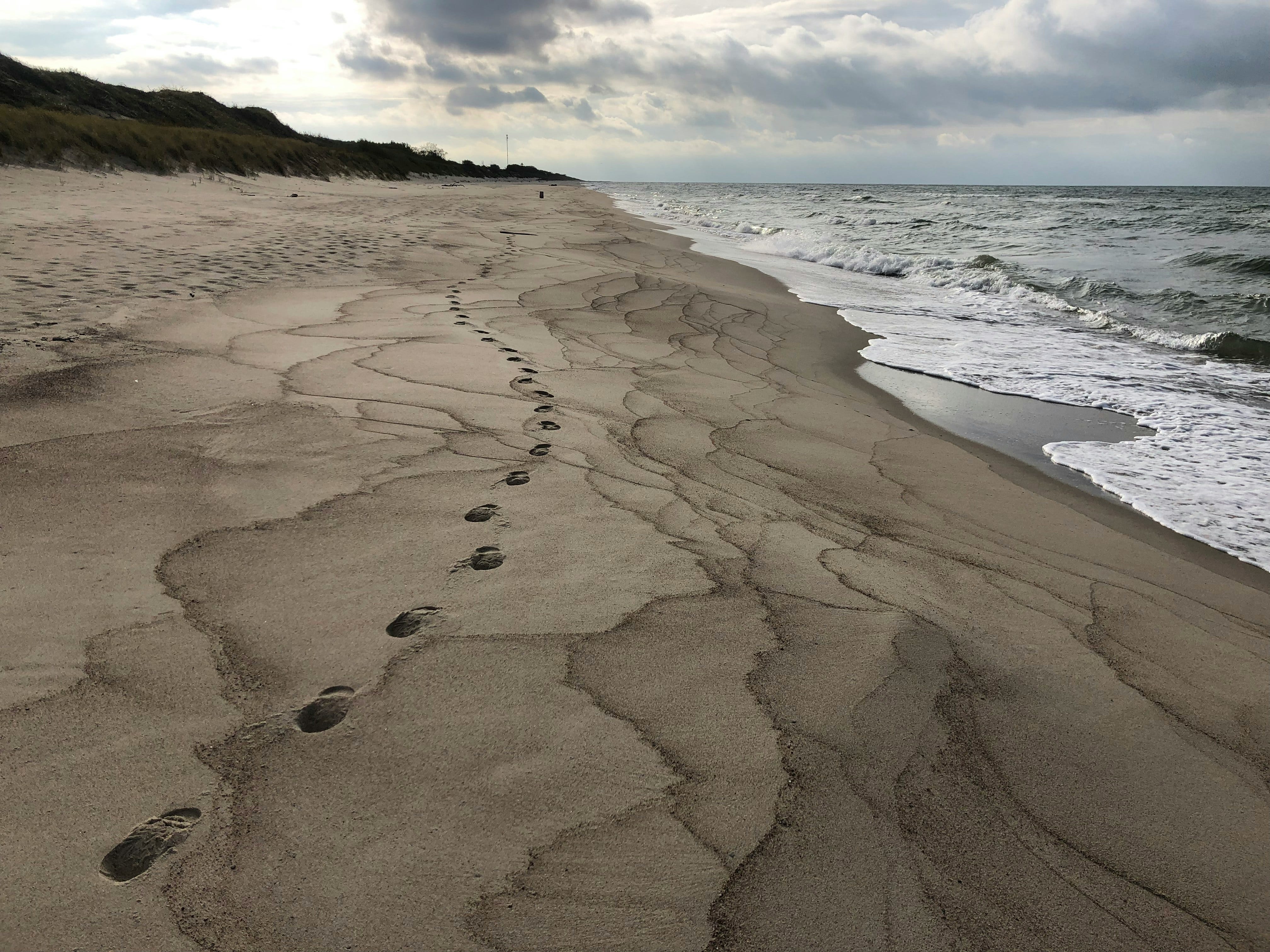
I used my Anti AI-Tells Prompt to create the following output on “what it’s like to fall in love,” which was inspired by a piece by Sean Kernan.
I shared the following piece with my wife after I generated it, and even though she knew I used AI—I felt I needed to tell her first—it still brought tears to her eyes. In addition, I shared this on my personal Facebook page and received several comments from friends as to how thoughtful and beautiful it was. It also received a restack on my other Substack account, where I posted it as a Note.
I created this to prove that LLMs aren’t bad at writing, just that the average human isn’t all that good at LLM prompting.
I “wrote” the following 100% with ChatGPT. Apart from the subtitle and several small edits for punctuation (I added four commas that Grammarly suggested), the output remains as is. No doubt, I could improve the piece by focusing on targeted edits, but this was just an exercise.
Sand, Held
Reflections on love, time, and living by the sea
Falling in love feels like stepping onto a beach you thought you already knew, then realising the ground has shifted under your feet.
At first, it is all edge and electricity. You can feel the line where you end, and something else begins, and your old measures stop working. Time changes its posture. Hours start arriving dressed like minutes. Your attention, once scattered across ordinary errands and small irritations, gathers itself and points in one direction, steady as a compass.
You meet someone, and suddenly your inner world has weather.
You carry it around like a secret tide. It follows you into quiet rooms. It taps at you while you talk to other people. It rises in the middle of a sentence and turns you tender, for no practical reason.
In the beginning, love is loud. It announces itself. It makes promises without asking permission. It fills the space between two people with meaning so thick you can almost lean on it.
Then the days keep coming.
They bring dishes and bills and errands. They bring fatigue and misread tones. They bring the slow arithmetic of being two humans with histories, habits, blind spots. They bring the kind of hours that do not sparkle, yet still count. They bring time as it actually behaves, patient, unromantic, relentless.
If you have ever stood at the shore long enough, you know what the tide does to sand.
It takes the sharp ridges you swore would last forever and smooths them. It pulls the bright patterns apart and lays them down again. It carries away what was loose. It drifts new grains in. It shifts the whole beach by inches, then feet, then a life.
From a distance, a person might say the beach is the same. Up close, it is always changing.
Love works like that.
Early love is the sand piled high, warm with fresh impact. Later love is the sand packed firm by repetition. It holds shape differently. It does not leap as often. It does not shout. It supports weight.
There is a grief in that, if you cling to the first version as the only proof. There is also a relief, if you let yourself notice what replaces the thrill.
The shoreline becomes a place you can return to.
You learn the weather of each other. You learn when to wait, when to speak, when to touch a shoulder and say nothing. You learn the small repairs that keep a life from cracking. You learn the shape of the other person’s tiredness, and the map of what steadies them. You learn how to apologise without turning it into theatre. You learn how to forgive without keeping score.
You learn that devotion has a quiet voice.
Sometimes love looks like standing in a room you have stood in a thousand times, seeing your person across it, and feeling something simple and undeniable settle into you. A kind of gratitude that does not need a spotlight. A kind of belonging that does not need witnesses.
The tide keeps moving. It always will.
Some days it pulls out, and you feel distance, space, the exposed rocks of yourself. Some days it rushes back in, and you remember that first bright surge. Most days, it does what tides do, in and out, shaping the same place through change.
The beach remains.
It gives life. It gives beauty. It keeps receiving what time brings, and it keeps offering a place to stand.
Falling in love is the first wave.
Staying in love is learning the shore.
—
Show Your Work
What makes this unique is that the output doesn’t resemble the typical ChatGPT prose many users are used to, and what the critics point to.
If you’re interested in how I tested and refined the prompt, be sure to subscribe, as I will share that process in an upcoming post. In it, I’ll provide the prompt tests so you can get an idea of what didn’t initially work, what I changed, and how I iterated on the prompt to achieve the desired output—it’ll surprise you how a minor tweak to the input can change the entire output.
Always Iterating
Remember: The fastest way to get better results with an LLM isn’t finding the “perfect” prompt. It’s testing, tweaking, and running it again.
Small refinements beat big overhauls. One line changes the tone. One constraint fixes the mush. One example makes the output usable.
That’s the whole game: iterate, learn, tighten, repeat. Then save the prompt for future use.
If you want more practical prompts, agents, and AI workflows you can use day-to-day, be sure to subscribe.
Happy Prompting,
-BottBott
Comments
Nothing yet. Say the first thing.
Sign in to join the conversation.