
one of the constant epistemological problems of the human condition can be aptly summed up by the lyrics of “the smiths” song “the queen is dead.”
“has the world changed or have i changed?”
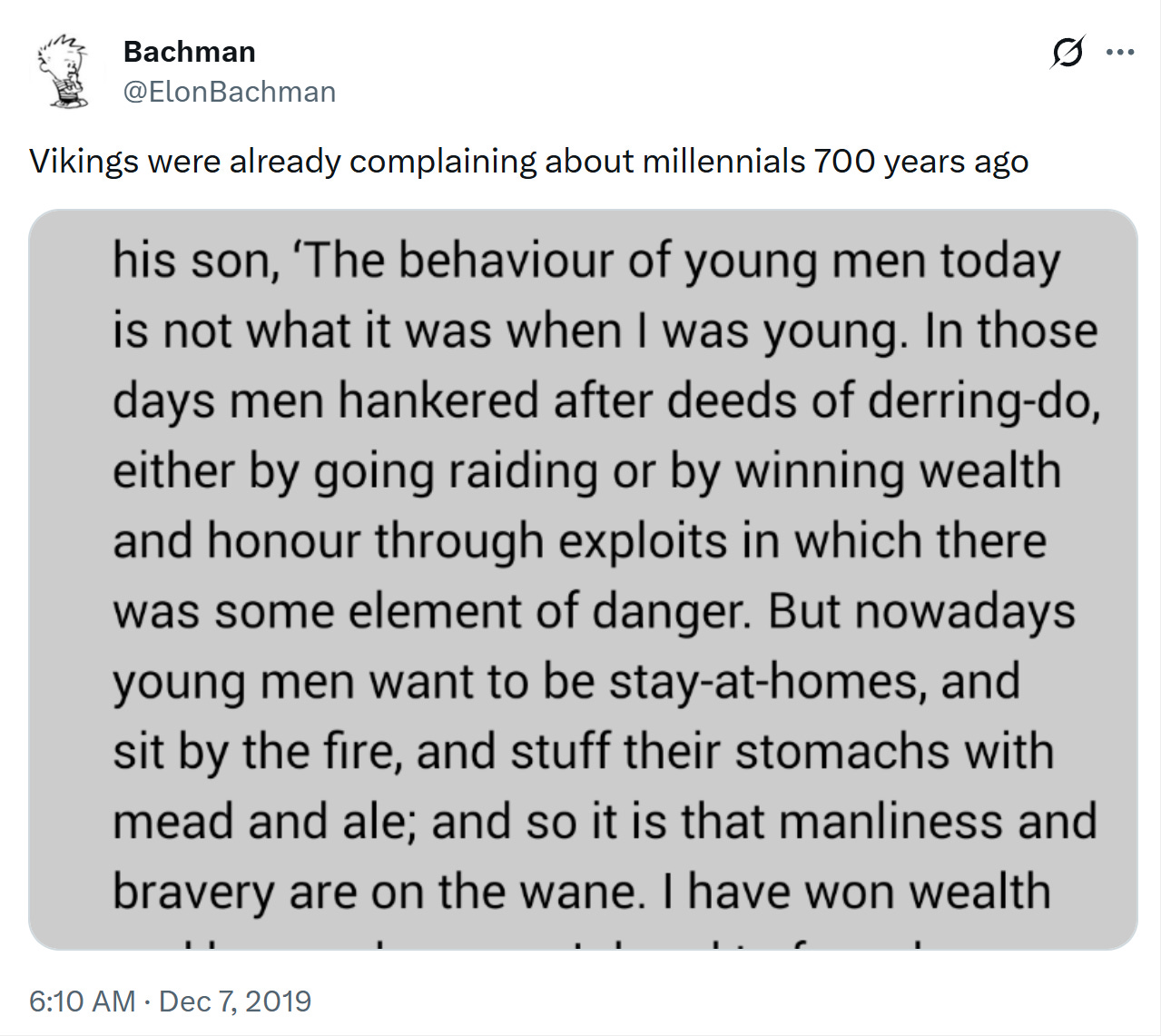
there is always a great deal of mistaking drift in oneself for drift in the world and one of the ways to spot that it’s you changing instead of the world is to seek out consistency in the things that people keep saying are changing. if the transform is constant over time, then it’s likely more fruitful to examine that which has changed about oneself. and there is probably no transform with such durably abiding self-similarity as the “kids today are not a patch on what we once were” meme.
we all do it. you almost can’t help it. but the fact of the matter is that this is mostly an artifact of growing old and getting grumpy, out of touch, and glossing up one’s memories of oneself and one’s times.
it’s been going on since time was time.
if you want to have some real fun, read this letter to karl marx from his father.
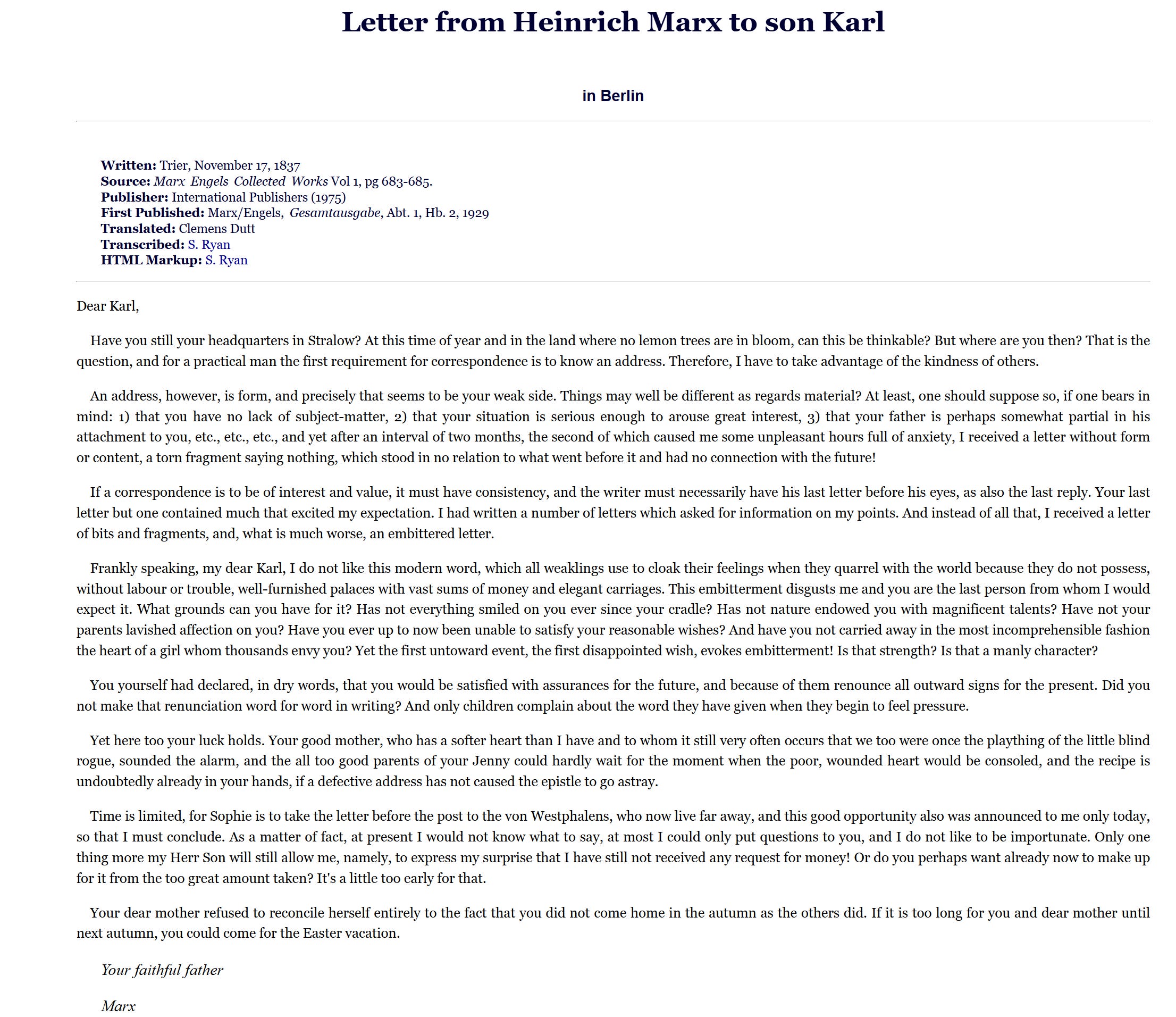
i mean, let’s not mince words: word to your moms, marx senior came to drop bombs:
“Frankly speaking, my dear Karl, I do not like this modern word, which all weaklings use to cloak their feelings when they quarrel with the world because they do not possess, without labour or trouble, well-furnished palaces with vast sums of money and elegant carriages. This embitterment disgusts me and you are the last person from whom I would expect it. What grounds can you have for it? Has not everything smiled on you ever since your cradle? Has not nature endowed you with magnificent talents? Have not your parents lavished affection on you? Have you ever up to now been unable to satisfy your reasonable wishes? And have you not carried away in the most incomprehensible fashion the heart of a girl whom thousands envy you? Yet the first untoward event, the first disappointed wish, evokes embitterment! Is that strength? Is that a manly character?”
change the verbiage and this could be any boomer slamming generation avocado toast.
this practice appears to be universal and cross cultural.
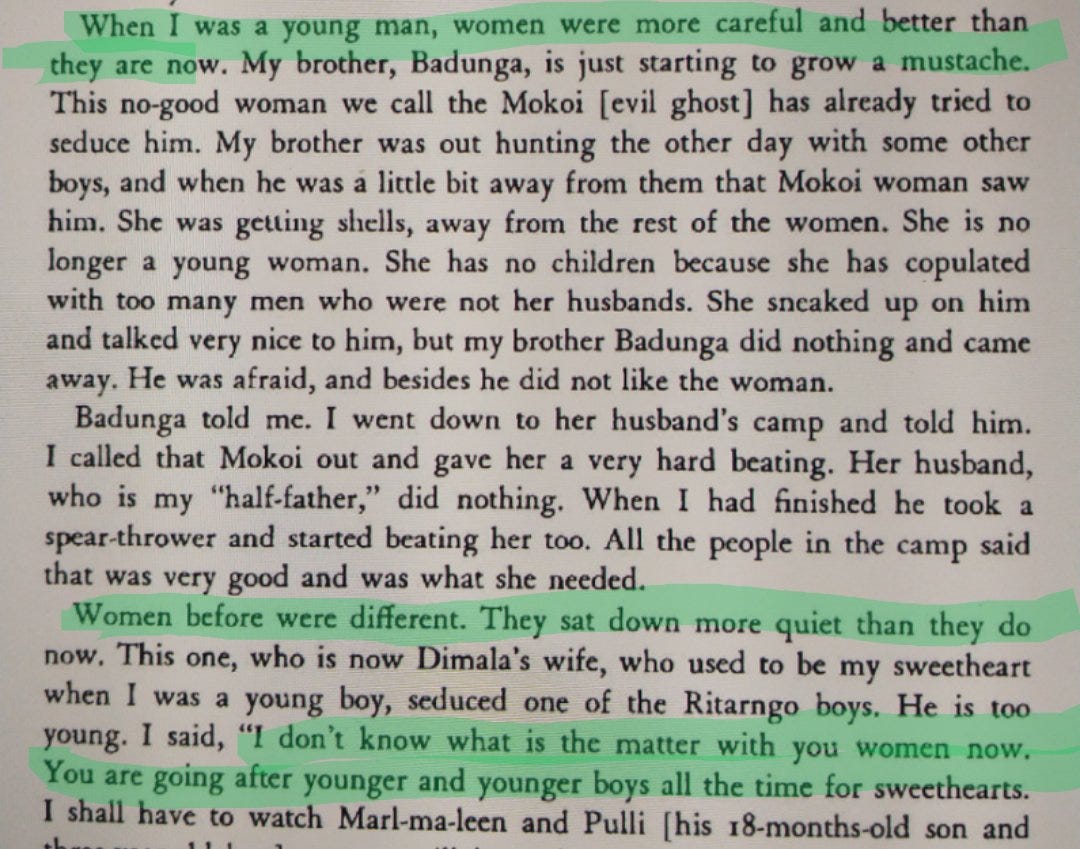
and the “old people today suck, are out of touch, and are out to get us/literally killing us” meme is just as pervasive and time honored.

the simple fact is that if one were to unearth a fresh cache of sumerian tablets and translate them, a third of it would be old people complaining about kids today and another third would be the kids complaining about the old people. (the final third would, inevitably, be dirty jokes)
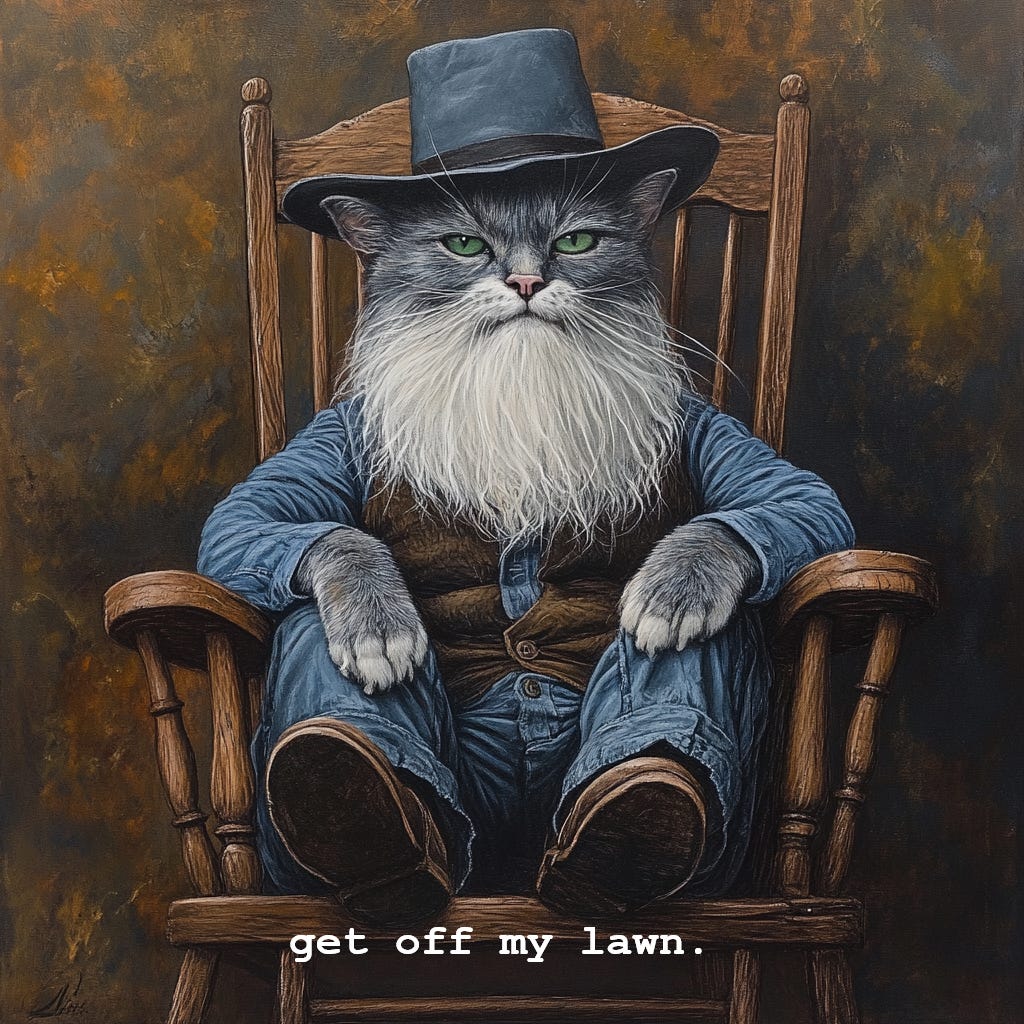
as such, i try to be careful about wading into waters such as those i am about to dive, but i have a thought on one particular issue that, at the risk of “going full curmudgeon” i suspect i may actually have something to add to the debate here (and a solution).
first: the problem.
service in restaurants, even nice ones, expensive ones in nice places, is going to hell in a bucket. not always, not everywhere, but more and more, i keep having experiences that are just plain bad because the waitstaff are just comically awful and inept, inattentive and just plain lazy. i say this as one who, back in the day worked quite a few jobs in restaurants from busing and waiting tables to tending bar and catering and is therefore 100% qualified to judge.
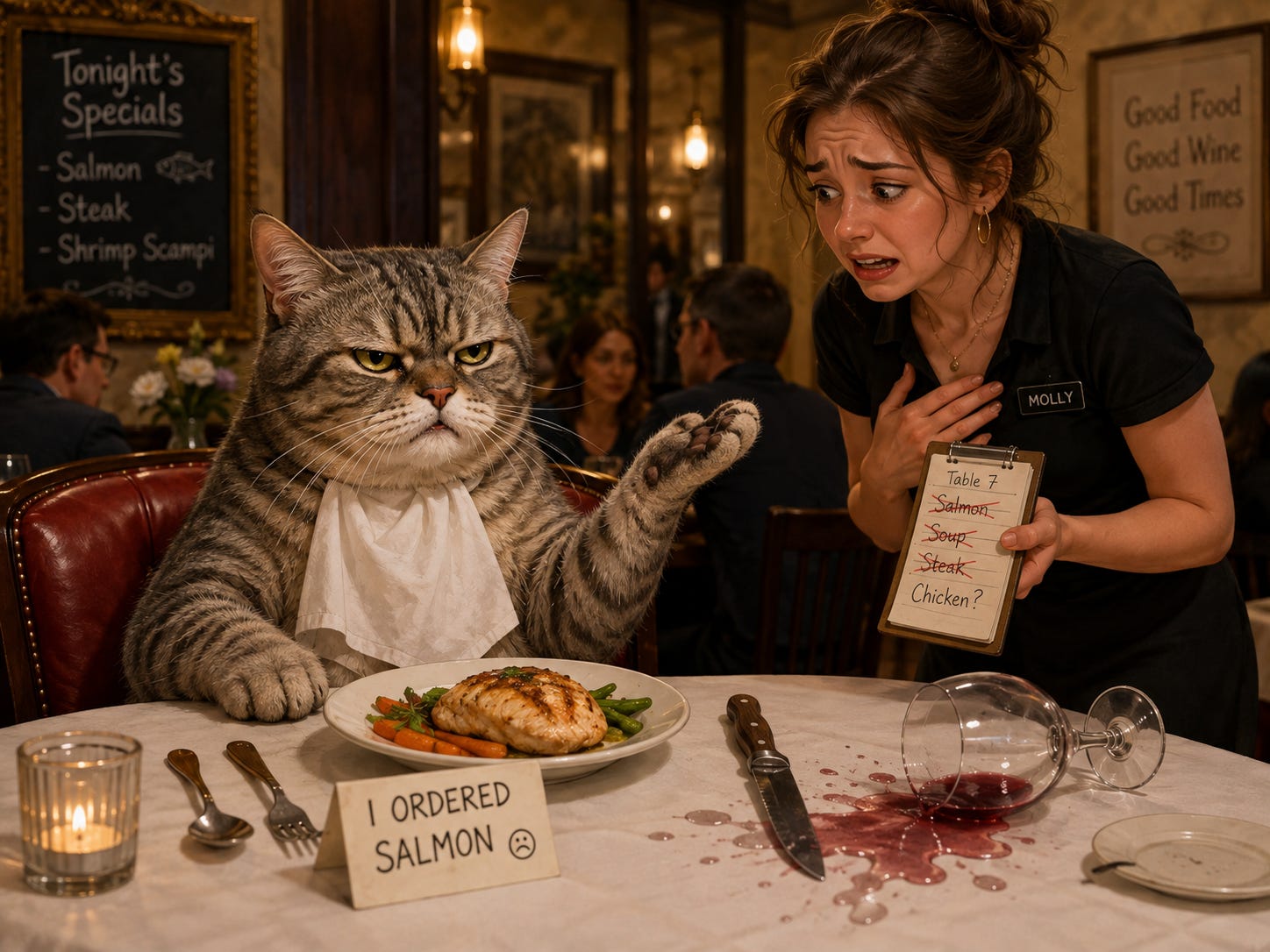
this missive was brought on this sunday morning by an experience in a nice restaurant in a nice town, the kind of place the (very) well heeled go on vacation, the kind of place with a $22 bacon and egg sandwich.
the order:
coffee with cream
grapefruit juice
bacon and egg sandwich
we are not way out on the complexity curve here, it’s about as simple as a breakfast order gets.
first to arrive is orange juice.
excuse me, said the cat, but i had ordered grapefruit juice, i believe there has been a mistake.
oh, sorry, said the runner who had brought it (not my original waitress). we’ll get your grapefruit juice.
a new (third) runner who basically did not speak english returns with another glass of orange juice.
i’m sorry, said the cat, but again, this is not what i ordered.
gawping incomprehension until another waitstaff (again, not my waitress) jumped in to add a useful bit of information: “we do not serve grapefruit juice, only orange and apple.”
then please take it off my bill. i do not want either of those.
“OK” again from a waiter who was not my waitress (but who did seem to know what he was doing).
now, it’s hard not to look back in time to my original waitress taking my order and thinking “gee, this sure seems like it could have been handled then,” and also to wonder a bit about “so how did you write down grapefruit juice then go enter orange into the squirrel system?”
meanwhile, there is still no coffee. in fact, it never came at all despite my asking twice.
in the end i ate my sandwich (not actually that good) and simply asked for the check which came to around $24 including tax.
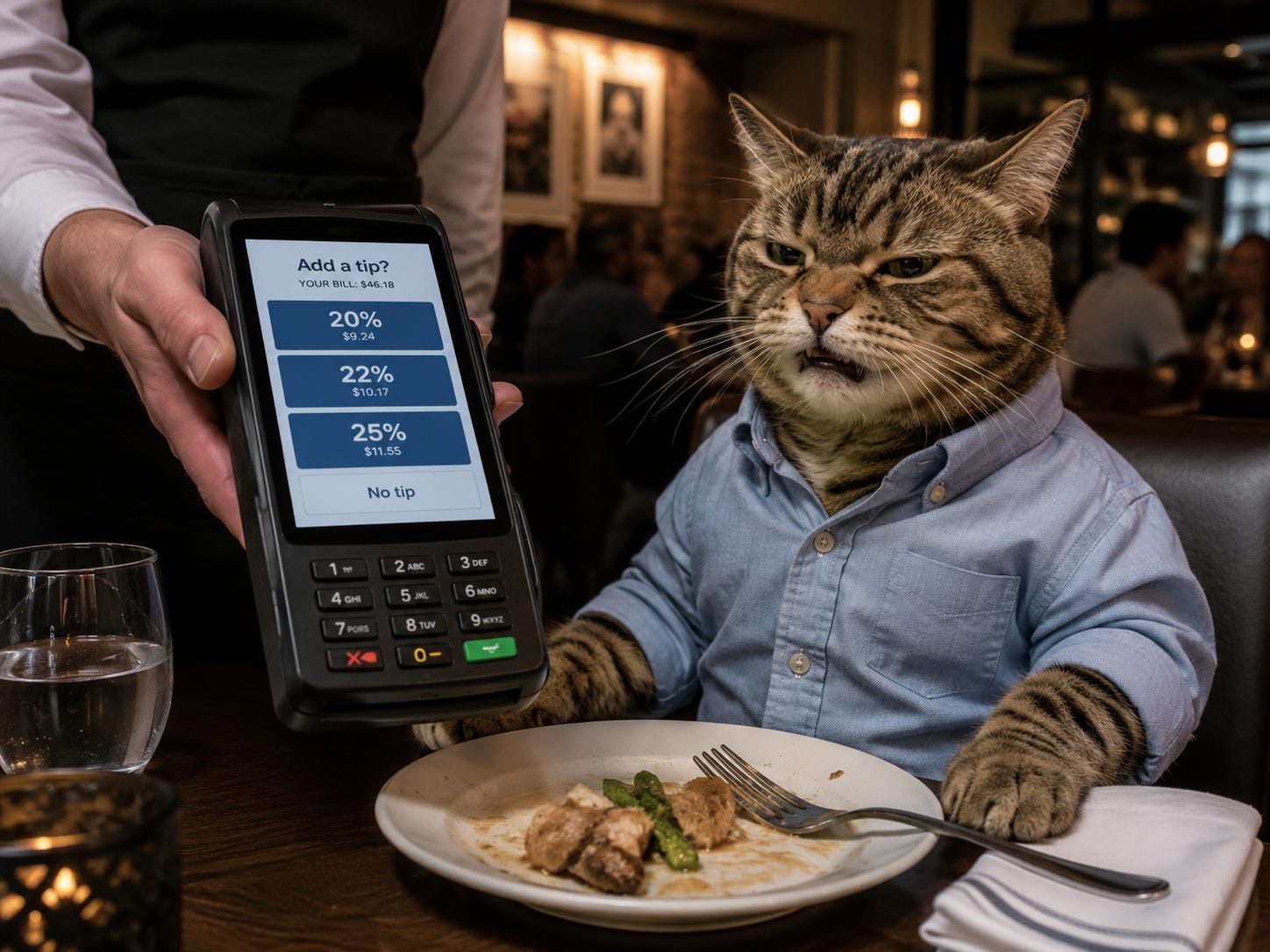
i was then handed one of the new ubiquities of wireless device to pay by card and leave a tip.
the tip screen was 20%, 22%, 25%. down at the bottom (and requiring significantly more effort) was a button for “custom” which i dutifully found and into which i entered $0.00. tips are for service, not for multi-level explorations of the lack thereof.
i find this experience to be far from universal but vexingly more and more common and ot be increasingly creeping into places where one would never have expected such previously.
there are still lots of great waitstaff. i experienced some not 5 minutes later when i went to a coffee place to fulfill my desire for the java that never came. but this sort of stuff almost never used to happen and it seems to be becoming ever more general. the very inconsistency of it itself may provide a clue as to origin story.
one might be tempted to ascribe the whole thing to “damn kids today not knowing the value of a good day’s work” and the like, but this feels to me like a lazy and unsatisfying answer.
i also thought about this new sort of “zone coverage” that seems so prevalent in restaurants where your server is not the one who brings your food or drinks and the whole experience becomes a sort of (hopefully coherent) collage of unclear tasks and responsibilities.
and whether that is a symptom or a root cause becomes an interesting question because the same issue i will lay out below likely created it as well.
some thoughts on the likely culprit:
premise 1: people respond to incentives in predictable ways
premise 2: change incentives, change behavior
the rest is just selection process and emergent order.
and i think the blame here lies with the wireless terminals (or at least the systems around them)
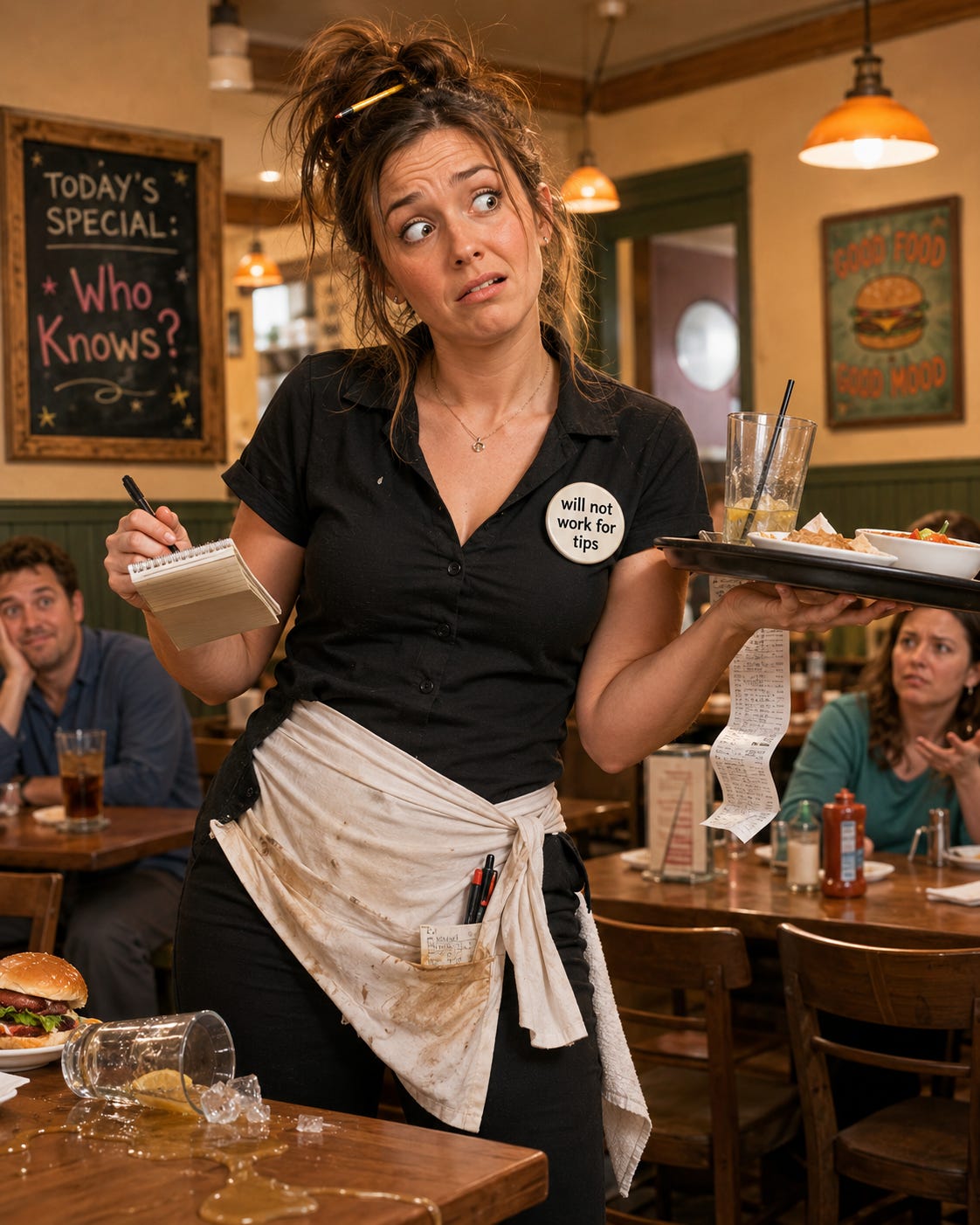
they are the waitstaff equivalent of a welfare system that pays people not to work.
back in the days of the cash economy and even of “here’s your paper check with a blank tip line for you to fill in in ballpoint pen” tipping was 100% opt in and value based. you, the diner, fresh from whatever service experience you had just had, chose a number from the set of all possible numbers ranging from 0 to a lot.
now, there are 3-4 choices that basically never go under 15% and these days, increasingly never under 20. whereas it used to be as easy as anything else to tip low or not at all, “custom” and then picking a low number is now high friction and makes you feel like you’re deliberately being somehow mean. it’s a lovely piece of inversion to make one feel like not tipping is somehow a taking. it’s a sort of embedded asch conformity test and this is not a test that humans are good at passing.
i doubt very much that the proliferation of this system is an accident.
it’s likely winding up paying servers more, especially in counter based establishments where tipping was less prevalent.
but it removes the incentive structure around good service provision
people just pick “low, middle, high” as an expression of satisfaction level and suddenly “20% tip, which used to mean “great service” now means “was dissatisfied.”
but from the server side, it means that bad service gets a 20% tip vs good service getting 25%. this breaks the fundamental point of tipping which is to encourage good service. the parallel to “i could work 40 hours a week and earn 5% more than my welfare checks pay me” becomes alarmingly exact and the incentive structure leads to the same outcome “why bother?”
to put this in behaviorist lingo:
the menu of preselected tip levels changes the behavioral default and increases the psychological/transaction cost of expressing dissatisfaction through a low tip which compresses choice distribution toward the offered choices
some will always work and work hard anyway, it’s who they are. this does not affect them. but those who always wanted to do the least amount possible are now getting paid like they did good work. in earlier decades, they would have washed out of the job because their tip count would have been terrible. now they get the participation trophy of 20%. and as such, they stay in the job and have no real incentive to change their ways.
and the feedback loop to see which servers stink has lost resolution. payment becomes “an entitlement.”
i suspect the same is true of this growing “zone coverage” waitstaff phenomenon where a combo of system automation and servers being less incentivized to care about your individual experience has led to a kind of service no waitstaff really focused on making you happy to earn a gratuity would have tolerated 10 years ago.
the question becomes “is it zone coverage causing the issue or a proliferation of bad waitstaff propped up by bad incentives"?”
i still lean toward the latter simply because explanatory variables like “does not know the menu” and “waitstaff uninvested in diner outcomes” are not rooted in zone coverage systems structure.
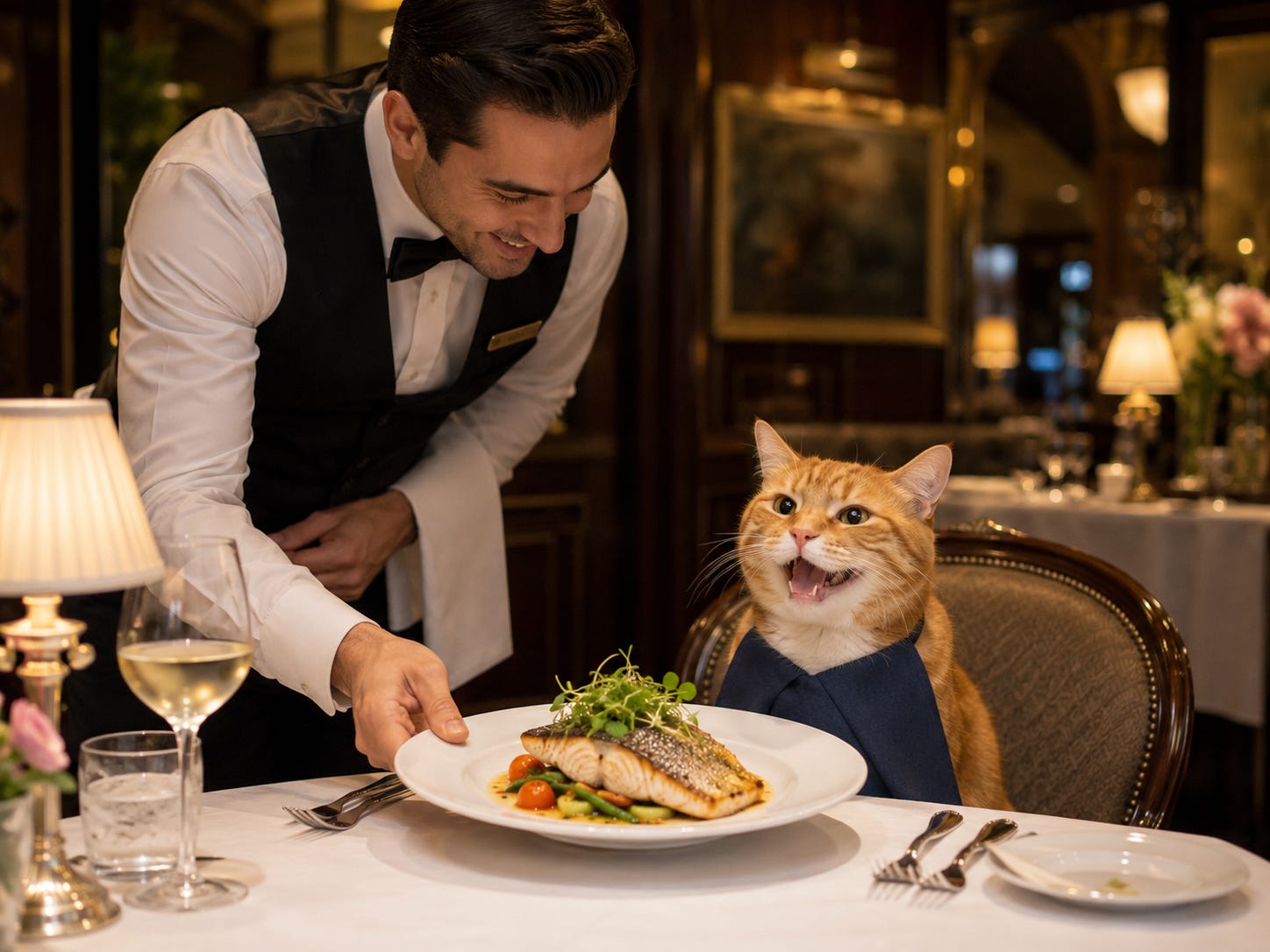
it’s funny, i had been blaming a lot of this seeming decline in service on some sort of change that swept restaurants during the times covidian and from which the labor pool somehow never managed to recover, but i am now of the view that that was likely a red herring. it just happened to coincide with the rollout of these payment terminals/systems.
and as i think back now, i’m not sure i have seen this trend occur in a restaurant still using paper checks and “fill in your own tip amount” lines, but it’s also possible this is confirmation bias and so i want to explore that a bit more, but if i were running a restaurant and wished to ensure good service, i’d be giving serious thought to eliminating these wireless terminals or, at the very least, setting them up with no preset tip amounts and therefore making the entry of any value as easy as any other while eliminating the pressure to choose a preset.
i suspect it would help restore incentives to provide good service.
it also interested me to notice that this breakfast place did not, despite this cavalcade of errors, offer to comp my meal. at dinner the other night, (eating by myself at the bar of another restaurant) my entrée was quite late because, as the manager explained, another waiter (not my waiter) had grabbed it by accident and served it to the wrong table. she (the manager) would not have dreamed of making me complain or ask for something. she’s much too good at her job for that. she just told me it was comped when she brought it to the table personally. this was generous beyond reason and i protested that this was absolutely not necessary. she insisted. and i left a ~35% tip on a paper check as nature and the tipping system intended. (after all, this was not the waiter’s fault and, despite that, they made it right which is precisely the sort of service i am endlessly happy to tip for, especially on such a reduced amount.)
i note that the service at this restaurant remains excellent and the “bad waitstaff who have no idea what they are doing” phenomenon is 100% absent there. so its not the talent pool, it’s something else.
so, let’s end this one with a poll because i’m curious about other people’s perceptions here.
have you noticed a newfound rise in poor or spotty restaurant service? and if so, to what do you ascribe it?
Comments
Nothing yet. Say the first thing.
Sign in to join the conversation.