
In this issue:
Questions > Answers
What on Earth is SAP Joule?
Throw Money At It
Architectural Learning
Cost of Doing Business
Waiting for the Non-Code Moment
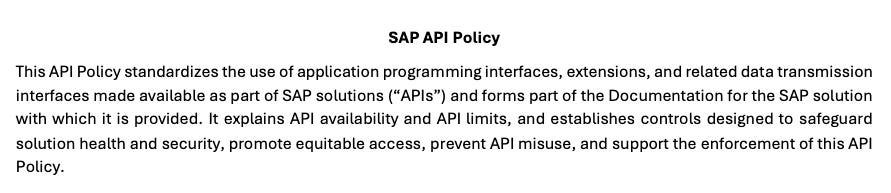
Late breaking news before going to press: SAP drops a stink bomb in the room for people wrangling APIs. I will pull one quote from it and then just leave some questions.
“Except through and within the limits of SAP-endorsed architectures, data services, or service-specific pathways expressly identified and intended for such purposes, SAP prohibits API use for: (a) interaction or integration with (semi-) autonomous or generative AI systems that plan, select, or execute sequences of API calls”
What are the SAP-endorsed architectures that pertain to this?
How much does this matter for the approximately 80 billion MCP servers floating around using ADT?
Is the specific call-out for autonomous/generative AI systems for a particular product announcement or release purpose?
I’m not trying to be snarky (well, maybe a little). I genuinely want to know. PM

[epic action music, Honest Trailers guy’s voiceover]
In today’s… rapidly evolving tech landscape… there is only one game changer. S [boom] A [boom] P [boom] Joule!
[record scratch]
What exactly is Joule, though? Do you know?
“It’s SAP’s AI thing” is the obvious answer, but I can already see people say “Joule” and mean different things, so let’s clear up confusion before SAP renames everything. (Or worse, adds “Build” to the names. Shudders.)
SAP Joule for Developers – a copilot-like tool for SAP development. I’m wondering what the future holds for it because it was late to the game when it was announced. And if you’re late, you need to knock it out of the park with standout features. It just didn’t do that. So why even bother?
SAP Joule for Consultants – the mysterious copilot-like tool for, you’ve guessed it, functional consultants. Rumor has it that it’s kind of OK, but also expensive (here’s one eyewitness account).
Joule Agents – this is the (currently) important part of the whole Jouleverse. Compared to its ugly step-siblings, this capability didn’t start with “too little, too late.” And competitive advantage is there as well. Agents can actually execute business transactions in your system, and having that under the SAP brand will certainly make the purse-string holders feel warmer and fuzzier. Joule agents are built using Joule Studio - here’s a good blog post on how to get started.
SAP is releasing some standard agents, with more on the roadmap. One big question is which systems they’ll be fit for, because there doesn’t seem to be much love for “available in Public Cloud!” right now. In absence of standard, you can also DIY, of course. Agentic ZSAP version, here we come! JP

Boring Nerd Friend Lars Hvam published Patterns for Using LLMs in ABAP Development, so naturally yours truly forgot about other things in my life and read through. Like Heliconia Labs’ other stuff, it is thoughtful, concise, and organized. Lars lays out six patterns and analyzes them under five dimensions: autonomous development applicability, cost, risk, ABAP versioning needed, and applicable ABAP object types covered. From this magnum opus, I glean two things.
First, as many who straddle ABAP and other development worlds recognize, an easy and common pattern in not-ABAP - ephemeral systems that spin up ad-hoc, run to develop and test a single change, and then exit to the Great Recycle Bin in the Cloud - is basically unheard-of (in practice) in ABAP land. From a practical standpoint this makes a lot of sense: the only evidence you need of this is the “” in the “Cost” dimension of the “Decentral” approach. Throw more money at this and you’d have it. (The exercise is left to the reader to establish the cost-benefit relationship on using this approach.)
The other thing I get from this paper is a bit at the end, in section 4.1 “Job displacement”. I have been talking about this a lot for the last few years and I always want to highlight when other people say things like this: “LLMs increase developer productivity significantly. At scale, this reduces the number of developers needed…this may mean role changes”. It’s clear now. It has been for a while: if you develop code for SAP stuff, your job is going to change. If you’re not allowed to use AI to help your development at work, go get in a fight with your management. To not use it is simply absurd.
Both the “Decentral” approach and any sort of AI assistance are going to cost money. Find a blank check somewhere and get going. PM
Once in a blue moon, one stumbles upon a helpful document miraculously made available online by SAP. Some people would quietly bookmark that treasure chest and keep it all to themselves. But not The Boring Enterprise Nerds. We blow the cover right off anything useful we lay our eyes on. (Only for the Platinum Nerdletter subscribers, of course. Make sure to upgrade your membership.)
Helpful treasure chest of the day: SAP Architecture Center. It contains a fair number of architectures and guidelines, with contributions from the broader community. As a bonus, the architecture samples can even be downloaded into draw.io for… well, whatever it is architects do. There’s even a feedback link at the top! Enough to make one almost fall off their ergonomic office chair. Run and download all you can before the Eye of Marketing Sauron finds it and sends Nazguls to spoil the content. JP

The concept of paying per use is not new for enterprises. Even before cloud - and all the jokes about going bankrupt by leaving an AWS instance unattended - there were e-commerce solutions, EDI integrations, and the like.
The AI era kicks it up a notch. A random LinkedIn post asks: is anyone keeping an eye on AI agent costs? And are your partners ready for this brave new “post-go-live Joule goes brr” world?
I have to say, anyone who believes the traditional SAP licensing model was “predictable” and “budget-friendly” must be smoking something. And again, paying off the bridge trolls is not a new business model. But $$ question is: can anyone even forecast the cost of AI agents?
The true cost may be tricky to determine. Another person on LinkedIn claimed to have built a solution for umpteen dollars (in token cost), conveniently forgetting the value of their own time. Serendipitously, while working on the Joules story, I stumbled upon this SAP AI Estimator tool. It seems pretty basic and uses weird units like “requests” and “AI Units”, but it’s better than nothing. Microsoft provides more elaborate, but at the same time seemingly vague, information on the subject. I can’t even begin to imagine how someone would estimate the scenarios of “Microsoft Copilot Agent calls SAP Agent to reply to a customer with their order status”. As always, business dream is an IT nightmare. Now with more AI (tm) JP
Late 2025 was when agentic software development landed. Many - not all - naysayers finally saw the light with Claude Code hooked up to Opus 4.5. I couldn’t agree more: it’s here. You’re probably sick of hearing me say so.
Now go look at what people think of the non-code, business-user-shaped agents. Are these things having an impact? Have they had their Claude Code moment yet? Doesn’t seem like it. For business use cases where agents autonomously perform tasks, the big moment that rallies the masses isn’t here. To me, it feels like a hiccup that’s just about to happen. You know it’s coming, but you can’t predict exactly when, and you get distracted if you try to focus on it.
In the time before the Claude Code wake-up in late 2025, there were people getting lots of value out of coding agents. They had to think through many more details because they lacked convenient harnesses, but they saw the big picture. The same idea applies today in non-coding jobs/tasks: there are people crushing through their unique tasks using AI agent powers. They have had to cobble things together a bit more, but they see the big picture, too. It’s just not happening yet with Joule, Agentforce, or many of these enterprise-y agents. Yet. PM

Watch our Nerdletter Talk 99 for a conversation about these stories and MOAR content too hot for press. Hulu executives, give us a ringy-ding-ding for amazing exclusive ideas!
Are you interested in sponsoring the Nerdletter and featuring your amazing product? Have a story to share or feedback to give? Get in touch!
This newsletter is always free and proudly written by humans and for humans. Show your support before it’s too late!
Comments
Nothing yet. Say the first thing.
Sign in to join the conversation.