
In this issue:
Bot-splosion ‘26 (slightly longer-form)
SAP Integration Suite

If you visit SAP Integration Suite (IS) product page, you’ll see words like “enterprise-grade”, “scalable”, “AI-assisted”, and of course, “business”. But what does it actually do?
Much like Microsoft Office, Integration Suite is a collection of products united by a common purpose: to integrate stuff. SAP refers to these as “capabilities.” They ultimately map to specific applications, I suppose, but the relationships are not always clear. The main components of IS, however, are easier to identify:
SAP Cloud Integration – the Big Kahuna and core of Integration Suite. When people say “Integration Suite,” they often mean Cloud Integration. The correct abbreviation is unclear, but after years of renaming, you might still hear it called “CPI”.
API Management, including SAP Graph (which Paul wrote about back in 2022).
SAP Event Mesh (Advanced Event Mesh is also there).
If you’re wondering why Integration Suite is the talk of the town these days, that’s partly due to mass migration from SAP PI/PO, which is going to ride into the sunset eventually (just like ECC).
Some companies are also asking whether they need Integration Suite if they never used PI/PO. Well, it’s like a kitchen mixer: you can live without one - people made dough and batter by hand for centuries - but it makes the job faster and easier. And once you want to expand your baking repertoire or increase volume, then it becomes unavoidable.
As for SAP professionals wondering whether Integration Suite is a get-rich-quick opportunity: I generally don’t recommend chasing “hot skills”. That said, having any knowledge about IS capabilities is going to be useful. Training materials are a mixed bag, but I can recommend this learning journey for developers and this migration-focused course. Also, check out the Show&Tell on our channel - and subscribe for extra goodness! JP
It Takes a Village to Raise a Fresher
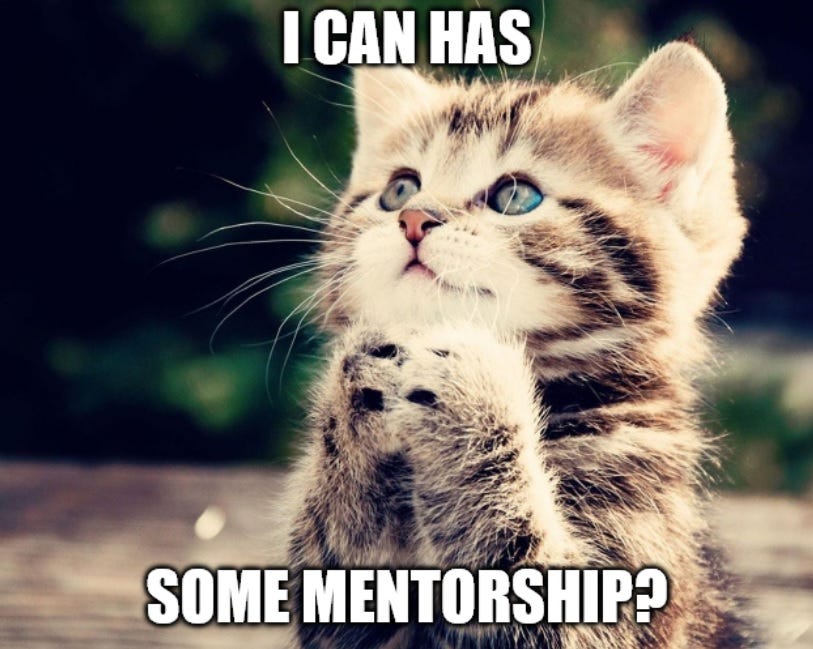
They say “it takes a village to raise a child,” but it also takes a village to be a good parent or to grow as a professional. Humans have survived as a species not because of rabid individualism, but because of our communities.
Yet judging from this heartbreaking Reddit post, this concept is unfamiliar to some organizations. Too often, “freshers” (a colloquial term for recent graduates) are hired as cheap labor and then left to “sink or swim.” What a terrible approach.
Managers, this one is mainly on you. You are managing real people, not just abstract “resources”. Here is what you need in place if you plan to bring in a fresher (or any inexperienced worker):
Actual support. Not just a link to an SAP course, but real time from experienced team members. If everyone is booked at 100%, how do you expect them to find time for mentorship?
Appropriate work. If you hire a developer, give them work where they actually develop something. Don’t assign them to debug SAP or perform tasks they have no chance of succeeding at.
Ongoing guidance. Check in not in a status-reporting way, but in a “do you have the necessary resources?” way.
And a special message to “seniors”: don’t be jerks, guys. Support your less experienced colleagues. This includes not just sharing technical knowledge and corporate wisdom, but also letting them do work and make mistakes (in DEV, of course). I get it that sometimes it’s much easier to push someone aside and do it yourself - but resist the urge. Remember: everyone was a fresher once. JP
Emily Post Sends Regards
A catch-22 of polite society is that pointing out someone else’s bad manners is also considered rude. And it sometimes raises questions like who appointed you the new Emily Post?
That’s why, instead of confronting coworkers who are unfamiliar with Slack or MS Teams etiquette, we just quietly slip them “best practices”, such as this Collaborate With Kindness article from Slack. Are there any doofuses in your life who constantly commit Slack faux pas by not using threads to reply? Or colleagues who just send “hi” on Teams and disappear? You know what to do. JP
Bot-splosion ‘26

A recent Searchlight Institute survey captured this tidbit:
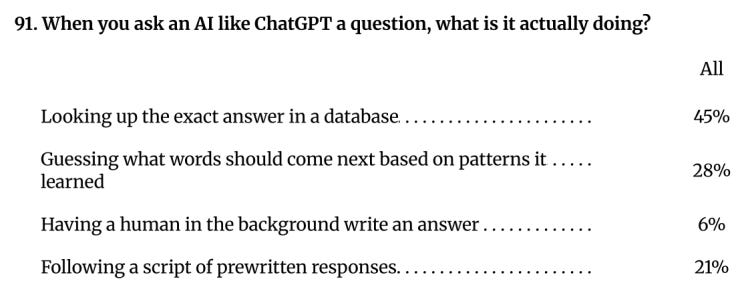
If you’re a switched-on super turbo nerd, you have a smug, hearty chuckle to yourself, “Ha! Those 72% of people who didn’t pick the second choice don’t have a clue!” From those options, the second one is clearly the one intended to be the “right” answer.
In a lot of conversations I hear, not everyone in the 28% bucket is turned on to the idea that predicting the next word from learned patterns is one of the most powerful pieces of technology ever invented. This leads to two seemingly contradictory true statements about enterprise AI:
The technology itself is awesome
At the moment, most applications of it suck
These truths come from people’s belief that next word prediction is best suited to knowledge retrieval, and they design enterprise systems for that. That’s not bad: it is astounding how well modern AIs can answer factoid questions! But if factoid-grabbing is your only measure of the AI’s usefulness, you’re missing a bigger picture.
In this article, I’ll talk about one bigger picture (agents) and give my thoughts on how SAP nerds should look at the Cambrian explosion of SAP assistant chatbots happening.
Yep, I’m Talking About Agents
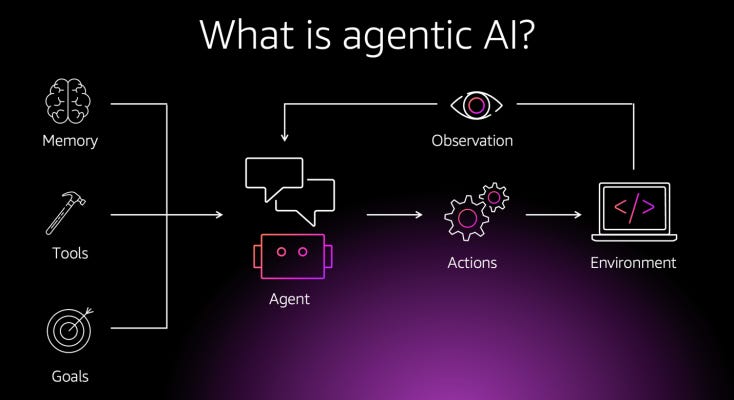
At the base level, next word prediction tells you what a human might say, if given the preceding words in an AI prompt. Now consider that a human has awareness of what external tools he or she might use to answer a tough question. It turns out that, when presented with a menu of external tool options (and trained for this purpose), the AI can also output its prediction of what tool it thinks should be used to continue its line of thought.
The ability to output a tool-using prediction, and have a system respond to that request for the tool, is a core piece of so-called “agentic” AI. In some sense, you could say the AI “knows” that using this tool will better inform its continued next word prediction process. Think of it this way: next word prediction won’t get the AI to information that it hasn’t already been trained on, but next tool prediction opens the hailing frequency to sources outside its training.
The better the tools and the tool use training increases the utility of the AI. It moves the question from “what have you memorized?” to “what can you discover?” or even: “what can you accomplish?”. Properly set up, an agentic approach does SO MUCH FREAKING MORE than a prompt-response approach. But it can also be hard to figure out just what kind of chat/agent/tools/etc are right for your particular scenario.
VOLCANO ERUPTION SAP CHATBOTS EVERYWHERE
At Boring Enterprise Nerds HQ Mega-Plex, we (of course) spend a lot of time talking about SAP stuff. While the SAP world tends to lag the bleeding edge of technology, the marketplace is getting crowded with AI chat/assistants, and so we hear repeatedly about Joule for Consultants and Joule for Developers, ABAP AI Capabilities. (Yes, there are other flavors of Joule - but the marketplace being what it is and our connections being what they are, these two are what we hear and talk about most.)
When presented with an array of options like Joule, it’s important to think about how you’ll decide which is right for you. Our crack research team has finished their analysis, so we proudly present Paul Modderman’s Official Boring Enterprise Nerds Three Point AI Chatbot Evaluation System: Knowing Things, Doing Things, Weirdo Crap
Knowing Things
Does the chatbot know specialized stuff about your needs?
How does it know that specialized stuff?
The “how?” is important here, because that will indicate whether this chatbot can go beyond its own borders to answer questions in its expertise but that it wasn’t trained on. A bot with agentic capabilities can typically go far beyond a bot pre-stuffed with a bunch of answers.
What do you want your bot to know about?
Doing Things
Is this a question/answer bot, or can it accomplish things in my system?
How does it accomplish things in my system?
The “how?” is, again, perhaps the most important aspect. Pre-programmed workflow steps can be useful, but it’s also increasingly possible to have the AI invent a workflow as it goes. The most purely agentic systems can take - rather than a question - a stated goal and direction, then create the pieces of that workflow as it goes.
What do you want your bot to do?
Weirdo Crap
Can this bot adjust itself to my system?
How does it do that?
See the theme? The “how” is important here, too. Every. Single. Business. has unique stuff they need to do - processes, compliance, strange integration scenarios, and more. Same deal - with agentic systems, there is a lot more flexibility to adapt to these scenarios. My take is that this one is the most important.
What does your bot need to adapt to?
Why I’m Going On About This
I’m laying this all out because in your SAP world, you are probably drowning in pitches from bot vendors. They will tell you about the knowledge and capabilities of their solutions (and probably compare them to Joule). But only you can take the weirdo crap from your environment and put the bot through its paces. It might be that non-agentic, simple Q&A bots do exactly what you need. GREAT! Don’t spend the extra money on the fancy stuff, then.
My bet is that once you get good Q&A going, you’re going to want to go to the next level. That’s where you need to pay close attention to the Joule space. Between Joule for Consultants, Joule for Developers ABAP Style, and other kinds of Joule in other places - there are differing levels of agentic-ness on offer. Only your business’ needs can inform whether Joule fits the bill. PM

Watch our Nerdletter Talk 94 for details too hot to publish and exclusive bonus content for Platinum subscribers only.
Treat your ears to Boring Enterprise Nerd Paul Modderman on the ASUG podcast, doing his nerd thing pushing AI.
Are you interested in sponsoring the Nerdletter and featuring your amazing product? Have a story to share or feedback to give? Get in touch!
This newsletter is always free and proudly written by humans and for humans. Show your support to resist AI slop!
Comments
Nothing yet. Say the first thing.
Sign in to join the conversation.