
In this issue:

SAP Devtoberfest has had a somewhat uneven history. It started with a bang back in 2021, then suffered from a Marketing Invasion in 2022, recovered in 2023 (exhibits A and B), and received a glowing Nerdletter review in 2024.
This year, it got new branding (“Devtoberfest by TechEd”) and what looks like a theme: SAP Joule. It clearly dominated the sessions, with some reusing the slides with the same “Accelerate, Empower, Transform” malarkey. Whatever has left from the ABAP track even made one wonder if ABAP is now officially dead. Hoo boy.
I found some respite from Joulefest in the sessions more loosely-coupled with SAP.
Supercharge SAP Build Process Automation with the UiPath Foundation Add-On The marriage of UiPath’s user-friendliness with SAP data might finally give Excel a run for the money. I’m curious to see if this will go anywhere.
Open Resource Discovery – How to build a well-connected metadata catalog across silos. Ignore the boring-sounding name: it’s about an interesting non-SAP concept of ORD that might as well be a solution to many documentation woes.
How to Interview for an SAP Tech Job was a rare crowd-pleaser, as is anything from Thomas Jung. He shared his own experience from suddenly finding himself in a job market after getting caught in the SAP layoff wave.
Bottom Line – Teaching Neural Networks with Snap! was a little gem about programming language Snap! (something like Scratch for adults?). A super nerdy and thoroughly enjoyable session from a passionate presenter Jens Mönig. JP
Trick or share! Delight your friends or annoy your enemies by sending them this special Halloween edition.
I was going to spend a whole post praising friend of the pod Vadim Klimov for an amazing (as usual) video session from this year’s Devtoberfest. And it is amazing! And Vadim is awesome! However, the level of quality inspired me to write about something else.
One secret to doing interesting things is simple: give a crap. Giving a crap about stuff is incredibly powerful. If you wrote a social media post using AI - great! I can imagine no better tool to help you sharpen a thought. But if your writing consisted of a 10-word prompt to get 10 paragraphs of slop - f**k you. You wrecked my brain time because you didn’t care about what you were doing. Give a crap!
If you don’t give enough of a crap to make something that’s worthwhile, why would you put it out there? Nobody cares if you don’t post a blog or video. But if you do post something and it is obvious that you didn’t even give it a glance-over, I judge you. I judge you hard. And I promise other people do, too.
Giving a crap will get you an extra 20% quality boost that compounds with every drop of effort. The result: one minute of Vadim video is worth 100 minutes of shrugs. PM
AI coding agents are blowing up all over the place. Like, duh. If you’re fascinated or find usefulness in them, they’re powerful tools. If not, you’re probably annoyed at upper management getting on your case to use GitHub Copilot. Both are reasonable positions to take, depending on what you’re up to in software.
For those on the useful side, I notice that they’ve taken the time to understand parts of how the AI powering the agents works. Even if the interface feels kinda human and chatty, you’re still interacting with a weird thing that isn’t human. You gotta understand where the carburetor is, and other very manly things I definitely know a lot about.
So if you’re one of those folks who have been pressured and feel stress, I gently suggest taking the time to learn a few things. One great place to start is two short videos by Matt Pocock:
These are great because they’re short and to the point. A 20-minute investment might make a big difference in your dev flow. And don’t take “most devs don’t understand” as an insult - it’s just to get you to click. :) PM
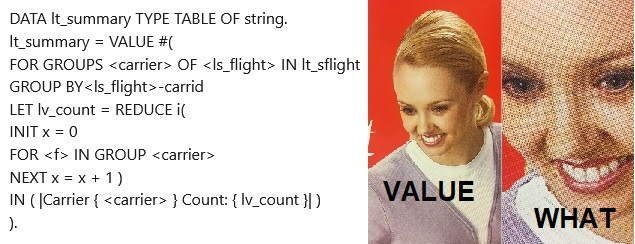
Almost every time I open LinkedIn, there is some post about “modern ABAP.” But what does it even mean? What makes ABAP “modern,” as opposed to… uh… “classic”?
Many authors think it’s about the “new” 7.4 syntax. After all, it was released merely 12 years ago (in the SAP world, that’s practically yesterday). The responses to my question on Reddit also varied widely. And while this cheat sheet offers solid wisdom on the subject, is it even possible to define? Well, FWIW here is my personal interpretation: Modern ABAP According to Jelena is…
Readable. Just like the three secrets of French cuisine are “butter, butter, and butter,” the three signs of modern ABAP are: readable, readable, and readable. It’s not a competition to see who can use the most new commands per line, folks. (By the way, this is also why I absolutely hate EML. Yuck.)
Clean. Yes, yes, I’m going to thump my Clean ABAP Bible again. Deal with it. Clean = maintainable.
Composable. This is not about “composition over inheritance”; it’s about the vibe. It’s not enough for the code to just be modular. If you can’t easily build stuff from those modules, then what’s the point?
Purposeful. It’s tempting to turn to prescriptions: use X model or Y technique and bada beem, bada boom - hip, modern ABAP. I think it’s more important to understand what we are doing. Like what problems are we solving and what value are we adding? I won’t simply equate modern ABAP with ABAP Cloud. If a customer wants an ALV report in 2025 and that’s what makes sense for their use case, then they will get the most modern ALV report. Cloud-compatible doesn’t automatically mean good. There are ABAP crimes being committed even with RAP and CDS views.
Come to think of it, my modern ABAP sounds suspiciously like what classic ABAP should have been all along. It doesn’t surprise me, though: modern ABAP didn’t just appear out of nowhere - it’s a rebirth of the OG ABAP from the sea foam of experience. JP
This oldie but goodie TED Talk video is best summarized by one of the YT comments: “I like how it’s all information we know, but still it needs to be said before you realize it”.
Indeed, reminding us that we need to not just perform but take time to practice doesn’t sound at all groundbreaking. But I especially appreciate Eduardo Briceño highlighting the importance of making mistakes.
I’ve seen this in quite a few beginner developers: paralyzed by the fear of “breaking the code”, they did not experiment and explore. Want to get better at something? Get into the Learning Zone and start breaking stuff! A short dump is a valuable learning experience, as long as it’s not in Production. JP

Stack Overflow always does a great job with their yearly developer surveys. The 2025 survey results are here, ready to digest. (By the way, I also think that SAP does, too - but where are the 2025 survey results?) If you’re not interested in AI, you can probably just move along from this survey. A great deal of it focuses on AI adoption/usage, and you get great insights into that world through Stack Overflow’s lens.
I want to highlight one simple factoid which the writeup seems to want you to think is bad but I think is good. According to those surveyed, only 3.1% highly trust the accuracy of AI tools. In the current AI agent regime, this is the right take. If you are not in that 3.1%, you officially have the Correct Opinion. Congratulations!
I work at an AI company, and I think you should treat AI agent code output exactly like you would a fellow human developer’s code. Read it to understand it, and question the decisions. This makes everyone better. This is not at all the same thing as saying that AI coding agents are useless - far from it! They are INCREDIBLY useful - but they’re not magic. Yet. PM

The Nerdletter Talk is lurking in the shadows of our SpookYTube channel. Enter if you dare for haunting insights and enterprise frights. And smash that Like button before it rises again!
Have a potion to show or a tale from the crypts of enterprise software to tell? Get in touch!
Sponsor The Nerdletter and your brand could be the treat among the tricks!
This newsletter is brewed by humans, not AI zombies. Keep us caffeinated and curse-free!
Comments
Nothing yet. Say the first thing.
Sign in to join the conversation.