
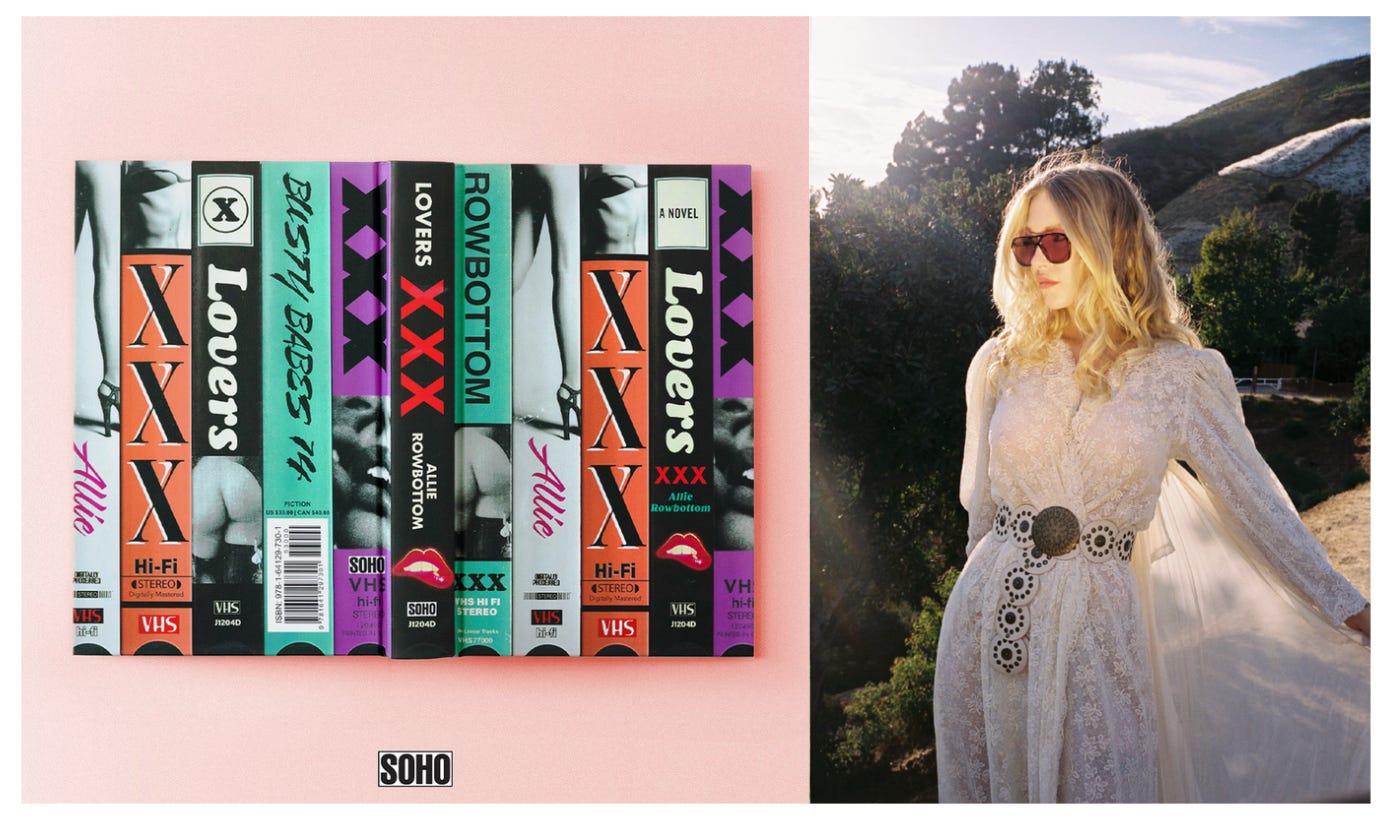
I am so excited to share today a Q&A with the incredible Allie Rowbottom, who is the author of June 2026 new release Lovers XXX, a book that I devoured in a few days and easily gave 5 stars. I LOVED, LOVED, LOVED THIS BOOK! (love three times for each X ok?)
Lovers XXX is centered around two young women navigating the porn industry in Los Angeles 1980s. Hailed by the New York Times book review as a novel “everyone will be reading this summer”, and recommended by the LA Times and The Guardian, this is the thought-provoking, edgy novel of the summer. In the answers below, Allie gives us the scoop on inspiration for her novel and navigating writing an underrepresented subject matter in literature.
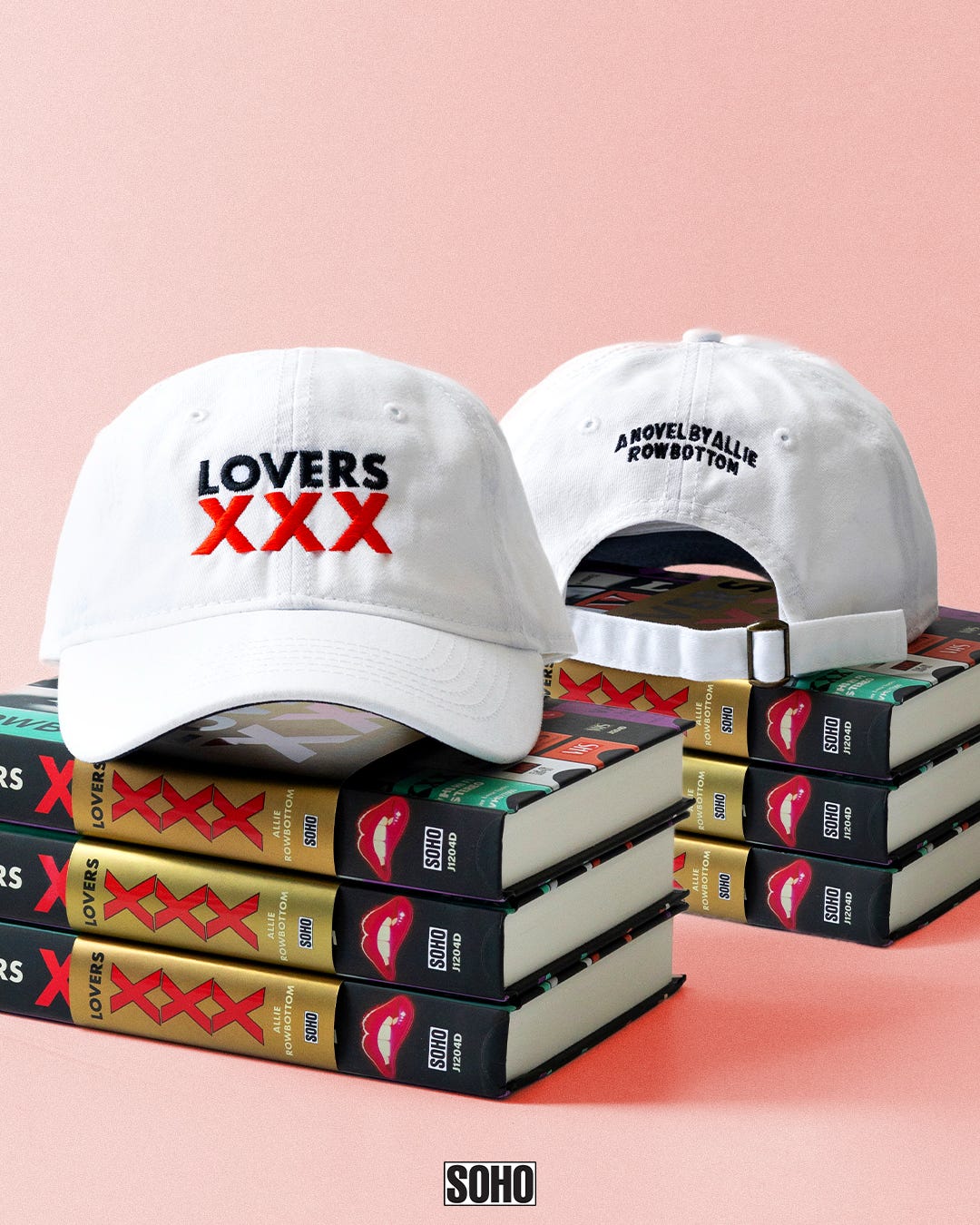
I am also excited that Lovers XXX is the August book club with lauren pick! I will be doing a giveaway (see giveaway via Notes here!!!) for 5 COPIES of Lovers XXX also including some fun book club goodies! I’m sure some may initially feel that a book or discussion centered around porn is uncomfortable, but I am a firm believer that reading is one of the most important catalysts for meaningful conversation and growth. Rarely is growth rooted in comfortable bounds, and I think readers have so much to gain and learn from this novel. There is so much empowering conversation to be had around Lovers XXX, and I can’t wait for more of you to read it.
Anyone who purchases LOVERS XXX gets FREE admission to a writing and publishing Q&A Allie is doing on zoom August 30th ❤️🔥 Just dm her proof of purchase and she’ll send the login info and details.
Thank you to Allie who so thoughtfully answered these questions! I’m obsessed with these answers!!!
If you’re curious about my thoughts on the book, you can see my longer review here:
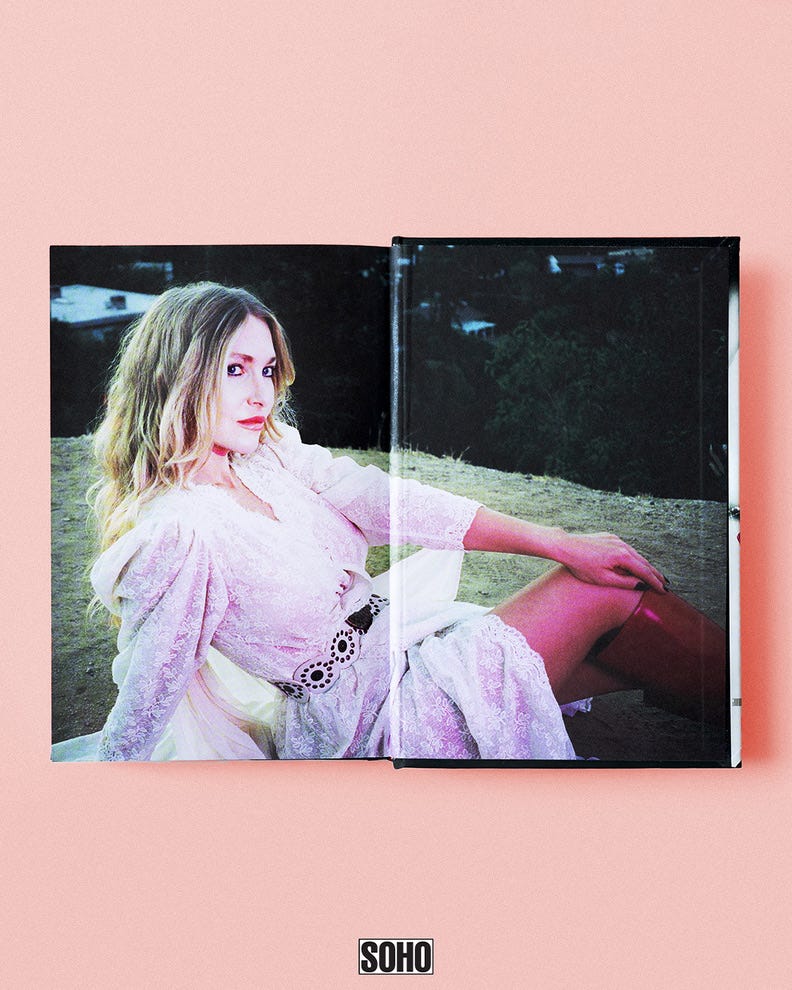
LAUREN: Lovers XXX does an impeccable job at balancing a literary fiction character driven plot, with the tension and pacing of a thriller. It’s rare to see that combo and I loved every second of it; there was so much emotional depth while simultaneously being unputdownable. Why did you decide to pursue a thriller route?
ALLIE: As a novelist working in 2026, with the market for literary fiction shrinking exponentially, it behooves me to consider how to keep readers turning pages. Actually, it would always behoove me to consider that (such is any writer’s job!) but more so in 2026. There’s just so much media to compete with, not to mention readers’ attention spans, which are shrinking. I would be hard pressed to write another novel that doesn’t have thriller elements for that reason. But I would never writer a thriller without also making it a literary-minded character study. Characters drive plot and plot forces characters to reveal their truest selves. You don’t, imo, get one without the other. There’s also this: in LXXX the characters are working in a wild industry at a wild moment in history. So the plot had to fall in line and get wild too.
LAUREN: Romantasy is a genre that has exploded in popularity in the last several years and has taken over Booktok and Bookstagram. With the popularity of these books, why do you think people are still so hesitant to read a book centered around the porn industry?
ALLIE: Right before sitting down to answer this question I was reading Working Girl by Sophia Giovannitti (recommend), who quotes affect theorist Lauren Berlant as such: “Fantasy is the means by which people hoard idealizing theories and tableaux about how they and the world ‘add up to something.’”
Porn, the way most people consume it, is a fantasy; it exists in consumers’ lives for the purpose of visiting and performing that fantasy. Consumers might intellectually know porn isn’t real, but to truly contend with the reality of porn requires contending with the fact that our fantasies, too, aren’t real. And I don’t just mean the fantasies portrayed in porn, but also the fantasy that porn can be boiled down to a tidy moral judgement (it truly can’t). Put another way, most people have a fantasy about porn, even if they don’t use porn, even if that fantasy is simply that porn is gross; and most people don’t want their fantasy challenged.
I’ve never read a romantasy novel, but I would hazard a guess that, like porn, the idealizing worldview these novels present differs vastly from reality as most of us understand it. The genre is an escape, as is pornography for many people, who would prefer not to have their proverbial bubble burst. I get it: the world is so stressful these days. Everyone is yearning for fantasy and escape. But I fear that we’re all getting dumber because of it. And I do think we have a responsibility to ourselves to resist the urge to numb out by reading for dopamine hits rather than for empathy and understanding, as is delivered by the best literary fiction.
I do want to say: one thing that separates romantasy (however graphic) from porn, is shame. In the past five to ten years it seems like we’ve seen a pretty remarkable shift in how readers feel about reading fantasy and romance–it’s no longer as disdained as it once was, and I think that has everything to do with the internet, social media, and the attendant democratization of taste. Nobody is ashamed of having “low brow” taste anymore, for better or for worse. But many people–for reasons having to do with religion, I guess–remain ashamed of using porn. Or ashamed of partners who use porn. Which in turn makes them less interested in explorations of porn that refuse to moralize.
LAUREN: The scenery was SO vivid and well researched. I’d love to know more about how you researched this era? Any restaurants or site visits you did to get a grasp on the scenery?
ALLIE: Ah! Well, I live in Malibu, which is right over the hill from the San Fernando Valley. Certainly the Valley has changed significantly since the early 80s. But in many ways, it retains its iconic, sprawling, seedy vibe. Much of the site visits and scenic detail in the book came organically, from spending a lot of time in the valley, running errands and just living my life. But one specific place bears mentioning: the “Fuck Palace” as it’s referred to in the novel, is based on the home of my friend, Jamie Nelson, an incredible photographer who has renovated her Northridge ranch house to the specifications of the late 70s/early 80s. You can see it here.
LAUREN: Jude and Winnie are incredibly complex characters. I loved their evolution throughout the book, the good and bad. What inspired their characters?
ALLIE: Well, they started out loosely based on Joni Mitchell and Judee Sill, my muses for the singer/songwriter version of this novel. Joni Mitchell is obviously the better known of the two and I loved her backstory–teen motherhood, giving up her child for adoption so she could pursue a career, fame and fortune, missing Woodstock, painting, reconnecting with her daughter late in life. Much of that is not in Winnie, but I think of her as the Joni of the two. Whereas Jude is so Judee Sill, an iconoclast and addict with an interest in religious ecstasy, who robbed liquor stores to feed her heroin habit. But really, most of Jude and Winnie came from myself, my relationships. This novel is my least autobiographical. But as Flaubert famously said, Madame Bovary, c’est moi.
LAUREN: I am a huge fan of books that confront hard truths without any softening. Cognitive dissonance is something I’m constantly getting myself into trouble with when I bring it up in conversations. Why do you think porn remains taboo despite being a billion dollar industry?
ALLIE: That’s a topic for another book. It’s just such a vast, nuanced and gnarled answer. Let me try the cliff notes, though. Given human history, given patriarchal hegemony (the normalization of male dominance), sex work, a loophole through which women might assert some dominance, some power over men, has had to be criminalized, demonized, derided, so as to maintain existent power structures. Treating women, and sex workers specifically, less as discardable objects who exist to facilitate male pleasure, than as humans with free will, agency, sex drive, equal rights and abilities, would entirely overturn the world order.
Of course today there’s more equality, but old notions about sex work, and porn particularly, persist in the form of taboo. It’s a double edged sword because the very taboos that keep sex workers from accessing rights and safety, also fuel industries like porn, taboo, the forbidden, being closely linked with human desire. But taboo is also closely linked with shame. And when people feel shame, that squirmy, uncomfortable emotion, they often project it onto whoever “made” them feel that way. In this case, the porn star.
LAUREN: Other related sex-work/porn industry books/movies/TV shows (i.e. Pretty Woman, Margo’s Got Money Troubles, Anora, The Calamity Club) don’t at all show the exploitative side of the industry and in fact attempt to show the empowerment of the women protagonists (which I actually find to be glorification and commodification masked as empowerment). What inspired you to take a differing approach?
ALLIE: I resist the idea that a cultural mechanism as vast and omnipresent as pornography, with which billions of people have a relationship, could be reduced to the good/bad, empowering/disempowering binary. It’s simply impossible for it to be any one thing. It’s like the internet. Or like music. It’s omnipresent, intrinsic. But when something is so vast, it’s human to want to make it one thing, good or bad, empowering or disempowering. Otherwise, it’s overwhelming, and scary, quite frankly.
I knew I wanted to show as many differing relationships to porn as I could within the confines of a 400 page novel. While researching, I read and listened to a lot of testimonies from adult performers of the 70s and 80s, mostly women. Many of them felt positively about their careers, which were fun, and compensated them well; I wanted to be sure I honored that experience without turning away from those who had different experiences, who sometimes didn’t live to tell them. But I likewise didn’t want to oversimplify by suggesting Jude was empowered by her work and Winnie wasn’t. I had to give them both contradictory experiences. That felt the most realistic.
LAUREN: I find a lot of irony in the fact that the porn industry is designated “adult film” when the average age of many porn stars is 22, with most entering the industry between ages 18 to 25. Despite the legality behind the number, hardly anything feels adult about an 18 year old. When I felt frustrated by Jude and Winnie’s actions throughout the book, it’s probably because I was forgetting their age. Was this something that you intentionally wove into the narrative?
ALLIE: And yet, here in 2026 the most popular category by a landslide is that of the “MILF”!
A huge part of any satisfying narrative about porn performers has to be how they got into the work. And as you say, most people who perform decide to do so in their late teens and early twenties. It wasn’t hard for me to imagine making that choice at their age, not at all. But of course a huge part of the story, and one I think is less common is: what happens once the choice is made and the career has run its course? After the energy and excitement and first times have come and gone; after glitter fades, as it were. Maybe that’s why the second portion of the novel is my favorite, and the part I’m most proud of.
LAUREN: You originally were planning to write the book about musicians with 1960s Laurel Canyon as the backdrop. What propelled you to shift the narrative?
ALLIE: Honestly, I started researching that time period and felt slightly bored! It was harder to find the heart of the novel, I think because my interest as an artist tends to position itself on the razor edge between empowerment and objectification. Certainly the music industry offers up plenty of scenarios in which this razor edge must be walked; but for me, porn felt more daring, complex and fresh. I’m also pathologically drawn to subjects I feel are underrepresented in literature, for little reason other than they have to do with women the literary establishment might dismiss as silly, unserious, and therefore unimportant. My last novel, Aesthetica, was about an influencer with a plastic surgery addiction. Setting this novel in the porn industry felt like a fitting continuation of some of the conversations I started in that novel and some of the institutional buttons I like to push, for better or for worse.
LAUREN: I’m actually going to re-read Lovers XXX before book club in August. I think that there was so much packed into this book that I’d like to revisit and analyze. If there is one thing that you hope readers take away from reading Lovers XXX, what would that be?
ALLIE: The heart of the novel, which is about love.
Join us in August for book club! I’m cooking up some extra special activities for engagement and discussion in August! Subscribe to book club with lauren. See details on the how to here.
Join book club with lauren , a virtual book club! See deets here
Join me on Goodreads here :)
No posts
Comments
Nothing yet. Say the first thing.
Sign in to join the conversation.