
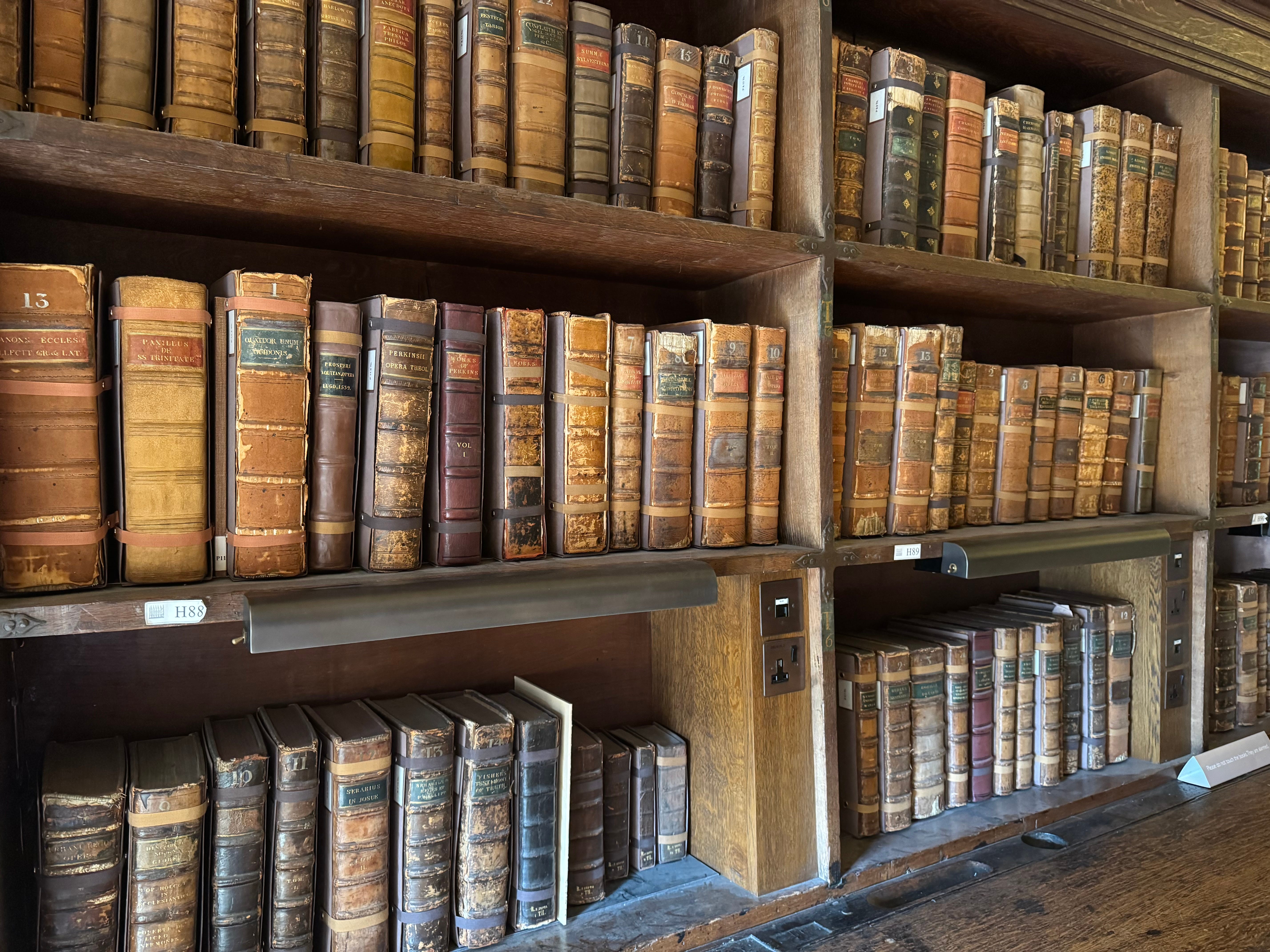
A few weeks ago, I was reading in the Duke Humfrey’s Library at Oxford University. Above the desk were books that were hundreds of years old. Many of them contained a word I was unaccustomed to seeing on the spine of a book. That word was Opera.
I looked it up and learned that Opera was part of a Latin phrase (opera omnia) that referred to the complete works of a single author. Opera is the plural form of opus (a work or labor).
I loved that idea. There in front of me were the complete works, the opera, of different authors.
The book I had brought into the library to read was Plato Complete Works. Here I was in front of a bunch of books of Opera with my own copy of Plato’s Opera.
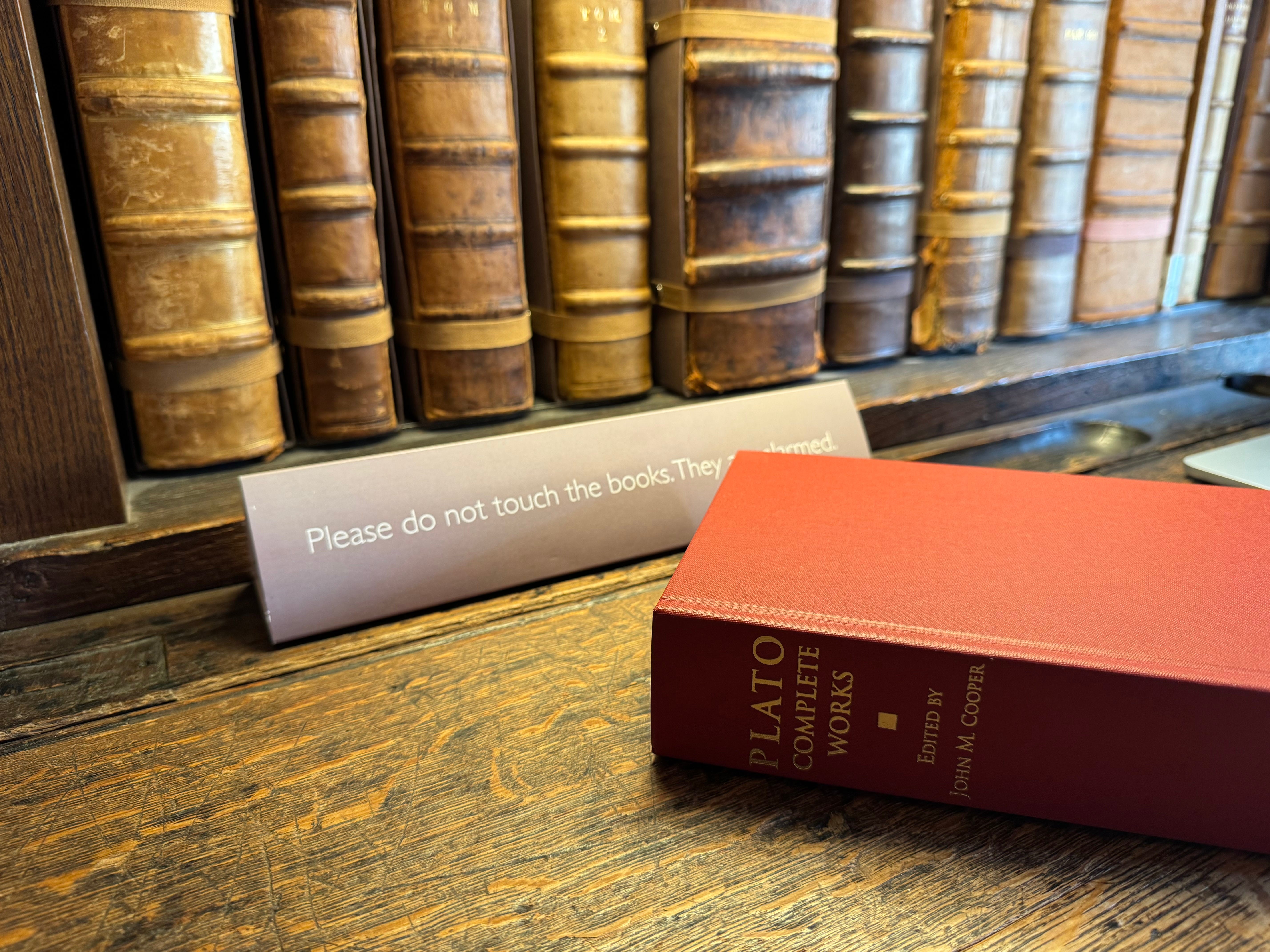
Something dawned on me. Here I was trying to figure out the list of Great Books that I wanted to read for this reading project. But as I continued on, I was enjoying the reading so much that I was naturally choosing to read the Opera of each author. Despite initially selecting a few plays per tragedy playwright, I had ended up reading the complete surviving works of Aeschylus, Sophocles, and Euripides. I had initially decided to read a few dialogues of Plato, but here I was, slowly making my way through his Complete Works.
So, I’ve made a few executive decisions for the Books of Titans reading project. I’m setting aside 40 years to read through the complete works of 200 authors. Those are my limits - 40 years, 200 authors. I’ve thought long and hard about these authors (my list has always centered around authors first and books second with this recent decision to not select particular works, but to read them all, within reason). I’m four years in of the total 40 years and I am 46 years old, so 36 more years makes this a lifelong reading project. I’ll read the works chronologically by author according to the year the author’s death. There are only two authors who died within the past 50 years.
I combat burnout by taking regular breaks during the year. Eight months are dedicated to The Great Books and four months to the Bible and newer books that catch my fancy. Forty years may sound like a terrible chore, but these last few years of reading have been the best of my entire life. I look forward to the next 36 years of reading with great anticipation.
I have a rather strange goal with all of this. C.S. Lewis is the 194th author on my list. By the time I reach him and read his complete works, I want to catch the majority of his references to earlier works, not because I can see them mentioned in the footnotes, but because I’ve come to know those works in my soul.
The 200 Immortal Authors
Here they are in chronological order. The year either signifies our best guess of a creation date or the author’s year of death. Many of the works are by unknown authors. In those cases, I’ve listed the name of the work instead of the author’s name (Gilgamesh, the Rig Veda, The Mabinogion). If the author or work is in bold, I have read their complete works as part of this Books of Titans reading project. As you can see, I have a long way to go over the next 36 years:
Enheduana - 2250 BC
The Epic of Gilgamesh - 2100 BC
Writings from Ancient Egypt - 2000 BC
Enuma Elish (Creation Epic) & Atrahasis (Flood Myth) - 1700 BC
The Rig Veda - 1500 BC
Homer - 700 BC
Hesiod - 700 BC
Sappho - 570 BC
Aesop - 564 BC
Lao Tzu - 531 BC
Sun Tzu - 496 BC
Confucius - 479 BC
Aeschylus - 456 BC
Herodotus - 425 BC
Sophocles - 406 BC
Euripides - 406 BC
Thucydides - 400 BC
Aristophanes - 386 BC
Xenophon - 354 BC
Plato - 348 BC
Aristotle - 322 BC
Chuang Tzu - 286 BC
Epicurus - 270 BC
Euclid - 270 BC
Archimedes - 212 BC
The Ramayana - 200 BC
Terence - 159 BC
Lucretius - 55 BC
Cicero - 43 BC
Virgil - 19 BC
Ovid - 17 AD
Livy - 17 AD
Seneca - 65 AD
The Bible - 0
Josephus - 100 AD
Quintilian - 100 AD
Tacitus - 117 AD
Plutarch - 120 AD
Epictetus - 135 AD
Ptolemy - 168 AD
Marcus Aurelius - 180 AD
The Mishnah - 200 AD
The Bhagavad-Gita (in the Mahabharata) - 200 AD
St. Irenaeus of Lyons - 202 AD
Origen - 253 AD
Plotinus - 270 AD
Eusebius - 339 AD
St. Athanasius of Alexandria - 373 AD
St. Basil the Great - 379 AD
St. Gregory of Nazianzus - 390 AD
Gregory of Nyssa - 395 AD
St. John Chrysostom - 407 AD
St. Jerome - 420 AD
St. Augustine - 430 AD
The Talmud - 500 AD
Boethius - 524 AD
The Koran - 632 AD
Beowulf - 1000
Murasaki Shikibu - 1014
Abolqasem Ferdowsi - 1020
Sei Shōnagon - 1025
The Song of Roland - 1100
Saint Anselm of Canterbury - 1109
Anna Komnene - 1153
Hildegard of Bingen - 1179
The Mabinogion - 1200
The Forest of Thieves and the Magic Garden - 1200
Moses Maimonides - 1204
Magna Carta - 1215
Saint Francis of Assisi - 1226
The Saga of the Volsungs - 1270
The Poetic Edda - 1270
Rumi - 1273
Thomas Aquinas - 1274
Njal’s Saga - 1280
The Sundiata - 1300
Dante Alighieri - 1321
The Tale of the Heike - 1330
Giovanni Boccaccio - 1375
Geoffrey Chaucer - 1400
Sir Gawain and the Green Knight - 1400
Julian of Norwich - 1416
Margery Kempe - 1438
The Arabian Nights - 1450
Thomas à Kempis - 1471
Niccolò Machiavelli - 1527
Thomas More - 1535
Desiderius Erasmus - 1536
Nicolaus Copernicus - 1543
Martin Luther - 1546
The Book of Common Prayer - 1549
François Rabelais - 1553
John Calvin - 1564
Teresa of Avila - 1582
St. John of the Cross - 1591
Michel de Montaigne - 1592
Edmund Spenser - 1599
The Story of Hong Gildong - 1612
William Shakespeare - 1616
Miguel de Cervantes - 1616
Francis Bacon - 1626
John Donne - 1631
George Herbert - 1633
Galileo Galilei - 1642
Miyamoto Musashi - 1645
Westminster Confession of Faith - 1647
René Descartes - 1650
Blaise Pascal - 1662
Molière - 1673
John Milton - 1674
Baruch Spinoza - 1677
Thomas Hobbes - 1679
John Bunyan - 1688
Matsuo Bashō - 1694
Jean Racine - 1699
John Locke - 1704
Isaac Newton - 1727
Daniel Defoe - 1731
Alexander Pope - 1744
Jonathan Swift - 1745
Charles-Louis Montesquieu - 1755
David Hume - 1776
Jean-Jacques Rousseau - 1778
Voltaire - 1778
Founding Fathers - 1787
Adam Smith - 1790
Edward Gibbon - 1794
James Boswell - 1795
Olaudah Equiano - 1797
Immanuel Kant - 1804
Jane Austen - 1817
John Keats - 1821
William Blake - 1827
Georg Wilhelm Friedrich Hegel - 1831
Johann Wolfgang von Goethe - 1832
Sir Walter Scott - 1832
Samuel Taylor Coleridge - 1834
Alexander Hamilton, John Jay, James Madison - 1836
Alexander Pushkin - 1837
Emily Brontë - 1848
Edgar Allan Poe - 1849
William Wordsworth - 1850
Mary Shelley - 1851
Søren Kierkegaard - 1855
Charlotte Brontë - 1855
Alexis de Tocqueville - 1859
Arthur Schopenhauer - 1860
Nathaniel Hawthorne - 1864
Alexandre Dumas - 1870
Charles Dickens - 1870
John Stuart Mill - 1873
George Eliot - 1880
Gustave Flaubert - 1880
Fyodor Dostoyevsky - 1881
Charles Darwin - 1882
Ralph Waldo Emerson - 1882
Karl Marx - 1883
Victor Hugo - 1885
Emily Dickinson - 1886
Herman Melville - 1891
Walt Whitman - 1892
Alfred Tennyson - 1892
Frederick Douglass - 1895
Harriet Beecher Stowe - 1896
Friedrich Nietzsche - 1900
Anton Chekhov - 1904
George MacDonald - 1905
Mark Twain - 1910
Leo Tolstoy - 1910
William James - 1910
Henry James - 1916
Marcel Proust - 1922
Joseph Conrad - 1924
Franz Kafka - 1924
Thomas Hardy - 1928
G.K. Chesterton - 1936
Edith Wharton - 1937
Sigmund Freud - 1939
William Butler Yeats - 1939
Mikhail Bulgakov - 1940
James Joyce - 1941
Virginia Woolf - 1941
Dietrich Bonhoeffer - 1945
Willa Cather - 1947
Sigrid Undset - 1949
George Orwell - 1950
Ludwig Wittgenstein - 1951
Albert Einstein - 1955
Thomas Mann - 1955
Dorothy Sayers - 1957
Zora Neale Hurston - 1960
William Faulkner - 1962
W.E.B. Du Bois - 1963
C.S. Lewis - 1963
Flannery O’Connor - 1964
T.S. Eliot - 1965
John Steinbeck - 1968
J.R.R. Tolkien - 1973
Daphne du Maurier - 1989
Aleksandr Solzhenitsyn - 2008
24 of the 200 authors are female, including the very first author on the list
Comments
Nothing yet. Say the first thing.
Sign in to join the conversation.