
Inspired by the excitement around the World Cup, and in preparation for the new season of Ted Lasso coming out on August 5th, I am currently rewatching the first three seasons of the show. This is my ideal show as I am a complete sucker for found family, community building in the midst of struggle, and humor mixed with heart. Luckily, you do not need to know much about sports to enjoy and understand this show. I often joke that my sport in high school was Mock Trial, and I was the kid with asthma who was allergic to the grass we had to run around during Physical Education class. In Junior High, I had straight As in all of my classes except Gym because I couldn’t climb the wall or the rope ladder. That B+ still haunts me. My love for sports is about the team work, the fans, the stories of the athletes, and the overcoming of obstacles.
I tell my students that I am their English coach as well as their English teacher, as many of them are willing to put in the hard work to succeed in their sports, and I hope they’ll bring that same work ethic to their studies. At my school, we call students who play sports “scholar-athletes,” and I have seen how students who are challenged on the field or court can be encouraged to approach the classroom with the same determination.
When I teach my students to dig into challenging texts and write thoughtful responses to these works of literature, I hope that they will become better readers because I believe that that will help them become better people. Our culture often treats education like career training, and so students begin to focus on grades in order to get into a prestigious college in order to get into a high paying job. This leads to the distressing trend of discounting school work which doesn’t have an obvious connection to career success. I believe that becoming a great reader is not primarily important because of its financial value but for its life changing benefits, and I try to teach students books the same way that Coach Lasso instructs soccer players.
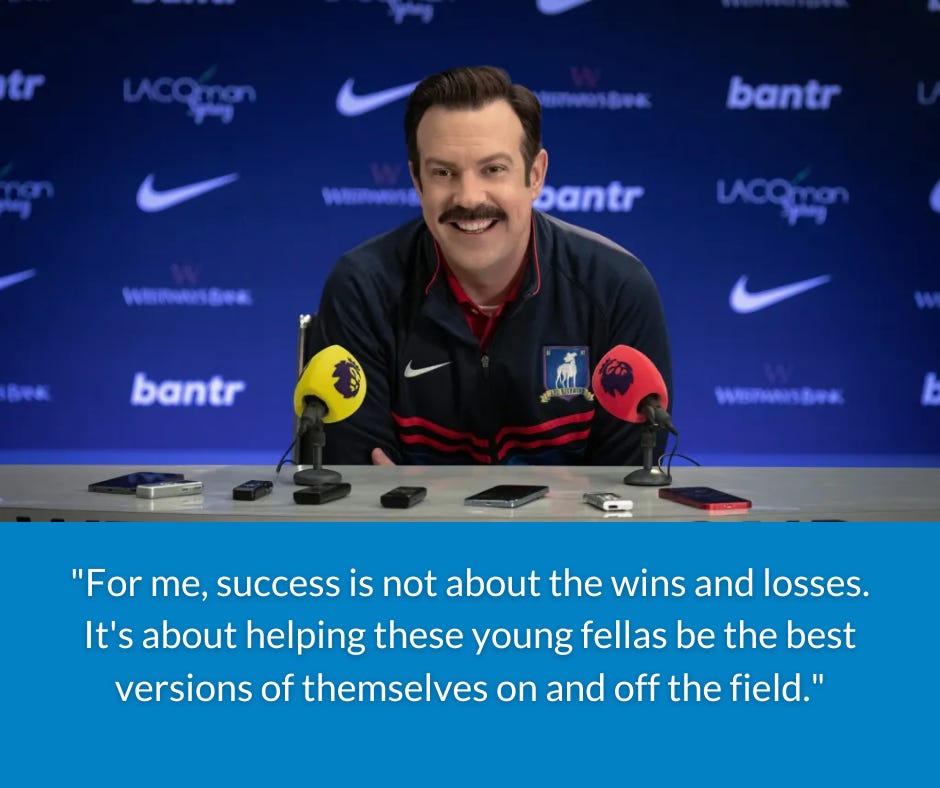
When asked his plans for winning, Coach Lasso happily declares to a room full of reporters,
Until this latest re-watch, I had forgotten that one of the ways that Coach Lasso goes about inspiring his players to become the best versions of themselves is to give them individually curated books that will speak to each of their personal and professional journeys. The arrogant Jamie Tartt throws away his book, the F. Scott Fitzgerald cautionary tale, The Beautiful and the Damned, and it will take him many episodes to begin to learn the lessons he refused to learn by ignoring that book. On the other hand, the team captain Roy Kent, reluctantly reads Madeline L’Engle’s classic, A Wrinkle in Time, and learns how to lead his team
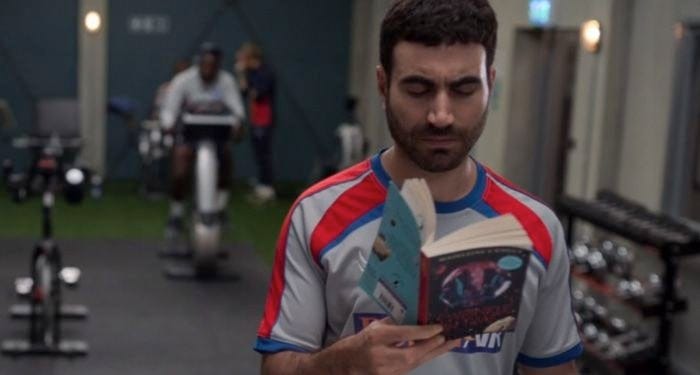
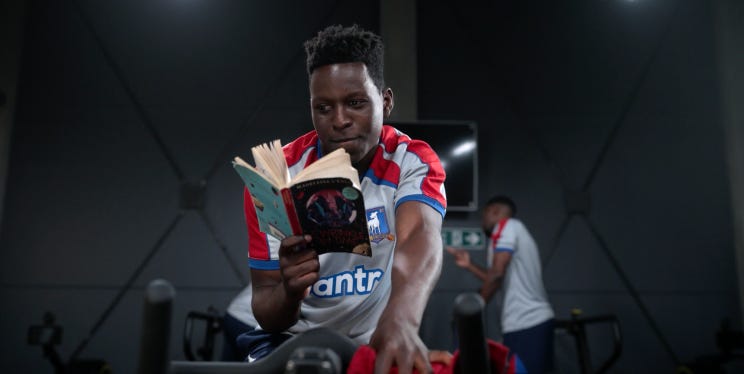
After first receiving the book, Roy skeptically demands from Ted, “What even is a wrinkle in time?” And, here Trent Crimm can’t help but jump in with, “It’s a lovely novel. It’s the story of a young girl’s struggle with the burden of leadership as she journeys through space.” Roy angrily asks if he’s supposed to be like the little girl, and Ted smilingly answers, “I’d like you to be.” Later that night, Roy is reading the book aloud to his sweet young niece when he comes across a realization from the protagonist, Meg: “It has to be me. It can’t be anyone else.” The line resonates so profoundly for Roy that he drops the book and swears as if he’s been personally slapped in the face by the story. The audience then watches him step deeper into his role as the leader of the team, and even pass the book onto his teammate, Sam, who is seen later reading the story while working out in the team training room.
To be able to see someone clearly and understand what book will help, motivate, encourage, and inspire them is a gift of all great teachers, but also anyone interested in loving others well. One reason we often ask people what their favorite song, movie, show, or book is is because we want to understand who they truly are. What makes them tick, what motivates them, and what do they care about?
A trend that worries me is that so many people are filling their days with short form entertainment. Not only short video content, but also music that they just hear in bits and pieces on Tik Tok edits, or snippets of movies out of context, or paragraphs from whole books taught in class without being asked to read the whole novel. When you ask people, especially young people, what kind of music they listen to, movies they watch, TV they like, or books they read, it is often a struggle for them to come up with specific answers, much less thoughtful reasons beyond, “It’s funny” or the guy in it is cute.
In a scene where Ted is trying to understand and befriend the intimidating sports psychologist, Doctor Sharon Fieldstone, he asks her, “What’s your favorite book?” She doesn’t answer until the end of the episode when she says that her favorite book is Pat Conroy’s 1986 novel, The Prince of Tides. This book about a football coach who is helped by therapy that he initially avoids is a perfect parallel to the situation Ted finds himself in with Doctor Sharon. Knowing that she connects with a book that depicts a therapist as an ally to a coach who hides behind a sunny exterior, causes Ted to begin to see her differently and trust her more completely.
This moment shows that curiosity about people is the best way to form connections with them. If Ted hadn’t asked that question, he would have continued to project all of his own insecure assumptions on who Doctor Sharon is and what her motivations are. There’s another scene that demonstrates this idea beautifully in which Ted gives a moving speech based on a quote he attributes to the writer Walt Whitman. The quote is an instruction for living well, “Be curious, not judgmental.”
He went on to explain that people had underestimated him his whole life, and we can see that happen throughout the series. Ted’s a little too earnest and that makes him “cringe” to many of the hyper cool and self-conscious characters around him. He seems slow on the uptake, and is easily seen as a goofy jock who acts like a joke. But, through it all, he shows himself to be incredibly emotionally intelligent, empathetic and engaged, and strategically sharp. His casual references to books, plays, and authors make it clear that he is never done learning and soaks up wisdom like a sponge.
In a time when we are rewarded for “owning”, roasting, cancelling, and “destroying” each other online, the idea of slowing down and looking for the best in others is radically counter cultural. Another lesson that Ted shares along these lines is that “all people are different people.” Not all members of a particular group can be lumped into the same mold and treated as a monolith. Again, this is where curiosity saves us from jumping to harmful conclusions.
I once attended a professional development seminar that explained research shows that curiosity is also important as one of the leading indicators on how well a student will do in their studies, and sadly shows that students often become less curious with each year that passes. Holding onto the desire to question, wonder, learn, and grow is what makes us strong individuals who make up a strong community.
And, nothing can train our curiosity like books. We open a book and assume only that we are going to be taken for a ride. The less expectations and assumptions the better. We don’t know where or how we will be surprised or changed, but if we are not different in some way at the end of the book we leave a little disappointed and look for a story that will make us a better version of ourselves. Ted Lasso often uses meta references to storytelling to explain what the characters are experiencing in the world of the show. One of these examples is this moment where the team is going through a difficult time in their season. Ted says to the team:
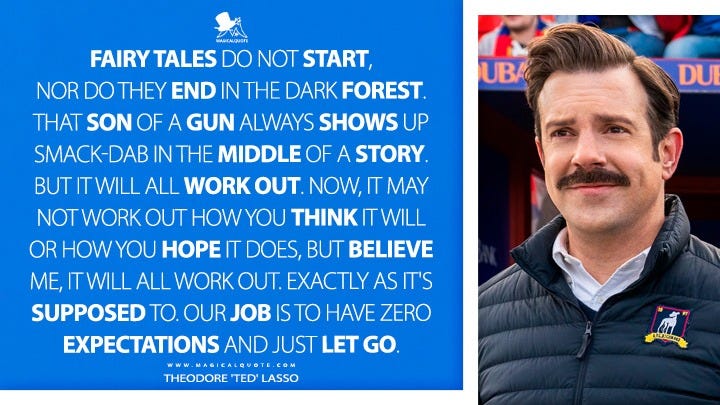
This commentary about fairytales requiring open hearts and minds and faith that all will be well in some unexpected way is a beautiful depiction of what books do for us. They teach us that life is not hopeless, even when it’s sad and scary. They teach us that expectations being thwarted is a good thing that actually keeps us from trying to control the story and allows us to experience it. And, they teach us that we can believe even when it’s hard.
G.K. Chesterton wrote, “Fairy tales do not tell children the dragons exist. Children already know that dragons exist. Fairy tales tell children the dragons can be killed.” And, this is what Ted Lasso does too. It shows us that so many of the things in life that make us feel small and underestimated, or judgmental and closed off, or scared and depressed are absolutely real and hard but also do not win. Fairy tales are not just or maybe even primarily for children. As C.S. Lewis wrote, “Some day you will be old enough to start reading fairy tales again.” After all, stories are what remind us that if we’re in a dark forest, we should keep walking. And, if we’re in a bad situation, we should keep reading.
Thank you so much for reading this article. I’m so grateful for each and every one of you. If you would like to support the work and writing I do here at Books May Save Us, please consider joining the community or upgrading to a paid subscription today.
No posts
Comments
Nothing yet. Say the first thing.
Sign in to join the conversation.