
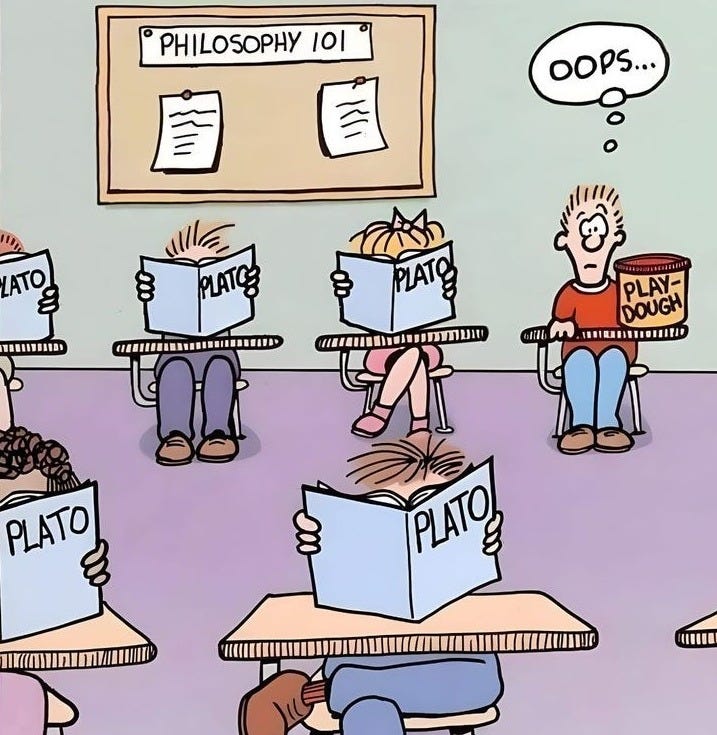
The image above by Mark Parisi was on a card that my mom gave to my husband years ago. She isn’t just his mother-in-law and grandma to our child, but she was also his first college professor in his very first college class. He jokes with her about how clueless he was when he walked into her classroom, so she lovingly gave him this card for his birthday one year. It is a great picture of how many of us feel as we start new school years as students, teachers, and parents. There is always so much to learn through living and endless trial and error. This is not only true of school days, of course. School is preparation for all of life in that way. You show up with the wrong idea or no idea of what you’re walking into, but the important thing is that you show up.
Psychologists call this a “Growth Mindset,” which is the opposite of a “Fixed Mindset.” To have a fixed mindset means you avoid situations that may be outside your control or comfort zone. You only play sports that you excel in, try to do well in classes you can easily ace, or apply for jobs that you are overqualified for. You think that your abilities, intelligence, and talents are fixed at a certain level and can not be improved or increased. Challenges make you feel discouraged, failure causes shame, and struggle is to be avoided at all costs. Conversely, when you approach life with a growth mindset, you understand that your brain is a muscle that can be developed and strengthened, and the resistance you feel when doing difficult work makes you stronger.
Now that AI has begun to do so much thinking for us, it has become even more difficult to believe that being inconvenienced by challenges would have any benefit. As you work problems out in your head, try to remember information, or struggle to find the right words to communicate, you begin to hear a voice inside telling you to “just ask your phone.” Why go out of your way to look unprepared, clueless, or wrong when you can avoid the awkward uncertainty altogether? Especially when surrounded by others, the vulnerability of not knowing and having to learn something new can be paralyzing. We’ve become used to assuming that everyone else knows everything, or certainly more than I do.
I remember being told once that imposter syndrome happens when people compare their internal reality to other people’s external performance. Social media is particularly insidious as we scroll through people’s well-curated highlight reel and compare that with what we hide as our felt insecurities and inadequacies. Other people are just naturally better at things, we think, because we see their finished product and experience our messy process.
When someone hands you a book or asks you to read, it can feel almost mean. Don’t they know that I don’t have the time, the attention, the ability to struggle through this? You want me to make sense of vocabulary I don’t know, concepts I’ve not learned, focus on a story that is sometimes slow, and make room in my endless agenda for time to read without falling asleep?
This is how so many people just decide that they are not smart, focused, or available enough to be readers. They look online at people who love books and read a hundred a year, and think that some people are just built that way. It’s the same way that I look at Olympians and think I can’t be an athlete because I have asthma and little hand-eye coordination. It’s hard to believe that I’m the same species as great athletes.
But that’s the miracle of humans. I’m never going to be built for professional basketball, but I can use my body to play sports for fun or even competition against friends and family. I can take walks that could eventually get longer, I can stretch in yoga until I can do that hard pose, and I can still get up off the floor without help, as long as I have a minute. I fully recognize that not everyone is built the same, and there will come a day when my middle-aged body can do much less than it can now, but I can do what I can do. And comparing myself to others so much that I completely give up on those parts of myself is not living to my full potential.
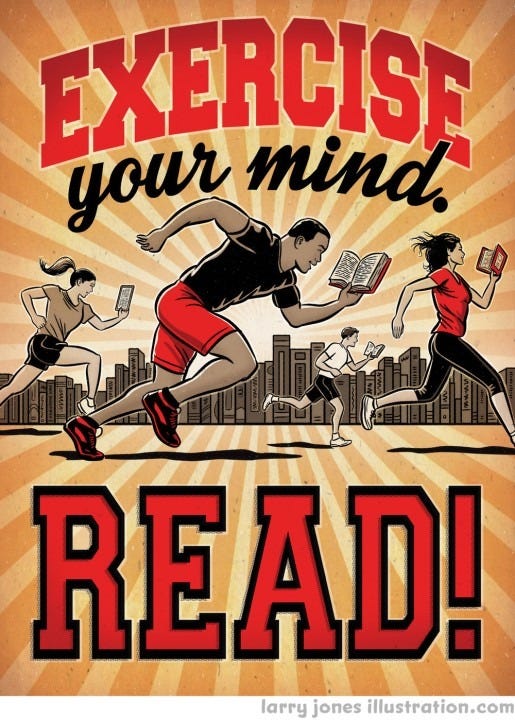
Likewise, reading might not be everyone’s number one passion or natural talent. It may not come easily, and I’ve had students who used large-print books because they have dyslexia, audiobooks because they are stronger in auditory processing, and hours of tutoring to understand what we were reading. Most of all, what I have seen again and again is the “power of yet.” There is an amazing song-and-dance number from Sesame Street that stars Janelle Monae called “The Power of Yet,” and it is about our ability to learn to do things we can’t do yet. Not only is becoming a reader one of these things - not just as children, but at any age - but the stories we read also open up other possibilities for our growth. Books themselves, and all great stories, are built on overcoming conflict and demonstrating growth mindset in their characters’ actions.
Conan O’Brien was recently joking on his podcast that no one actually does anything on new reality TV shows. He said they sit in a lounge chair in a villa and talk, and then they go to another room in the villa and sit and talk to someone else. That would not work in a book. There has to be action, conflict, overcoming challenges, some type of stakes, and change in the characters for a story to be worth reading for 300 pages. This means you are putting yourself in the shoes of people who are learning how to overcome, grow, and develop in ways that make you feel like you can too.
Books create the opposite of imposter syndrome as they remind us that if we can imagine ourselves doing something brave, we can also be brave in real life. They also allow us to compare our internal reality with the internal reality of the book’s characters. We see that we are not the only ones who struggle, or fail, or get embarrassed, or make mistakes. Unlike social media or reality TV, we are no longer subject to false images of perfection in others. The veil is lowered between the reader and the character, and we are invited into a deeper understanding of ourselves and others.
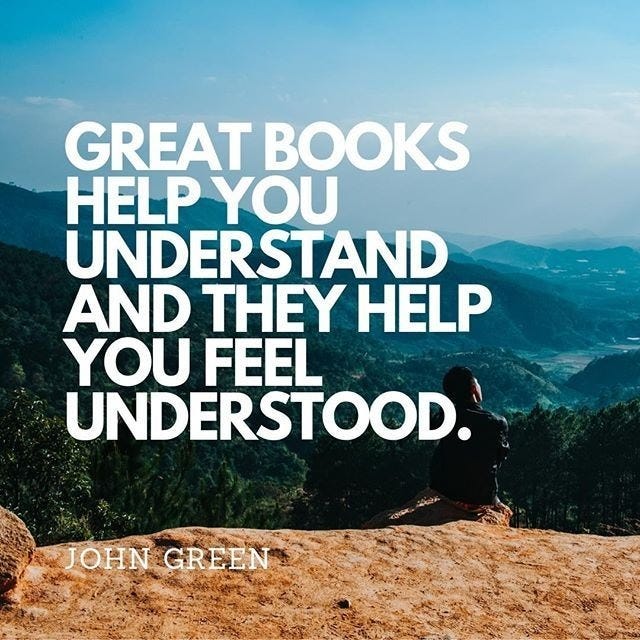
Books teach us to have a growth mindset when it comes to being kinder, more loving, braver, wiser, and more human towards each other. I have sometimes heard people lament that someone did something so rude or thoughtless that it seemed they forgot “how to human.” I love this expression because it makes the word “human” not just a noun but also a verb. If books help us understand what it is to be human and how to be more human in our interactions with others, then we all must consider ourselves readers. It doesn’t always have to be in the same medium (ebook, hardcopy, paperback, audiobook, etc.), and it doesn’t need to all be the same genre or length or author, but if I can learn to do the downward dog pose in yoga, I promise we can all be readers. And if we can all be readers, then we can do better in so many ways, as we learn the lessons that books teach us and remember how to human.
Thank you so much for reading!

No posts
Comments
Nothing yet. Say the first thing.
Sign in to join the conversation.