

When I write about the life-changing effect of reading books in this newsletter, I very much include plays as a genre of book. I was an English major in college, but I had a Theatre minor, and many of the classes I’ve taught have either been classes in Theatre or English in which we read, analyzed, and even performed plays. Play scripts are some of the richest literature available to us, and the unique properties of Theatrical storytelling are particularly powerful.
The day that I’m posting this article is April 23rd which is “Shakespeare Day” as it is both the day that he was born and the day that he died. So, I want to focus especially on Shakespeare’s works as a magnificent example of the kind of plays that are medicinal for the ailments of our time, but I want to start by giving an appeal to read, study, and perform plays in general.
One of the transformative powers of plays is the ways that reading them, even in your head by yourself, invites you to jump into a world where you speak the words of each character as if you are in their shoes. There is no third person narrator except for stage directions helping to set the scene. The reader is dropped directly in the unfiltered perspectives of each character and invited to see through their eyes.
Nick Reichert wrote this about reading plays:
Jumping back and forth between the voices and minds of the entire cast, the uninitiated will all but likely do a double take. You’ll flip back and forth of each scene to understand each nuanced detail of the plot, as well as the multifaceted nature of each character in your recently adopted fractured family.
When you dive into a play you are actor, director, and designer in one. It doesn’t take long before you begin to realize not only how hard each of those peoples’ art forms are, but you also feel for the struggles and euphoria that every character faces in their respective journeys in the play. How could you not? Each person’s words are tripping on your tongue. Before long, their problems, their joys, and their life meld with you own.
Any play is as potent a force for good as the most prestigious and dense novel. Plays and musicals are empathy supernovas. It’s that active understanding that give plays that unique ability to make a personal impact, large or small, with every read through.
The intensity of the empathy that plays create for readers is something that I have seen in the classroom many times. Students have asked if they could read the part of their favorite character and they have then justified their character’s choices, decided they dislike what their character hates, and began to love what their character values most. They gain ownership of the story as they imagine they are inside the people they are pretending to be, and they build the story together as a community as they read aloud or act out parts of the script.
I’ve seen awkward and self-conscious children, teenagers, college students, and older adults all come alive while reading scripts aloud together. I’ve seen them attempt strange accents, cheer for each other, try different voices, and practice unique personas. Nothing builds community like working on a play together. And, as I’ve had the great fortune of directing several plays, I’ve seen young people put their desire to protect themselves or judge others aside in order to serve the greater story they are all telling together. I’ve seen them literally fall on their face, lift each other up, and cheer each other on. And, when the audience gets to participate by watching a play they begin to breathe as one with each other and the actors on stage. Everyone is a part of the same world, and lessons are being learned, problems being addressed, and lives being transformed.

There are many reasons why Shakespeare is widely considered the “Greatest Of All Time” when it comes to writing plays. Countless books, dissertations, articles, essays, plays, and movies have explored what makes him such a timeless treasure. Many theories even persist that one man could not possibly have been responsible for so much important literature. To paraphrase Jane Austen, I’ll let other pens dwell on those scholarly ideas and interesting conspiracies for now.
In this post, I just want to focus on a couple of the many reasons that I am especially thankful to Shakespeare, and these all come from my own personal stories as a reader, admirer, audience, student, teacher, and director of his work. My hope is that you will be encouraged to pick up a play or buy a ticket for a production, and I would love to hear about your personal experiences with Shakespeare in the comments, please!

Humans need words not only to express what they are feeling but to actually understand what they are feeling. I wrote about this in an earlier post:
… these students are also growing up in a culture where Dictionary.com chose “6-7” as the “2025 Word of the Year.” Two numbers that are not words and have absolutely no meaning were selected as “Word of the Year.” These same students call everyone from their mom to their teacher to their girlfriend “Bro.” If each person has the same name, how can they have distinct and important roles? If we lose the word for “jealous,” will we know that that’s what we’re feeling, or might we think we’re angry? If we don’t have a word for “angry,” might we merely believe we are hungry? If we say “it sucks” when we get a bad grade and when our grandma dies, do these things begin to feel equally painful? If we’re always “fine,” can we ever know that we’re actually struggling?
Shakespeare wrote as though there were not enough words to fully create the stories of human experience he imagined, and he evidentially realized that he was not working with a broad enough palate of language to fully paint his mental pictures. So, he created new words and phrases.
There are arguments about exactly how many words and phrases he created, but all estimates seem to be in the thousands. Some of these were interesting blends of words like “eyeball” or “bedroom,” and some were almost entirely descriptive like “skim milk” or a change usage like using “elbow” as a verb. But, he also introduced words like “lonely,” “majestic,” “gloomy,” “generous,” and “amazement.”
These are words that help us to understand how people feel and behave with depth and nuance. He used metaphor, simile, personification, allusion, and hyperbole as tools to help us see things with more color, detail, and clarity. As Vincent Van Gogh wrote, “… how beautiful Shakespeare is, who else is as mysterious as he is; his language and method are like a brush trembling with excitement and ecstasy.”
His work doesn’t only make us feel because of the hilarious or tragic plots, but they contain the language to make sense of what we’re feeling when those events happen. He was unafraid to remake or create words or phrases to improve language as a tool for entertaining, but also healing and helping his audience.
I find this incredibly encouraging because it means that we all have the power to be rebels in this cause. Rather than simply accepting that our language is dwindling and brain rot is limiting our expression to a few nonsense words and sometimes simply sounds, we can insist on expanding our vocabulary and use of language to better serve us. Madeline L’Engle wrote decades ago that she worried that if we lost our language we’d be unable to read Shakespeare, and this is a real concern. But, I believe we can do something about it by following Shakespeare’s lead. We should be luxuriating in language, playing with it, creating more of it, and teaching it to our children with an enthusiastic sense of abundance. The loss of language is an urgent reality, but it is not a foregone conclusion.
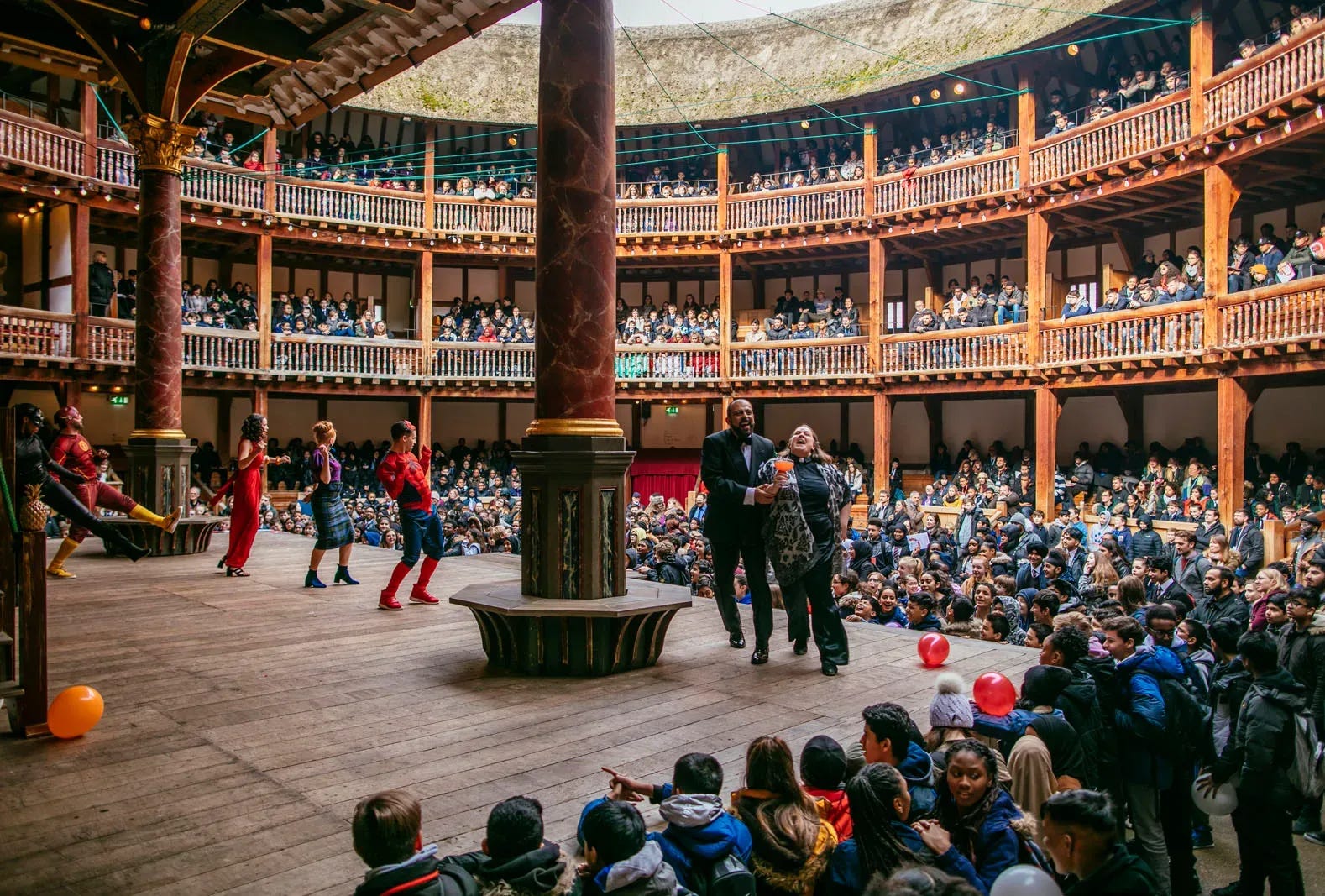
My students often feel intimidated or preemptively bored when we begin to study Shakespeare. I’ve even had acting students who confessed that they were hoping not to be cast in Shakespeare because they didn’t think they could possibly understand it enough to make an audience understand much less enjoy it.
But, we have done a great disservice to these young people by allowing them to believe that Shakespeare should be handled gingerly by sophisticated scholars. Though Queen Elizabeth enjoyed his work, the common people were an important part of his intended audience. And, he wrote his works with the knowledge that patrons would be deciding whether to go see his plays or incredibly sensationalist entertainment like bear-baiting. This was where a bear would fight a pack of dogs and sometimes other animals would be included to make it even more violent. These audience members would sometimes drunkenly boo if the actors were boring and even throw things on stage. They stood in the rain and heat for hours and paid a large sum to go and see a play, so expectations were high. Shakespeare didn’t write with an arrogant belief that people should be blown away by his genius, but as an artist who spoke to people with humor, excitement, entertainment, and beautiful poetry, deep tragedy, and fascinating history.
In the picture above there are many school-age children at the new Globe Theater in London standing where the groundlings would have stood hundreds of years ago. These children might not understand all of the language or Elizabethan references, but they look fully engrossed. It reminds me of the time that I saw Romeo and Juliet performed at an outdoor stage in the park. I was so young, and I didn’t follow all of the Greek allusions or iambic pentameter, but I remember acting out the scenes on the playground later with some very theatrical emoting. I understood the feeling of the words and I felt the thrill of young love and the despair of death with no need for translation.
Decades later, as an English teacher, I had a student tell me that it was, “A hard day to read Hamlet,” because her boyfriend had just broken up with her and reading Hamlet’s words to Ophelia was too difficult. She didn’t find it difficult because it was too esoteric or high brow, but because it was too relatable.

This leads me to the final thing I’d like to celebrate about Shakespeare for this article, which is that he is truly for all time. One of the great gifts of his works is that they are of a time and also so completely universal that they can be reimagined or set in any other time or place.
I’ve done an exercise with students where I’ve asked them to design a set and cast for their own interpretation of a Shakespearean play and gotten everything from settings in the Roaring 20s to Star Wars. One group did an incredible job of setting Much Ado About Nothing in the world of The Office tv show and used each of those characters as a character in the play. When I directed Much Ado, we set it in America right after the men came home from Wold War II. I’ve seen Shakespeare set in the past, the future, cartoons, and musicals.
One of the things that this does for us as audiences is that it means that we get to empathize with these characters forever. They can stand in for all people because they are telling such human stories, and humans have changed very little over time. Our technology has exploded, and AI makes us afraid that humans will lose their voice, but Shakespeare reminds us that human hearts and minds don’t change much, and they can’t really be replicated or replaced. We are separate from the machines that we make. We are made in the image of God, and our passions, our griefs, our tragedies, and comedies are all infinitely important and sacred stories. Shakespeare put his stage between an open roof and the deck below and called them heaven and hell, and he said that all the world is a stage. He reminds us that our lives are plays in which we each have a vital part, and no matter how much the world speeds up or changes, we like Shakespeare are timeless and eternal.
No posts
Comments
Nothing yet. Say the first thing.
Sign in to join the conversation.