
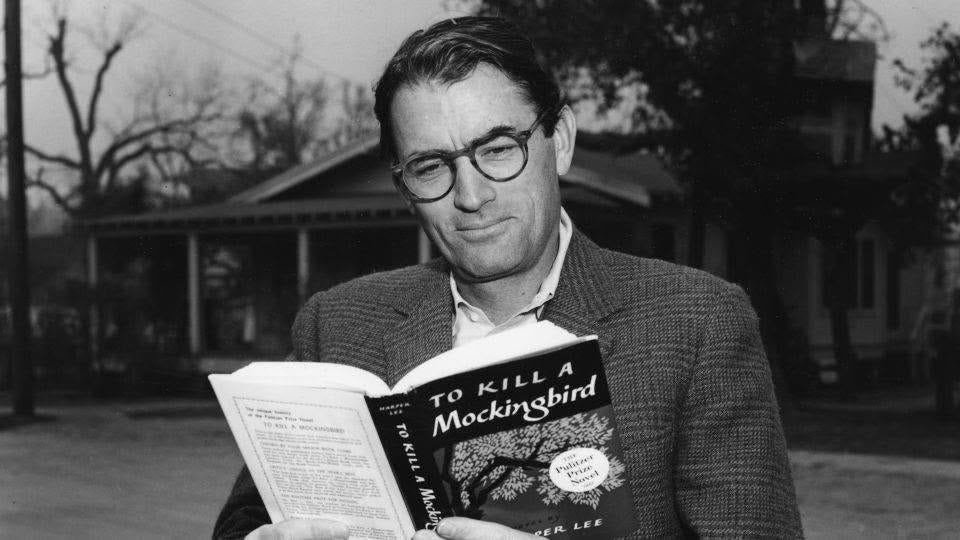
This Sunday will be Father’s Day here in the U.S., and it will be my first since my own precious dad passed away in November. I’ve always been sympathetic to those friends and family who I know have had difficult feelings around this day because of broken or missing relationships with their dads, but this year, I feel fully inducted into the club of people who approach this holiday with grief. I always hope to bring comfort, encouragement, and strength to the readers in this wonderful community, and today I feel a special desire to offer this article as a love letter to those missing their own dads, those who didn’t get the dads they needed, and those dads, like my incredible husband, who work to be there every step of the way.
I also want to use this character study of Atticus Finch from Harper Lee’s To Kill a Mockingbird as a helpful guide for anyone loving and caring for children right now - the moms, aunts and uncles, grandparents, teachers, pastors, counselors, coaches, and mentors. We are all called to protect, guide, and love the children in our lives, and to make the world a kind, moral, and just place for all children.
It is certainly not a surprising choice to focus on Atticus Finch as a champion father in literature. It’s a little like choosing Captain Ahab as the number one character who is obsessed with whales! Atticus is the top of just about every list of favorite literary dads that you find online. Lee was very close to her own father and writes about Atticus from the perspective of her narrator, Scout, his grown daughter, looking back on his impact on her life. The story has all the benefits of both hindsight and the deep love of a young girl making her way.
Atticus, as the mentor figure in Scout’s Hero’s Journey, is a single father, a titan of virtue, a brilliant and just defense lawyer, and still manages to be lovingly nurturing. Some have criticized this character as too perfect, or have felt that he falls into the trope of an idealized white man saving a black man, and that he is more savior than man. This is the kind of good discussion around literature that is important to have, and different people bring important perspectives to this text.
My own perspective, which led me to write this article, is that Atticus is a hero exactly because he does not win. He is unable to save anyone; he recognizes his insufficiencies, and the unfair system, but he fights for justice anyway. He knows that his community is broken, but he loves his neighbors. He wants to protect his children from the terrors of his world, but teaches them how to engage. Atticus is a guide for all of us raising, teaching, and loving children in our own broken world.

“There’s a lot of ugly things in this world, son. I wish I could keep ‘em all away from you." - Atticus Finch
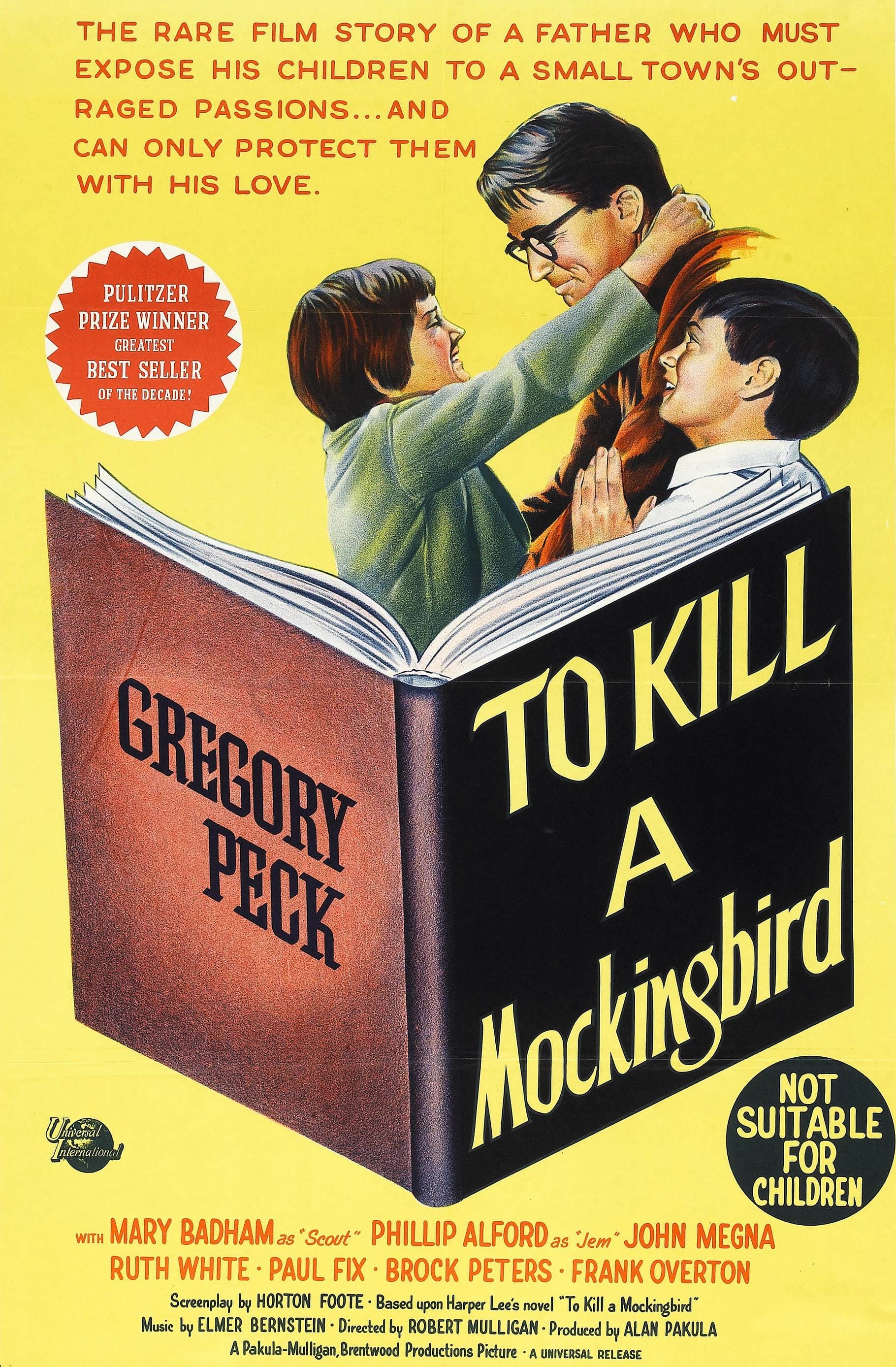
This poster from the film released in 1962, two years before the outlawing of Jim Crow laws, is extraordinary because of its tagline at the top, and also because it is marked as “Not Suitable for Children.” The film, like the book published just a few years before, was about the current realities that families were facing every day. It was considered so controversial that Gregory Peck was seen as brave by some for even taking the role of Atticus Finch. The film is about a dad who is brave enough to walk children through a world that is full of things that were considered too adult for children to watch in the film. It makes me wish that we could go around putting “Not Suitable for Children” on everything that makes our world unsafe and unkind, and I wish that that label would make those things disappear from our reality.
My husband and I have been raising our child, as so many of you have, during a pandemic, lockdown, school shooting safety drills, violent political rhetoric and actions, the explosion of fentanyl overdoses, the threat that AI will take future opportunities, online tracking, social media dangers and bullying, phone addiction, natural disasters in our area and on the news, multiple wars, racial injustice, mass deportations, and people being pitted against each other for every possible difference between them.
There have been many times that I have wished that I could put her back in my tummy like a mother kangaroo, and my husband and I often “joke” about moving to the middle of nowhere and losing our phones on the way. There is nothing we want more than to keep her safe from the non-stop barrage of terrors being streamed to us on a 24-hour loop on the device we hold in our hands.
And yet, as people of faith in a good God who asks us to love our neighbors and live in courage and fight for justice, we know that we have to walk her through and not around. So many children are growing up feeling overwhelmed, depressed, anxious, and helpless because we are teaching them that they can’t handle hard things. Our older generation is often misguided by feelings of love to shelter, defend, or excuse bad behavior from children, and to want to make the world easier for some instead of better for all. Atticus faced this same choice. Unlike families forced onto the frontlines because of their skin color, he had the privileged option to keep his white children away from the horrific realities of segregation, lynching, and unlawful courtrooms. Instead, he walked them through what they didn’t understand. He held their hand through the valley of darkness and encouraged them to do right while being there to protect them when danger got too big to face alone.
Here are just a few of the pictures of Atticus getting down on the same level as Scout in order to explain things to her. He sits with her, looks her in the eye, or looks at the world from her eye level. He hugs her, holds her, and lets her hang onto him. There is no need to be “tough” or distant in order to be strong. The world is hard and so Atticus is a soft place to fall while also being a foundation that doesn’t give way. He literally doesn’t talk down to her while he tells her hard truths and gives her sage advice. She knows that he understands that things aren’t fair, but he also gives her answers and guidance to give clarity in the chaos. The last quote about being the “bravest man who ever lived” struck me. He is an expert marksman, but the only time he ever picks up a gun in the book is to protect his family and the community from a rabid dog. It also provides a kind and quick death to an animal suffering. Later, when he faces a lynch mob, he sits reading in a chair and does not arm himself. He knows when and how and why to show strength and what kinds are called for in any given situation. There is no bluster or aggression, but there is so much bravery.
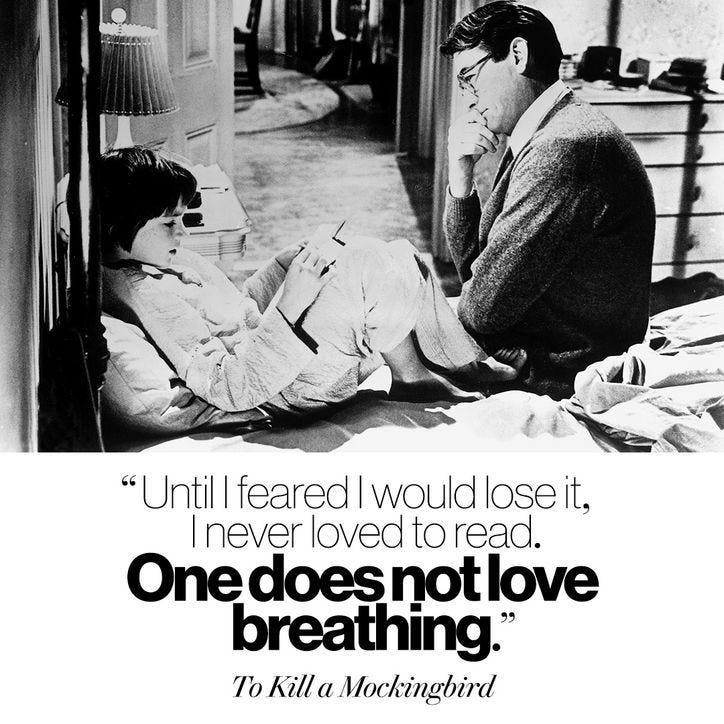
Speaking of him bringing reading material into a standoff against a mob, I would be derelict in my duty if I didn’t mention his love for books and the knowledge, wisdom, and empathy they instill. In fact, Atticus feels to me a bit like if a book was transformed into a human being. In the picture below, Atticus is smiling at Scout reading her book. He has never tried to change or control things like the way she wears her hair, her clothing preferences, the name she wants to be called, and he encourages her to be an early reader when that is something that she shows interest in. Then she has a teacher at school who is upset that she learned to read before starting school, and Scout is worried that books will be taken away from her. I love the way she describes reading like breathing. It’s that natural and that necessary. Atticus, of course, understands and protects this passion in Scout. He smiles warmly at his child, who refuses to go by other people’s rules or timelines, but also seeks to love and care for the people around her. Knowing what to care about, when, and how, is what Atticus has taught her well and what he continues to teach us all.
Thanks for reading! Subscribe for free to receive new posts and support my work.
Comments
Nothing yet. Say the first thing.
Sign in to join the conversation.