
Turnout was light, but we had a lively discussion about many different types of cast design tools. Questions were asked. Answers were proposed, but… you’ll never know if something works for YOU unless you try it.
We had a small group of paid subscribers but a great discussion last week on the subject of Cast Design Tools. I should’ve already posted this and I’m sticking with the no-recording policy of deep dives for now, so I’m forcing myself to type this up today so that I don’t lose any more brain cells and context.
These are some of the tools we talked about.
I’ve been invited to host a session in ProWritingAid’s free Novel Summer Camp. From 13 July through 07 August 2026, you can avoid mosquitoes, predatory volleyball enthusiasts, and sunburn by enjoying the free summer camp PWA is offering you. For the low, low price of nothing and from the comfort of your own home, you can immerse yourself in:
Educational Workshops from Camp Counselors: craft-focused sessions from published authors and industry experts
Daily Writing Sprints: structured community sessions to build momentum and accountability every day
Cabin Groups: small, matched cohorts of 10–15 writers for peer support and friendship
Campfire Story Circles: weekly showcase events to share excerpts and receive peer feedback
S’mores Social Hours: casual, pressure-free hangouts for community connection
Choose Your Own Adventure Tracks: genre-specific camps (Romance, Fantasy, Writer Mindset, etc.), Writing, Editing & Revision, or Plotting & Planning
I will be presenting a session called Stick the Landing: How to Create a Cathartic and Satisfying Conclusion:
There’s a lot to consider about THE END before (and maybe after) you type those words…for each novel. Are you sure you got everything? Do you know what to check for? Do you know how to even check? Join us for some satisfying tools and scintillating conversation about how to know you’re done when you’re done.
Sign up today so you don’t forget. 😏
We talked about several different views of cast design in Aeon Timeline. It’s not primarily a novelist tool, but it’s very useful for managing complexity.
The unpublished gritty urban fantasy thriller, Demonic Sanction, that I used as an example takes place over the course of about fifteen hours on a Saturday afternoon in El Paso. I initially put all the chapter time metadata into AT in order to make sure I didn’t lose track of the ticking clock, events that occurred simultaneously, or events that didn’t happen on-the-page but had a direct effect on the story and plot.
The biggest benefit, though, was figuring out that I had a missing witness: a point-of-view character whose story it is first and foremost. People on the call got to hear the embarrassing story about how I figured that out and what I’m doing to fix it.
There are many more views in AT that we discussed, but these are the most relevant to cast design.
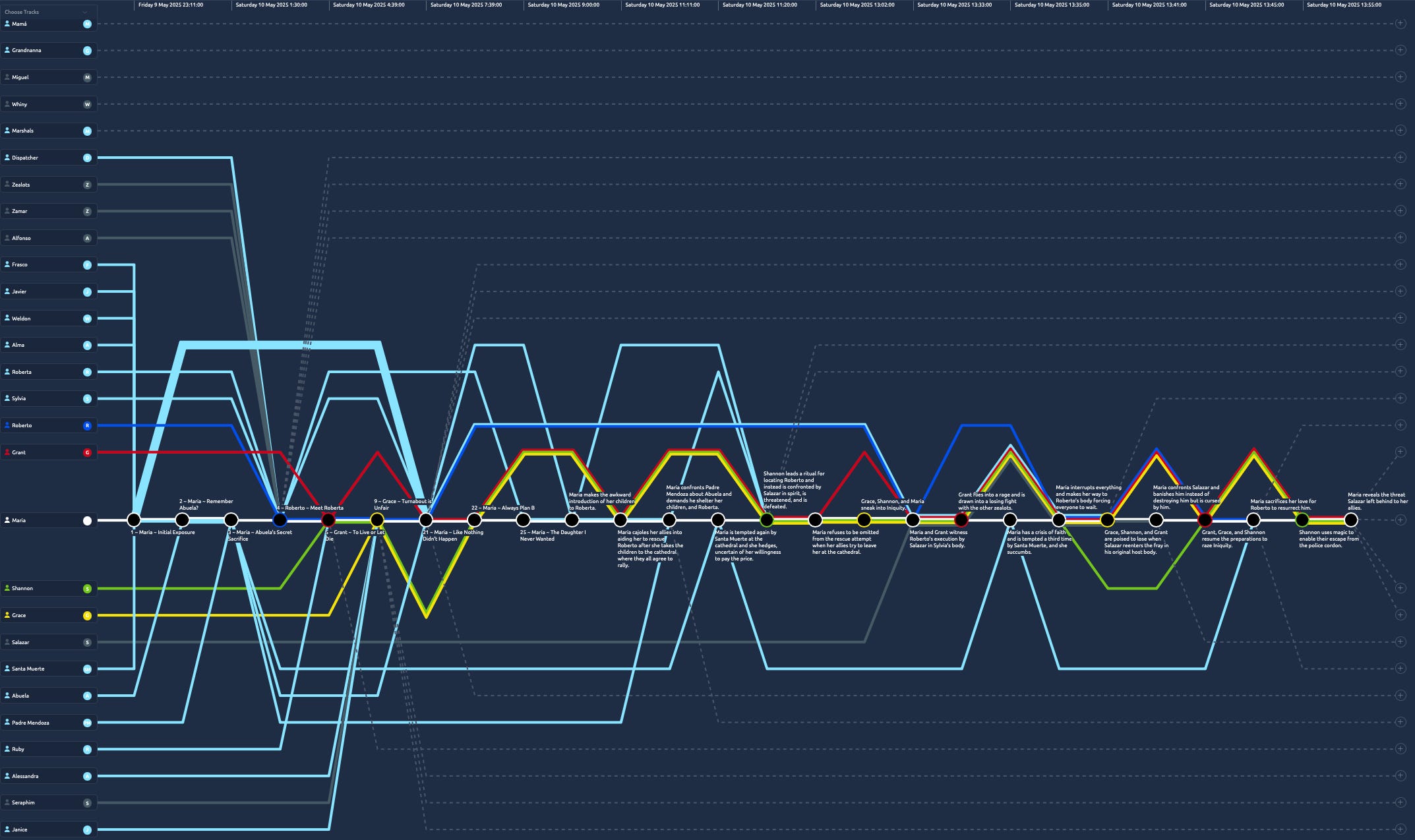
This is the first of the AT views. This one shows each scene and each character, whether they are on-page or off-page and their relationship across the timeline to the whole narrative.
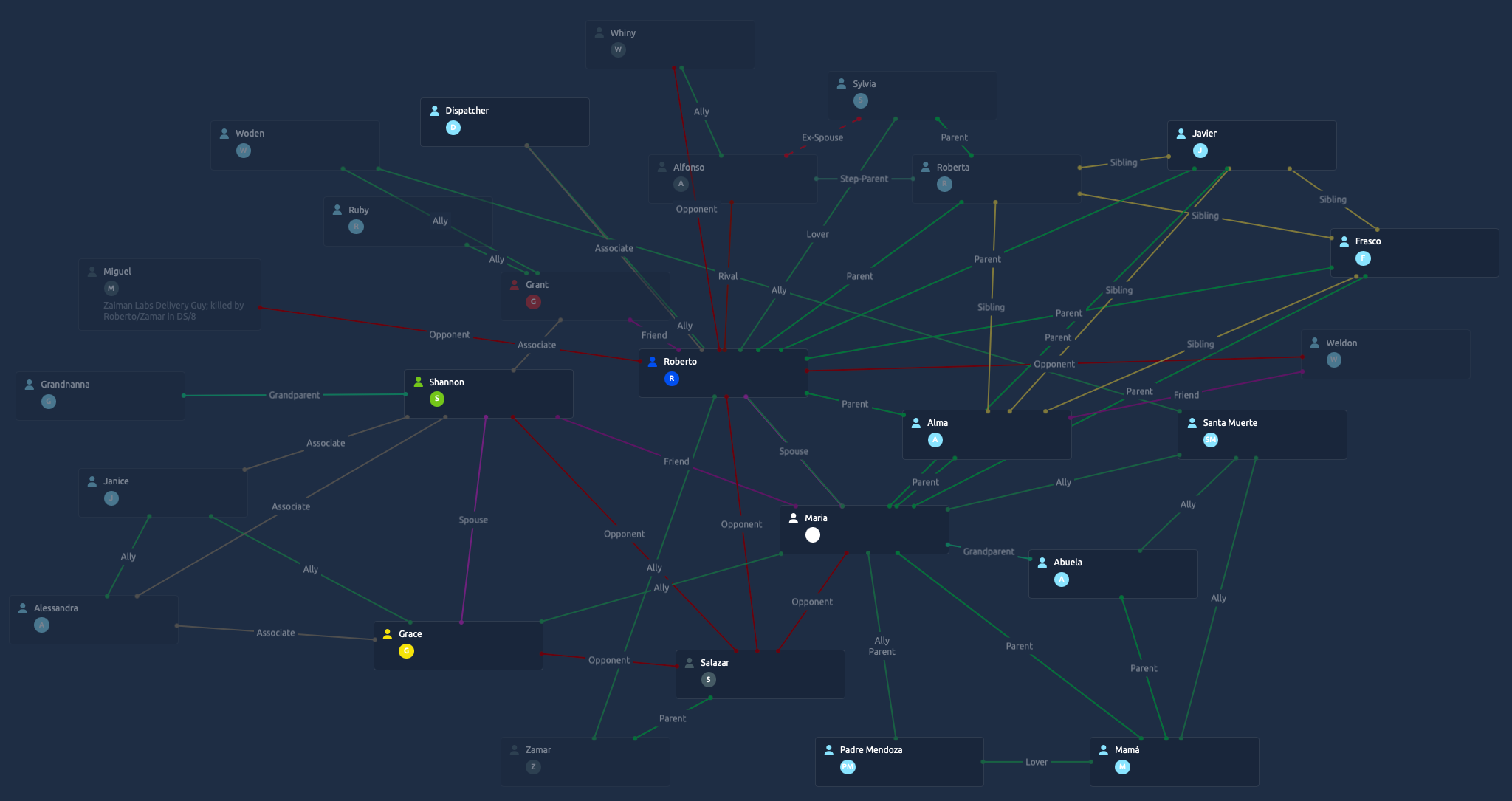
Using the same data in AT, this view surfaces the relationships between the cast. It’s useful for figuring out whether you can combine characters or whether you need to make specific characters more present in the book.
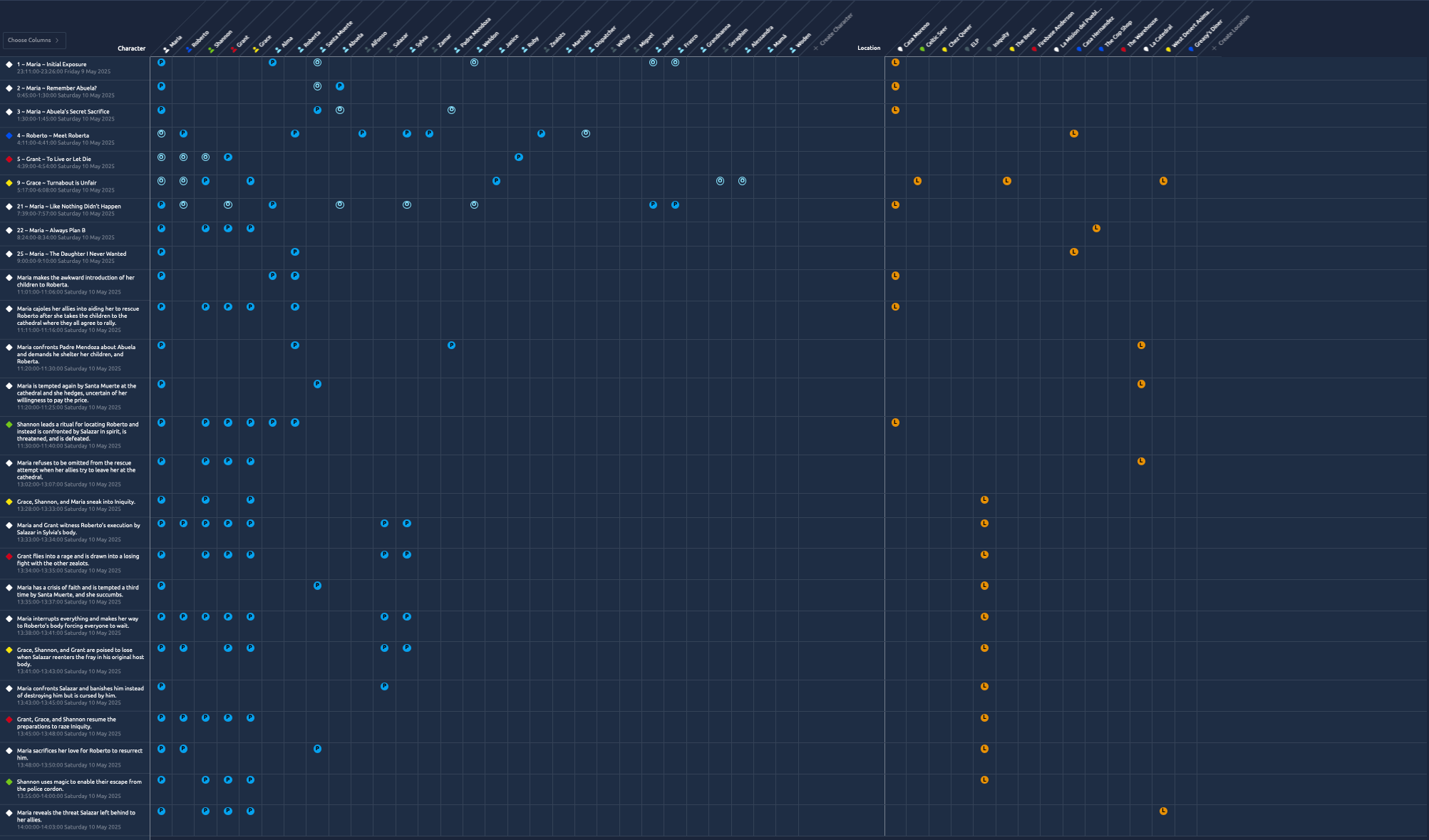
At first glance, this view looks more like a boring project management tool (which it could be); however, it’s very useful for diagnosing cast interaction issues chapter-by-chapter and looking for potential plot holes at a glance without having to re-read a hundred and forty thousand words.
While this isn’t one of my favorite cast design tools, it’s an interesting byproduct of doing the work of sorting out your cast and all of your settings (locations) and you novel timeline in the same tool. It can be handy to see who’s a participant and who’s an off-page reference. Aeon Timeline also has other roles for characters in scenes that I didn’t use but seem useful. It seems limiting, though, in how it constrains a character to a single role in a scene. In my own software, I enable characters to be wear several hats (roles) as witness, catalyst, and agent in a cycle (a.k.a. scene or series of exchanges).
All Book Shaman posts will always be free. Share this post with a novelist or writer of any kind whom you love or hate. 😇 😈
I use Microsoft Word for this at the moment, because I haven’t found a better tool yet. Yes, I’ve tried many. Yes, that one, too. I hated it. So, I’m in the process of building my own Sekret Skwirrel Software™ project for writing novels, which will include these tools alongside your scene-words so that it’s all in one place and you won’t lose track of things. In the meantime, here're the tools we talked about.
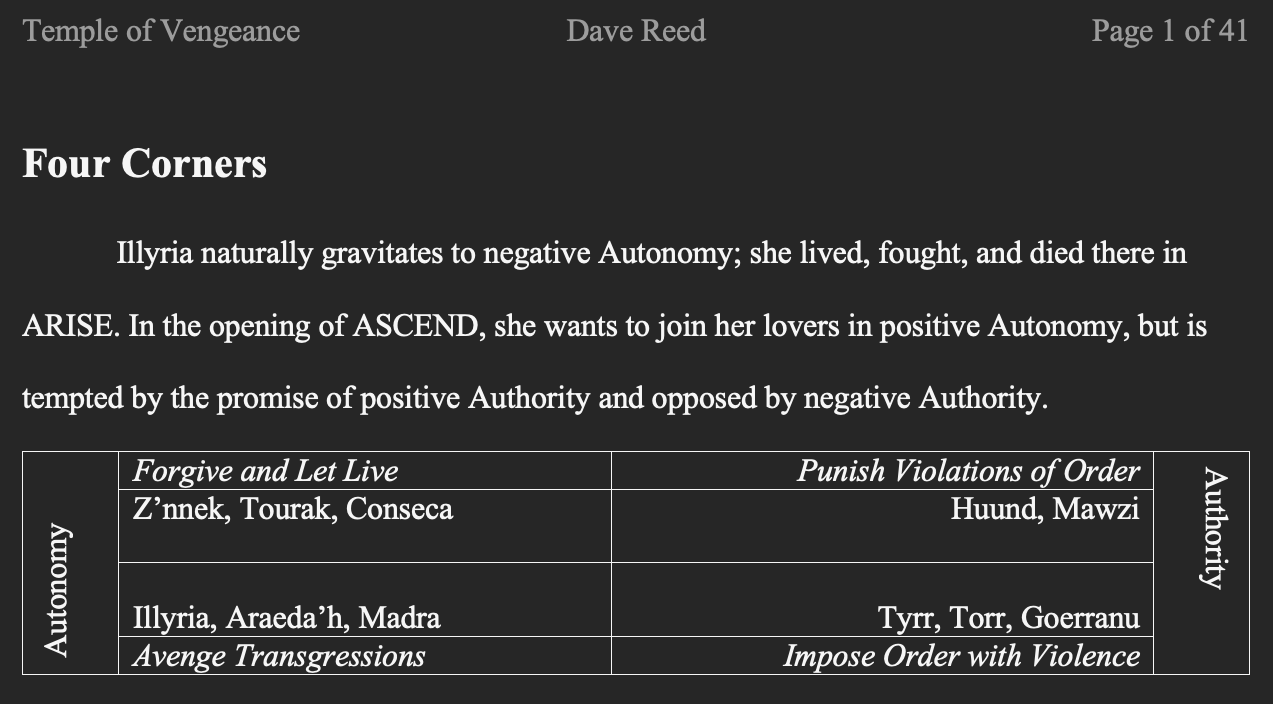
Here’s one of the videos that I send all of my new clients which is the best explanation of John Truby’s four corner opposition tool that I’ve found so far:
The one tweak that I add to it for myself is to give each corner a credo, belief, or mantra that describes their philosophy or modus operandi. I use it often enough as an example, that I keep it at the top of my Temple of Vengeance world bible.
I’ve accumulated a large number of metadata elements about cast members from a wide variety of narrative design methodologies and story gurus over the years. Here’s the top-level structure of the most important tables of information that I use when I’m initially imagining a book and what I (try) to keep evergreen as I write (i.e. get stuck or forget an important detail).
I keep a column in this table for each main character to track:
Plot: the archetype of the external series of events the character will experience
Story: the archetype of the internal transformation the character will experience
Subplots: all of the archetypes of the B plots the character will participate in
Roles: all of the role archetypes that the character will adopt throughout
Notes: any brief reminders for me about this character’s purpose in the series
We debated whether my use of the word theme was the right one here for each character. It’s probably closer to a core belief for each, but having them all in one place for the entire main cast is a useful reminder.
From Robert McKee’s book Character, I keep track of the internal contradictions of each character for my own purposes to ensure I get them on the page in sufficient detail for the reader to pick up on them subliminally.
This is a grab bag of character aspects, but it’s important to make sure you have a diversity of them and they’re all high contrast so that your cast members don’t blur together in the reader’s mind.
Religion/Spirituality
Frustration Responses
Common Cultural Adaptation
Familial Engagement
Human Contact / Frequency
Core Cultural Identity
Love Life
Same as the previous, but related specifically to the internality of the character. They all have useful nuance despite their similarity. I use them all together, because I’m (apparently) a masochist.
Wound (as per Michael Hague’s workshops that I’ve attended)
Void (as per Damon Suede’s Verbalize method)
Misbelief (as per Lisa Cron’s Story Genius method)
Wants (many story gurus use this term)
Needs (many story gurus use this term)
I’m a social sciences nerd. I can’t help it. I find these all to be useful in defining characters for myself. These will all (probably) be entires posts unto themselves someday in the not-too-distant future.
Verb (from Damon Suede’s Verbalize method)
Sun Sign
Moon Sign
Top Five Strengths (from the Clifton StrengthsFinder methodology)
MBTI (i.e. Meyers Briggs)
Enneagram type and subtype (from Claire Taylor’s Write Iconic Characters method)
Do you want a novel or do you want to be a novelist? I can help you with either. (Yes, I am willing to ghostwrite your book if you’d rather describe the story you want and pay me to do the hard work of producing the words. I promise that no “ai” will be used.)
I’m here if you need me (for story stuff). You are my full-time job now. Let’s chat about how I can help you write the book of your dreams.
⭐️ I did announce the big (for me) preorder, but in case you missed it:
Baby's First Official Editor Credit
·
May 15

Jed Rawls hid in the safest corner of the law: his sleepy Chicago trust-and-estates practice. Wills. Probate. Doling out money to his dead clients’ obnoxious nepobabies. He should have made partner years ago. He also knows exactly why he never will.
Get Your 34% Marriageversary Discount
Monthly Free Story Consultations | Monthly Free Narrative Concept Deep Dives
Comments
Nothing yet. Say the first thing.
Sign in to join the conversation.