
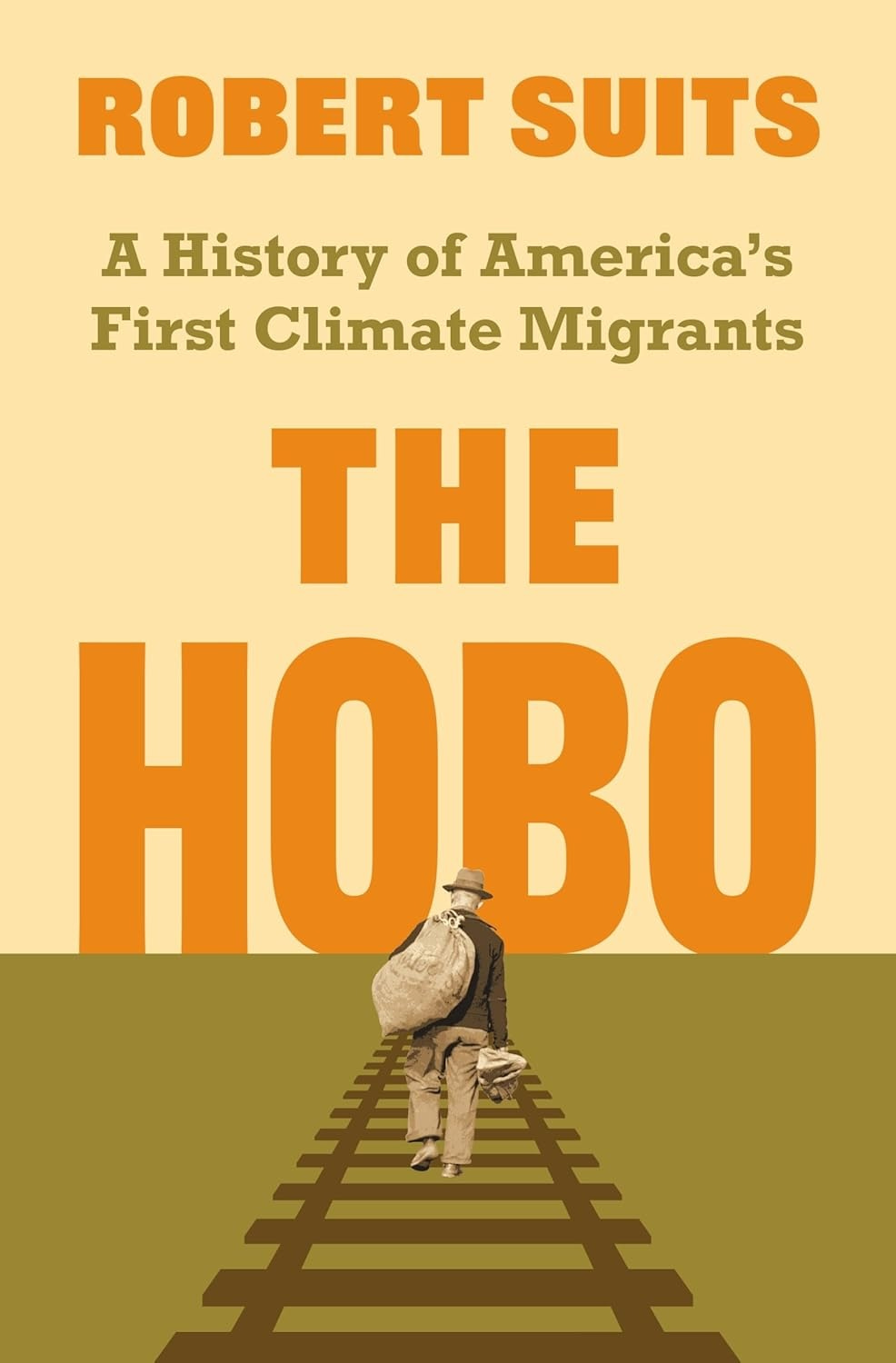
Many years ago, as part of a chili cookoff, I decided to dress up as a hobo. I assembled my costume from the first images that came to mind: dirty oversized pants tied with rope, a bindle slung over my shoulder with a can of beans dangling from it—filled with my team’s vegetarian chili—and a bowler hat. The look was Chaplin’s Little Tramp transplanted to a Hooverville. I had no idea how jumbled and wrong these cultural references were until I picked up environmental historian Robert Suits’s new book, The Hobo: A History of America’s First Climate Migrants.
Far from the ragged, rootless caricature of popular memory, the hobo was a highly skilled seasonal laborer whose mobility answered the volatile demands of work after the Civil War. Often a clean, neatly dressed young man—and occasionally a woman—he left a broken home or depressed local economy to steal aboard freight trains. The work he sought was piecemeal: summers as “harvest hands” threshing wheat on the Great Plains, winters as lumberjacks cutting timber in the North Woods around the Great Lakes, with stints tamping railroad ties or shoveling muck in between. A hobo might work only a few days and wander hungry the rest of the month. Yet from 1870 to 1930, Suits argues, the American economy could not run without him.
The hobo appeared just as machines were meant to be abolishing manual labor. Steam engines weighed tons and consumed prodigious amounts of water and fuel, making them impractical for much rural work. Trains could haul mountains of wheat to market, but fields, forests, and mines still ran on human and animal muscle. As railways opened more land to farming, logging, and mining, the demand for muscle grew, and the hobo supplied it.
That labor, however, was at the mercy of the climate. A wet 1892 drew twenty thousand extra harvest hands to Kansas; a year later, a national depression flooded the same fields with more workers than work. Farmers could not retain enough hands for the best years, so laborers bore the risk, riding a thousand miles toward a harvest that might not exist and going hungry or to jail when it did not. Suits calls the hobo America’s first climate migrant because the weather decided where the work would be, and the worker followed.
With the transition to oil, the hobo disappeared as a distinct worker and passed into the folklore I drew on for my costume. Lighter and more portable than steam engines, internal combustion engines brought fossil-fuel power to worksites that had depended on muscle. In wheat farming, tractors shortened harvests from weeks to days. Fruit and sugar beets still required human hands, but oil-powered irrigation and other agricultural inputs made production predictable enough for employers to recruit Mexican workers months in advance, often as families. The improvised circulation of mostly white male hobos gave way to a planned, transnational labor system.
The Hobo trains its sights on the structural forces that made migrant labor necessary, especially the steam economy’s reliance on human muscle, more than on the lives of hobos themselves. What these travelers did in camp, what they wrote, or how they understood themselves remain somewhat out of view. That imbalance is partly archival, since mobile workers left few records. Suits’s reconstruction from oral histories, weather data, and payroll records is a feat, and individual lives occasionally break through. Harry Kemp, a writer and sometime hobo, carried a secondhand Shakespeare in his bundle. “Once or twice,” he wrote, sheriffs preparing to arrest him for vagrancy “let me go, because it awed them to find a tramp reading Shakespeare.” Suits shows how America transferred the risks of an unpredictable climate to precarious migrant workers, a pattern that outlasted the hobo. The Mexican farmworkers who followed him were seasonal, often noncitizens, and written out of the New Deal’s labor protections. Temporary contracts and weak legal protections allowed employers to continue relying on migrant labor without assuming responsibility for the people who performed it. It is a long road for a book of 215 pages, and one that does not end in 1930.
The word “first” in Suits’s subtitle points toward climate migrants to come, but the epilogue emphasizes the limits of that analogy. For hobos, the recurring droughts of the Great Plains generally meant shrinking harvests and disappearing work. Contemporary climate migrants may instead be displaced as homes and livelihoods become untenable, whether or not work awaits them elsewhere. That difference is why Suits acknowledges that the history of the hobo cannot tell us what future crop failures and displacement will look like. What it can show is how environmental instability reaches individual lives through hunger, insecure work, and forced movement. That an indispensable workforce could dwindle into the caricature behind my costume suggests how readily migrants disappear from view, and how unprepared we may be for the scale and suffering of climate displacement to come.
Stephanie DeGooyer is an associate professor at the University of North Carolina at Chapel Hill. She is the author of Before Borders: A Legal and Literary History of Naturalization and a co-author of The Right to Have Rights. Her writing has appeared in The Guardian, The Nation, The Paris Review, Boston Review, Dissent, and Lapham’s Quarterly.
Book Post is a by-subscription book review delivery service, bringing snack-sized book reviews by distinguished and engaging writers direct to our paying subscribers’ in-boxes, as well as free posts like this one from time to time to those who follow us. We aspire to grow a shared reading life in a divided world. Become a paying subscriberto support our work and receive our straight-to-you book posts. Some Book Post writers: Adrian Nicole LeBlanc, Jamaica Kincaid, Lawrence Jackson, John Banville, Marina Warner, Álvaro Enrigue, Nicholson Baker, Kim Ghattis, Michael Robbins, more.
Whose Books in Dallas, Texas, is Book Post’s Summer 2026 bookselling partner! We partner with independent booksellers to link to their books, support their work, and bring you news of local book life across the land. We send a free three-month subscription to any reader who spends more than $100 at our partner bookstore during our partnership. To claim your subscription send your receipt to info@bookpostusa.com.
Follow us: Instagram, Facebook, TikTok, Notes, Bluesky, Threads at @bookpostusa
Comments
Nothing yet. Say the first thing.
Sign in to join the conversation.