
Literary fiction on exit and exile is coming to include return and the returned. This configuration can provide the author with a two-way mirror: the fiction of exile can bring a fresh understanding—and sometimes even appreciation—for the place left behind; the fiction of return can bring a forceful reckoning of one’s own evolution as well as places one thought one knew. It’s rather like a sequence of backward leapfrogging. Who were you before you left? Who were you while you were elsewhere? Have you truly been of here the whole time you were there, or do you return here as someone of somewhere else? Who will you become now you’re back?
Might an author’s eye might be a usefully estranged one? In a 1993 radio interview William Trevor said of being a writer, “You’ve got to be edgy, you’ve got to be on the outside of things looking in. You’ll quite often feel, as I always do, that you don’t belong.”
Narratively, fiction of return is expansive, and can allow more space for complexity than “I am gone and never going back.” It can reframe historical periods. Elaine Feeney’s recent novel Let Me Go Mad in My Own Way featured an Irish woman returning to East Galway from London, bridging the span between civil war times and contemporary trad wives on TikTok. Ireland wrote back to England rather than England writing back to Ireland. The novel marked an economic shift: places people historically had to leave have become places they can go (or go home to).
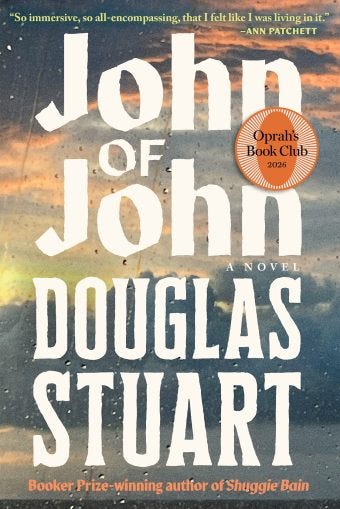
John of John, the third novel by Scottish-American Douglas Stuart (author of Booker Prize-winner Shuggie Bain and Young Mungo), is almost a forensic study of this double-displacement or the twice displaced. The reckonings shuttle back and forth like the ferry that links Glasgow, the “mainland” (Scotland), with the fictional village of Falabay on the Isle of Harris in the Outer Hebrides, where much of the novel is intimately set. The Isle of Harris is well known for producing expertly handwoven Harris tweed, the integrity of which remains protected by an Act of Parliament. Stuart has deliberately chosen a rural setting of rich and distinctive tradition in which to embed his fictional characters. The novel is sprung of situation but is inscribed in the past and present of its setting.
The title John of John sets up an immediate thematic overture: to whom do you belong, or—who claims you? The two Johns are John Calum or Cal, gay son of John, a stern and rigid Presbyterian Calvinist. Summoned by his father, Cal has just returned to the Isle of Harris after finishing art school in the city. Stuart has gone double espresso on the alienations of return by provoking the question, how much would you be claimed if it were understood you are a gay man? Can you be out and still be of John?
Cal returned only because he is broke and worried about his (allegedly) sick granny. The novel opens and concludes with him musing about granny. The attention to granny becomes understandable as one realizes how challenging it is for Cal to care for his parents, who are estranged under contested circumstances. Ella (granny on his mother’s side) is a lively, expressive woman, who likes Cal and encourages him to stand up to his father. His father is an angry, despotic weaver and the Deacon of the village church. Cal is loyal, conflicted, stoic, and emotionally stuck between the polarities of his parents and deceived by their secrets.
These secrets remain closed to us for two hundred pages, trapping us with John in their hidden implications as Cal, struggling to find work, is forced to hand weave Harris tweed under his father’s eye. Such turnarounds are what Stuart does confidently in this novel. He topples our anticipations and complicates them, forcing readerly recalibration.
Stuart is a much-admired chronicler of the Scottish working class. His three novels find readers with more ease than his fellow working-class raconteur and Booker Prize winner, the somewhat less obliging James Kelman. There are solid reasons why John of John appealed to Oprah’s Book Club. Such selections can favor immersive, intergenerational family epics, and this is certainly one, albeit taut, with a carefully fashioned weft. A work with rare tenderness peeping among the brutal, the broken, the befuddled, and, ultimately, the becalmed. Still, you can imagine streams of people making pilgrimages to the Isle of Harris after reading it.
While John of John is obviously a novel of place and a people, chiefly it is a novel of versions: Family members, neighbors, visitors as versions of each other. A family’s version of one of their own rarely changes or is reassessed, until that person is dead. John the father has his version of who his son Cal is, Cal has his version of who his father John is, John has his version of his ex-wife and his son’s mother Grace (who has run off to the mainland and distastefully hooked up with John’s brother), John has his version of Grace’s mother Ella (who hasn’t done a runner and remains much underestimated and living with John and now the returned Cal). There’s so much pairing or duality in the novel, it’s like sets of muscles: One contracts while other relaxes. The chapters switch perspective between John (the father) and Cal (the son) and everyone else (usually paired with the extended family in ways that somehow tug or nag at the plot). The saga is rolled into and out of each character’s reckoning with their own version.
Even the different places have inferred or presumed positions that are reckoning on each other. The island’s point of view on the mainland, the mainlanders or townies who are largely clueless about the island and the islanders. All this reckoning with misunderstanding one another is the binding in the novel!
Cal’s own secret is mirrored in the secrets being kept by others. He may be bringing a disruptive modernity from the city, but it becomes enveloped in the novel’s traditional commitments to character and plot and development, just as his attempt at reinventing or restoring himself is turned back inward on caring for his aging elders. Look for example how the following sentences manage duality and contrast. Notice how each detail gives us an immediacy and furthers or cements a character, often with rattling humour. Stuart is meticulous this way.
He pulled Cal a warm stale pint to welcome him home. Cal nursed it, with no money to buy another, and Flash did not offer to fill it again.
Or
Cal wondered how [his father] could know so much about people, when he knew so few of them.
Or
He seemed happy to talk about island politics, and she pretended to be interested.
While an occasional qualm might arise in conversations, the island’s religiosity rains verbally down and reigns morally supreme. Religious fervor is never particularly dynamic to the narrative though; it seems more decorative, like timed thunder.
What is dynamic is how the setup reveals the ramifications of sexual secrecy on others. A deep homophobic masculinity permeates the society, and the men must navigate it, not only confining them, but co-opting all the women, who are either relegated to collateral damage or cast as soothers or negotiators. It’s notable that the women in the novel suspect the men aren’t always transparent about their true sexual predilections, and they allow other possibilities imaginatively for them, yet the men never do.
For this reader what was more invigorating than the rather traditional fabric of the novel were the less obvious throughlines. Dad and son not understanding each other isn’t unusual—though we can never run out of ways they might misunderstand each other—but the story’s mashup of intimacies and secrets makes for some startling juxtapositions and stagecraft. For a novel about secret sex it’s notably less carnal than it might have been (and Stuart can write sex very well), but here Stuart is a maestro of trapping the awkward, pounding into the page the humor of rejection. The mood is more coughing and conspiring to fold sheets together or fix a door to be near your man.
Once I came to identify structure and rhythm of these movements beneath the surface I could really appreciate Stuart’s quieter achievement in this book, particularly his lighting on sexual discomfort as a field for the visceral complexities of homecoming. Unfortunately, the ending overdoes conventional plot, and resorts to a frantic exodus off the island, shredding the novel’s subtler textures. Stuart, who had a career as a fashion designer before writing a novel about textiles, has labored here to interweave the old and the [new?] now, clothing us well enough as readers to cohabit with some wisdom and love.
Anakana Schofield is the author of three novels, most recently Bina: A Novel in Warnings. She has written for Book Post on Fleur Jaeggy, Vivian Gornick, Jenny Diski, and Clarice Lispector, among other subjects.
This post includes an Editor’s Note for paying subscribers. Upgrade to get full access.
Book Post is a by-subscription book review delivery service, bringing snack-sized book reviews by distinguished and engaging writers direct to our paying subscribers’ in-boxes, as well as free posts like this one from time to time to those who follow us. We aspire to grow a shared reading life in a divided world. Become a paying subscriber to support our work and receive our straight-to-you book posts. Some Book Post writers: Adrian Nicole LeBlanc, Jamaica Kincaid, Lawrence Jackson, John Banville, Marina Warner, Álvaro Enrigue, Nicholson Baker, Kim Ghattis, Michael Robbins, more.
Whose Books in Dallas, Texas, is Book Post’s Summer 2026 bookselling partner! We partner with independent booksellers to link to their books, support their work, and bring you news of local book life across the land. We send a free three-month subscription to any reader who spends more than $100 at our partner bookstore during our partnership. To claim your subscription send your receipt to info@bookpostusa.com.
Follow us: Instagram, Facebook, TikTok, Notes, Bluesky, Threads at @bookpostusa
Comments
Nothing yet. Say the first thing.
Sign in to join the conversation.