
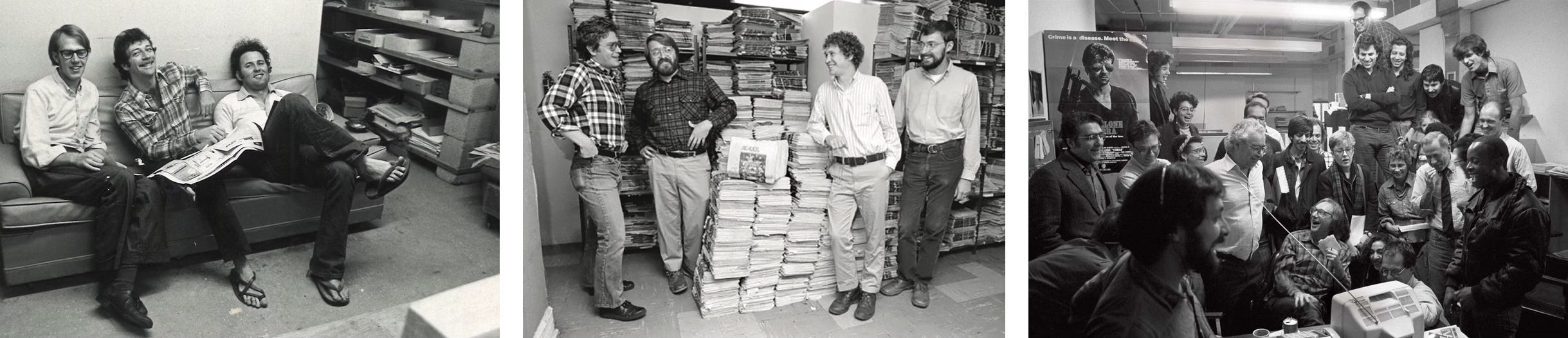
New Times founders Michael Lacey (center) and Jim Larkin (right) at the Phoenix New Times offices in 1972; Chicago Reader founders (from left) Tom Rehwaldt, Bob Roth, Tom Yoder, and Bob McCamant in 1979; cover image from The Freaks Came Out to Write, Village Voice staffers in 1986, by Catherine McGann

Read Parts I and II of this post here and here
Like the classified and local business ads that kept the lights on, the event listings that made alt weeklies required reading also informed their character. The editors and writers who compiled the listings were ferreting out shows and happenings all over town and discovering in the process culture that “has yet to explode,” as Chicago Reader editor Tracy Baim put it. “The woman who did the music listings,” Chicago Reader founder Tom Yoder recalled for Mark Jacob’s fifty-year retrospective of the paper, “part of her routine each week was to call this guy at the Jazz Record Mart and find out who was playing this weekend at these obscure south- and west-side bars. Because we wanted to be comprehensive.” Music critic Ann Powers has said she “remembers going to shows most nights, then working into the early morning at [San Francisco’s SF] Weekly’s old office on Bryant Street, putting together the week’s calendar listings.” In a passionate elegy for such music listings, composer Gabriel Kahane wrote last summer that they “weren’t just a boon for artists like me,” picking them out from the flock and bringing listeners to obscure places to hear their music, “they were also a teeth-cutting opportunity for cub journalists, one that demanded brutal concision.” “In its heyday,” he writes of the Village Voice, its newsroom
reverberated with the chaotic counterpoint of freaky choristers, all covering New York City with an obsessive commitment to hyperlocalism: Scenesters haunted hardcore shows at warehouses in Brooklyn; theater nerds ventured to East Village basements for experimental one-acts; dance lovers frequented Lower East Side nightclubs to cover bawdy performance art and contortionist spectacles. Here was a newspaper that, through dogged documentation of small and sometimes-fragile artistic microclimates, came to wield wide-reaching influence over national aesthetic trends.
Comments
Nothing yet. Say the first thing.
Sign in to join the conversation.