
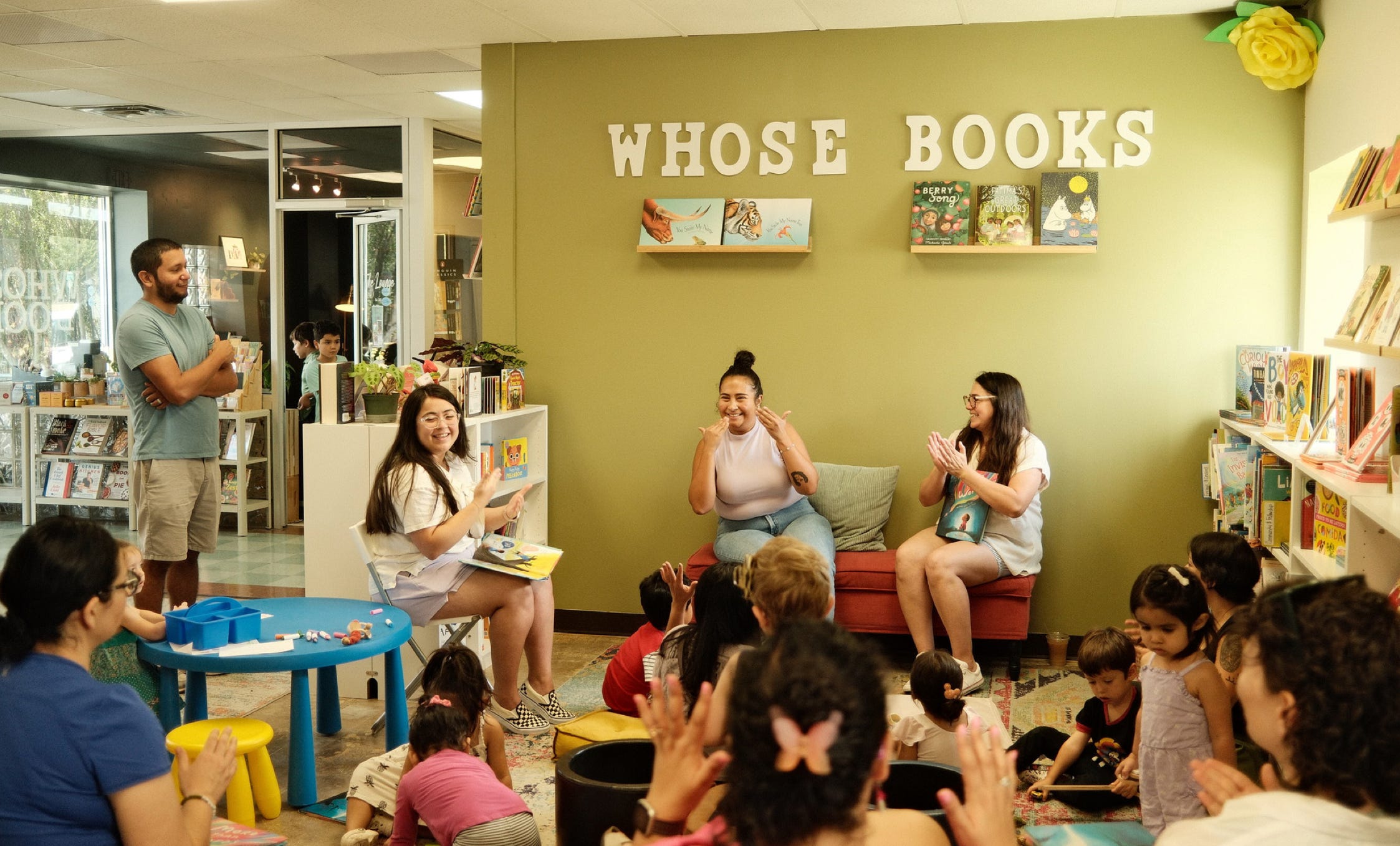
In 2021 Claudia and John Vega, both high school principals with decades of teaching between them and six children in their combined families, decided to make a change. Claudia thought, she recounts, “‘OK, I’m at the next season of my life, what do I want to do?’ I decided I wanted something where I was surrounded by books and where I could share books with other people.’” They had each grown up in a house full of books (Claudia’s parents were also Dallas educators; she was a student in the high school where she became principal), but this was a rarity in their South Dallas neighborhood of Oak Cliff. “We both grew up with families that instilled the importance of reading, but we didn’t have consistent neighborhood access,” she says. “If we wanted to buy books, we had to go to North Dallas or the suburbs. Eventually, it became the same for our children.”
As an educator Claudia had seen the same thing that Susan Neuman had seen as an Assistant Education Secretary implementing No Child Left Behind during the second Bush administration: that curricula and teaching methods and education policy are only part of the story of growing readers. “Some of the most critical factors in kids’ achievement involve family and environment,” Susan Neuman has said. She published two pioneering studies, in 2001 and 2016, of what she identified as “book deserts,” areas where there is very low density of retail that provides print resources for kids of any age, including fiction and nonfiction books and newspapers. She observes that complex vocabulary is only really communicated by reading, not orally; she and her co-authors argued that this scarcity created significant obstacles to low-income parents finding things for their children to read, reenforcing the detrimental effects of housing segregation on kids’ prospects. (Their studies also considered the difficulties low-income families face in accessing libraries and online ordering, as well as the benefits of home libraries.) A third study found that free children’s books offered through a vending machine in Anacostia were eagerly snatched up, demonstrating that parents with few resources lacked not motivation or interest in finding their kids things to read, but opportunity. Two other studies conducted in the teens (2010 and 2014) across dozens of countries and cultures found that growing up with books in the home is strongly correlated with a child’s academic advancement, independent of a their parents’ level of education, living standard, occupation, or class. Having many books at home over none corresponded with three years of additional education, as great an advantage as having university-educated versus unschooled parents, with the most powerful differentials seen among those with smaller libraries.
Claudia and John observed these inequities at close range, in their own childhoods and those of their students. In a city of great wealth and resources, with sometimes just a few blocks separating children from abundant opportunity, “more than 50 percent of fourth graders read below the national average,” Claudia reports, “an estimated 20 percent of adults are illiterate, and 33 percent are categorized at the lowest literacy level (Level 1)—struggling with basic tasks like filling out forms.” Claudia has shared a map provided by the advocacy group Unite for Literacy indicating that in more than a third of the area of Dallas, the southeastern section that is her home, 0 to 10 percent of households have more than a hundred books. She describes searching for spaces for a bookstore in her historically redlined, largely Spanish-speaking neighborhood and encountering skepticism that such a business could ever survive.
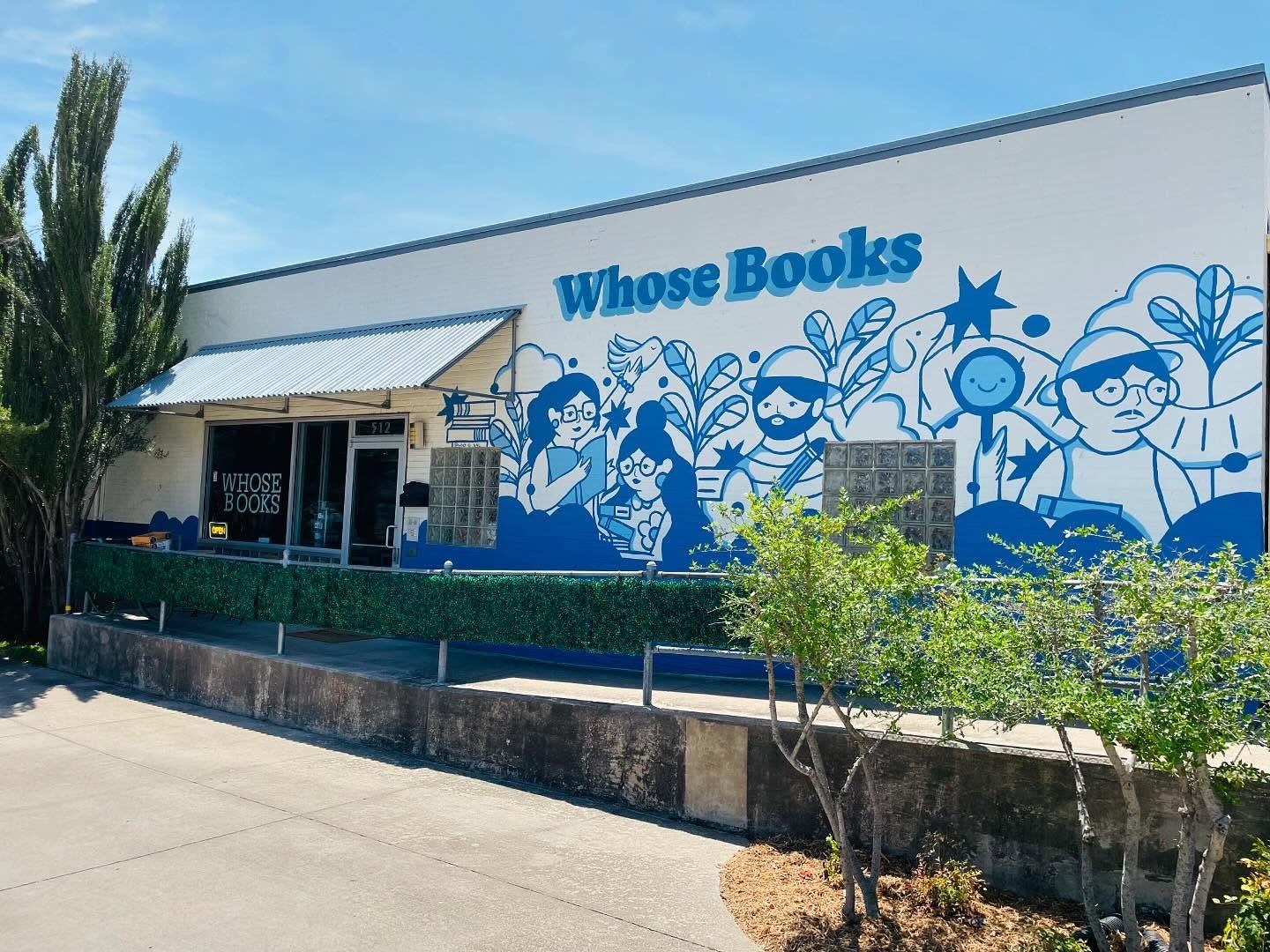
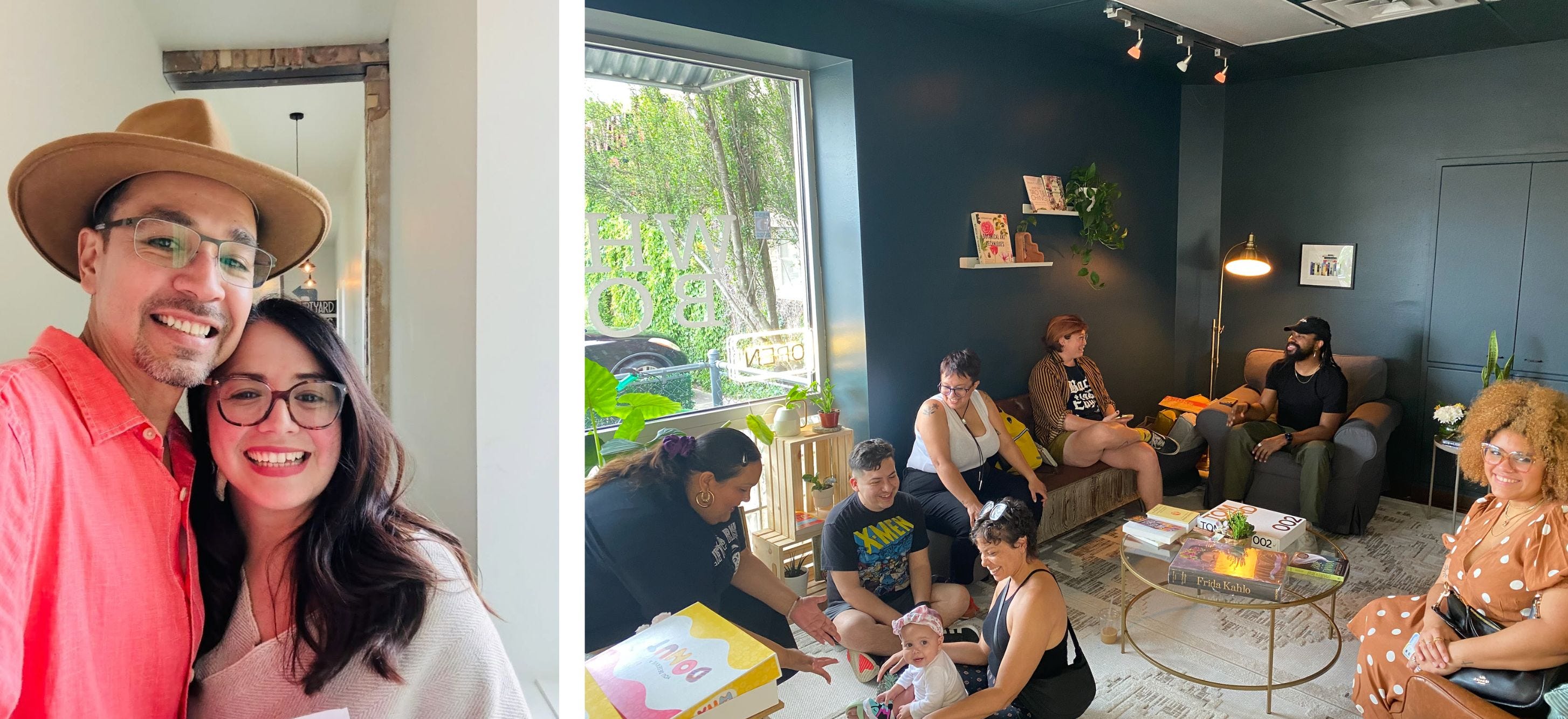
For Claudia and John these realities were not obstacles but the very rationale for their project. Median income should not dictate who has access to books. Books should not fall into the category of “luxury items” for the few. “This reading gap that we have is directly related to access and to low reading culture,” Claudia says. Claudia and John opened a cheerful, welcoming bookstore, Whose Books, first in a small incubator space in a development with a community-focused landlord, and then as they grew in a more commodious space that includes a community lounge; they are just now extending their range with a colorful bookmobile (see our Notebook on bookmobile history). When I hear their store’s name I think of the protestor’s call and response: “Whose streets? Our streets!” Whose Books offers what any serious reader might look for in a bookstore, books from a wide range of emerging authors as well as literary classics, books on history, philosophy, and political science, but within this familiar milieu is a laser focus on growing readership and creating a welcoming space for who people might not see bookstores as for them. Claudia describes Whose Books as a “social-impact startup,” “designed to champion literacy on all levels. Its shelves are curated to represent the community’s interests.” “Every day we have one person come in who has never been in a bookstore,” she told a local news outlet. “Some people would ask if they had to pay to enter,” she has said. “Some people asked if they had to pay to browse, where to find the price on the book, all kind of little signals of they’ve never been exposed to this before … For a lot of people who have not had access, it’s a foreign concept that’s really hard for a lot of people to grasp.” Visitors have told booksellers “I never did anything like this as a child myself, so I’m happy to start this tradition with my child and grow his own collection of books” and “This was something new for me …” “To the average person that might seem a little strange, but it’s really a matter of privilege,” Claudia concludes.
Just as she and John were starting to wonder how their ambitions for Whose Books could be squared with its economic prospects, they came across a group of bookstores, gathered under the auspices of the Emerson Collective, a company that combines investment and philanthropy to advance social goals, that was exploring ways to layer nonprofit support for the community-building work of bookstores into a retail enterprise. (The folks who designed Emerson’s bookstore partnerships read some of Book Post’s work on the value of bookselling and invited me early on to advise in the project as a volunteer.) Booksellers might reasonably ask why they need also raise money to float the business of selling books on behalf of American publishers, when publishers might rather create terms that make this business possible—but in the American marketplace, in contrast to the rest of the world, we leave the vital work of sustaining written culture (as well as other kinds of culture) at the mercies of a market unsympathetic by nature to protecting and advancing sustained and critical thought. As Will Ames, Emerson’s portfolio director for the bookstore project, described in a recent article, bookstores “need to compete as for-profit businesses in a market increasingly stacked against them” and “often accept high risk and financial strain to provide a public good, particularly in the less affluent markets and rural places that need them most.” The solution Emerson developed in collaboration with the bookstores was mechanisms for creating nonprofit bookstores and “hybrid” bookstores that pair the shop with a nonprofit tasked with advancing its work of developing reading culture. Claudia in 2023 founded a nonprofit Activating Reading Communities Organization (ARCO) to “create book access and positive reading experience in our community” of South Dallas. “Access to books and books ownership isn’t just about literacy; it’s about equity,” ARCO’s founding mission states. “We’re committed to collective action in helping our community to create opportunities to engage with books and activate and support the reading culture within our community,” to “addressing barriers to book access,” and to seeing that books are “integrated into everyday life.”
The nonprofit allows the bookstore to buy books to give away or sell at a discount to underserved readers, to pay authors to visit locations that might not otherwise present enough of a sales opportunity to attract the attention of publishers and to show publishers that markets exist in places they are not looking, to invest in stock for creative or risky events that it can distribute to readers in need without having to return it to the publisher, to develop relationships with other local organizations to reach untapped audiences and bring books into new situations. Claudia has found that after she has helped bring author events to schools with the help of a subsidy from the nonprofit, for instance, PTAs get the hang of it and begin doing it themselves. The muscle strengthens. Bookstores in the Emerson cohort give away books at book fairs, during story hours, out of bookmobiles, in prisons and to newly released people, at sporting events, in the post office. (New Jersey senator Andy Kim introduced grant-making legislation in March called the “Open Books, Open Doors Act” that would support book giveaways in places like barbershops and salons, houses of worship, community centers and childcare centers, laundromats, and hospitals and clinics, as well as bookstores.) The nonprofit can cover staff, space, and equipment expenses related to community programming.
Claudia and John take great care to select books and authors that will be meaningful to the community they serve and not impose some standard from without, even when giving away donated books. “I always knew we needed a bookstore in our neighborhood, even as a kid,” she has said, “when I wasn’t able to see stories about people like me. I’ve struggled to find diverse books for my kids and students, and wanted to provide something so we didn’t have to drive across 75 to find it.” Like a number of Emerson booksellers they offer vouchers or tokens that allow readers to choose books for themselves. Claudia has said that creating a positive reading culture means pursuing our true interests. Susan Neuman’s studies (and others) showed that the element of “agency and choice” in selecting books and creating one’s own library is important to forging a connection to books. As John Paul Brammer wrote beautifully recently, even for those of us who struggle to maintain what might have been rich reading lives amidst the digital world’s distractions, satisfying curiosity, rather than following instructions, is the surest route to abundant reading. Bookseller Calvin Crosby, of The King’s English in Salt Lake City, who is of indigenous ancestry and also grew up in a bookless, redlined community, has said that entering a bookstore was the first place did not feel marginalized. He has spoken of the importance of subduing the prestige of book environments. The language of his nonprofit, Brain Food, has evolved away from “literacy” and toward “access and choice.”
Some of the most powerful conversations I’ve heard among the Emerson bookstore partners involve the element of cultivating trust in one’s readership. Trust of your bookseller allows the bookseller to put something in front of you that you may not agree with, but that you might give attention to. The bookseller does not say, “think this,” but rather, “you will learn something from considering this.” Claudia has noticed that because the store has gained the trust of its readers, they were willing to go into libraries after she partnered with them, even though before they might have hesitated to involve themselves with a government entity. She has taken care to learn about and honor their identities as readers, to learn about “the points of celebration and the pain points,” including some of their “fractured relationships with reading.” A sticker inside the books they give away asks the reader to complete a survey to help the nonprofit in its work. The survey helps the store identify neighborhoods that are drawing readers, so they can send the bookmobile there or partner with a local organization. The survey also asks, what role has reading played in your life? Many have replied (many men especially), a negative one. Claudia and John look into these “pain points”: How can early experiences of failure or inadequacy that are related to reading be overcome?
One important way is with intergenerational reading. Bilingual story hours at Whose Books allow parents to participate in their children’s reading even if their command of English or their own literacy is limited. They help parents create a strong reading culture at home and “foster a sense of belonging and pride for our Spanish-speaking communities, promoting bilingual literacy and a love for reading across generations,” Claudia says. She observes that sometimes parents “didn’t finish school and never got a chance to really become fully literate. When their children go to school, if they struggled with either vocabulary or language or a reading disability, then reading can become a point of frustration.” Lisa Uhrik, of Emerson partner bookstore Plenty in central Tennessee, which is fully nonprofit, has said, “there are people you love who struggle with reading.” At Plenty she tries to be “strategic, to be sensitive about our invitation.” Meanwhile bookstores across the country are seeing more Spanish book-buying as schools embrace bilingual education and parents seek connection in particular to Latin American cultural experiences (see our Notebook on Spanish-language bookselling). “When we came to the market in 2020, we met a significant pent-up demand for Spanish and bilingual books from families and dual-language educators,” Nina Sánchez, owner of Chicago’s 51st Ward Books, told Publishers Weekly a few years ago, with a particular demand for folklore and customs as well as contemporary literature from Latin America.
Claudia and John Vega are deliberate about developing their store, and its presence in parks, community centers, and cafes, as a “third spaces,” using the term developed by Ray Oldenberg in his book The Great Good Place. (Like many bookstores, Whose Books has contributed to rising property values and commercial life in its neighborhood.) She told Will Ames that “the bookstore brings all kinds of people, people from the richest part of town, from this neighborhood, sometimes people coming out of prison. We know where our neighborhood has been and where it’s going. Houses to the left are going for $400-500K, to the right for $60K. We’re at the crossroads of two different types of neighborhoods. And we see them come together.” In his epic sociological study Bowling Alone, Robert Putnam identifies a decline in shared experiences for people across socioeconomic differences as one of the most ominous of contemporary trends. The necessity of such spaces for physical gathering has become more visible to us since the pandemic and the isolations of digital life. One of Whose Books’ customers has said, “The Third Spaces events have made reading feel like a shared journey, not just a solitary activity”
Every year Emerson has brought its booksellers to a gathering that combines talks, workshops, and just hanging around, and there I’ve encountered some of the most interesting, creative, open-hearted, and of course well read people I have ever met. This year we heard some invited speakers who brought out common threads that bookselling shares with other labors of cultural renewal. Brian Bannon of the New York Public Library asked if we need a science of reading persistence to accompany the science of reading, and who owns it? Erin Barnes, of Main Street America pointed out that book deserts lack strong main streets, and that the Pew Research Center has identified small business as one of the few trusted institutions left in American life. The Smithsonian’s Lonnie Bunch observed that the objects in the Smithsonian’s collections, like books in bookstores, help the public embrace ambiguity: you have to understand the totality before you can move forward, and reflecting on that assembled record gives people the skills to face what they are going to face. And I got to fulfill a longstanding dream of talking with Ron Charles about how without the diminishing support of magazines and newspapers books criticism can have a role in fostering a shared culture of reading. This shared labor of preserving and conveying, treating one another with respect and trust, to make choices and draw conclusions, seemed a common thread, precious and vulnerable work, that perhaps demands the participation of what Lewis Hyde called the gift economy along with the economy economy. Whose Books is a neighborhood bookstore (“your neighborhood bookstore”) on West Davis Street in Oak Cliff, that is open from 11 am to 7 pm most days, and a bookmobile that will trundle about southwest Dallas. But it is so much more. I increasingly feel that it is these labors of the local that hold, like a magic pebble, so much of the hope we have to offer.
Ann Kjellberg is the founding editor of Book Post. Read her Notebooks on books and the reading life here.
Book Post is a by-subscription book review delivery service, bringing snack-sized book reviews by distinguished and engaging writers direct to our paying subscribers’ in-boxes, as well as free posts like this one from time to time to those who follow us. We aspire to grow a shared reading life in a divided world. Become a paying subscriber to support our work and receive our straight-to-you book posts. Some Book Post writers: Adrian Nicole LeBlanc, Jamaica Kincaid, Lawrence Jackson, John Banville, Marina Warner, Álvaro Enrigue, Nicholson Baker, Kim Ghattis, Michael Robbins, more.
Whose Books in Dallas, Texas, is Book Post’s Summer 2026 bookselling partner! We partner with independent booksellers to link to their books, support their work, and bring you news of local book life across the land. We send a free three-month subscription to any reader who spends more than $100 at our partner bookstore during our partnership. To claim your subscription send your receipt to info@bookpostusa.com.
Follow us: Instagram, Facebook, TikTok, Notes, Bluesky, Threads @bookpostusa
Comments
Nothing yet. Say the first thing.
Sign in to join the conversation.