
Midway between Summer Solstice and the Autumn Equinox, the cross-quarter signals both the descent of summer and the awakening of the harvest, and has been a point of celebration in the liturgical year. I note one feast day name, “Lammas,” which is from Old English hlāfmæsse, "loaf-mass.” More fully, Evan Daniel, in The Prayer-book: Its History, Language, and Contents published in 1909, had this to say:
“Lammas Day. In the Romish Church this day is known as the feast of St. Peter ad Vincula (St. Peter in the fetters), being the day on which the Apostle's imprisonment is commemorated... Lammas is a corruption of hlaf-masse,*the loaf-mass. In the Early English Church it was customary on this day to offer an oblation of loaves made of new wheat, as the first-fruits of the harvest. In the Sarum Manual it is called Benedictio novorum fructuum.”
[Note from Jane: Curious about “the Feast of St. Peter ad Vincula (St. Peter in the fetters)”? I was too! See the end of this post for more discussion.]
This year the cross quarter fell on August 7, and the very next day, my husband Andy happened to bake a loaf of sourdough bread made from newly harvested and just-arrived-in-the-mail Einkorn berries (grain). Our source for bulk Einkorn berries had run out a couple of months before, due to a surge in the popularity of this ancient species of wheat. Many who can’t tolerate wheat - much less American wheat - can enjoy bread made with Einkorn.
Receiving this first harvest, we of course had to celebrate, thus the baking of this bread, which Andy then took to monastery to share at the meal following Divine Liturgy.
So, hlaf-masse, Loaf-mass. In an echo or a rhyme, and no premeditated thought, we participated in the liturgical cycle of giving thanks to God for the first fruits of the harvest. At the monastery, which follows the Old (Julian) Calendar, the First Fruits will be blessed on the Feast of the Transfiguration of Our Lord, tomorrow, August 19. Perhaps I will tuck in some of my freshly dried herbs and a newly made herbal tincture into my basket of First Fruits.
I have been harvesting herbs since early spring. Even now, with so many herbs past flower, I find plenty to pluck or clip into my harvesting bag. The succession continues, the herbs expressing in leaf, flower, seed, and back to root, their own liturgy.
Here are few of my floral friends:
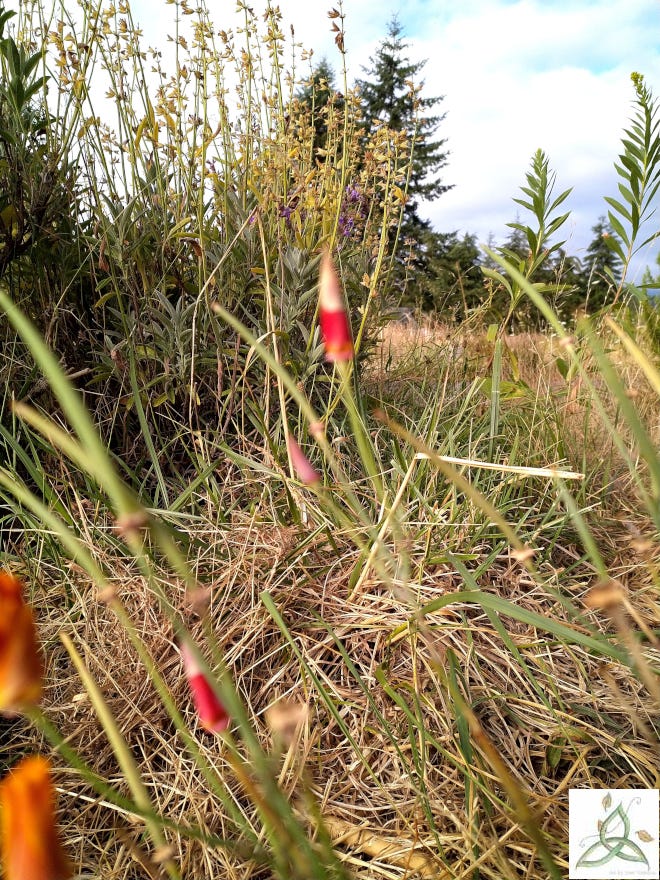
Even in late July, a few California Poppies burst forth in a last hurrah, charming me with their gnomish caps. I didn’t harvest any poppies for medicine this year, but the whole plant, roots, stems, flowers, leaves, and all, make a nice calming remedy. As a tea or tincture, California Poppy (Eschscholzia californica) soothes the nerves, gently sedates, and helps ease physical pain. Tinctured in brandy and honey with a little chamomile, California Poppy makes a lovely elixir. For a stretch of years whenever insomnia struck, I would take a dropperful or two of the elixir, or sometimes a microdose of 2-3 drops. It is a good child’s remedy, so I gave it to my daughters too, when illness or other reasons disturbed their sleep.
These days, I am at peace (generally) with waking in the night, and treat my own wakefulness differently. Before the disruptions of artificial lighting which began with gas lamps two hundred or so years ago, multiple sessions of sleep in the night was common. I hear about “biphasic sleep” - with a First Sleep and a Second Sleep spoken or written about. The Midnight Office, in the monastic prayer cycle of the Hours, leans, I am sure, into a pattern that God created for us in our physiology.
"At midnight I arose to give thanks to You.
Because of the judgments of Your righeousness."
- Psalm 118 (119):62
Unless I stay up too late working on my laptop (ugh, if you want to sleep restfully, don’t do that. And especially don’t tend to emails, texts or social media!), I welcome this “quiet wakefulness.” Here, I experience the moonlight slanting through the house, and the beautiful dark of a cloud-cover night. I may catch some stars shining in the windows, or listen to the coyotes partying in our field (and give thanks that our hens are safely locked up and sound asleep).
And sometimes I get up in the night and walk through the house like women of other places and times, offering prayers for the protection of the home, and for the family. And I converse with Christ and our Our Lady, and offer gratitude for life and the shape of it.
To return to sleep I often settle into a long “string” of short, focused prayer, such as the “Jesus Prayer” - “Lord Jesus Christ, Son of God, have mercy on me, a sinner.” If I’m particularly anxious about something, I’ll recite Psalm 23 (24), “The Lord is my Shepherd,” and enter the words as deeply as I can. In the latter case (wakefulness from stress) I may also add in any and every other longer prayer that I can remember. I usually finish with some faith-related reading.
These remedies have not only paused and dispersed circling thoughts, but have helped keep them from taking hold in the first place.
Herbally, Passionflower (Passiflora incarnata - yes, in reference Christ’s passion) has been a good herbal support for this purpose, and I think Skullcap (Scutellaria lateriflora), which is growing abundantly in our new garden, will become a most excellent friend in that regard. As I resume working with herbs, I think bundling “plants with chants,” will add another hue of kindness to a night wakefulness that modernity doesn’t often embrace as a time of gifts.
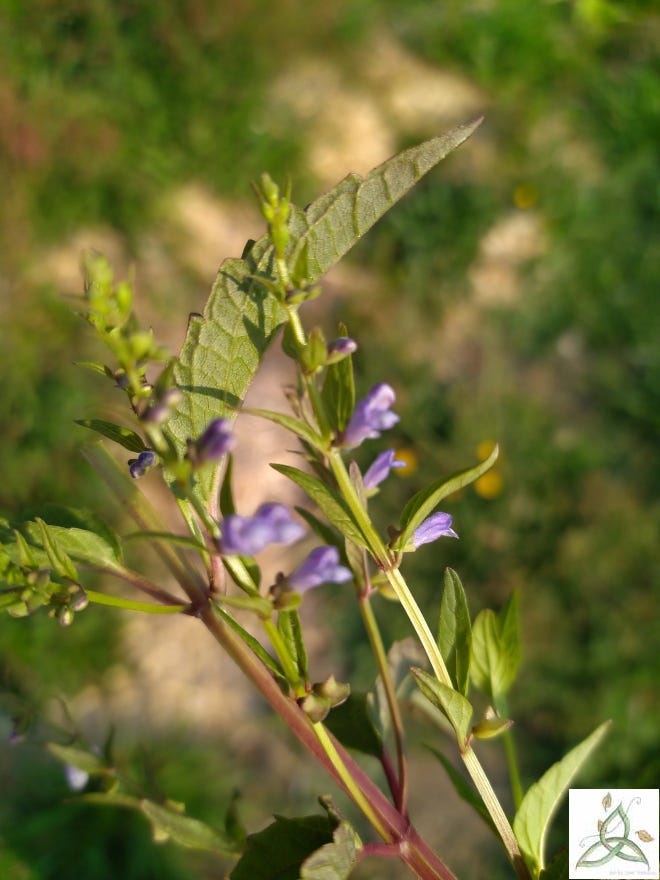
As I said, I’ve been out in the field and garden, gathering whichever herb is ready for that. Above is Skullcap. An herbalist friend had given me some starts last year, and amazingly, the starts not only survived my neglect, but took well to being planted very belatedly in our garden in early summer. I started some Skullcap seeds too this year, so now I’m in abundance with this lovely plant!
Below is a 4 oz jar of Skullcap I clipped teeny-tiny and soaked in brandy. I chose the brandy for its name, Grand Blue, and in honor of Skullcap’s tiny purple flowers. Not blue, but close.
As I tinctured the Skullcap, a bit of Benedictine chant sprang to mind, so I chanted as I prepped.
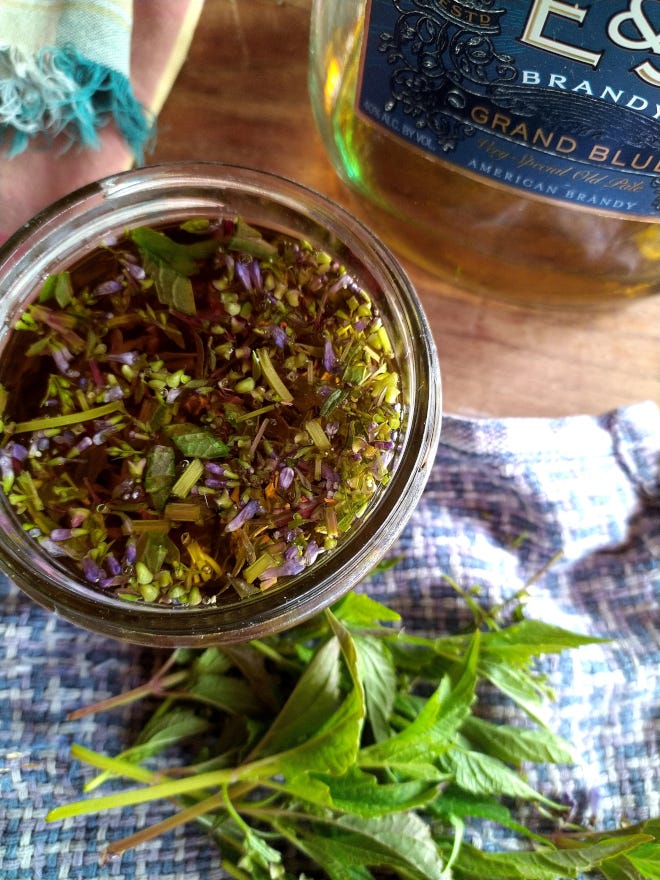
I’m not sure why this particular chant volunteered, but here it is:
Antiphon: O God, all your ways are holy. * What God can compare with our God?
Easter Season Antiphon: The waters saw you, O God; you led your people through the sea, * Alleluia.
When I wrote out a card to accompany the remedy, I included the chant too: a little prayerful reflection to add to the making and taking of the tincture.
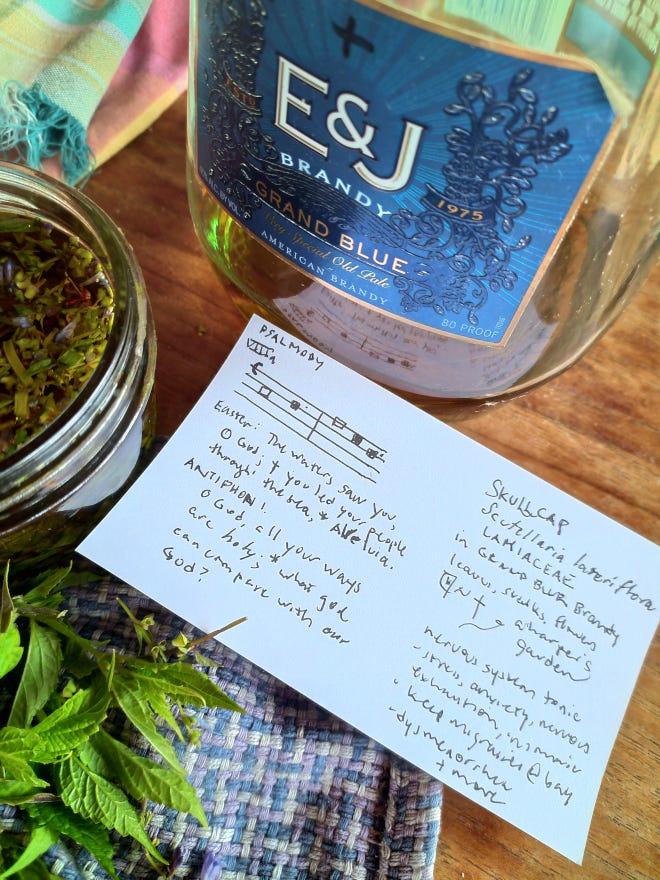
Most herbs can be worked with in a variety of ways. The notes on the card, transcribed below, list just a few reasons why you might choose Skullcap, and are related to conditions some people have asked me about for help:
Skullcap - Scutellaria lateriflora - Lamiaceae (Mint family) in Grand Blue Bandy. Leaves, stalks, flowers.
nervous system tonic
~ stress, anxiety, nervous exhaustion, insomnia
~ keep migraines at bay
~ dysmenorrhea, and more
While I haven’t used Skullcap much yet, I have found that its name, thus far, is apt. When my thoughts are whirling, just a drop or two calms the whirl - as if a cap indeed is being placed gently on my skull. A microdose works for me. Others might require more.
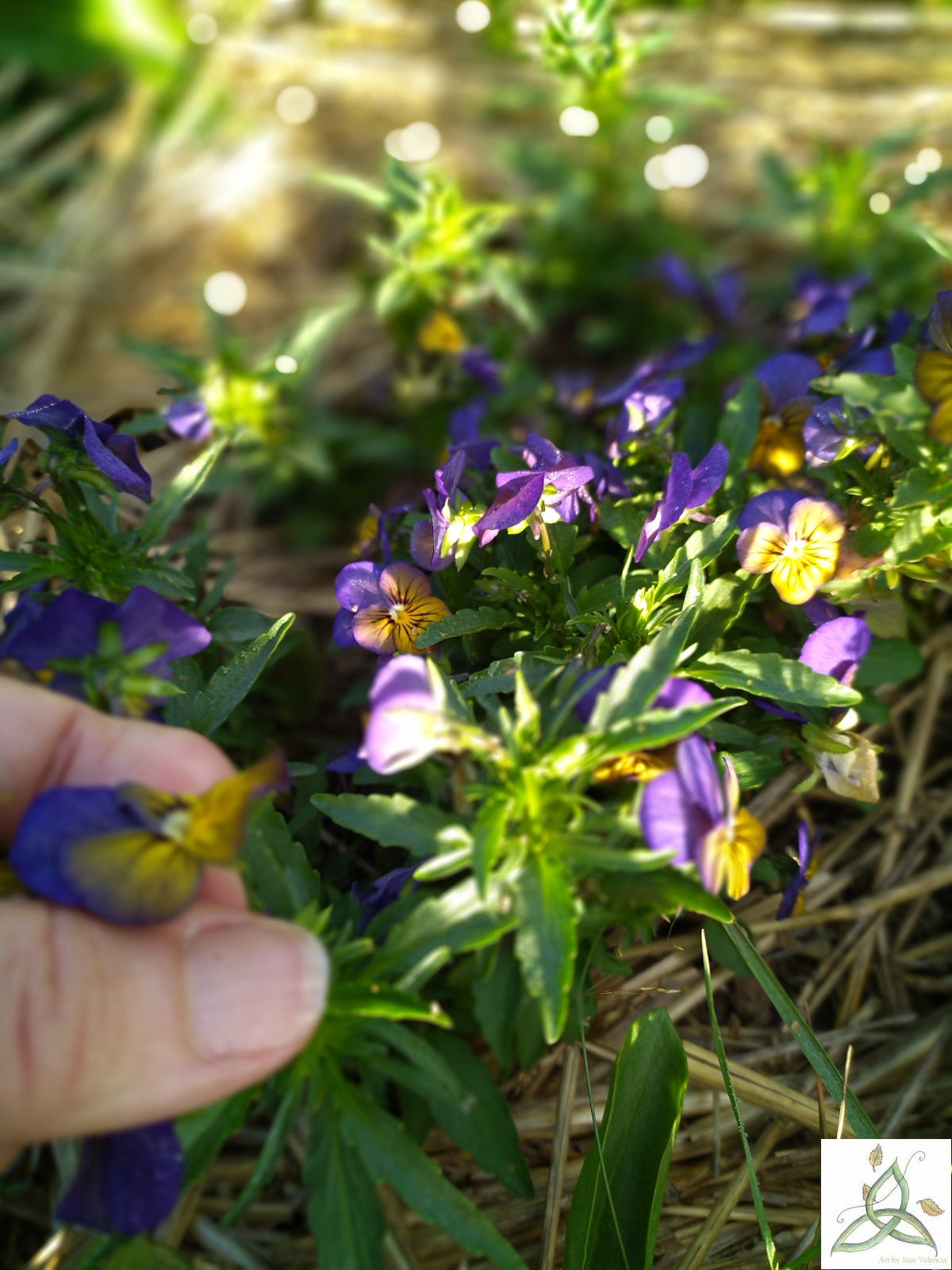
Here’s another herb I’ve been harvesting: Johnny Jump Up, (Viola tricolor) - a Violet, and such a cheerful plant. One morning last week, they seemed like little angels to me, angelitas! I chanted a prayer as I picked each flower - not to the flower itself, but to my guardian angel, each flower akin to a prayer bead: “Holy Angel, my guardian, pray for me.”
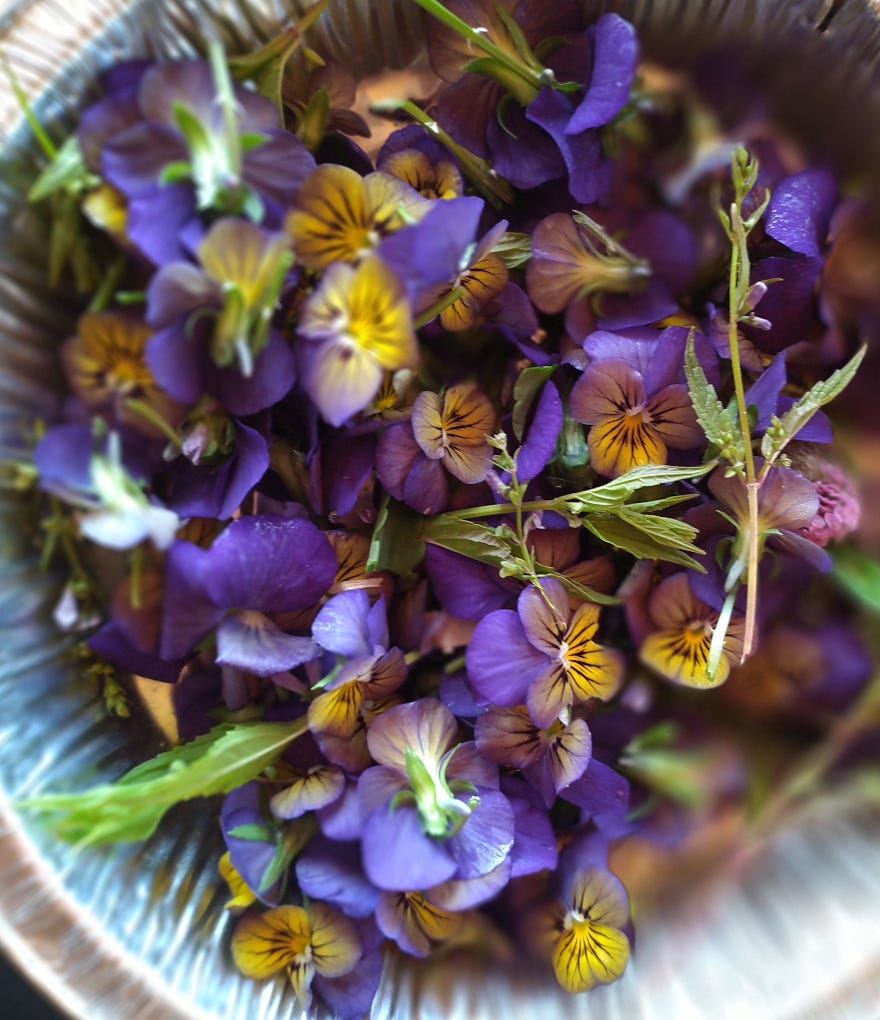
Here are the Violets, set out to dry, with a few other herbs tucked in - Skullcap and a Red Clover blossom. Violets are such lovely demulcents - soothing to irritated tissues, and with a subtle, almost vanilla flavor. Here is a post I wrote about the Evergreen Violet. Johnny Jump Up shares the medicinal properties mentioned in the Litany.
I’d never heard of this feast day, so this is just an initial research. In Acts of the Apostles, St. Peter was imprisoned twice in chains - even double bound the second time, and was twice freed by an angel (Acts 5:17–25, Acts 12:1-11). Learning of the miracle, Christians gathered these chains, considering them precious. Afflicted faithful would approach the chains to receive healing.
The Roman Catholic church “from at least the fourth century,” commemorates The Feast of St. Peter’s Chains on August 1.
The Orthodox Church and the Eastern Catholic churches celebrate The Veneration of the Honorable Chains of the Holy and All-Praised Apostle Peter on January 16, or January 29, Julian/Old Calendar.
Einkorn! With help from our daughter, the primary Einkorn baker in our home, my husband wrote about baking Einkorn bread in a recent article: Fresh, Yet Ancient Bread.
Here’s my recipe for Einkorn pancakes: Pancakes for Matrona.
Herbs! And because it is Wildfire Season, if you are herb-curious or inclined, here is an article by me: Fire Season - Plants to the Rescue!
My Creative Works! I’ve added a tab at the top of page that links to my harp music, writings, and art posted elsewhere.
Thank you for reading!
No posts
Comments
Nothing yet. Say the first thing.
Sign in to join the conversation.