

Tl;dr - A book on the science of relationships that takes aim at evolutionary psychology (or a caricature of it at least. An odd combination of pop-y social psych, self-help, and dating advice, rather than a rigorous, evolutionary-grounded science of relationships that I was expecting.
I’m an evolutionary psychologist by training. I studied sexual psychology from an explicitly evolutionary perspective, focusing on sex-differences, sexual strategies, mate retention, and romantic attachments. I became focused on attachment research early on in grad school when I found that evolutionary theory could be generative for understanding romantic attachments and the pair-bonding nature of humans. You can read about my thinking in this area summed up in this academic publication of mine from 2020.
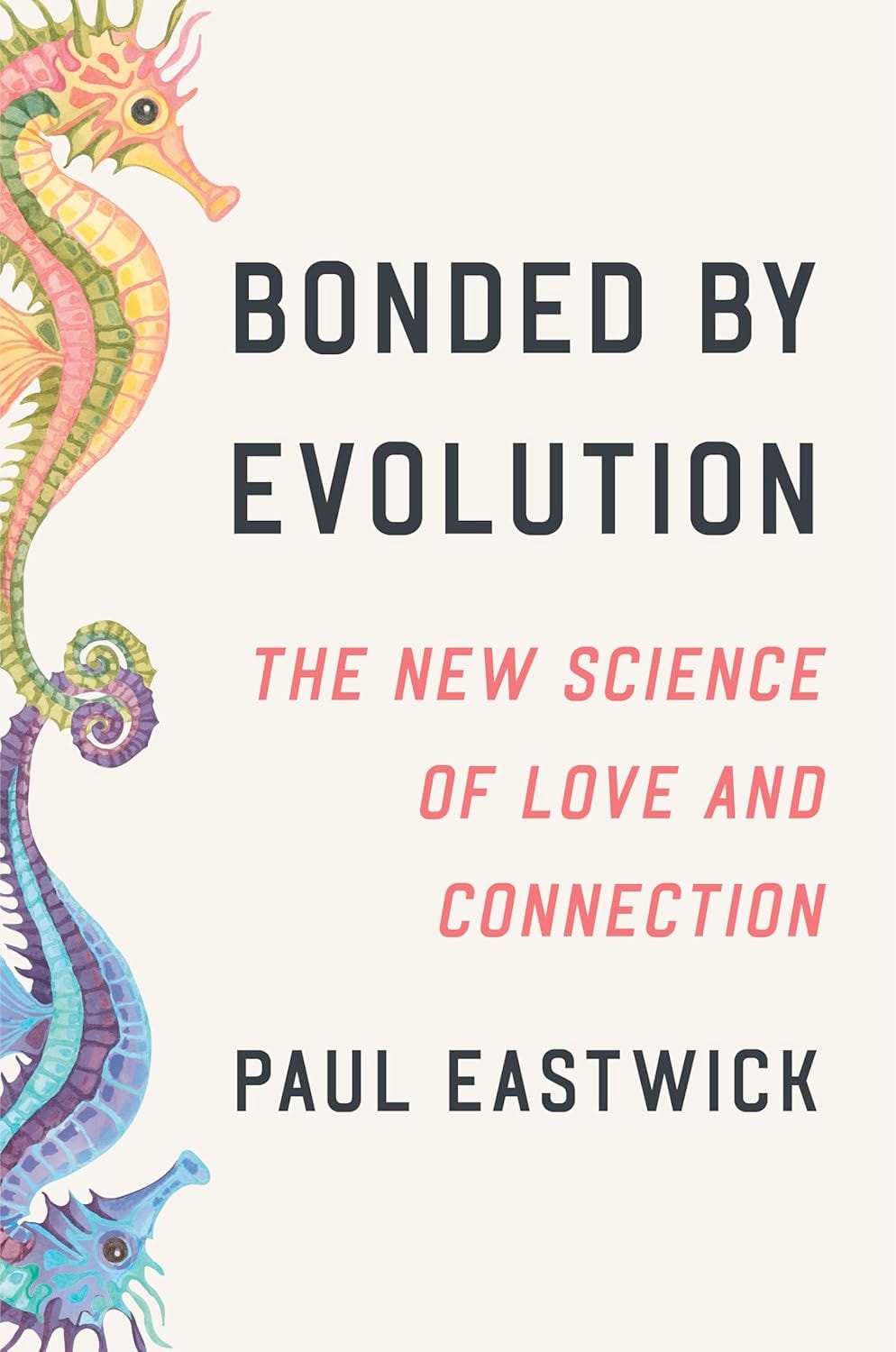
Understandably then, I was very excited to see this new book, Bonded by Evolution: The New Science of Love and Connection by Paul Eastwick. Eastwick’s thesis is that “compatibility” is the essential ingredient to explain why we pair bond and how couple patterns form within these relationships. More perniciously, his book is a hit piece on evolutionary psychological theories of relationships while maintaining that his work is the “true” evolutionary informed approach.
Before I start: I really dislike writing negative reviews, but when the book is squarely in my expertise area, I feel compelled to share my honest thoughts. And for the record I like Eastwick’s academic scholarship on its own merits but this translated into a bad book. This distinction is important.
Now, taking aim at other perspectives as Eastwick did is not inherently bad. But defining your scientific perspective and framing your entire book around a given cheap moniker of “the EvoScript” I think makes for a bad book. It also forces one to over-emphasize the relatively small differences and under-emphasize the overlap among the perspectives. I’m not going to go through each criticism but I’ll highlight a couple things that I found most frustrating while reading.
The first is the opening chapter on mate value as a good example of his approach. He argues that mate value, traditionally defined, is ephemeral and only matters mildly in the beginning of the relationship. He argues that trait matching explains little of why people pair up, and that the only effect you find is in the aggregate (which, ironically is exactly the point contemporary evolutionary psychologists like Dan Conroy-Beam, whose work Eastwick cites, argues). He argues that sex differences are minimal and actually instead men and women want the same things in their partner (the reality is both, exactly what evo psych pioneer David Buss, whose work Eastwick cites, finds). He argues mate value fluctuates, which of course it does and I don’t ever recall encountering a serious claim that it doesn’t. This is exactly what I mean about his approach of packaging all of evolutionary psychology of mating into a caricature of a box to argue against it. It creates a straw man of the “opposing” science.
Another frustrating point is that the claim of taking seriously the role of evolution, he offers no serious engagement with evolutionary anthropology. The book consistently references a vague “evolutionary past” where we formed relationships “in small groups” therefore rendering evo psych concepts of markets and strategies baseless. Despite claiming that evolutionary psych research fails to seriously address the real evolutionary past, his approach fails to engage with evolutionary mismatch (engaging briefly with the concept just once that I recall offhand). It’s not that he is wrong here — lots of evo psych fails to engage with the real past — but the irony is not lost on me while reading this.
Then the last part of the book makes an odd detour into a critique of incel culture and pick up artists, claiming that “out dated pop evolutionary psychology feeds existentialist and deterministic impulses.” Although he notes that such (mis)use of evo psych is “an accidental byproduct” and “we” didn’t know it would be used by such things like men’s rights movements and pick up artists, he also says “I view evolutionary psychology as reckless,” because it “preys on laypeople”. He is trying to bludgeon “the EvoScript” while also trying “to save evolutionary psychology from itself.” This rhetoric and approach is exactly the wrong approach (and is completely unpersuasive) if his goal (as it seems to be) is to convince evolutionary psychologists to do better.
The whole thing feels to me like Eastwick is judging and arguing against the “pick up artist” caricature of evolutionary psychology, kind of like judging the entire field of behavioral genetics only by the use of its methods and oversimplified findings by so-called “race realists.” I’m not saying evolutionary psychology is perfect — there is a lot of crap and similarly so in the field of social psychology where Eastwick resides — but this book isn’t the way to persuade the “other side” with his “alternative” new science of relationships.
It’s unfortunate because back in my science twitter days I often shared and engaged with the folks in his research team; I genuinely believe they are doing good science and adding valuable knowledge to this area. But I was still disappointed by this book. I was so excited about this book because there are no popular science books on attachment. So many relationship science books are pop-sci with a dose of self-help, and this unfortunately falls into that category for me too, despite his academic work being rigorous.
Published: February 2026
Publisher: Crown
Format: Kindle
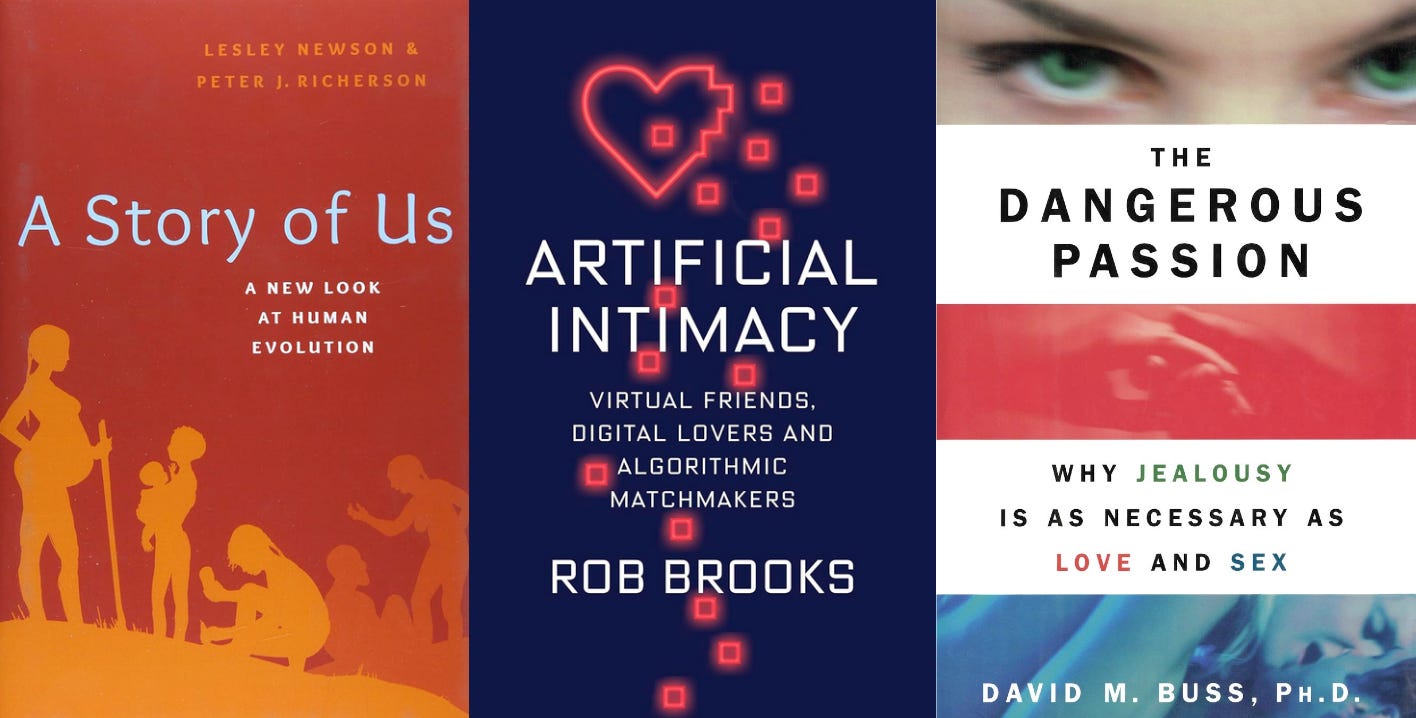
A Story of Us: A New Look at Human Evolution (2021) by Lesley Newson and Peter Richerson.
Artificial Intimacy: Virtual Friends, Digital Lovers, and Algorithmic Matchmakers (2021) by Rob Brooks
The Dangerous Passion: Why Jealousy is as Necessary as Love and Sex (2000) by David Buss
Comments
Nothing yet. Say the first thing.
Sign in to join the conversation.