
Hello and welcome back to the BookGo newsletter.
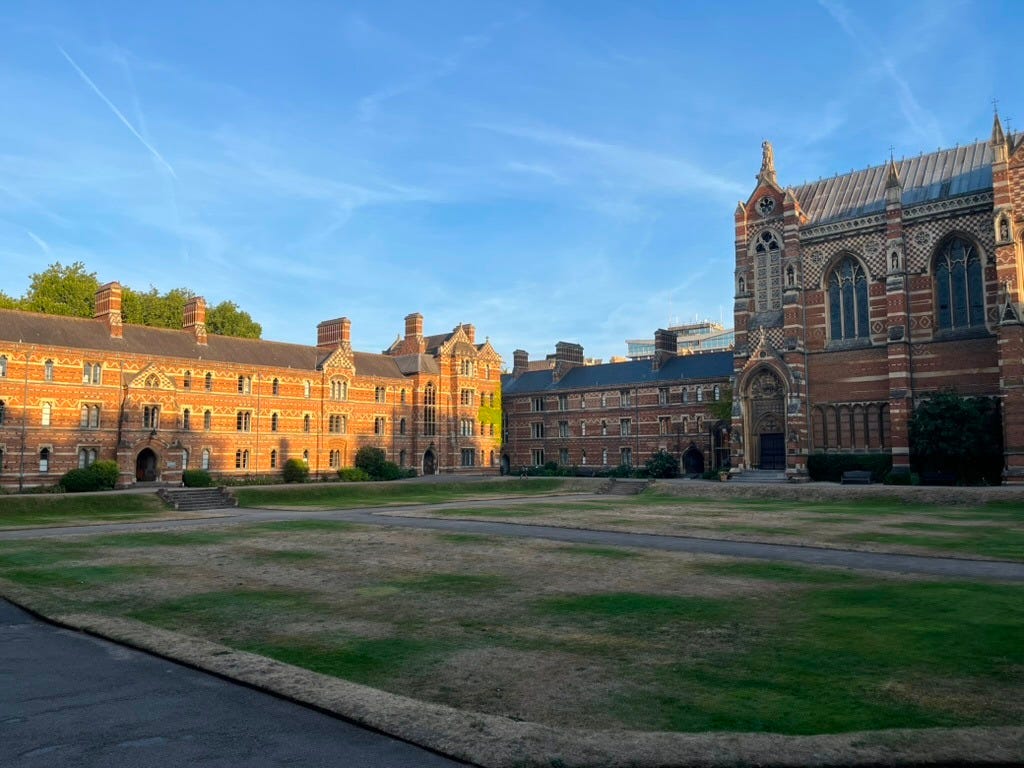
Today marked the inaugural launch of the Oxford Writers’ Workshop at Keble College. The morning started slow and quiet, like the best Oxford mornings should, with the sun rising softly over the incredible Liddon quadrangle of Keble College. The grass is a bit burned out from the terrible heatwave we’ve been suffering in England, but there’s still no place like an Oxford college to get you ready for a week of writing and exploring ideas and imagination.
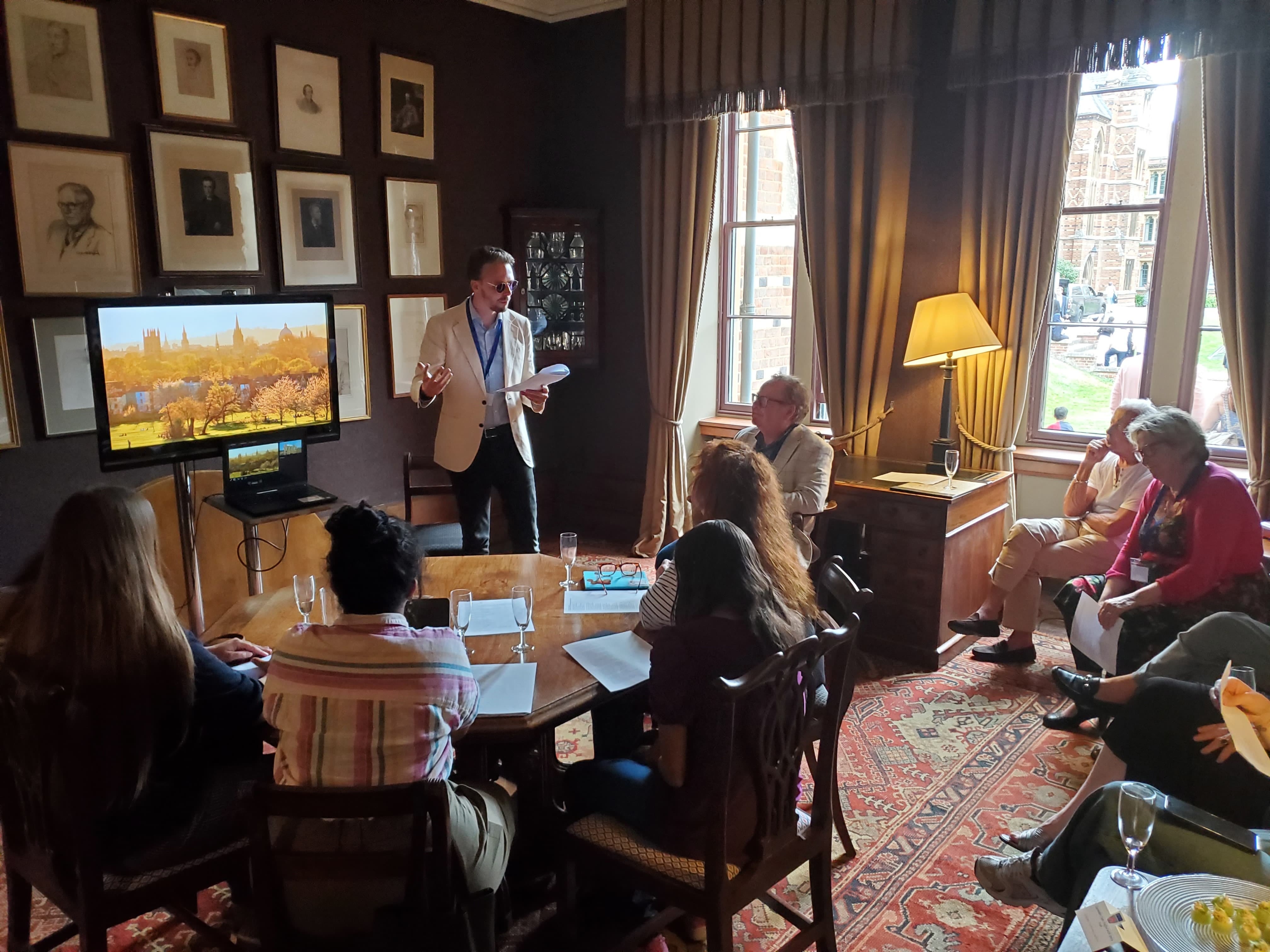
We welcomed our writers with a lecture from BookGo’s Tom Elliott in the Keble’s writers room. Tom took our attendees on a tour of the long and unruly tradition of Oxford writers, from medieval scholars through the Romantics and on to the fantasists of the twentieth century. It was followed by dinner in the Senior Common Room, where we swapped stories over good food in one of Keble’s most storied rooms.
Our poem of the week this week comes from Tom’s lecture, entitled “Writing Oxford: Rebels, Visionaries, and the Occasional Scholar.” You had to be there to hear from the rebels and the visionaries, but the poem of choice comes from one of those occasional scholars, the great cultural critic and essayist Matthew Arnold, whose poem “Thyrsis” gave Oxford its most famous ever description, as the city of “dreaming spires.” Here are a few stanzas of Arnold’s beautiful Oxford pastoral.
“Thyrsis: A Monody, to Commemorate the Author’s Friend, Arthur Hugh Clough”
By Matthew Arnold
Text within this block will maintain its original spacing when published
How changed is here each spot man makes or fills!
In the two Hinkseys nothing keeps the same;
The village street its haunted mansion lacks,
And from the sign is gone Sibylla's name,
And from the roofs the twisted chimney-stacks—
Are ye too changed, ye hills?
See, 'tis no foot of unfamiliar men
To-night from Oxford up your pathway strays!
Here came I often, often, in old days—
Thyrsis and I; we still had Thyrsis then.
Runs it not here, the track by Childsworth Farm,
Past the high wood, to where the elm-tree crowns
The hill behind whose ridge the sunset flames?
The signal-elm, that looks on Ilsley Downs,
The Vale, the three lone weirs, the youthful Thames?—
This winter-eve is warm,
Humid the air! leafless, yet soft as spring,
The tender purple spray on copse and briers!
And that sweet city with her dreaming spires,
She needs not June for beauty's heightening,
Lovely all times she lies, lovely to-night!—
Only, methinks, some loss of habit's power
Befalls me wandering through this upland dim.
Once pass'd I blindfold here, at any hour;
Now seldom come I, since I came with him.
That single elm-tree bright
Against the west—I miss it! is it gone?
We prized it dearly; while it stood, we said,
Our friend, the Gipsy-Scholar, was not dead;
While the tree lived, he in these fields lived on.
Too rare, too rare, grow now my visits here,
But once I knew each field, each flower, each stick;
And with the country-folk acquaintance made
By barn in threshing-time, by new-built rick.
Here, too, our shepherd-pipes we first assay'd.
Ah me! this many a year
My pipe is lost, my shepherd's holiday!
Needs must I lose them, needs with heavy heart
Into the world and wave of men depart;
But Thyrsis of his own will went away.
[...]
Too rare, too rare, grow now my visits here!
'Mid city-noise, not, as with thee of yore,
Thyrsis! in reach of sheep-bells is my home.
—Then through the great town's harsh, heart-wearying roar,
Let in thy voice a whisper often come,
To chase fatigue and fear:
Why faintest thou! I wander'd till I died.
Roam on! The light we sought is shining still.
Dost thou ask proof? Our tree yet crowns the hill,
Our Scholar travels yet the loved hill-side.
There is of course an elegiac tone to Arnold’s words, lamenting the loss of a beloved companion and a city and a world that the speaker used to know. But there is also a great capacity to capture the imagination that a city like Oxford inspires.
In the final stanza, the speaker gives the invocation to “Roam on!” for “the light we sought is shining still… Our tree yet crowns the hill / Our Scholar travels yet the loved hill-side.”
With our writers joining us for the Oxford Writers Workshop from around the world, we are so excited to roam on with them, to continue on the tradition of scholars, travelling the loved hill-side.
Two books from the BookGo roster are open for pre-order, and both feel fitting for this Oxford week.
The First Guidebook to International Universities by Richard Major offers an essential companion for students weighing their options abroad, including Oxford itself, a fitting read for anyone following along with this week’s workshop.

Things That Blow My Mind About Animals by Elvia Gómez Troya, aka Elvia la rastreadora, is available in both its original Spanish edition and English translation. Pre-order now to be among the first to read it. The book will launch directly after the writers workshop in Miami, Florida – a bit of a change of scene from Oxford!

Our writers have a jam-packed schedule coming up, kicking off with our first masterclasses tomorrow morning, “Once Upon a Time” and “Understanding Genre,” followed by tours of Oxford colleges and an opportunity to see Shakespeare’s Romeo and Juliet in the grounds of Oxford’s medieval castle.
While we’re exploring all of that with them, we’re also loving connecting with you through the ether.
As always, thank you for reading. More to come soon from Oxford!

✨FOLLOW BOOKGO ON SOCIAL MEDIA! ✨
We love connecting with authors and readers.
Follow us on Facebook, Instagram, Bluesky, and LinkedIn.
Every new follower helps us keep doing what we do.
BookGo is reader-supported. To receive new posts and support our work, consider becoming a free or paid subscriber.
Comments
Nothing yet. Say the first thing.
Sign in to join the conversation.