
This is not my end of year recap, that will come in January—I’m currently stuffing my entire life into three suitcases, prepping to move to London.
I am, however, ready to continue my list of queer books from this year.
Read the first part of this list below:
·
July 13, 2025
June has come and gone, but I am still gay. As such, I believe it is my duty to share every single queer book I’ve read this year so far.
So, let’s break down my queer reads:
In the last 6 months of the year, I read 46 books.
23 of those were queer (at least in part) stories. 19 of which were written by out queer writers. Of the 23, 20 were fiction reads, and 3 were non fiction/poetry reads.
I’m going to go through all of them here and highlighting my favourites, so buckle up!
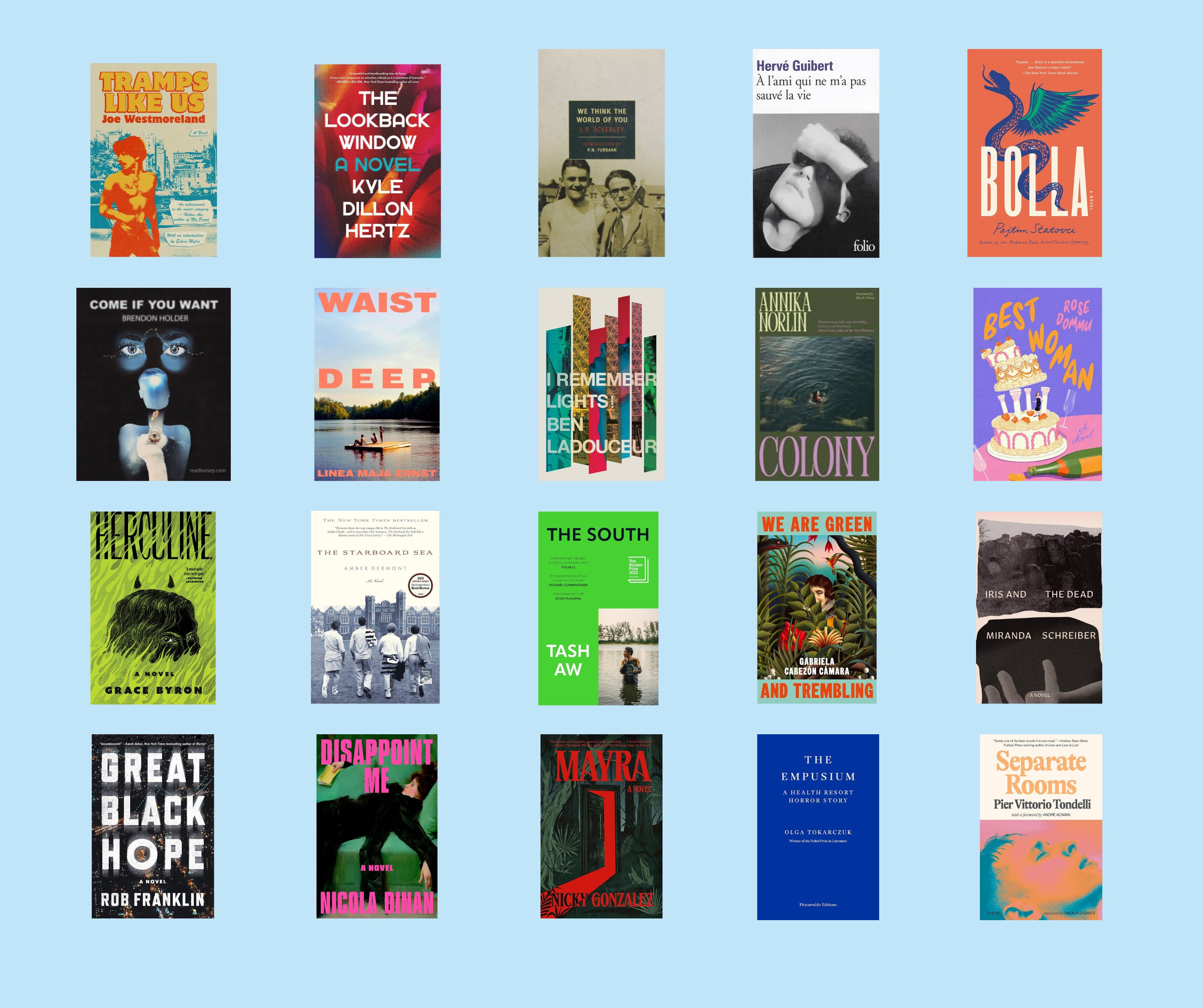
Tramps Like Us by Joe Westmoreland
Originally published in September, 2001, this novel is getting the second life it deserves. It is a work of autofiction recounting a writer’s life growing up queer in the United States from the 1960s to the 1980s.
It’s a very fast-paced account of a life from Missouri and New Orleans to San Francisco and New York City. We zoom through harrowing childhood abuse into a life of promiscuity and quest for love, connection, and drugs.
The Lookback Window by Kyle Dillon Hertz
This novel follows a queer man as he is faced with the opportunity to sue the people who abused him and trafficked him when he was a boy. The dust on the dormant trauma is shaken off by this possibility. His husband and his friends slip further and further away from him as he feels the gap between who he is and who he was shrink.
We Think the World of You by J.R. Ackerley
This is a forgotten queer classic from the 1960s. While it is a queer book, it’s not really about being queer. The main characters happen to be two men with a queer relationship.
Frank is a middle-age gay man with money, brains, and a lot going for him. He’s in love with Johnny, a married working-class man who is sent to prison for petty theft. The entire novel is essentially Frank orbiting the people in Johnny’s life who, as the book goes on, tolerate him less and less.
À l’ami qui ne m’a pas sauvé la vie by Hervé Guibert
This is a pillar of French queer literature, published in 1990, by a critically acclaimed novelist.
The novel is a diaristic depiction of life as AIDS looms over the narrator and his world. It discusses the realities of the diagnosis, the way the virus takes hold of the body, watching friends whither away, and the struggle to find meaning in the looming face of death.
Bolla by Pajtim Statovci (tr. by David Hackston)
This is a queer novel set in Kosovo right around the time of the Yugoslav wars. It jumps between different timelines and narratives, but the through-line is a relationship between two men on opposite sides: an Albanian family man and a Serb. They fall in love at a time and in a place where they can’t do this openly. One of them is married with a child on the way, and the ethnic groups to which they belong are on the brink of war with each other.
Come If You Want by Brendon Holder
This is a four-part novella published right here on Substack! In it, we follow Palmer as he faces the plight of, well, being a person today.
Hellish group chats, mesmerizing TikTok fortune tellers, puppets, dating men… There’s so much going on in such a short time and it’s all done so well. The novella kept twisting and turning, was never predictable, and ends in the kookiest of ways. What a ride from an incredibly sharp writer.
Waist Deep by Linea Maja Ernst (tr. by Sherilyn Nicolette Hellberg)
This book has so many things I love: queer mess, summer cottage claustrophobia, strong bonds whittled down to flimsy over time.
A handful of friends from university escape the city for a week in the country, packed into a small cabin by a lake. They’ve all changed from who they once knew each other as, they’ve grown slightly apart.
I Remember Lights by Ben Ladouceur
This is a novel about gay life in Montreal in the 1960s and 1970s. It takes inspiration from Expo ‘67, an international fair held in Montreal to celebrate the culture of 62 participating nations, and a slew of raids of gay bars in the city that happened in the 70s.
We follow an unnamed narrator from New Brunswick who upends his life to move to Montreal. He learns the ins and outs of being a gay man from his cruising partners, nightlife regulars, new friends, and live-in lovers.
Colony by Annika Norlin (tr. by Alice E. Olsson)
This culty novel kicks off with Emilie, a journalist on burnout from contract work and the bustling city life, as she floats towards the woods in search of reconnection with nature. When she arrives, she is captivated by a group of misfits seemingly living an alternative lifestyle together. The rest of the story unfolds through spiralling deep-dives into each of the group members’ lives.
Best Woman by Rose Dommu
This book is a delicious romcom that fires on all cylinders. It’s the story of Julia, a twenty-something living in NYC, whose brother is getting married in her home state of Florida. She’s the best woman in the wedding, and the maid of honor happens to be a girl she crushed on all through high school. What follows is something straight out of a 90s Julia Roberts movie.
Herculine by Grace Byron
In part, this is a jagged literary fiction exploring trans identity, mental health and trauma, and none of it in a sterile way. Its other part is a twisted and rotten horror with demonic possession that reminded me of watching The Exorcist for the first time.
These halves don’t really make the whole you might expect, their respective edges start to blur into each other until it’s a gnarly mash of literary horror.
The Starboard Sea by Amber Dermont
This novel is set in the late 1980s in the world of elite prep schools on the East Coast of the US. It’s an exploration of class, privilege, morality, desire, consequence, and a heavy dose of sailing.
Jason has conflicted feelings about his family, his wealth, his circumstances, his sexuality, and his past. When he gets to a new school, his inner turmoil bubbles up to the surface.
We Are Green and Trembling by Gabriela Cabezón Cámara (tr. by Robin Myers)
This novel is about Antonio, a Basque nun who transitions into a war lieutenant in the 17th century Spanish conquest of Argentina.
We float between different forms and different timelines—at times it’s dreamlike, other times it’s solid and sturdy. Half of this novel is a life recollected in letters he writes to his aunt, and the other half is his experience in Argentina from the moment he touches down.
The South by Tash Aw
This is a queer coming of age set in rural Malaysia in the 1990s. We follow Jay over the course of one summer when his mother inherits her family’s farm and they move there from the city to tend to the struggling land. Jay meets Chuan, the farm manager’s son, and the two grow very close. Meanwhile, the family is slowly drifting apart.
Iris and the Dead by Miranda Schreiber
This book is told from the perspective of a narrator looking back on her young life through vignettes. It recounts her coming out as a teen, falling for an older mental health counsellor she’s seeing, and finding her way through the fog of depression… all at once. She feels the spark of recognition and it ignites something in her that feels so loud in contrast with the dim whisper of her world.
Great Black Hope by Rob Franklin
In this novel, we follow Smith, a young queer Black Stanford grad, who gets arrested for cocaine possession in the Hamptons. This happens just weeks after the death of his closest friend who was a New York socialite and a member of the Black elite.
The tug-of-war that ensues between race and class is fascinating. The class he’s part of gives him access and protection and privilege, but his race can strip those things away in the same breath.
Mayra by Nicky Gonzalez
This is an unsettling literary horror set in a remote cottage in the swamplands of Florida. We follow Ingrid, a twenty-something still living in her hometown, as she goes about her days with apathy until her old friend, Mayra, invites her to her to a cottage just a few hours away. This turns into a twisty haunted house story about the horrors of friendship as we grow up.
Disappoint Me by Nicola Dinan
This novel follows two people—Max, a trans woman, and Vincent, a straight cis man—as they start dating. Their worlds collide, their pasts are uncovered to each other, and with each peel of an onion layer things become more complicated. Dinan tackles so much through these two POVs: the cost of transition on the body, artists with survival jobs, morality in the face of someone you love having a sorted past. Race, class, identity, it all gets unpacked with the sharpest of pens here.
The Empusium by Olga Tokarczuk (tr. Antonia Lloyd-Jones)
On the surface, The Empusium is about the men at a health resort/sanatorium in the middle of the mountains in Poland in the early 1900s. We follow them as the undergo treatment, coexist with one another, eat, drink, debate, and do it all over again the next day. There is also a looming horror woven in because every year people in the nearby town turn up dead.
*Note that I’m not quite sure how I feel about the queerness, but I still wanted to mention it
Separate Rooms by Pier Vittorio Tondelli (tr. by Simon Pleasance)
An Italian writer is slowly mourning his dying lover by tracing over his own history across Europe. It dips in and out of the past, stacking it onto the present, striking a very delicate balance between the two. We don’t get much plot. What we do get is a touching contemplation examining life and loss and love.
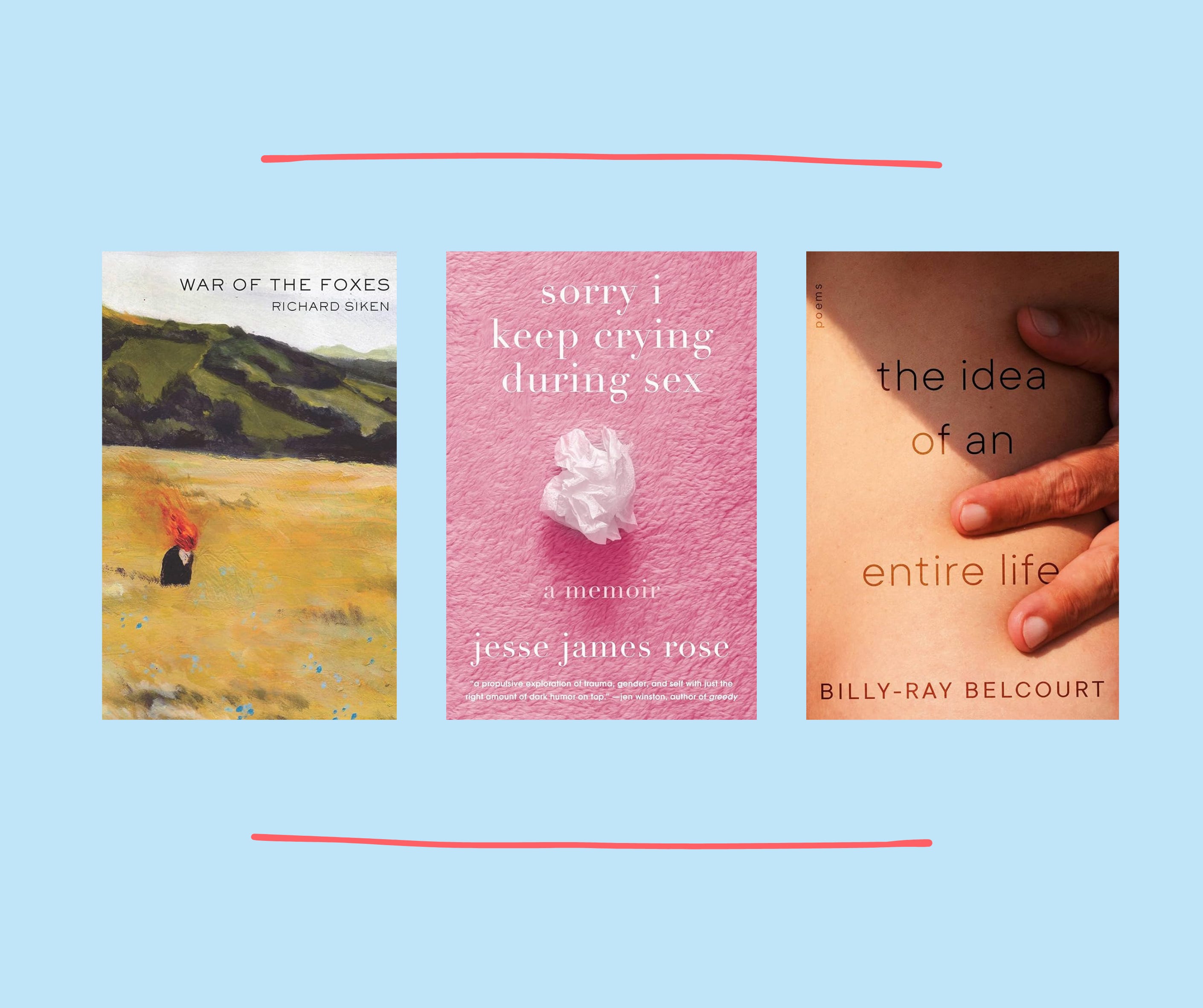
War of the Foxes by Richard Siken
I really loved Crush, Richard Siken’s first collection, and that might be the reason I was slightly disappointed by this.
War of the Foxes is a poetry collection that is interested in the natural world, in the order of things. To me, that made this feel a little impersonal and like I was being held at arm’s length. There’s a lot of rumination and thought and search for meaning, but done in a way I thought felt like a half-truth.
Sorry I Keep Crying During Sex by Jesse James Rose
This is a literary memoir that breaks all the rules. It’s experimental and sharp, but the emotional through-line is so loud. Jesse braids together healing from trauma, coming into herself and losing her grandfather to illness, to create a resonant story of a person finding her way through.
The Idea of an Entire Life by Billy-Ray Belcourt
In poetry and in prose, Billy-Ray Belcourt’s writing feels like a breeze swishing through hair. It has a shimmery quality that really inspires me. The subject matter in this poetry collection is indigeneity, queerness, being an artist, pain, hope, life. He also speaks urgently about a desire for love and partnership and sex. It was incredible.
My TBR is already longer than it should be, but I love discovering new queer books to sink my teeth into.
No posts
Comments
Nothing yet. Say the first thing.
Sign in to join the conversation.