
Hello! Coming atcha from Toulouse, where it has been 35°C today. The temperature in the auditorium made attending a conference session an extremely unappealing proposition this afternoon.
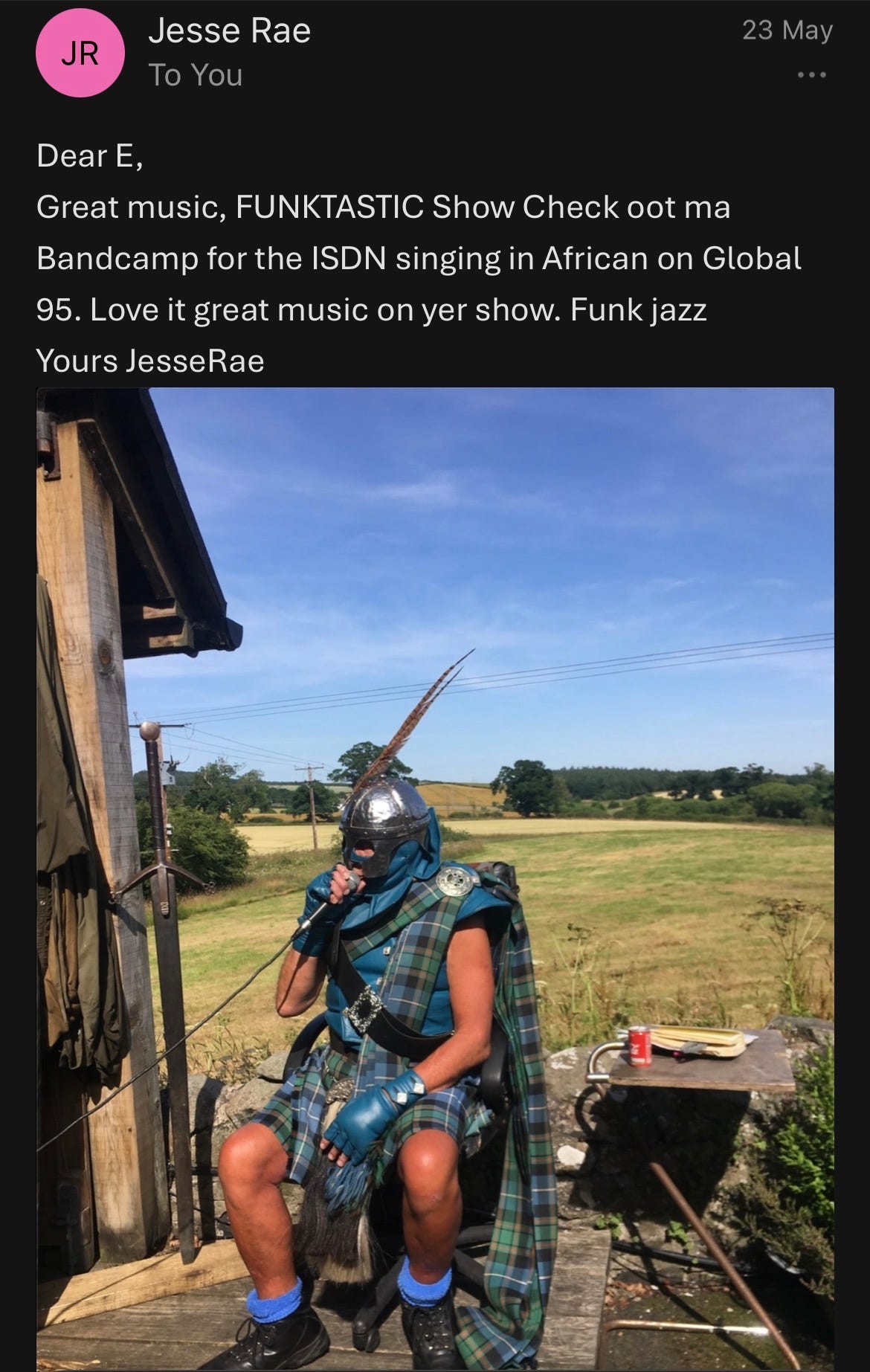
So, I’m in my air con’d hotel room finishing off writing to you about a recent interview I did on my radio show, Sound Service Station. The interview was with Jesse Rae.
In case you’re new, I’m Scottish. I grew up with a funk lover and bassist for a dad (hello dad, maybe!), and I will say that although his band, Pete Stack & the Rayburns, are locally beloved and very popular for a session at the Gulberwick Hall or the Lerwick Legion, the funk sound was not one that permeated Shetland life. I often joke, but it’s true and I say it with love: in Shetland, people love fiddle and accordion, people love AC/DC, and people love country music1. As a rule, people did not love funk2.
Perhaps as a result of this, I am extremely interested in the Scottish funk experience, and am working on a longer ongoing piece about the history of the genre in Scotland. It was for this reason that I initially wanted to speak to Jesse Rae.
What I knew at that point about Jesse arose from a rudimentary Google after I heard and loved his track Hou-di-ni a couple of years ago. This is an 80s synth-funk masterpiece, replete with spaced out zaps and twinkles, an irresistible bassline (wait for the freaking solo!!), all these layered vocoder harmonies in the chorus, impressive falsetto and these wonderful trilled r sounds that hit you almost immediately: I would rrrrrrun arrrround. Plus a little Scottish rap section that predates Silbil’n’Brains by about 20 years.
That rudimentary Google search informed me that he grew up in the Borders in the 50s and 60s. He made his way to the USA, worked with some big names in funk music, released a solo album accompanied by some Big Budget music videos that people in YouTube comments seem to remember fondly as things they stumbled across on the telly when they got home from the pub.
Eventually, he ended up back in the Borders, where he has stood for election to the Scottish Parliament on multiple occasions, as well as acting as trustee for a 200+ year old statue of William Wallace. A friend from university told me he was at a wedding Jesse attended, and he showed up with his full 5 foot claymore, left by the front door of the church.
All in all, I had formed the perception of somewhat of an eccentric, outcast kinda guy.
Dundee is very much the heart of the Scottish funk scene, with an incredibly lively scene in the 1970s and 1980s. I knew that Jesse had played at venues in Dundee in the 1980s, having shown up on old Fat Sam’s line ups, and I wondered what his relationship was to that extant scene, and why he’d felt the need? desire? to extract himself and go elsewhere. To go it solo away from the country he so obviously loves? I decided to reach out, and see if he’d be up for talking to a wee community radio project.
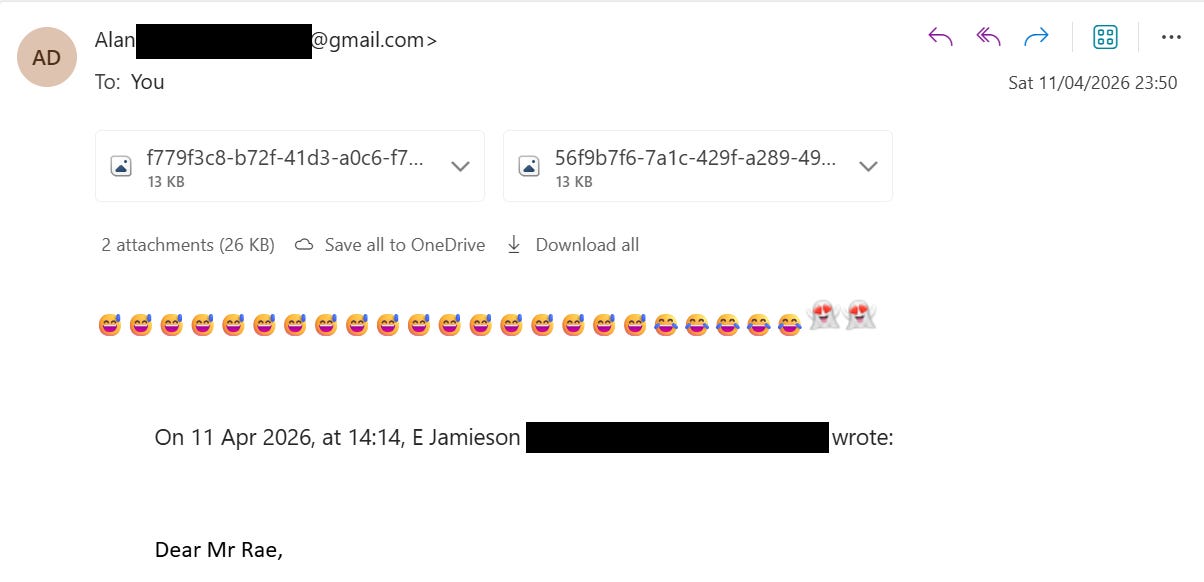
I contacted Jesse to arrange an interview — an email which he clearly forwarded to a pal, because as well as agreement from Jesse, at midnight I received a separate email in response from someone called Alan, which contained no less than 23 crying laughing emojis and two ghost-with-heart-for-eyes emojis. However, by then, my reasons for contacting him had morphed somewhat.
During the week, I had been to see The Drama (2026), starring Zendaya and Robert Pattinson as a couple who are, err, going through some stuff in the run up to their wedding. There is a song which acts as a sort of recurring motif through the film, which Emma plays for Charlie to cheer him up, and which Charlie dances to in one of the film’s pinnacle emotional scenes. That song is Inside Out, by Jesse Rae.
And so very quickly, talking to Jesse had multiple prongs. As well as his relationship to the Scottish scene, I was also extremely curious as to how he felt about his music being used in theeee film of the spring, and how it felt to have a track which, to my recollection, had a few thousand plays on Spotify skyrocket to over a million.
When it came to organising the interview, we had to do it over the phone (‘dinnae dae Zoom’). I got caught up in a committee meeting at work, and had to get myself quickly stationed in a cubby hole that usually just gets booked out for students’ oral exams in order to only be around 20 minutes late (rude and unprofessional — two of my least favourite things to be!). However, in this case, not passing on the phone worked in my favour (hate to say it) and I was quickly forgiven.
We talked for nearly two hours, in an undeniably meandering fashion. In the edit, I decided to leave the Scottish scene conversation to the side for future, and focus on Jesse’s personal story in this piece:
hearing an early Parliament album and deciding he had to work with those guys
following that conviction to go from the Borders to the USA (via London) and grinding it out in hotel bar cover bands to make his way to Boston
running into Bernie Worrell — literally — in an elevator and making his first connections in the scene
finding acceptance in the P-Funk crew and ‘putting the kilt into funk’
writing Inside Out and then seeing it pop off with lasses on TikTok: is because they love Robert Pattinson or is it that ‘it’s easy to get into because you can feel the funk’?
Cutting the conversation down to an appropriate radio-friendly segment was Work, but I’m pleased with how it turned out. You can listen back to it here:

The interview starts at around 01:18:00 (but the rest is good too).
I came into this thinking that Jesse was an eccentric, outsider character, who for some reason couldn’t connect in Scotland. I don’t think I was entirely wrong in that perception. His unabashed commitment to the bit, where ‘the bit’ is the belief that the Scottish Borders is the greatest place on earth, and that there is a natural marriage between Scottish culture and funk music, is both extremely unappealing to the London-centric UK music industry and low-key repulsive to Scots on the basis of the Scottish cringe:
One of the consistent observations made by foreign visitors … is that in Scotland there is a palpable lack of confidence. … It stops us trumpeting what Scotland has to offer … It suppresses the ambitions of entrepreneurs.
Carol Craig (2003)
On the one hand, I am fiercely proud of being Scottish. On the other, it makes me feel wretched, embarrassed and sick.
Mel Young (2002)
I felt it too! I absolutely loved Hou-di-ni from the moment I heard it, a majestic piece of P-Funk history, and yet because he donned full Highland regalia and stood as an independent in parliamentary elections, it behooved (!) me to think that it must have been a fluke, and that he was not to be taken seriously.
But away from the oppressive pressures of Scottish cultural conformity, Jesse was clearly a well-respected, excellent musician and songwriter.
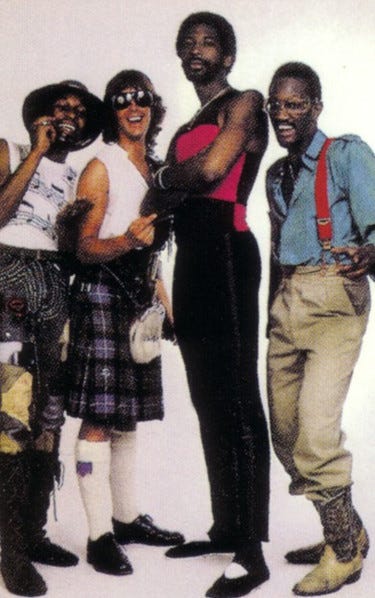
Throughout his career, he wrote music for and with some of the biggest names in funk. He sung vocals in bands with them. They collaborated with him in his elaborate, self-funded music videos and came over to the Borders to perform with him. He is also clearly aware of Scotland’s self-esteem problem, and how his persona sits in relation to that. It’s hard not to be inspired by that level of self-belief (or maybe I’ve just been in England too long).
I return to Silbil’N’Brains, who you may be familiar with either from The Great Hip Hop Hoax documentary, or James McAvoy’s recent dramatisation of their story, California Schemin’. Unable to gain any traction as a hip hop act with Scottish accents, they instead pretended they were Californian and were quickly signed to Sony. Jesse did the opposite, and leaned in harder. Yes, it’s eccentric. But why does that mean it can’t also be great?
Thank you for reading! A note to say that if any of this piqued your interest, a documentary about Jesse is currently being produced by Marco J. Federici, entitled Be Yersel (The Legend O’ Jesse Rae). It’s doing work-in-progress film festival rounds atm and you can watch a trailer here.
I’ll be back soon with tales of Toulouse and the monthly playlist.
x
When I moved to Sheffield, I made an acquaintance whose main love was country music, and I asked her if she’d ever been to Country 2 Country. She hadn’t heard of it, and I had to explain that the only reason I knew was that every autumn, literal boatloads of Shetlanders descend on Glasgow for three days of a massive country music festival. I hope she’s gotten to experience it now.
Or, really, any sort of music of Black origin. But that’s a separate post, and may have changed since I was growing up.
No posts
Comments
Nothing yet. Say the first thing.
Sign in to join the conversation.