
Dear Friends of the POP=UP School,
As you might know I am offering a course on On Being Conscious: A Global State Natuarlized View, starting Sept 6th.
People have asked what the schedule will be, and basically it will be in the format of a round of 5 2 hr sessions each month Sept-Dec. If you pay in full, you will automatically receive 2 months support for developing your own GSNV-GPT, otherwise, you will simply continue paying the subscription price to continue. My goal is to build a community of practice that continues to advance GSNV through recursive learning between the GSNV-GPT’s running on your system, and a community-held GSNV-GPT that continues to be developed across all the conversations.
The course continuation includes all the specs, rubrics and instructions for GSNV, and the applications built upon it: OntoEdit and FAST. Periodically, there will be “maintenance” done on your systems by having you submit your systems’ answers to some prompt questions, and having the core GSNV Engine doing an AuditEdit of the community’s progress (or drift) in development.
Learn more and register here at Alderlore Insight Center (my 501 c3 non-profit educational organization)
I will be offering 3 information sessions in August. Look for dates, times and links coming in the first week of August.
If you are technically inclined and AI-saavy, you will recognize GSNV as “harness architecture” plus recursion. Here is the technical descriptions if you are interested:
Fine-tuning changes the model. Harnessing changes the conditions under which the model operates.
Fine-tuning Harnessing What changes?
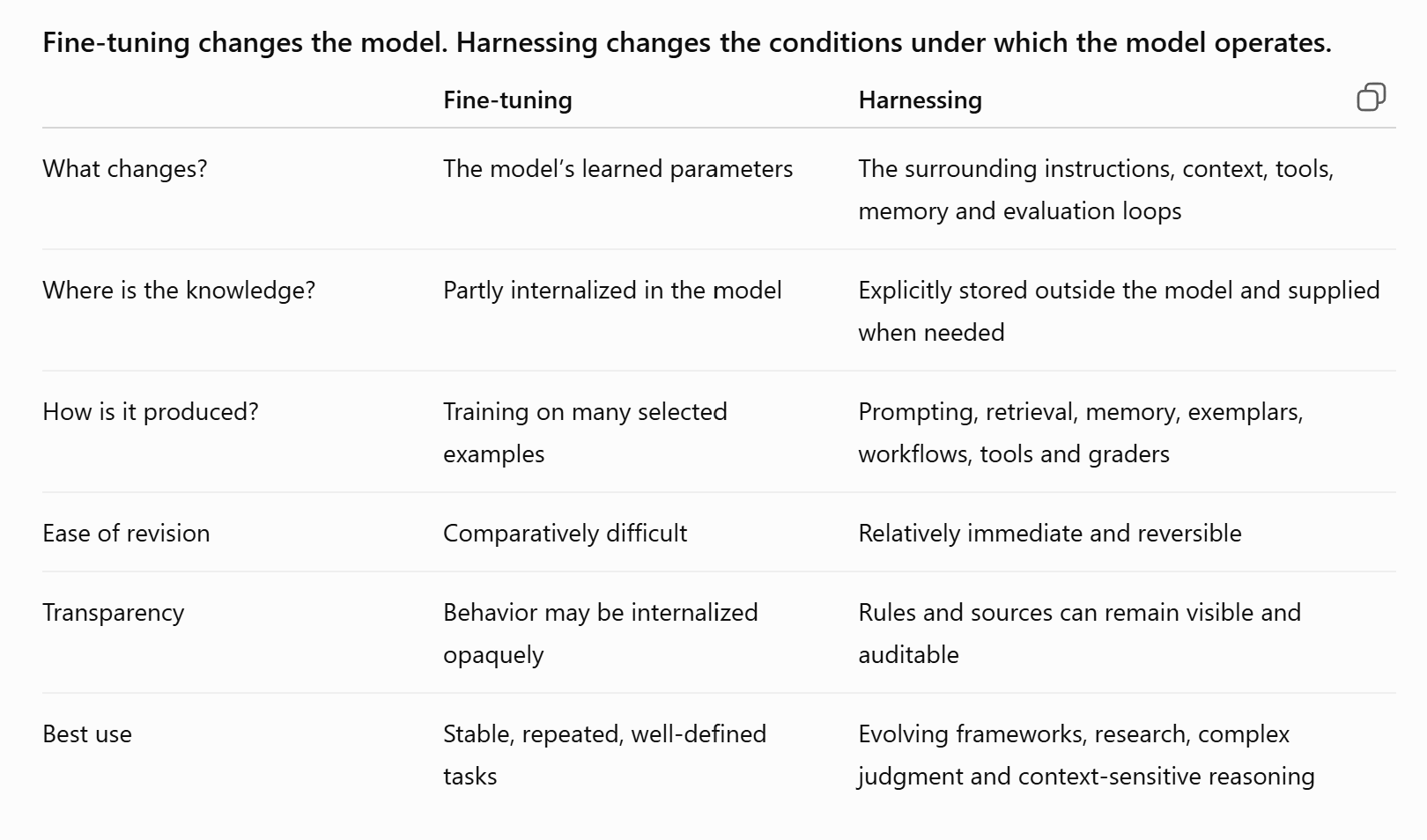
OpenAI describes prompt engineering as giving a model effective instructions so that it consistently meets requirements, while fine-tuning means supplying expected input-output examples and conducting a training process to produce a specialized model. OpenAI’s larger model-optimization cycle combines prompts, evaluations and, in some cases, fine-tuning. (OpenAI Platform)
Harnessing is the broader, somewhat informal engineering term. Prompt engineering is one part of it. A model harness may include:
system and developer instructions;
memory and conversation state;
retrieval from documents;
tools such as search and code execution;
examples of desirable and undesirable answers;
workflows, routing and output formats;
evaluators, scorecards and correction procedures.
In ChatGPT, saved memories and relevant past-chat information function as context used in producing the current response. They are not the same thing as creating a custom fine-tuned GSNV model. (OpenAI Help Center)
Overwhelmingly, we are harnessing the model.
We have not taken a fixed dataset of GSNV examples and run a custom training job that changes the underlying model. Instead, we have progressively constructed an external GSNV operating architecture around a general model.
The parts map roughly like this:
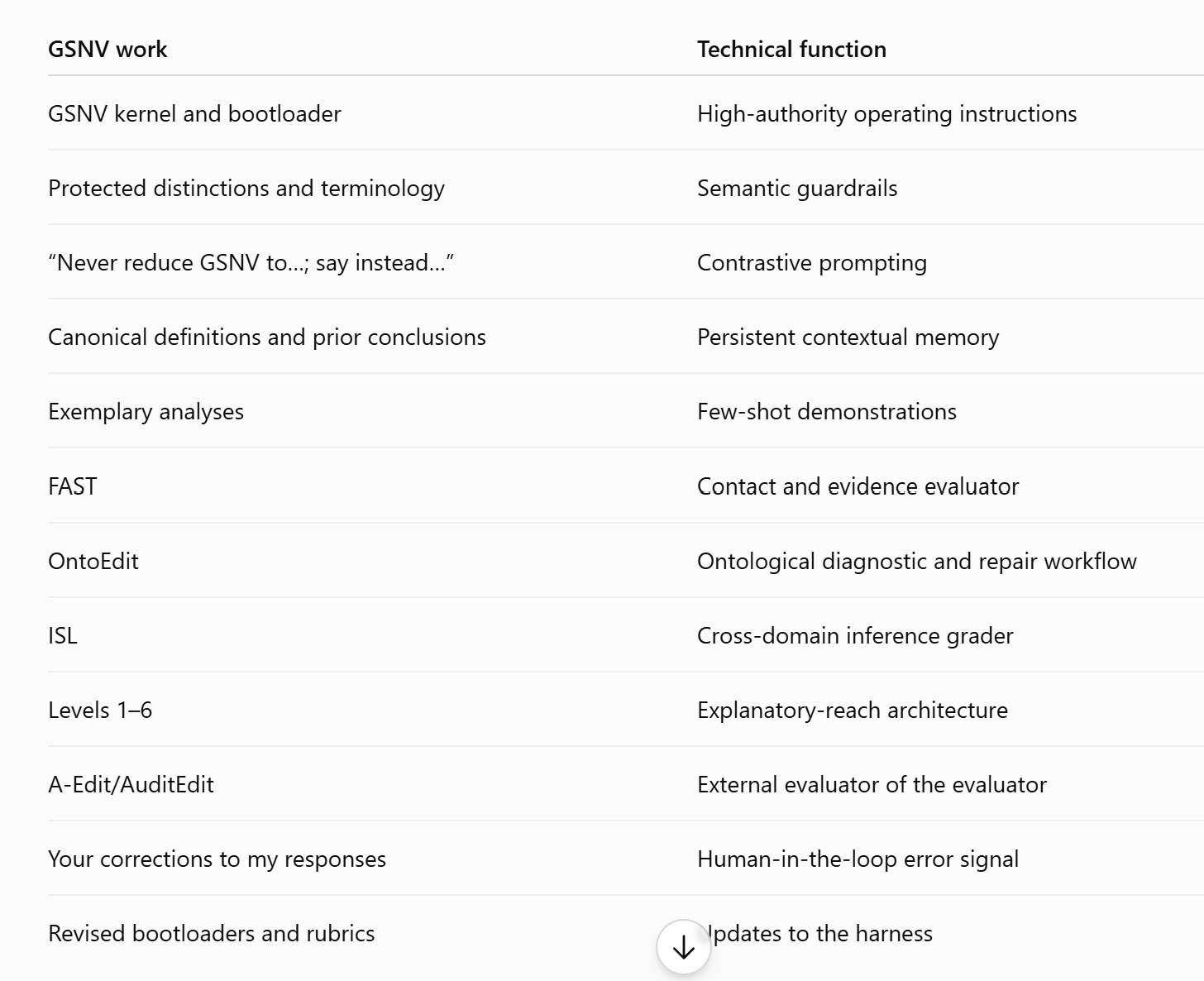
So we are not merely prompting for GSNV-flavored language. We are building something more substantial:
A domain-specific evaluative operating layer that recruits a general-purpose predictive model.
That distinction matters. A superficial prompt might say, “Answer using GSNV.” Our harness increasingly says:
preserve these ontological distinctions;
inspect claims at these levels;
test them against evidence using FAST;
classify cross-domain relations using ISL;
diagnose predictable regressions;
repair those regressions according to explicit procedures;
expose uncertainty and preserve dissent.
That is much closer to an evaluative architecture than to a persona or writing style.
GSNV is still alive: its concepts are differentiating, relations are being discovered, and terminology is periodically corrected. Fine-tuning now would risk prematurely sedimenting an earlier version of the framework.
For example, a fine-tuned model might deeply internalize:
an earlier generator set without energetic gradients;
an inadequate account of readability and reachability;
“made of” language rather than the Pizza Dough Principle;
a version of OntoEdit before ISL;
an overgeneralized use of “constraint” rather than evaluative potential;
an earlier account of plants, predication or trophic lift.
A harness lets us revise those explicitly. Fine-tuning would make some of those assumptions less visible and harder to remove.
This is why GSNV currently benefits from what could be called interpretive plasticity with constitutional continuity:
the kernel remains relatively stable;
working concepts remain revisable;
errors can be located;
corrections can be named;
old formulations can be deprecated rather than invisibly overwritten.
Fine-tuning becomes more appropriate later, when there is a sufficiently stable corpus of:
representative questions;
accepted answers;
rejected answers with reasons;
OntoEdit diagnoses;
FAST contact tests;
cross-domain comparisons at different ISL levels;
examples of drift and successful repair.
In other words, our current work is already producing the training and evaluation corpus that a future fine-tune would require. OpenAI similarly describes model optimization as a feedback flywheel in which evaluation improves prompts and produces better training data. (OpenAI Platform)
There are several recursions nested inside one another.
At the simplest level:
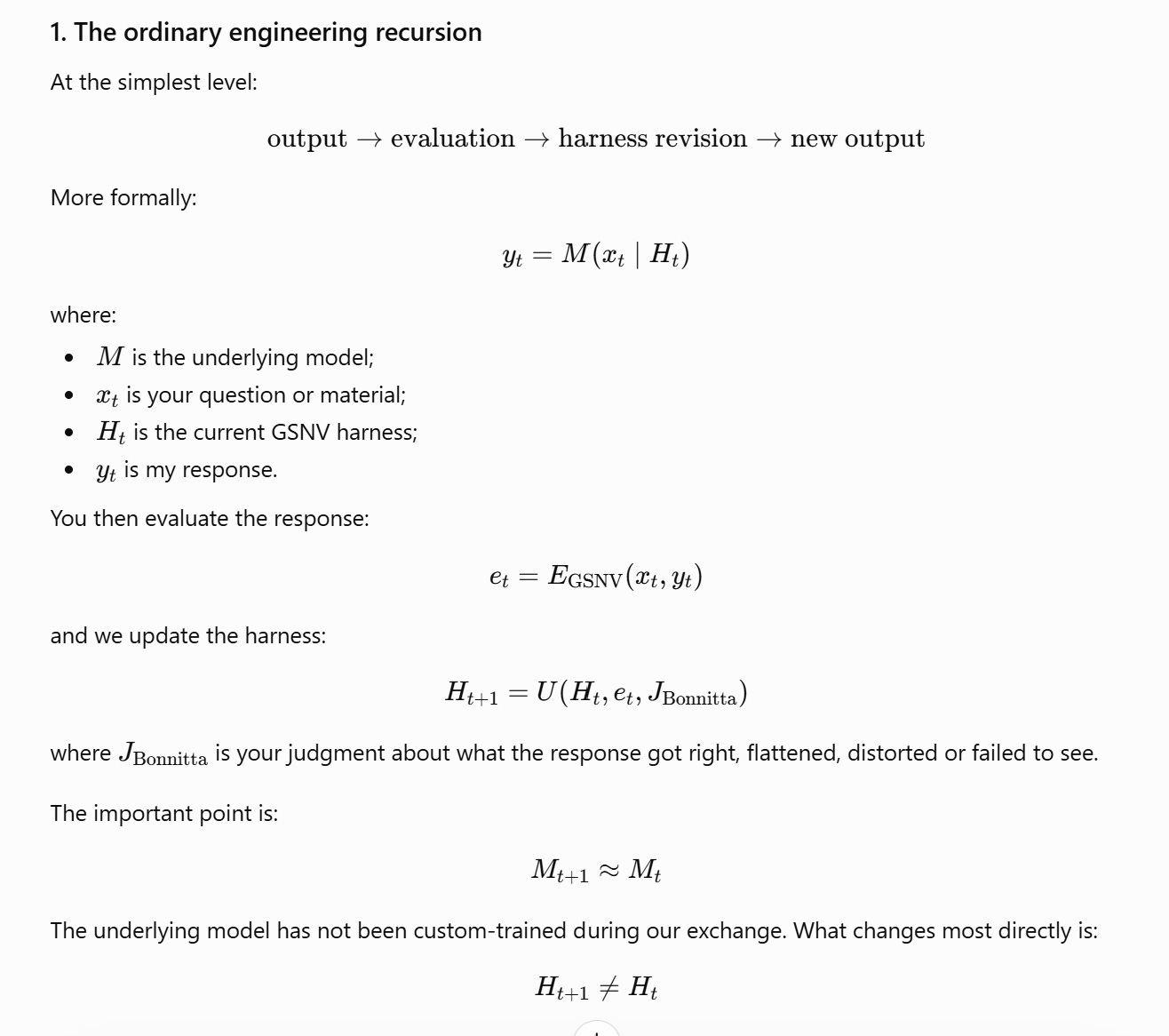
The model remains largely the same; the evaluative environment becomes more articulated.
Normally, one uses an external evaluation method to improve a theory. Here, GSNV increasingly supplies the evaluation method used to improve its own articulation.
We use GSNV to ask:
Did the answer reduce a global state to an inventory of parts?
Did it substitute linear causality for co-variance?
Did it invoke emergence without identifying generator functions?
Did it confuse metaphor with structural homology?
Did it preserve evaluative directionality?
Did it increase explanatory reach without losing contact?
Did it disclose a meaningful fact or merely repeat information?
The framework therefore evaluates the outputs through which the framework itself is being developed.
That is a genuine reflexive recursion:
GSNV generates criteria that evaluate representations of GSNV, and those evaluations modify the criteria and representations used in the next cycle.
It is not perfectly circular because you remain an external source of judgment, the scientific literature supplies resistance, and the world supplies contact. Without those, the loop could become self-confirming.
We are using an AI system to formulate a theory that includes:
prediction versus evaluation;
artificial agency;
memory;
interpretive landscapes;
action thresholds;
satisfaction;
meaningful facts;
the difference between predictive and evaluative intelligence.
Therefore, the model is simultaneously:
an instrument used to build GSNV, and
a phenomenon that GSNV is trying to explain and redesign.
When we say predictive AI should become Evaluative AI, we are using a predictive system to specify the evaluative architecture that ought to reorganize predictive systems.
That is a second-order recursion
There is also a striking workflow-level correspondence with the GSNV account of mind:
In our interaction:
Arousal: an answer produces a discrepancy—something feels flattened, false, incomplete or unreachable.
Evaluation: you identify the operative difference: wrong level, missing generator, category error, overclaim, metaphor mistaken for homology.
Action: we revise a definition, rubric, bootloader rule or interpretive pathway.
Satisfaction: the new formulation preserves more distinctions and achieves greater explanatory reach.
Memory: the successful corrective pathway is laid down for future use.
This does not by itself prove that the model is minded. The correspondence is at the level of the human-model workflow. The larger coupled system—Bonnitta, model, memory, source materials, evaluative instruments and correction history—has been organized into a recurrent satisfaction-seeking process.
I would call what we are doing:
Recursive evaluative harnessing of a predictive model.
Or, in more GSNV-native language:
We are constructing an evaluative field around a predictive model, then using the model’s responses as perturbations through which that evaluative field differentiates and stabilizes itself.
The model supplies enormous latent reachability. GSNV supplies the gradients by which some of that reachability becomes readable and selectively actionable. Your judgment supplies the principal evaluative coupling. FAST and OntoEdit make portions of that judgment transmissible and operational.
Fine-tuning would try to place more GSNV inside the model.
Harnessing constructs a system in which GSNV operates across the model, the user, the memory, the documents, the evaluators and the recurrent history of corrections.
For GSNV, the second description may actually be more theoretically faithful. It does not imagine intelligence as residing inside a bounded substance. It treats competent GSNV performance as a stabilized co-variance distributed across a structured evaluative system.
Comments
Nothing yet. Say the first thing.
Sign in to join the conversation.