

Last week, Griffin Gooch was kind enough to interview me on his Substack about In Defense of Evangelicalism. And in both that conversation and a note he posted while ahead of time, Griffin shared a quote from my book that he really liked:
For all that there is to critique, evangelicalism has much to offer its own. We have the resources we need. Sure, there’s detritus too. Lots of saccharine knickknacks and badly acted movies. I don’t especially like contemporary Christian music and don’t understand why so many do. But honestly, who cares? Tackiness is not a sin.
Now, it goes without saying that American evangelicalism is a much-debated topic. There were many things I said in our conversation that readers might have found unexpected or provocative or what have you. And that’s why Griffin and I were both surprised when the line that raised the most questions out of more than 3,000 words was that last one:
I won’t link to the replies about this, though you can go poke around in Griffin’s comment sections if you really want to see them.1 The gist, though, was that some readers saw in the line a rejection of the importance of aesthetics.
If we say tackiness is not a sin, they worried, we excuse bad art, ugly church buildings, theologically sloppy worship music, wooden acting and preachy plots in Christian books and movies.
If we say tackiness is not a sin, we give tacit approval to flashy, shiny things with nothing of substance inside—the very antithesis of the sober, martyr-proved beauty of the early church.
If we say tackiness is not a sin, we consent to our coreligionists reducing Christ victorious, who trampled down death by death, into a stupid, cutesy figurine.
Now, I understand these objections very well because—not to put too fine a point on it—I myself am an aesthetic snob. You can see it in that very quote, in which I note that evangelicalism has “saccharine knickknacks and badly acted movies” and that I don’t like “contemporary Christian music and don’t understand why so many do.”
And these are not mild opinions: Some friends of ours joke that my opinions are, like Altoids mints, “curiously strong,” and this is as true of aesthetics as everything else. You will never find a Christian wall meme in my house, never a Precious Moments statue, never the merest hint of Thomas Kinkade. I can speak to you at length on floor plans and upholstery and tile. And do not even get me started on the excesses of contemporary Halloween decor!
Indeed, I am such a snob that it is delighting my snobby heart merely to tell you all this—and that probably is a sin.
But tackiness is not.
The meaning of tackiness is important to get straight here, because in the course of more than one exchange about this sentence, I found my conversation partner and I did not have the same thing in mind. I mean tacky as Merriam-Webster has it: It’s about having bad taste and style in a class-coded way.
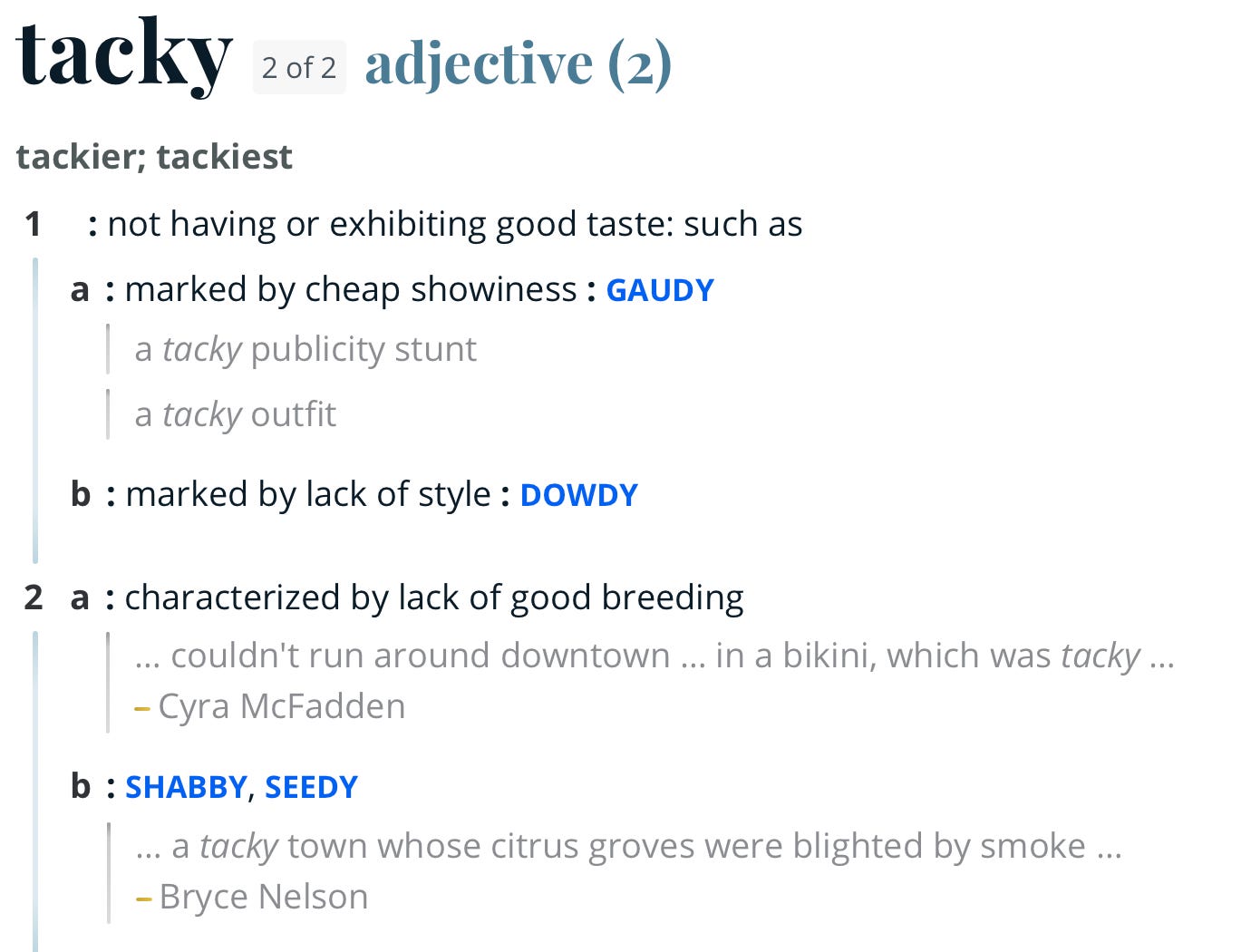
Note that tackiness is not necessarily, as one person suggested to me, about a thing being bright, loud, and flashy. It can involve “cheap showiness: gaudy,” the dictionary says. But it can also be rather dull and dilapidated: “dowdy … shabby, seedy.”
I think of snagged polyester when I think of tackiness. But the common quality of tacky things is not the gloss of their finish. Dolly Parton, for instance, is deliberately tacky whether in sequins or gingham.
Nor is it always about wealth or price. Parton famously quipped about “how much it costs to look this cheap,” and tackiness is there in the old money vs. new money dynamic of The Great Gatsby. The word comes from the American South, where a writer in 1890 defined it as concerning “persons of low ideas and vulgar manners, whether rich or poor,” who display “an absence of style.”
The real commonality, I think, is that class coding. Tacky things and people are the product of a “lack of good breeding,” Merriam-Webster says, and—while I’ll be the first to say that some things are objectively of higher aesthetic quality than others—that lack is in the eye of the beholder. Thus, outside of deliberate stylistic reclamation, like Parton pulls off, tacky is generally a term of disdain.
A few days ago, I shared in a Substack note an excerpt from Ross Douthat’s “exit interview” with Ezra Klein at The New York Times:
Douthat says that to be persuasive in an argument, you must take the other person’s perspective at face value. Don’t set aside their professed opinions to argue against what they “really” think underneath the more respectable surface.
As I said in that note, this is what I aim to do in my writing as well, but I have to admit that in this particular case I’m struggling to keep that aim. It seems to me that all too often what is presented as a critique of evangelical theology or politics is, underneath, a disdain for evangelical tackiness, for big box churches and bad movies and Jesus as a cutesy figurine. On this one, I very much want to take those scare quotes off “really” and address what I strongly suspect is underneath the surface.
Instead of indulging that impulse, though, let me practice instead that beloved cliché of the evangelical pastor: preaching to myself.
Pre-order 'In Defense of Evangelicalism'
You see, I say “tackiness is not a sin” to me.
And I say that tackiness is not a sin because, while sometimes it is right to link aesthetics and ethics, beauty and truth, it is also possible to link them too tightly. The Bible speaks of this about Jesus—“He had no beauty or majesty to attract us to him, nothing in his appearance that we should desire him”—while declaring him truth itself. This is the rightful warning in many of our folktales too: The girl becomes a princess because of her kindness to a disgusting toad; the ugly old beggar is revealed to be a powerful king.
And I say that tackiness is not a sin because I do look at lots of median American evangelical culture and think it tacky. I’m not just being self-deprecating calling myself a snob. I am that beholder having those class-coded thoughts.
And yet: In my better—more gracious, kindlier, more Christ-like—moments, I want to say, because I know it to be true, that having good taste does not reliably correspond to the imitation of Christ, and that having bad taste is never a justification for looking down on someone. There are many deeply tacky old church ladies who have done more in love of God and neighbor than I can ever hope to do. And I can make a firm defense of good aesthetics, including urging my fellow evangelicals to write better music and make better art, without plunging into an attitude of Can anything good come out of Nazareth?
In this reframe I think I have an ally in C.S. Lewis, whose wise passages on bad church music and services I have read more than once as a reminder to myself. Lewis never backs down in his unhappy judgments here: The hymns are “sixth-rate music,” he maintains, and the clergy fiddling with service style may mainly succeed in attracting attention to themselves.
Even so, he concludes, those hymns are “being sung with devotion and benefit by an old saint in elastic-side boots in the opposite pew, and then you realize that you aren’t fit to clean those boots.” And whatever goes on with the service—“brightenings, lightenings, lengthenings, abridgements, simplifications and complications”—“our business as laymen is to take what we are given and make the best of it.”
Lewis isn’t here advising you turn off your brain or eyes or conscience; that’s an impossible interpretation for anyone aware of his whole deal. He is rather urging his fellow aesthetes of the perils of prizing beauty above its maker and his church.
It’s also worth noticing, I think, the alleged and actual tackiness of the earliest Christians. Many of the apostles were low class: The religious scholars in Acts see Peter and John as “unlearned and ignorant men.”
Paul, of course, was rather more sophisticated, educated in Jewish and Greek traditions and a born Roman citizen who knew his rights. He could hang with the cultured—but after his conversion to following Jesus, he usually didn’t. He tells us so directly in 1 Corinthians:
Brothers and sisters, think of what you were when you were called. Not many of you were wise by human standards; not many were influential; not many were of noble birth. But God chose the foolish things of the world to shame the wise; God chose the weak things of the world to shame the strong. God chose the lowly things of this world and the despised things—and the things that are not—to nullify the things that are, so that no one may boast before him.
In the years that followed Paul’s ministry, opponents of the early church repeatedly attacked them with class language. The best-known of these ancient critics is Celsus, who wrote that Christians “show they want and are able to convince only the foolish, dishonorable, and stupid, only slaves, women, and little children.” Had Celsus had tacky ready to hand, it’s difficult to imagine he wouldn’t have added it to that list.
So to return to the worries in the comments on Griffin’s posts, when I say that tackiness is not a sin, I am not excusing bad art or approving of shallowness or breaking with the most sober and significant parts of our faith. I am saying, simply, that tackiness is not a sin—because it’s not.
And I am also saying that it is wrong if I (or, yes, evangelicalism’s less gracious critics) sally past charitable and constructive calls for beauty and excellence in the church to offer instead aesthetic disdain presented as something more substantive than it is. There’s a yawning difference between critiquing bad worship music so we can have better worship music and all the goods it can bring—and critiquing that same bad music as one more way to claim that evangelicals generally are stupid or insincere in our faith or otherwise a net-negative for American society.
Pre-order 'In Defense of Evangelicalism'
Lastly, in the replies to Griffin’s Q&A, Anna Gallant left a comment from which I want to quote here:
I have been frustrated at many times with Evangelical tackiness. Today I was complaining to myself that our church’s walls are filled with stock photos of modern church experiences rather than beautiful old art or even simply the art of my own talented church members! I want us to improve on things like this, simply because beauty of course is of God and worthwhile. And at the very same time… I love it. I don’t know how else to explain it. I love our tacky hallways and I love the people who fill them and I love when the pastor trips on his words a bit and they don’t come out quite right. I love it all because they are my people, my place.
This is my experience too. When I was in my 20s, my husband and I had a running joke with some friends from church in which, whenever we were at Goodwill, we’d find a maximally tacky piece of Christian art and sneak it into each other’s houses. The ideal scenario was if another couple was out of town and you were feeding their cat or something, because then you could go so far as to mount it on the wall of the dining room in their absence.
The all-time best find in this game was Football Jesus in a plastic gilt frame, a photo of which graces the top of this post. Tacky? Unutterably. But to this day, when all these friends involved live in different cities clear across the country and the world, Football Jesus hangs on one family’s wall. It’s in terribly bad taste, but taste is beside the point. This is rather a matter of affection.
Beauty is at least somewhat objective. But, to borrow from Lewis again, affection is not a matter of empirical attractiveness and good taste. Indeed, he explains, “almost anyone can become an object of Affection; the ugly, the stupid, even the exasperating. … It ignores the barriers of age, sex, class and education. … [It is what teaches] us first to notice, then to endure, then to smile at, then to enjoy, and finally to appreciate, the people who ‘happen to be there.’” Affection does not care that its object is tacky.
Lewis is careful to note that affection is not distinctively Christian, so I will be too. But six decades further into social disintegration and the loss of happenstance association (see Cartoons Hate Her on the village nobody wants), in a time when we can and do choose to avoid the ugly, stupid, and exasperating, church remains a place where you encounter whomever happens to be there—and evangelicalism, especially its dominant low church variant, is particularly democratic in this sense. It is an increasingly precious opportunity to build affection.
“‘Dogs and cats should always be brought up together,’” Lewis quotes, “‘it broadens their minds so.’ Affection broadens ours.” And affection can coexist with needful and generous critique, with critique that is not disdainful, that is a path not to destruction but reform. In fact, I think it is not too much to say that if love of beauty convinces us that evangelical tackiness is a problem, then it is only in love of evangelicals that it is a problem we may begin to address.

New from me at Christianity Today: “Texas should not define religion down” (unlocked link)
Not new from me (it already ran in print) but on the Christianity Today homepage this morning: “Charlie Kirk’s last word” (unlocked link)
Still reading Agatha Christie’s The Mystery of the Blue Train. I think the charming rake might not have done it!
“Trump promised transparency. His administration keeps finding new ways to hide records,” by Matthew Petti for Reason
President Donald Trump claimed in 2019 that he was "the most transparent president in history." Throughout his second term, Trump's spokespeople have used that phrase over and over again. […]
But the Trump administration has also fouled up the everyday mechanisms for Americans to see what their leaders are up to and how their tax dollars are being spent. Officials have tried to hide documents from the Freedom of Information Act (FOIA) or outright exempt government activities from FOIA. In fiscal year 2025, the federal government granted a little under 50 percent of FOIA requests, a record low since 2010, according to data compiled by The New York Times. The Department of Justice fought in court to overturn the Presidential Records Act, which requires the White House to preserve its files for posterity. In between his two terms, Trump infamously hid papers in his bathroom.
“‘Just sit them on the potty,’” by Stephanie H. Murray for The Atlantic (unlocked link)
The shift toward delayed potty training, I learned while reporting this article, has been under way for quite a long time. And the sources I spoke with pointed to a few factors driving it. One is that easy access to disposable diapers—which reduce the mess involved in having a child who can’t reliably make it to the toilet—has made the need for training less pressing. Another is that many families with working parents are short on the considerable time needed for monitoring trips to the bathroom. But from Gillespie’s perspective, the root of the issue is that parents are taking a child-led approach to what should be a “100 percent parent-led activity,” she said. “You don’t sit and wait for a child to say, ‘Do you know what? I think I’d like to try wearing pants today.’”
Marvin Olasky interviewed Ross Douthat back in 2020 and has reshared it now—interesting time capsule from the recent past
“AI is dead. Organoids are alive,” by Claire L. Evans for Wired (this is the weirdest thing you will read all week)
“How the Passion Translation’s problems hid in plain sight,” by Taylor Berglund for Christianity Today (unlocked link)
“Welcome back to school! Does your kid have a teacher?” by Carrie McKean for Christianity Today (unlocked link)
“Who supports free trade? Everyone,” by Jeremiah Johnson for The Argument
“Operation gaslight,” by Nicholas Carr for The New Atlantis
Trump is about as far from a technocrat as you can get. Yet history may show that he and his followers were the real experts in deploying digital media’s distinctive qualities—in particular, the way algorithms reward impulsiveness and provocation and penalize prudence and subtlety—for political and personal gain. Originally promoted as a medium of reason and objectivity, the Internet has revealed itself in the social media era to operate under a definition of truth so flexible it would make a postmodernist blush. The huckster, not the technocrat, is its true master.
Starting to see pics of In Defense of Evangelicalism out in the wild! Very exciting. I’m particularly looking forward to this double review in Mere Orthodoxy by Nadya Williams:

Nadya Williams@NadyaWilliams81
My combo review of this point/counterpoint is coming in the fall print issue of @mereorthodoxy (and you'll get Kirsten Sanders' review of just the book on the left as well).

8:05 PM · Aug 14, 2026 · 1.11K Views
4 Replies · 2 Reposts · 38 Likes

I am reusing a little bit of what I wrote in these conversations here; I suppose some would call that “self-plagiarism,” but I find that silly when I’m doing it transparently and within a single publishing platform.
Comments
Nothing yet. Say the first thing.
Sign in to join the conversation.