
Good morning! It’s Wednesday, and here’s this week’s post. As a reminder, my third book, In Defense of Evangelicalism: A Response to Its Cultured Despisers, releases on September 1. Take a look at its gorgeous cover, and:
Pre-order 'In Defense of Evangelicalism'
I’ve got a new piece up at Christianity Today about Senate candidate James Talarico of Texas. (That’s an unlocked link.) It’s about the fundamental misunderstanding undergirding widespread suggestions that because Talarico is a seminarian who speaks openly and often of his faith, fellow Christians—including politically and theologically conservative evangelicals—really ought to put party loyalties aside and give him their votes.
As I write there, I understand why that might seem plausible to some, especially in the context of this particular race: Talarico’s Republican opponent, Texas Attorney General Ken Paxton, is an alleged repeat adulterer who has been “indicted on charges of felony securities fraud, and he’s been impeached, too—with votes from members of his own party—on allegations of bribery, dereliction of duty, obstruction of justice and abuse of the public trust, and other misdeeds.”
Huge yikes, and if I still lived in Texas, you would not find me voting for that guy. Nevertheless, as I argue of suggestions to back Talarico despite deep disagreement:
[T]hat’s not how any of this works!
Yes, character matters immensely. Yes, we have a problem with partisanship in this country. Yes, Paxton’s record makes his candidacy unacceptable to many Christian voters, even lifelong Republicans, and this article is not an argument for voting Paxton.
Yet big political disagreements with a heavy moral valence—on issues like abortion, transgender issues, and immigration under the Trump administration—don’t cease to matter just because a candidate professes the same faith. And in Talarico’s case, for evangelicals, whether he does profess the same faith is itself in question.
You can read my whole case over at CT. Here I want to make another comment on Talarico, and this one is more specifically about him than voter dynamics generally: He talks about the Bible like a flat earther.
Pre-order 'In Defense of Evangelicalism'
I know that may seem unlikely, but hear me out. Very conservative Protestants, especially fundamentalists, get knocked for a simplistic style of biblical interpretation. Sometimes critics call it biblicism, sometimes literalism, sometimes something less flattering, but in any case what they have in mind is a crude method of reading Scripture in which—to give the most extreme example—the Bible in some translations speaks of the “four corners of the earth,” so (these readers conclude) the world must be flat and rectangular.
Very few Christians would go that far, and these criticisms can bleed into caricature, but relatively naive styles of biblical interpretation do exist. Of course, one man’s naive literalism is another’s basic Christian faith, and I can’t parse all that here. When I searched for examples while writing this post, Google’s AI summary told me it was fundamentalism to believe in the bodily Resurrection of Christ. As we say in journalism, big if true!
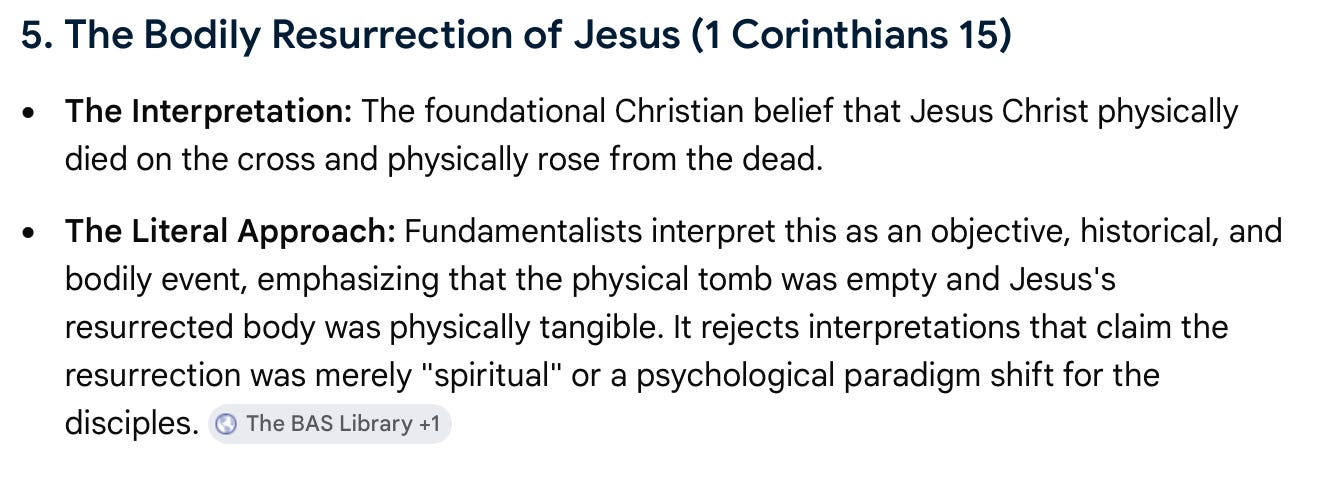
Suffice to say, that’s not what I mean. Beyond the flat earther example, what I have in mind is more like the kind of hyper-literalist reasoning—or really, lack of reasoning—in which arguments are rife with context-free proof texting and far too often start with The Bible never mentions … or Jesus never said anything about …
I’m sure you’ve seen that kind of thing. I was kind of dumbstruck to realize it, but this is just the simplistic way Talarico talks about the Bible—only he does it not as a conservative fundamentalist but as a political and theological progressive.
In a much-quoted podcast interview, for instance, Talarico explained his pro-choice views by saying, “Jesus never talks about abortion. The Bible is silent on abortion.” And sure, the Bible does not use the word “abortion,” at least not in any translation I’ve checked.
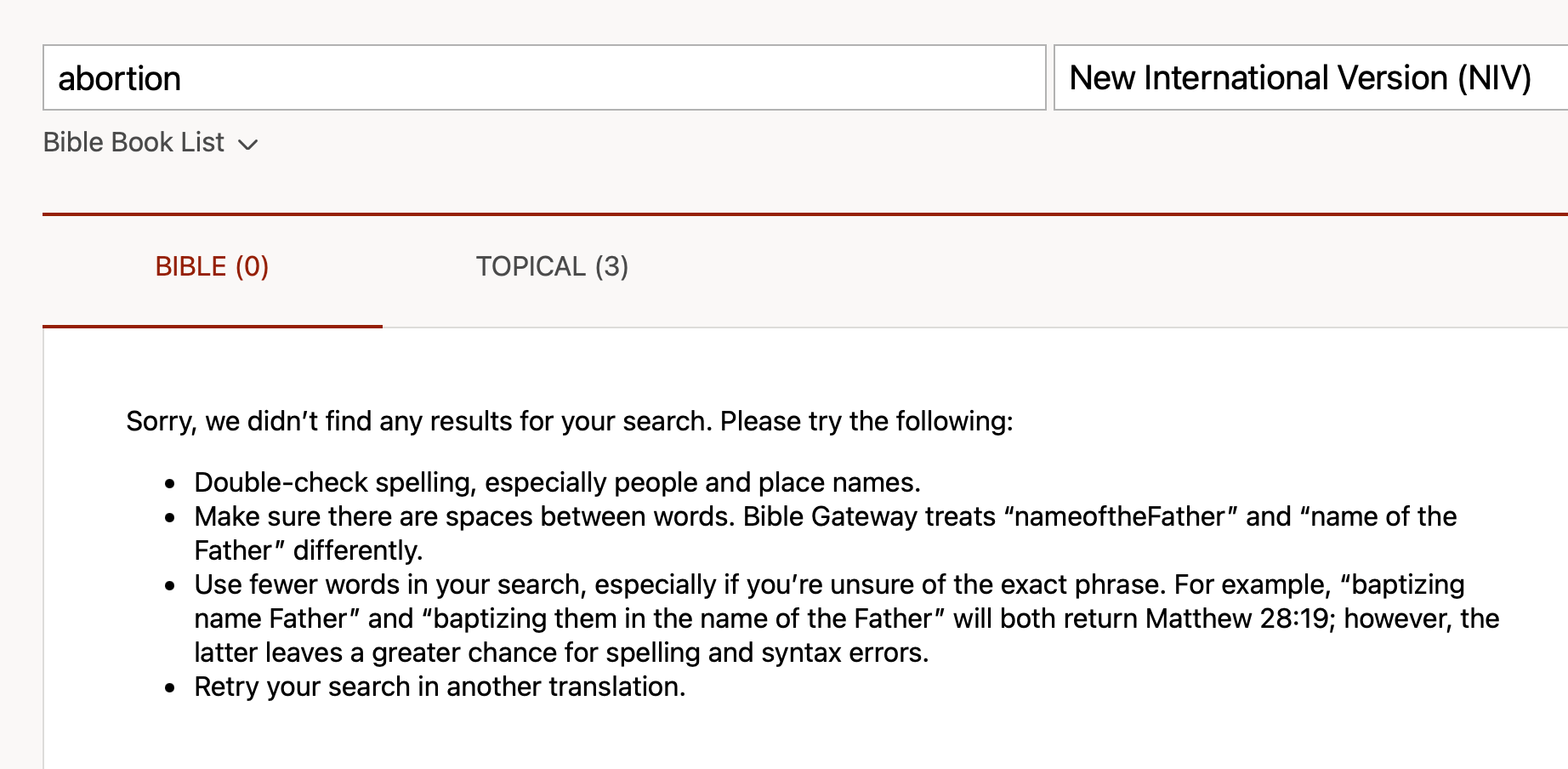
Yet that doesn’t mean there’s no scriptural basis for the pro-life view—far from it. The Bible also never says “IVF” or “euthanasia” or “vaccines” or “artificial intelligence” or “revenge porn” or “landmines” or “nuclear warfare,” and in none of these cases is that a reason to conclude we can’t take a good stab at determining God’s perspective on the subject. Indeed, there are all kinds of ethical questions on which the Bible is thus “silent”—and citing that silence as Talarico did here is an answer I’d expect from a finagling 17-year-old trying to argue for his God-given right to smoke weed, not a grown man (a seminarian!) running for the U.S. Senate.
Truly, this is not a serious means of biblical interpretation and argumentation. As theologian Brad East observed a recent Christianity Today piece:
The Bible is not a spiritual FAQ. True, the Bible does answer our biggest questions. But if you live long enough or read your Bible deeply enough, you’ll see that the Bible cannot and will not answer every specific question in advance. It is authoritative in and for all of life, but it doesn’t speak directly or explicitly about every subject. How could it?
That abortion line isn’t the only example of Talarico talking about the Bible with what I want to dub naive progressive biblicism.
For instance, in a CNN clip, he defended a past provocation about God being “nonbinary” by citing Galatians 3:28’s affirmation that in Christ “there is neither male nor female.” The context of the verse makes it obvious that the apostle Paul is using “in Christ” as he often does: to mean our being saved and transformed by Christ and united with him and his church (emphasis added):
For you are all sons and daughters of God through faith in Christ Jesus. For all of you who were baptized into Christ have clothed yourselves with Christ. There is neither Jew nor Greek, there is neither slave nor free, there is neither male nor female; for you are all one in Christ Jesus.
Talarico misleadingly rearranged the phrase—reversing it and applying the part about maleness to Jesus rather than the church—then interpreted it to suggest that Paul was somehow denying that God incarnate in Jesus was male in the ordinary way. Here’s what Talarico said (emphasis added again):
Most Christians would acknowledge that God is beyond gender—in fact, the apostle Paul in his letter to the Galatians said that in Christ there is neither male nor female, and so if someone’s got a problem with that statement [that God is nonbinary], they shouldn’t take it up with me. They should take it up with the apostle Paul.
Compare the passage and Talarico’s rendering and you’ll easily see that his version is not what Paul said, and it’s certainly not what he meant. You don’t need to go to seminary to figure this out; that “in Christ” is about us and not about the physical body of Jesus isn’t difficult to discern with a little attention to New Testament context. You just need to do better than naive progressive biblicism.
The best example of this interpretive style, though, may be in a preaching clip Talarico posted to his Instagram account a couple years back. Here’s the text:
Jesus didn’t tell us to love our churches. He didn’t tell us to love our doctrines and our creeds. He didn’t even tell us to love our Scriptures. He told us to love our neighbors. And there was no exception to that commandment. Love thy neighbor regardless of race, class, gender, sexual orientation, or immigration status.
One of my favorite theologians, Barbara Brown Taylor, once wrote, “The only clear line I draw these days is this: When my religion tries to come between me and my neighbor, I will choose my neighbor. Jesus never commanded me to love my religion.”
You know what’s interesting? Not once in the entire Bible does Jesus ask us to worship him. All he asks is that we follow him. Love like he loved. Love the outcast. Welcome the stranger. Feed the hungry. Heal the sick. Free the oppressed. As the hymn says, “They will know we are Christians by our love.”
This is absolutely wild stuff.
First, a handful of caveats: Yes, Jesus did command love of neighbor without exception, so much so that he extended the same command to love of enemies who would do us real harm and died for us while we’d made ourselves his enemies. And yes, Jesus did command us to love as he loved, which included loving the outcast, and he did tell us to welcome strangers, feed the hungry, and care for the sick. I’d quibble on the bit about setting the oppressed free: Jesus actually did not command that of us—he said he was doing it—though that doesn’t mean he’s against our tackling it too. But otherwise, yes, Talarico is right about all this.
However, then we come to all the rest, all these arguments from silence:
“Jesus didn’t tell us to love our churches”
Jesus “didn’t tell us to love our doctrines and our creeds.”
Jesus “didn’t even tell us to love our Scriptures.”
“Jesus never commanded me to love my religion.”
“Not once in the entire Bible does Jesus ask us to worship him.”
Sure, these sentences as phrased do not appear in the Bible. Got ‘em, I guess.
But it is ignorance—whether natural or willful I’ll leave for others to consider—to suggest there is no biblical basis for love of our churches, sound doctrine, and Scripture, or for worship of Christ, and if you have those four pieces, that’s basically the Christian religion. I’ve linked to a few verses here, because I can’t stop myself, but it’s not just those verses. It’s not a single phrase here or there! We do have creeds, but Jesus did not speak in creedal form, neatly addressing every point the modern reader raises with all the precision of a veteran social media poster anticipating his reply guys. If we want to understand firsthand what Jesus and other biblical voices claimed about his divinity, we’ll have to do some work beyond ctrl+f for “worship me.”
One last line from Talarico’s sermon is worth flagging: “Love thy neighbor regardless of race, class, gender, sexual orientation, or immigration status.”
Now, the Bible never speaks of sexual orientation in the terms we use today nor of immigration status in the U.S. legal system. How could it? Yet on these matters, somehow, Talarico is able to reason from what he finds in Scripture to conclude that Christ’s sweeping commands of neighbor love must extend across all these lines on which Scripture is, well, “silent.”
It’s almost like his progressive biblicism is not as naive as it seems.
My husband, a software engineer, is talking in a panel webinar about the papal encyclical on artificial intelligence tomorrow (Thursday) afternoon at 3 p.m. Eastern for Michael Wear’s Center for Christianity and Public Life. Click here for more details and to register to attend!
Still reading Albion’s Seed: Four British Folkways in North America, by David Hackett Fischer. I’ve gotten to the part about colonial-era Virginia now, and if I may: no thank you. The marital strife—recorded in diaries of the day—was off the charts, just ridiculous levels of infidelity, chaos, open hatred between spouses. At least the Puritans, the focus of the book’s prior section, seemed to have pretty good marriages on average (and in many ways were surprisingly egalitarian). The early Virginians were in a bad way on the marital front. The men were also obsessed with bloodsports from a young age. I’ll spare you the graphic account of what these dudes got up to with geese (this is a family newsletter!!), but here’s something little boys did for “fun”:
A boy had his hands tied together behind him, and the tip of one wing of a sparrow or other small bird was placed in his mouth. He then tried by the action of his teeth and lips gradually to draw the wing of the bird into his mouth and bite off its head, the bird in the meantime pecking at his cheeks and eyes and endeavoring to escape.
“The future belongs to those who resist it,” by Clare Coffey for The New Atlantis
The phone is everywhere; the phone is woven into the fabric of your social networks; the phone is useful for a hundred little tasks of everyday life. And there is nothing actually morally wrong or damaging, in any isolated moment, with taking the phone out of the pocket to while away five minutes.
By the time we looked up and realized that by repeatedly defaulting to a new habitus of engagement with the world we had allowed the phone to utterly transform it in ways we largely abhorred, it was too late for anything but rearguard action.
With AI, we have a chance to learn from and correct our mistakes. If we fail to pass the test a second time, there is every indication that the results will be even more catastrophic.
“Teaching them to decide when and for what purpose it ought not to be used” will not be enough. Because we are dealing with technologies of ubiquity, only communities — with their power to embed alternative defaults in a shared life, to offer alternative social networks and create unambiguous guardrails through social norms — will constitute meaningful units of resistance to the worst of AI’s possible effects […] by which the image of a boot stomping on a human face forever is now being replaced with that of a human face slack-jawed and dribbling on itself.
“DHS says it has ‘zero tolerance’ for protesters’ ‘verbal assaults.’ Here’s what the law says,” by Autumn Billings for Reason
To try: cherry tomato spritz

Comments
Nothing yet. Say the first thing.
Sign in to join the conversation.