
Join me Saturdays at 8:00 AM (LA) on Zoom for Write NOW! Two hours of focused writing, rigorous insight, and inspiration. Message me for the link.
Have questions about my six-week, six-person Storytelling Lab? Reach out.
If you’ve been wanting to write but don’t know where to start, this is exactly what the Storytelling Lab is built for - unlocking your voice and getting you moving.
I was looking for a new series, and someone suggested that I watch CALL THE MIDWIFE. Before I could respond, Jim (my husband of half a century) said, "Bonnie only watches disturbing shows." I'd revise his adjective and replace it with “provocative.”
It wasn't always true. I grew up on Doris Day and Sandra Dee. But somewhere along the line, I transitioned from pink to black. The darkness descended when I began to watch “foreign films.”
I first became aware that movies weren't always made in America when my parents went to see Room at the Top with Simone Signoret. In 1959, the foreign film business in America was a niche. When they crossed the pond and played in the US, they appeared in small "art houses."
There was something different about Room at the Top besides British accents.
Room at the Top's advertising campaign would be provocative today, let alone in 1959. "A Savage Story of Lust and Ambition." I was forbidden to see the movie because it was too "grown-up." Children under 18 had to be accompanied by a parent. This made me more eager to know what it was about. My parents refused to tell me because I wouldn't understand anyway. I was only eleven.
The UK's Guardian called the film "100 minutes of some of the most emotionally devastating film-making ever created in the UK, a film that genuinely changed British cinema forever." By the time I was old enough to see Room at the Top, it was too late. Once a movie disappeared from the cinema, it was relegated to cinema history. Writing about it reminds me that I still haven't seen it. It just moved to the top of my list.
The first "disturbing" film I actually saw was Z in what might have been my family's theatre had my father taken the fantastic opportunity when it presented itself. Before the film began, all I knew about Greece was that it was in Europe. I started dipping into foreign cinema in college. My parents frequently saw foreign films, and their conversations piqued my interest. In the case of Z, a guy I had a crush on recommended it. What better endorsement?
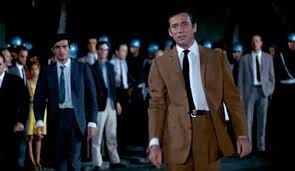
Z is a 1969 political thriller directed by renowned Costa-Gavras and considered "one of the cinematic sensations of the late '60s." The filmmaker was born in Greece but emigrated to France, where he became a legendary director. The story is loosely based on the 1963 assassination of Greek left-wing activist Gregoris Lambrakis. It remains an astonishingly relevant and contemporary film. Check out the Trailer.
Within the first five minutes, my heart began racing and never stopped. Story, history, character, and politics unfolded rapidly, inundating me with new information and reshaping my worldview. I grew up with Democrats vs. Republicans. My family is the former. But how left vs. right played out in the modern world was new to me. Z opened the window, exposing me to the big picture.
Costa-Gavras subject matter is as relevant today as it was then. He shows us the irrelevance of truth and the omnipresence of corruption. The legendary New Yorker critic Pauline Kael said, "It's almost intolerably exciting. It's an extraordinary thriller -one of the fastest, most exciting melodramas ever made. Costa-Gavras has made something very unusual in European films: a political film with a purpose and, simultaneously, a thoroughly commercial one.”
Z is a French-Algerian production with the unique distinction of receiving Oscar nominations for Best Picture and Best Foreign-Language Film.
It stars two legendary French actors, Yves Saint-Montand and Jean-Louis Trintignant, neither of whom I'd ever seen. Montand was a major actor/singer and was considered the Frank Sinatra of France. The director relied on Montand's regal image to convey the politician's charisma and kindness. Montand felt so personally drawn to the project that he turned down the opportunity to make Topaz with Alfred Hitchcock so he could act in Z.
Before writing this post, I read dozens of reviews, all expounding its brilliance. My favorite comment was, “Z is smarter than me, and it's smarter than you. It immediately proclaims, ‘Any resemblance to real events, to persons living or dead, is not accidental. It is deliberate.’
I walked out of the film exhilarated, dying to discuss it. My two friends were clueless. The following night, a girlfriend and I were "double-dating." I recommended Z. I had to see it again to talk about it. I knew my girlfriend would hate it; I was betting on the guys. While we had a great conversation, I doubt it had as profound an impact on them as on me. I wanted to learn more about Greece, dig into its real backstory, and see other films by Costa-Gavras, who often delved into political themes such as corruption, authoritarian regimes, and human rights abuses.
Somewhat unexpectedly, Z became an international hit and earned a significant place in film history for inventing the political thriller as a genre. In fact, Z was so popular that political thrillers were nicknamed "Z films."
UNDER THE RADAR FILM: I, Daniel Blake. Anytime you see Ken Loach attached to a film, you know you’re in the hands of someone deeply committed to the human condition - particularly the lives of the working class, which he has championed for decades.
If you take a class with me, one of the first things you’ll learn is that there is no such thing as plot. Plot only exists in relationship to your characters. The lesson of this film is simple: Less is more. Trust your characters, let them tell their stories.
While Z is a loud, political film, I, Daniel is quiet and understated. Both address powerful issues, but in two diametrically different ways.
In I, Daniel Blake, Daniel Blake is a 59-year-old widowed carpenter sidelined by a heart attack. Though he qualifies for welfare, he’s denied benefits and told to return to work. What follows is an infuriating descent into bureaucratic indifference as Daniel fights a system that seems designed to defeat him.
Along the way, he forms a bond with a young single mother barely holding things together for her two children. Their relationship becomes the film’s quiet center - human connection in the face of institutional failure.
It’s a restrained film, almost deceptively so. No theatrics, no manipulation. And yet it lands with devastating force. The kind of film that doesn’t just move you in the moment, but it stays with you long after recent films disappear from your memory.
Comments
Nothing yet. Say the first thing.
Sign in to join the conversation.