
This is the thirty-eighth part in a multipart series on the Book of Genesis. You can find the others here:
What Is The Imago Dei? What is the Sin of Ham? (Genesis 9:1-29)
Who Is “I Will Bless Those Who Bless You and Curse Those Who Curse You” Actually About? (Genesis 12:1-20)
No, Abraham Did Not Lie Because He Was Scared (Genesis 20:1-18)
Why Is There So Much Bronze Age Real Estate Law In The Old Testament? (Genesis 22:20-23:20)
Isaac and Rebekah as a Type of Christ and the Church (Genesis 24:1-67)
Esau Was ALWAYS The Bad Guy And Jacob Was ALWAYS The Good Guy (Genesis 25:1-24)
Isaac Did Nothing Wrong Deceiving Abimelech (Genesis 26:1-33)
Jacob Did Nothing Wrong In Deceiving Isaac (Genesis 26:34-28:5)
Jacob’s Ladder Is Not What You Think It Is (Genesis 28:6-22)
No, Jacob Did Not “Deserve” What Laban Did To Him (Genesis 29:1-30)
No, Joseph Did Not Provoke The Treatment He Got From His Brothers (Genesis 37:1-36)
Introduction
The story of Judah and Tamar is yet another tale in Genesis that doesn’t seem to fit the narrative and isn’t exactly rated-G. But God has given it to us in His Word; it is given for our instruction and edification, and a great deal of the theology of Genesis is revealed to us here. All of Genesis moves from the younger son replacing the elder son to the younger son redeeming the elder son. All of Genesis points to the first Adam being redeemed rather than merely replaced by the Second Adam. And in this passage, it all happens because a New Eve turns the Serpent’s attack against him using his own weapon of deception.
The Woodchipper is a reader-supported publication. To receive new posts and support my work, consider becoming a free or paid subscriber.
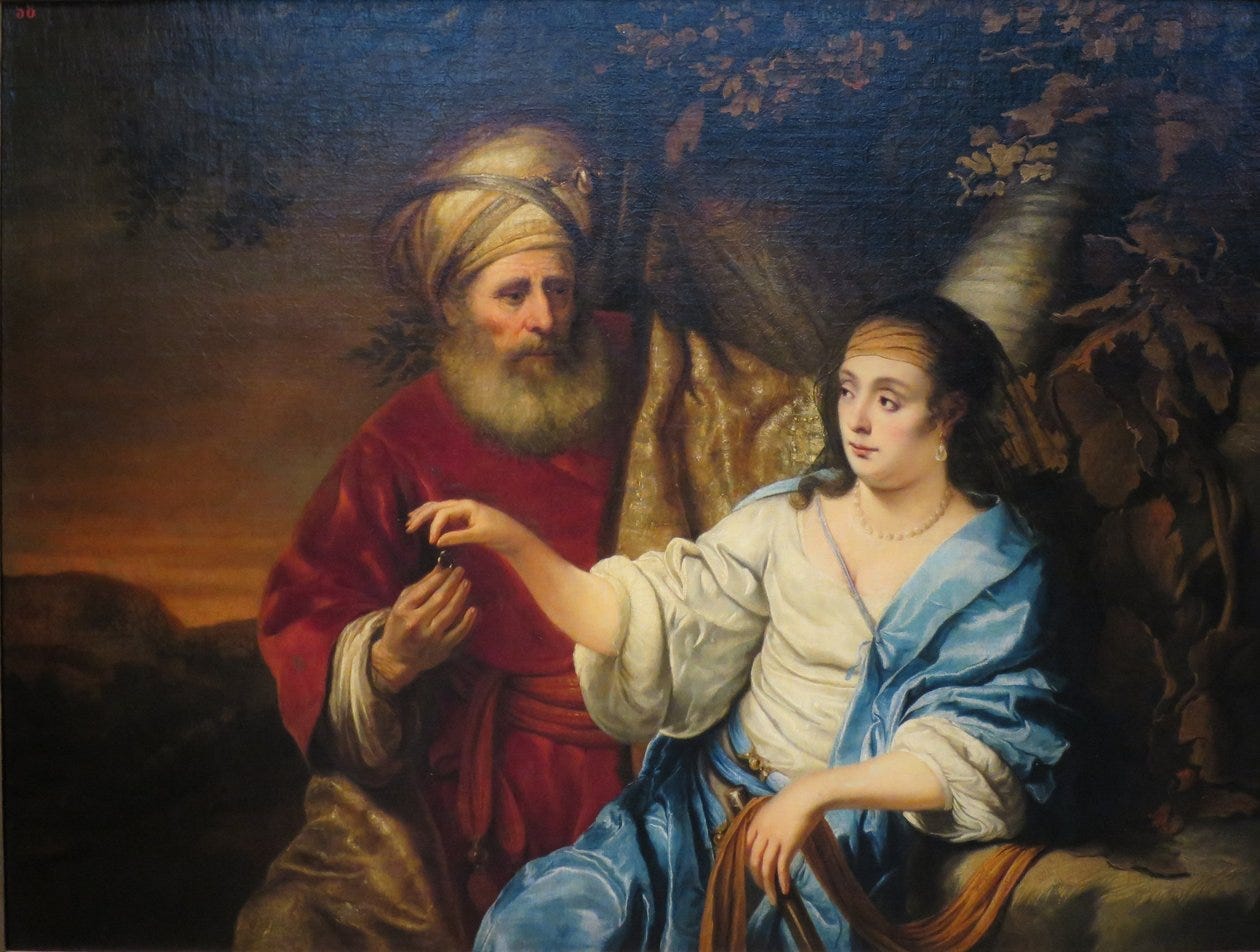
Judah and Tamar
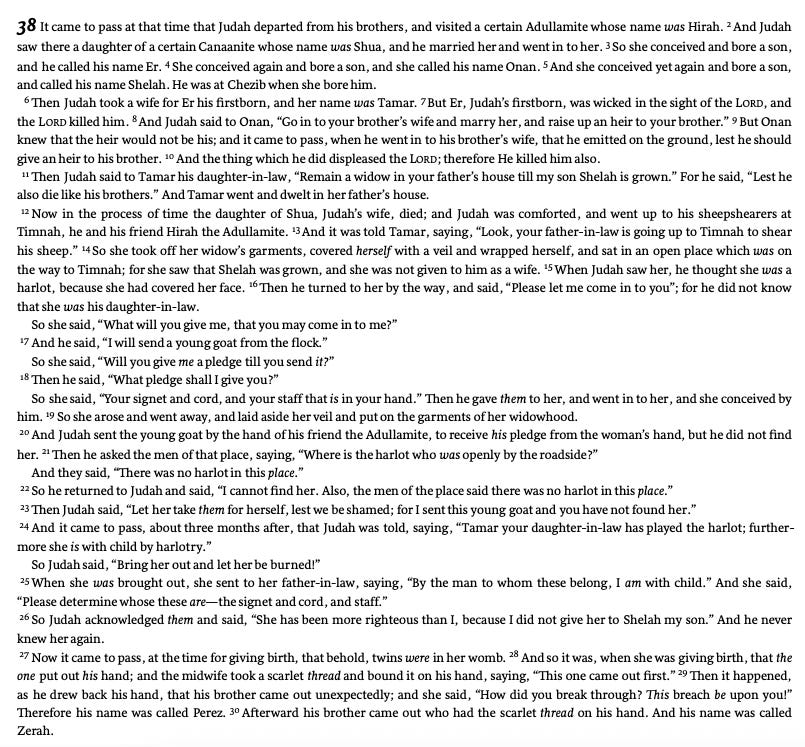
Judah left his brothers, presumably because he was opposed to their treatment of Joseph. This story takes place around the same time as Simeon and Levi raiding Shechem (and disqualifying and disinheriting themselves), as well as Reuben taking his father’s concubine (disqualifying and disinheriting himself, as well). So Judah at this point is the de facto firstborn son. Having departed from his brothers, he went to Hirah the Adullamite, and there he married a Canaanite woman, Shua. Now, it is possible this is a rejection of the covenant like Esau, or it is possible that this is a picture of the gospel going to Canaanites like Rahab. From the context, it is hard to tell in either case. With her, he had three half-Hebrew/half-Canaanite sons: Er, Onan, and Shelah.
Judah took a wife for Er, a girl named Tamar. But this half-Canaanite was wicked in the sight of the Lord, and He killed him. Then, Judah had his second-born take upon himself the duties of the Levirate. This law, later written down by Moses in Deuteronomy 25, described the requirement of the younger son to marry the widow of the deceased firstborn so that his children would be counted as heirs to the dead firstborn. In other words, the double portion of inheritance would skip the second-born son and go directly to his offspring.
Onan did not want to do this. He wanted the double portion of the inheritance to be his alone. So he made sure that during marital relations, a child would not be conceived. This is what the sin of Onan was, and not simply the act of preventing conception. He was attempting to steal the inheritance. That is what was such a great sin, that God killed him.
Judah told Tamar to remain a widow until the third son was of age, and she returned to her father’s house. Eventually, Judah’s wife Shua died. What does this mean? It means the Bride is dead, there will be no more seed raised up through her, and therefore Tamar inherits her place. It also means that Judah no longer had a righteous outlet for his passions. He went up to Timnah to shear his sheep, and here Tamar is told of it. She took off her widow’s garments and put on a veil and lay in wait for him on the way to Timnah.
Why did she do this? Because she had seen that Shelah was now grown, and she was not given to him as a wife. Either he had married someone else, or it was abundantly clear otherwise that Judah had reneged on his promise. Judah assumed that she was a harlot, and he went up to her to request her services; to this she asked for payment from him. He promised her a kid of the goats. Here, the details connect up with the deception of Isaac once again. The deceiver is in disguise, and a meal of a kid of the goats is central.
To this, she asks for a pledge for surety. He offers her his signet and cord (he is a wealthy prince) as well as his staff. What are these? These are symbols of Judah’s power and authority. The act was done, and Tamar had conceived an heir for Judah and his dead sons. Immediately after this deception, she put her widow’s garments back on. Why are we told this? Because she was not actually a harlot, she did so as a ruse.
Judah made good on this promise (interesting, he makes good on a promise to a prostitute but not to his own daughter-in-law). But no one could find this harlot. Interestingly, the word used here is different from the first usage, translated as harlot. Here, the word has even more meaning, that of a temple cult prostitute. Judah knowingly engaged in what he thought was a Canaanite sexual ritual, worship of the Canaanite gods. He has given himself over to the Canaanites fully and the demons they worship. And so he capitulates when she cannot be found. The Canaanites have his signet, cord, and staff. They have the symbols of his authority, and he just gives up.
And at this point, he is told that his daughter-in-law has played the harlot and become pregnant illegitimately. There is tremendous irony in this statement. She really did pretend to be a harlot, but her purpose in doing so was entirely righteous. She is converted and understands her role as the Bride who would bring forth the Seed to perpetuate God’s Covenant. She was forced (by Judah) to take the most extreme measures to ensure the covenant would continue.
Judah’s response to this, “bring her out and let her be burned,” is another example in this passage, along with the Levirate law, that the Laws of Moses were already known by this time in Genesis. In Moses’ Law, daughters who played the harlot were to be put to death, and daughters of priests were to be put to death and then burned with fire. What this shows is that the sons of the patriarchs operated as de facto priests; everywhere they went, they built altars and offered sacrifices upon them. Why were the daughters of priests burned? Well, when anything is burned, an animal, a person, a city, etc., what is it? It is a type of sacrifice. Rather than being redeemed by an animal pointing forward to the True Sacrifice, the person instead is killed and burned with no redeemer.
But Tamar came out and presented the evidence. She displayed Judah’s signet, cord, and staff and said the father is the man to whom these belong. What Judah says here is true and right: she has been more righteous than I because I did not give her to Shelah, my son. Tamar is vindicated. And Judah did not marry her nor know her again.
Tamar is further vindicated by bearing not one son but two. And something strange takes place. The first child put his hand out, and the midwife tied a scarlet thread on his finger, but he went back in, and his brother was born first. And that brother was named Perez, “breach.” The second brother, with the scarlet cord, was named Zerah, “rising or dawning.”
Conclusion
The end of Tamar’s story is confusing. Why is this bizarre story of their birth included? Because of the theological and typological themes in Genesis. Which one is the firstborn? It should be Zerah, since he broke out first and had the thread in his hand. But instead, it was Perez. It was through Perez that David would be descended from (and ultimately Jesus). The second-born supplants but also redeems the firstborn. The Second Adam supplants and ultimately redeems the First Adam and his descendants. He doesn’t merely replace the First Adam and create a separate lineage that is redeemed. God could have done that. He could have created a new, separate, sinless humanity descended from Jesus Christ. Have you ever thought about that? But instead, what God did was redeem humanity through Jesus. The second Adam doesn’t replace the first but redeems him. All of this was right there in Genesis from the very beginning if we have eyes to see it. Christ has redeemed His people. Trust in Him, that He is redeeming His entire creation. Trust that the Second Adam has taken his inheritance and He is redeeming it.
In the name of the Father, the Son, and the Holy Spirit. Amen!
The Woodchipper is a reader-supported publication. To receive new posts and support my work, consider becoming a free or paid subscriber.
Comments
Nothing yet. Say the first thing.
Sign in to join the conversation.