
This is the thirty-third part in a multipart series on the Book of Genesis. You can find the others here:
What Is The Imago Dei? What is the Sin of Ham? (Genesis 9:1-29)
Who Is “I Will Bless Those Who Bless You and Curse Those Who Curse You” Actually About? (Genesis 12:1-20)
No, Abraham Did Not Lie Because He Was Scared (Genesis 20:1-18)
Why Is There So Much Bronze Age Real Estate Law In The Old Testament? (Genesis 22:20-23:20)
Isaac and Rebekah as a Type of Christ and the Church (Genesis 24:1-67)
Esau Was ALWAYS The Bad Guy And Jacob Was ALWAYS The Good Guy (Genesis 25:1-24)
Isaac Did Nothing Wrong Deceiving Abimelech (Genesis 26:1-33)
Jacob Did Nothing Wrong In Deceiving Isaac (Genesis 26:34-28:5)
Jacob’s Ladder Is Not What You Think It Is (Genesis 28:6-22)
No, Jacob Did Not “Deserve” What Laban Did To Him (Genesis 29:1-30)
The Woodchipper is a reader-supported publication. To receive new posts and support my work, consider becoming a free or paid subscriber.
Introduction
Jacob meeting Esau is supposed to be the moment where Jacob “repents” for “what he did to” Esau. But if you have paid careful attention to the narrative of Genesis, Esau despised the covenant, despised his birthright, and participated in his father’s scheme to deny Jacob anything. God orchestrated a great reversal of this plot; Esau was the one who ended up with nothing. Still, God blessed him and made him the great nation of Edom, and when Jacob returns to the Land, this event is not Jacob’s repentance, but Jacob setting right what his brother and father had destroyed.
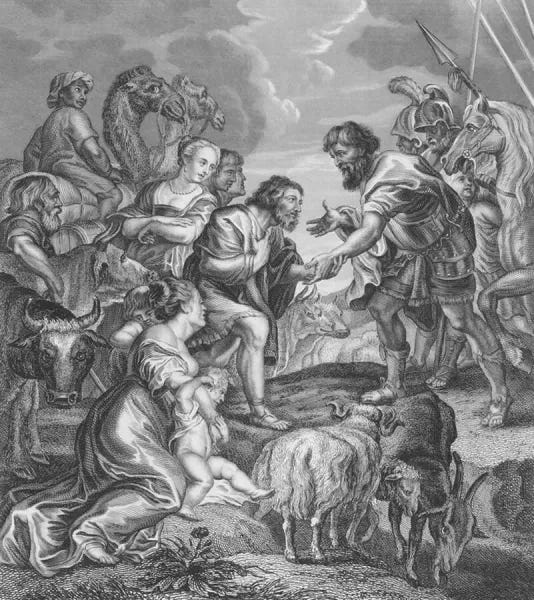
Jacob Meets Esau
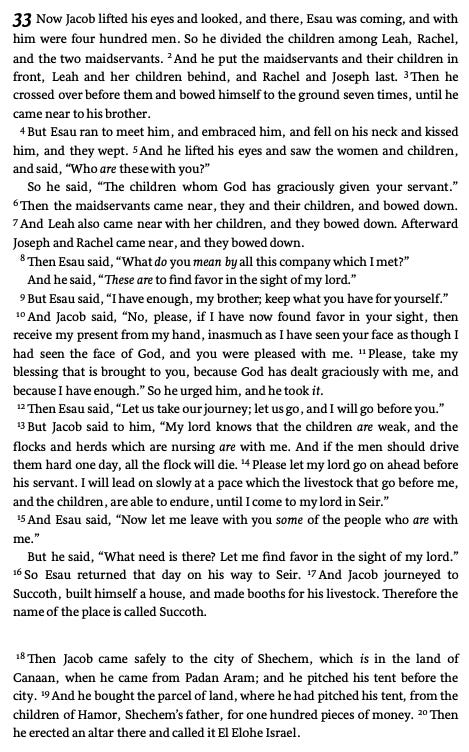
After wrestling with God at Peniel, Jacob sees Esau coming with his army. He divided the company again, the maidservants and their children in front, then Leah and her children, and lastly Rachel and her son. But he did not put the women and children at the front and hide in the back; he went over before all of them and bowed to the ground seven times before Esau, paying homage to him.
What does Esau do? He runs to greet his brother, embraces him (this would look like wrestling, just as with God), then kisses him, and the two of them wept together. He looked up and asked him who all the women and children were that were with him. Jacob told him these were the children God had given him. Then each of the mothers and their respective children came and bowed down before Esau.
Esau asks him what Jacob meant by all the animals he had given him. Jacob told him these are meant to find favor in your sight, calling him Lord. Esau, at the moment, is a lord of the Land. He has dominion there that Jacob and his descendants would not have for a few hundred years. Esau tells him he doesn’t need the gifts. But Jacob insisted. Receive them as a sign that I have indeed found favor in your sight. The phrase in verse 11 is especially illuminating: “Please take my blessing.” After this urging, Esau indeed took it.
Esau asks for Jacob and his company to journey with him; he would lead them, and they would follow. What is he doing here? He is asserting authority as the older brother. He will follow, they will lead. But Jacob tells him, both the children and the flocks are too weak to go with them. Esau and his men travel quickly. Jacob cannot. Jacob tells him to go on ahead without him.
Esau suggests leaving some of his men with Jacob. Why would he do this? Because he wants to help protect his brother’s family as they travel over land, a very dangerous thing. Possibly. Because he wants to assert his authority over Jacob and his host, as the older brother? This is likely as well. But Jacob rejects this as well. We won’t need them. So Esau went home to Seir. Jacob, however, did not go to Seir. He went to a place called Succoth, which means tabernacle, or tent, or booth. It was named such because this is where Jacob built booths for his flocks, and also built a palace for himself.
At some point after this, he journeyed to Shechem, in the northern part of the Land, and purchased land outside the city of Shechem. There, like his fathers had done, he erected an altar to worship, naming it literally, “God, the God of Wrestles-with-God.”
Conclusion
If this passage is not really about Jacob’s supposed “repentance,” what is it really about? Isaac had intended to give Esau not just a double portion of the inheritance as was owed to the firstborn, but the entirety of the inheritance, leaving Jacob with nothing. Isaac was deceived into giving it all to Jacob, leaving Esau with nothing. What Jacob has done here is set things right. He has righted his father’s wrongs. He has given Esau the portion of the inheritance his father stole from him. Jacob doesn’t have to do this. Esau even gave him an out, but Jacob insisted. Jacob was righting covenantal wrongs. The inheritance was always supposed to go to Jacob, but Isaac, in his rebellion, had messed everything up in both directions.
Secondly, Esau still does not seem to get it. The tangible blessings that Jacob had received should have been evidence to Esau that Jacob was indeed the one God had chosen to carry forward the covenant. Jacob and his family paid Esau homage; Jacob called him “lord,” but it should have been the other way around, had Esau had regard for the covenant. Esau’s rage had been sated, but bringing the people to Seir would have been an Egypt situation. Jacob’s family would have been under Esau’s yoke. Jacob could not bring them there. Esau’s insistence to leave men with them would mean the same thing, that they would have to go to Seir, and be under Esau’s dominion. Jacob refuses to do this and never goes to Seir at all. He remains in Succoth, then goes even further away from Seir, to Shechem.
What do these two points mean for us? First, the people of God must be those who put things right, even at great cost to ourselves. When a man’s ways please the Lord, He makes even his enemies to be at peace with him. We should put an end to rivalries and feuds, even if it is our “right” to remain offended and keep a fight going.
Secondly, the people of God cannot be led by the ungodly. Jacob goes to great pains to be at peace with Esau, who again is a wicked man who despises the covenant and is at war with Jacob through no fault of Jacob’s. He does all he can to bring peace between the two, but he refuses to be led by him. This is an important lesson for the church to understand in our own age. You can and should do what you must to be at peace, even with those who hate you, but you cannot let them dictate anything to you. We will not journey with you to Seir. You will not leave your men with us to lead us there. We will not tailor what we say or what we believe according to what you want. We will go to Succoth, we will go to Shechem, we will not go with you to Seir. We are at peace with you, but we will not join with you.
This is an apparently very difficult concept for modern Christian people. We assume being at peace with those who hate God, His Word, and His church means we have to change what we believe; that we have to adapt to contemporary cultural attitudes. But the church is a separate city within the cities of men, just as Jacob was a separate people living within the Land of Canaan. He did what he must in order to be at peace, but under no conditions could he join with them.
The same must be true of us today. People will call believing all of the Bible and taking it seriously “hate.” They will hate you for it. And your job is to bless those who curse you, which does not mean simply submitting to them and their way of life, but something far, far more difficult. It is easy just to capitulate. It is much harder to live a Christlike life of blessing those who hate you while remaining steadfast in your faithfulness to God. But God has called us to do difficult things. He gives you grace to do difficult things just as He gave it to Jacob. God goes before you, just as He went before Jacob. He has promised to be with you. And so, people of God, truly love your enemies, just as Jacob did here. And trust in the faithfulness of God to bring peace.
In the name of the Father, the Son, and the Holy Spirit. Amen!
The Woodchipper is a reader-supported publication. To receive new posts and support my work, consider becoming a free or paid subscriber.
Comments
Nothing yet. Say the first thing.
Sign in to join the conversation.