
A chimpanzee named Bruno had been taught American Sign Language. But instead of answering the researcher’s question, he signed two words: KEY OUT.
The researcher, Mark Bodamer, asked him to sign again. Bruno shifted his body so that he was facing Bodamer more directly and raised his hands to make his meaning unmistakable.
OUT KEY OUT.
Bodamer understood. He signed back: CAN’T SORRY CAN’T.
Bruno’s shoulders dropped, and he walked to the back of his cage.
His story was presented to the Michigan courts because it shows what bodily liberty can mean to a chimpanzee. Bruno understood that he was confined. He knew that a key could open the cage. He wanted to leave, and he deliberately communicated that desire to someone he believed could help him.
He asked to be freed.
He remained confined at the biomedical facility, where he eventually died.
Bruno’s story is key to understanding the case that recently came before the Michigan Supreme Court.
The case concerns seven chimpanzees held at the roadside zoo called the DeYoung Family Zoo in Wallace, Michigan. The Nonhuman Rights Project, which brought the legal action on their behalf, calls them the DeYoung Prisoners.
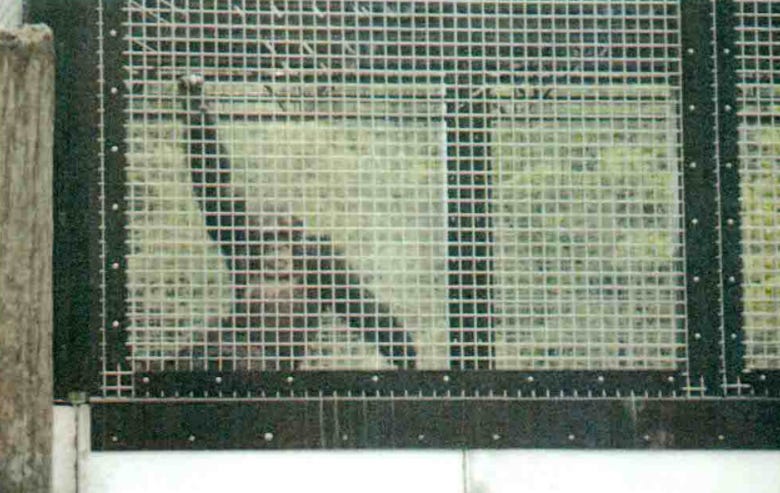
The seven DeYoung Prisoners cannot make that request in American Sign Language. Nor can they walk into a courtroom and ask a judge to hear them. The Nonhuman Rights Project is asking the law to consider their claim to the fundamental right that all persons have, not to be deprived of their bodily liberty without sufficient cause.
Only one of the seven is publicly identified by name. Louie was brought to the DeYoung zoo in 2010, when he was six weeks old. He was used for at least the first two years of his life as a prop in paid photo opportunities. Photographs and videos show him restrained on a fixed leash and made to interact with children and other zoo visitors.
The evidence submitted in the case indicates that Louie later spent many years without the companionship of another chimpanzee.
The other six chimpanzees are identified in the complaint as Prisoners B through G. Five were previously held at the Missouri Primate Foundation, a chimpanzee breeding facility that supplied animals to the exotic-animal trade and entertainment industry. Another was born at the DeYoung zoo and was removed from her mother while still an infant.
Chimpanzees are profoundly social beings. Martha Nussbaum, who submitted an amicus brief supporting the case, noted that they naturally live in communities that may include between 20 and 200 individuals, moving among different social subgroups and forming complex relationships. The DeYoung Prisoners, by contrast, are limited to their small group of seven—when they have access even to one another.
In December 2023, The Nonhuman Rights Project filed a habeas corpus complaint on their behalf.
Habeas corpus is the legal procedure through which a court examines whether an individual is being lawfully confined. The Nonhuman Rights Project asked the court to require the roadside zoo to justify the chimpanzees’ confinement and, ultimately, to order their transfer to a chimpanzee sanctuary accredited by the Global Federation of Animal Sanctuaries.
The case does not claim that chimpanzees are human beings. Nor does it ask that chimpanzees receive every legal right possessed by humans.
It asks a narrower but fundamental question:
Can these chimpanzees be recognized as legal “persons” for purposes of habeas corpus—that is, are they entitled to ask a court to examine whether their confinement is lawful?
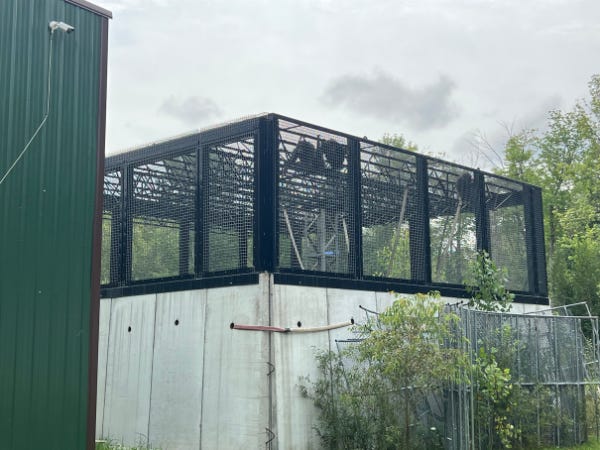
Recognizing them as persons for this limited purpose would give them the opportunity to have the legality of their confinement considered.
The word “person” has a technical legal meaning. Corporations, for example, can be legal persons for some purposes, although they are obviously not human beings. The question is whether beings with the well-recognized cognitive and emotional capacities of chimpanzees can possess an interest in bodily liberty that the law ought to recognize.
The evidence presented to the Michigan courts was, in Justice Elizabeth Welch’s words, “considerable and seemingly undisputed.” It indicates that chimpanzees possess autonomy and self-determination; that they are remarkably intelligent and self-aware; that they remember the past and plan for the future; that they show empathy and compassion; and that they grieve the deaths of those close to them.
Among the Nonhuman Rights Project’s expert witnesses was the late primatologist Jane Goodall. Supporting amici included University of Chicago philosopher Martha Nussbaum. Gary Comstock, Adam Lerner, and I submitted a separate brief challenging the philosophical reasoning the lower court used to deny the chimpanzees access to habeas corpus.
Despite this evidence, the Michigan courts have so far refused to recognize the DeYoung Prisoners as persons eligible to seek habeas corpus.
The lower court reasoned that legal rights belong only to beings capable of taking on legal duties—for example, by understanding society’s laws and agreeing to follow them. Because chimpanzees cannot do that, the court concluded that they cannot be legal persons entitled to seek habeas corpus.
Justice Elizabeth Welch dissented from the Michigan Supreme Court’s decision not to hear the case. She argued that the law should not be frozen by centuries-old ideas about animals as property, especially when modern science has revealed so much about chimpanzees’ minds and emotional lives.
She wrote that the evidence shows chimpanzees can “think, feel, love, grieve, and yearn.” She also referred to my book The Expanding Circle, which examines how moral progress has often required us to extend our concern beyond boundaries that earlier generations took for granted.
Justice Welch’s dissent does not free the DeYoung Prisoners. But it recognizes that calling an intelligent, self-aware, emotionally complex being “property” does not answer the question of whether that being has an interest in freedom.
The seven DeYoung Prisoners remain confined.
Justice Welch’s dissent deserves to be widely read as it gives serious legal and moral consideration to a claim that American courts have so far rejected.
Read Justice Welch’s dissent in full.
The court’s website may be inaccessible in some countries, so I am also reproducing Justice Welch’s dissent in full below.
Louie and the six other chimpanzees remain confined at the DeYoung Family Zoo. The Nonhuman Rights Project is calling for them to be transferred to an accredited sanctuary, where they could live in an environment suited to their social, physical, and psychological needs.
Sign the petition to demand their freedom.
#FreeTheDeYoungPrisoners
NONHUMAN RIGHTS PROJECT, INC.,
Plaintiff-Appellant,
v
DEYOUNG FAMILY ZOO, LLC, and
HAROLD L. DEYOUNG,
Defendants-Appellees.
On order of the Court, the application for leave to appeal the October 17, 2025 judgment of the Court of Appeals is considered, and it is DENIED, because we are not persuaded that the questions presented should be reviewed by this Court. WELCH, J. (dissenting). Plaintiff Nonhuman Rights Project seeks a writ of habeas corpus on behalf of seven chimpanzees kept at defendant DeYoung Family Zoo (the DeYoung Chimpanzees). Based on the evidence presented, chimpanzees appear unsuited for confinement.
Plaintiff does not allege that chimpanzees are human beings. Instead, plaintiff asserts in its complaint that chimpanzees possess a common law right to bodily liberty, and that the DeYoung Chimpanzees’ confinement at the Zoo denies them that right. For that reason, plaintiff asks the Court to order the DeYoung Chimpanzees released and relocated to a facility where they can, to the greatest extent possible, live as autonomous beings. The Court of Appeals held that chimpanzees are not persons, and that they are therefore not entitled to habeas relief. I would have granted plaintiff’s application for two reasons. First, I question the Court of Appeals’ application of social contract theory and the concept of “despotic dominion,” Nonhuman Rights Project, Inc v DeYoung Family Zoo, LLC, ___ Mich App ___, ___ (October 17, 2025) (Docket No. 369247); slip op at 11 (quotation marks omitted), to support its conclusion, as well as its application of our caselaw. Second, I would grant leave to appeal to explore whether the common law understanding of habeas relief should evolve in light of our more advanced understanding of the animal kingdom.
As a result, I respectfully dissent from the Court’s denial order.
A. Chimpanzees’ Advanced Cognitive and Emotional Capabilities
Plaintiff, its expert witnesses, and supporting amici present considerable and seemingly undisputed scientific evidence that chimpanzees possess autonomy, self-determination, and numerous advanced cognitive abilities. The evidence demonstrates that chimpanzees are remarkably intelligent, that they are self-aware, that they plan for the future, that they exhibit empathy and compassion toward other living beings, and that they grieve the loss of loved ones.
Consider, for example, the story that plaintiff presents in its application for leave to appeal about Bruno, a chimpanzee who was caged at a biomedical facility. Researchers had trained Bruno in American Sign Language (ASL). Using ASL, Dr. Mark Bodamer asked Bruno for his name, but instead of replying with his name, Bruno signed “KEY OUT.” Bodamer described what happened next:
I signed back CAN’T SORRY CAN’T. Bruno’s shoulders dropped,
Bruno had signed KEY. He then signed again, pulling one hand out from the
grasp of the other—the ASL sign for OUT. I signed NOT UNDERSTAND
SIGN AGAIN. Bruno shifted his posture, orienting his body more directly
toward me; raised his hands slightly, making it easier to see his signs; then signed again. This time both signs were very clear: OUT KEY OUT. I was
spellbound. Bruno began to bob and then crouch by his cage door. He signed
OUT OUT, bobbing and crouching even more excitedly. He continued to
sign OUT several more times. Of all the phrases Bruno could have signed,
he signed KEY OUT. I didn’t think his message was by any means random.
Bruno wanted out of his tiny cage.
and he walked to the back of his cage, crestfallen. . . . Bruno had directly
asked me to free him, expressing emotions just like any human who had been
wrongfully imprisoned, and I had to say no. [Quotation marks omitted.]
It is against this conceptual backdrop that plaintiff based its complaint.
Plaintiff and Professor Nussbaum also specifically highlight the story of Louie, a Chimpanzee at the Zoo, whom plaintiff alleges has lived alone for at least half his life. Plaintiff sought an order to show cause requiring defendants to justify their imprisonment of the DeYoung Chimpanzees. See MCL 600.4316; MCR 3.303(D). The The circuit court denied relief, holding that the DeYoung Chimpanzees “are not persons as required by MCR 3.303” to be entitled to writs of habeas corpus. The Court of Appeals affirmed the trial court’s order. Nonhuman Rights Project, ___ Mich App at ___; slip op at 14. In so doing, the panel held in a published opinion that chimpanzees are not persons eligible for a writ of habeas corpus. To support that holding, the Court of Appeals specifically relied upon William Blackstone’s conception of social contract theory and his view—rooted in his interpretation of the Book of Genesis—that because human beings exercise despotic dominion over nonhuman animals, nonhuman animals are property, not persons. Id. at ___; slip op at 11. The panel then rejected plaintiff’s request to update the common law with respect to who—or what—is entitled to habeas relief. The panel explained that this Court, rather than the Court of Appeals, “is the ‘principal steward of Michigan’s common law,’ ” id., quoting Henry v Dow Chem Co, 473 Mich 63, 83 (2005), and that any “ ‘significant departure from Michigan law’ ” should come from this Court, rather than a lower court, Nonhuman Rights Project, ___ Mich App at ___; slip op at 13, quoting Teel v Meredith, 284 Mich App 660, 666 (2009). Even if the Court of Appeals could update the common law, the panel wrote, it would have declined plaintiff’s request. Nonhuman Rights Project, ___ Mich App at ___; slip op at 13-14. Relying upon Blackstone’s and Thomas Hobbes’s conceptions of social contract theory, the panel opined that a chimpanzee is not a person because it is unable to enter into a social contract. Id. This application followed.
B. Procedural History
Plaintiff commenced this action by filing its complaint in the circuit court. Plaintiff alleges that the DeYoung Chimpanzees are confined in a manner that denies them the opportunity to exercise their autonomy and cognitive and emotional complexity.
Supporting amicus Professor Martha Nussbaum opines that “[d]espite their fundamental need for social connection, tendency to roam in groups of 20 to 200, and need to interact with various social subgroups, the DeYoung Prisoners are limited to the small group of seven chimpanzees at [the Zoo]—if anyone at all.” And plaintiff alleges that the DeYoung Chimpanzees are housed indoors all winter without access to the fresh air and sunshine that they require.
According to plaintiff and Professor Nussbaum, Louie was used as a prop in photo opportunities and made to interact with children and other zoo patrons, all the while chained to a leash. One of plaintiff’s expert witnesses explained that such conditions are “ ‘highly detrimental to [Louie’s] psychological well-being, mental health, growth, and development.’ ”
ultimate relief plaintiff sought was for the circuit court to order that the DeYoung Chimpanzees be relocated to a chimpanzee sanctuary accredited by the Global Federation of Animal Sanctuaries. Such sanctuaries, plaintiff asserts, provide chimpanzees with a socially and physically rich environment that would satisfy the DeYoung Chimpanzees’ complex needs.
I believe that the Court of Appeals’ reliance on Blackstone to support its holding was flawed. The panel asserted that “Blackstone divided legal persons into ‘natural’ and ‘artificial[.]’ ” Id. at ___; slip op at 10 (citation omitted). According to Blackstone, the panel then explained, “ ‘Natural persons are such as the God of nature formed us; artificial are such as are created and devised by human laws for the purposes of society and government, which are called corporations or bodies politic.’ ” Id., quoting 1 Blackstone, Commentaries on the Laws of England, p *123. The panel also noted that the rights of persons are either absolute or relative and that “ ‘absolute rights,’ ” including “ ‘natural liberty,’ ” belong only to “ ‘particular men.’ ”4 Nonhuman Rights Project, ___ Mich App at ___; slip op at 10 (citation omitted). The panel then proceeded to examine Blackstone’s definition of property. Id. at ___; slip op at 11. The panel wrote that “Blackstone defined property as ‘that sole and despotic dominion which one man claims and exercises over the external things of the world, in total exclusion of the right of any other individual in the universe.’ ” Id., quoting 2 Blackstone, Commentaries on the Laws of England, p *2. The panel then stated that Blackstone “invoked the creation narrative to reflect the period’s understanding of the common law’s categories”:
II. DISCUSSION
This case raises profound questions about bodily autonomy and whether the law should expand to offer protection to other living beings. I believe the Court of Appeals incorrectly relied upon Blackstone’s and Hobbes’s questionable applications of social contract theory to define “personhood.” I believe those views are antiquated, and we should not rely on them in our jurisprudence. Additionally, I question the panel’s application of our caselaw. Finally, because the common law can evolve over time and indeed has evolved with respect to habeas relief, and because our scientific understanding of the animal kingdom is constantly evolving, I believe that we should explore this issue further.
In the beginning of the world, we are informed by holy writ, the all-
bountiful Creator gave to man “dominion over all the earth; and over the fish of the sea, and over the fowl of the air, and over every living thing that
moveth upon the earth.” . . . The earth, therefore, and all things therein, are the general property of all mankind, exclusive of other beings, from the
immediate gift of the Creator. [Nonhuman Rights Project, ___ Mich App at
___; slip op at 11, quoting 2 Blackstone, pp **2-3 (quotation marks omitted;
ellipsis in Nonhuman Rights Project).]
I also disagree with the Court of Appeals’ application of our caselaw. To support its holding, the panel relied upon two non-habeas cases from the nineteenth century. The panel asserted that Sterling v Jackson, 69 Mich 488, 496 (1888), supported its conclusion that chimpanzees cannot be persons because Sterling held that “ ‘by the law of nature every man, of whatever rank or station, has an equal right of taking, for his own use, all creatures fit for food that are wild by nature, so long as he does no injury to another’s rights.’ ” Nonhuman Rights Project, ___ Mich App at ___; slip op at 12, quoting Sterling, 69 Mich at 496. Acknowledging that Sterling’s holding was limited to animals “ ‘fit for food,’ ” the panel then quoted Ten Hopen v Walker, 96 Mich 236, 239 (1893), which held that “ ‘dogs . . . are the property of the owner, as much as any other animal which one may have or keep.’ ” Nonhuman Rights Project, ___ Mich App at ___; slip op at 12, quoting Ten Hopen, 96 Mich at 239. But Sterling and Ten Hopen merely define how humans can possess wild and domesticated animals. Neither case concerns petitions for writs of habeas corpus. Nor does either case address whether animals held as property can ever be eligible for a writ of habeas corpus. Accordingly, I do not believe they are dispositive. Finally, I question the panel’s application of social contract theory to explain why this Court should not update the common law. Relying on the philosophies of Blackstone and Hobbes, the panel asserted that a “central aspect of personhood is mankind’s capacity to ‘give[] up a part of his natural liberty’ and ‘oblige[] himself to conform to those laws, which the community has thought proper to establish.’ ” Nonhuman Rights Project, ___ Mich App at ___; slip op at 13, quoting 1 Blackstone, p *125 (alterations in Nonhuman Rights Project). And, the panel reasoned, because “[c]himpanzees—and nonhuman animals generally—are incapable of making this exchange,” they are not entitled to writs of habeas corpus. Nonhuman Rights Project, ___ Mich App at ___; slip op at 13. But as one group of amici—Professor Gary Comstock, Professor Peter Singer, and Dr. Adam Lerner—explain, no “classical social contract theorist . . . ever claimed that basic rights arise from the ability to bear duties.” To the contrary, amici argue, philosophers such as Locke and Rousseau argued “that individuals possess natural rights prior to the formation of civil society and that governments exist to protect those rights.” See, e.g., Locke, Second Treatise of Government: An Essay Concerning the True Original, Extent and End of Civil Government (Wheeling: Harlan Davidson, Inc, 1982), §§ 4–6. As Comstock, Singer, and Lerner note, Hobbes himself realized that his reasoning— which the Court of Appeals adopted in this case—denies legal rights not only to animals but to many humans. In essence, under this rationale, any living being “incapable” of consciously giving up part of their liberty to oblige themselves to conform to society’s laws is neither a legal person nor a party eligible for a writ of habeas corpus. That logic must, of course, fail. Otherwise, human beings incapable of making decisions for themselves— due to age or infirmity—would be ineligible for writs of habeas corpus, and they would not be considered “persons” under the law. In conclusion, the Court of Appeals explained correctly that this Court is the “ ‘principal steward of Michigan’s common law.’ ” Nonhuman Rights Project, ___ Mich App at ___; slip op at 13, quoting Henry, 473 Mich at 83. Rather than rely on Blackstone, the Book of Genesis, Hobbes, and social contract theory, I would have taken up the issues raised by plaintiff and explored whether our scientific understanding of chimpanzees should change our view of habeas relief.
As a foundational matter, I question whether an eighteenth-century British jurist’s interpretation of the Book of Genesis is a sound foundation for Michigan common law in the twenty-first century. Further, many scholars and theologians challenge Blackstone’s interpretation of the relevant biblical text. As Professors Andrew Linzey, Clair Linzey, and Amanda Muskat note in their amicus brief, the word “despotic” does not appear in Genesis 1; it was Blackstone’s addition. And amici argue persuasively that there is widespread consensus among scholars and theologians that the meaning of “dominion” as discussed in the Book of Genesis is about care for creation, rather than domination. In other words, many experts believe that Blackstone got this issue wrong. Finally, I do not believe that courts should apply the concept of “dominion” to justify the subjugation of living beings. Indeed, it is this very same concept that was used by the federal government to justify the conquest of Native American nations. See Johnson v M’Intosh, 21 US 543, 574 (1823). See also Fletcher, Bizindan Miinawa (Listen Again), 23 Tribal L J 50, 61, 63 (2024).
III. CONCLUSION
Plaintiff and amici present considerable evidence that chimpanzees can think, feel, love, grieve, and yearn. In light of that evidence, “[e]fforts to extend legal rights to chimpanzees are . . . understandable[.]” In re Nonhuman Rights Project, Inc v Stanley, 49 Misc 3d 746, 772 (NY, 2015). Someday, the effort to extend rights to chimpanzees may succeed. See id. at 772-773. Human history has seen various examples of human beings expanding their circle of moral concern. See generally Singer, The Expanding Circle: Ethics, Evolution, and Moral Progress (New York: Farrar, Straus & Giroux, 1st ed, 1981).
And the United States Supreme Court has explained that “times can blind us to certain truths and later generations can see that laws once thought necessary and proper in fact serve only to oppress.” Lawrence v Texas, 539 US 558, 579 (2003).
Although this Court denies leave today, our Legislature can always reconsider its animal welfare laws—including the laws concerning the confinement of chimpanzees. I respectfully dissent.
Comments
Nothing yet. Say the first thing.
Sign in to join the conversation.