

👋 Hey, it’s Jaime. Welcome to my weekly newsletter where I share how thriving open source projects grow their communities.
Subscribe to get access to these and all future posts.
In today’s article I’ll cover a problem I suffered at my beginnings as an entrepreneur: “I don’t know how to show that my project is a better alternative”, aka “I’m terrible at positioning”.
But the word “positioning” can feel icky and marketing-y.
Remember school? When someone stood out, they were quickly called out as nerds or blowhards. So most of us try to be humble, be recognised for our merits and leave a clear path for those who have embraced showing off what they’re able to do.
And this has made most of us not very good at “positioning”. A lot of good open source projects and communities working for the common good are too busy working at their projects to manage where they fit with the competition. And this often leads to many people misunderstanding the project’s core goals.
Most of the time, we believe being open source or being ecological is enough of a differentiator. But being open source or ecological is a means to an end. If people don’t understand how it supports their goals, they won’t give you a chance.
This means well-deserving open projects often get the least credit for their work and thus don’t have the resources to develop and maintain their projects.
So let’s stop avoiding differentiating ourselves, and let’s start aiming at helping people quickly understand the benefits of what you do and whether they’re a good fit or not.
Here’s what we’ll cover:
What is positioning and why does it matter?
7 ingredients for positioning
Some examples in action
How to put it in practice
Hopefully this article will help you attract more people who need your solution, as well as collaborators trying to accomplish the same thing.
Read Time: 15-ish minutes
When we encounter something new, we all try to understand in which category it fits through the clues shown to us.
And when those clues don’t exist, you might have a hard time understanding what something does, and your project suffers to find its audience.
This is particularly challenging when you want to launch a community, an ecological project, a cooperative or an open source project that creates a real alternative to the GAFAM or other projects you consider harmful.
However, this approach rarely leads to success. Open source, ecology and being a cooperative are important features, but not something valuable in itself. Let me explain.
You’ve probably noticed that, beyond a few activists, most of your colleagues, friends and family don’t buy something because it’s open source or employee-owned. These are nice to have, but not enough when there are quicker, cheaper or better ways to reach people’s goals. Otherwise, Amazon would have lost against local cooperative supermarkets, Photoshop would be dominated by GIMP, Twitter would be taken over by Mastodon or Bluesky, and Apple or Microsoft would be replaced by Linux.
The problem is people don’t want open source solutions or companies owned by their employees or that pay living wages. Most people first want to reach their goals and then, hopefully, consider the ethics of it.
So if people are not looking for open source, what do we need to build a positioning that can compel people to give us a try?
Let’s look at the ingredients we need to gather first:
According to April Dunford in her remarkable book Obviously Awesome, from which I have summarised many of her ideas, there are five components of effective positioning:
Competitive alternatives: What your target people would “use” or “do” if your project didn’t exist.
Unique attributes: The features and capabilities that you have and the alternatives lack. Your secret sauce. These can be technical features, your delivery model, your business model, your network effects or your specific expertise, experience or other assets.
Value (and proof): The benefit only you can deliver to people because of your unique attributes. These are the reasons someone might care about your secret sauce. And you will need to demonstrate your claims through social proof, benchmarks or any other means.
Target market characteristics: Your target market is the group of buyers who really care about the value you deliver. They buy quickly, don’t ask for discounts and recommend your project to their friends.
Market category: Declaring that your product exists in a market category helps people understand your value, who your competitors are, and what functionality or pricing to expect.
Now that you have these five components, it’s now time to figure out each of them:
In an open source project, it’s easy to confuse your free users with your customers.
Open source users are generally your colleagues and competitors. These people have the technical skills to reproduce your project, so they will rarely pay you for what you offer. But they might become ambassadors in their companies, which will eventually become customers as their needs grow. And they might also become contributors that make your product better.
But open source customers are generally the people who need what you offer but don’t have the skills, the logistics or the network effects to install, maintain or deploy what you have created.
Here are some examples:
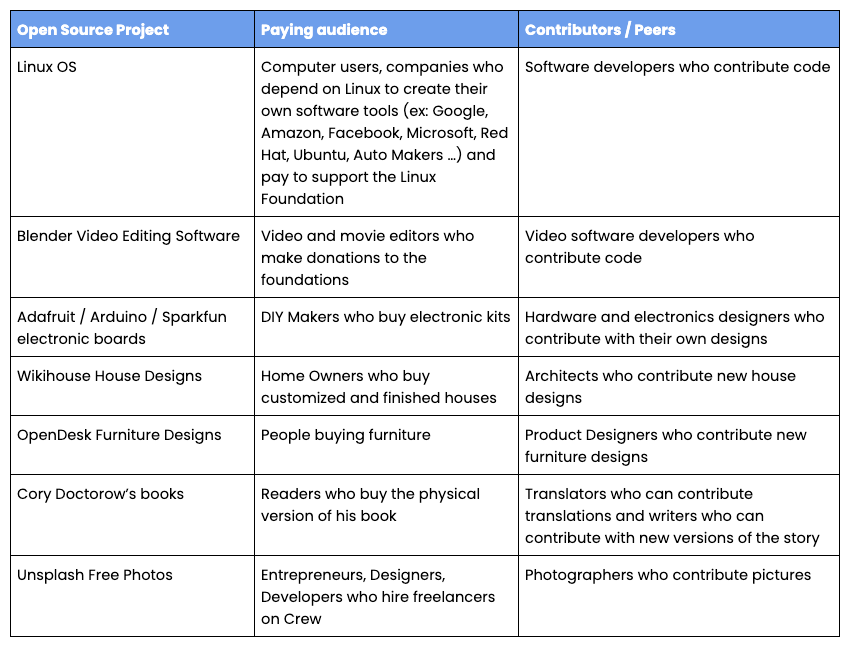
Since an open source project needs both audiences, now that you get the difference between both, we’re going to position our solution for each of your top customers and top contributors separately. But as you’ll see later, we can come up with a different positioning for many different targets, whether they are customers, contributors, people we seek to hire, investors and so on…
But I digress.
Who understands your product quickly and buys from you without hesitation? Who can’t stop recommending you to their colleagues?
List these people and keep them in mind, as they should become the focal point of all of your product roadmap, marketing, pricing and communication efforts.
But what happens if you don’t have these top customers yet?
You’ll have to make an educated guess of who this audience could be. Get your product in front of them, and test your offer to see some patterns emerge until you adapt your offer enough to find the people happy to pay for or use your product.
Since positioning will impact every area of your project, you should involve your fellow maintainers or one or two people responsible for the groups in marketing, business development, community, support, and product development.
These people need to be involved, as any new positioning will impact how they create communication campaigns, target certain customers, onboard the community or prioritise the product roadmap.
Understand what customers are trying to solve and the alternatives they might replace you with to understand how they categorise your solution.
But this is something that cannot be asked directly to customers, as we’re often terrible at describing our problems. An easier way is to understand the alternatives through the categories customers compare us to. This is how we perceive the strengths or weaknesses of a given solution.
However, if you are innovating and don't fit into an existing category, your options may include using a pen and paper, hiring an intern, or using an Excel spreadsheet.
For example, when the 3D printers were invented, the alternative was the expensive-to-start but cheap-to-scale injection moulding.
Wikipedia’s initial alternative was an elitist and slow-to-evolve paper encyclopaedia.
Some projects come up with ideas so innovative that customers have a hard time understanding that they have a problem, so the alternative might be to “do nothing”.
When creating your list of alternatives, don’t try to be exhaustive. Keep two things in mind:
Remain focused on the ideal customer we listed in the first step, and name only the alternatives those customers would mention.
Rank the list from most common to least common. This way you can focus on the most common ones and dismiss the rarities.
For the moment, focus on and list the features and capacities of your product, not the value those features provide (we’ll do that in the next step).
If we take inspiration from the metaphor below, we’d be listing the flower, not the powers the users get when using our features:
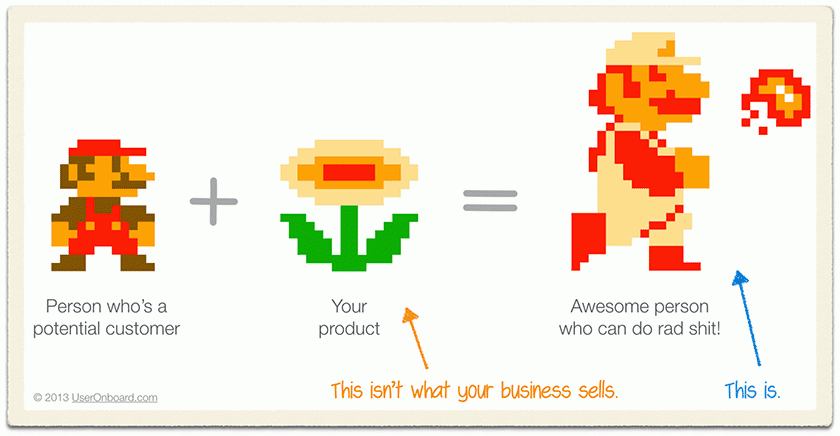
This can be “a type of material”, “integrates multiple tools”, “one-click installation”, “community support” or “open source solution”.
List every attribute you can think of, even if it feels like it could be negative or you’re not sure of its value.
These could be your:
unique expertise or skills in a special area
experience with a particular project or company
distribution channels
partnerships
community and network effects
accessibility
high-quality standards
factory’s or logistics’ performance
team’s talent
delightful support
community-driven governance
When you ask your customers why they chose your offer, think about the feedback you get from your users and customers.
You might be the only one with a certain amount of skills and experience, you might be the only one with a certain technology, you might be fun to work with, you might be a platform that moderates its content and weeds out the toxic members, you might use ecologically sourced materials, or you might offer the only user-friendly solution in a sea of complex alternatives.
But only focus on those attributes you can prove with objective facts.
If you are easier to use, how can you prove that? Do your alternatives require training, while your product doesn’t?
Can you quantify the amount of CO2 saved by your ecological materials?
And also distinguish between your “consideration” and “retention” attributes.
Consideration attributes are those we care about when evaluating whether we’ll buy something or not because it focuses on an immediate goal we have. We’ll focus our list on these.
Retention attributes are unimportant when we first buy but crucial when we need to renew, like being easy to work with or having great support.
So list as many consideration attributes as you can, and we’ll group them together in the next step.
If we go back to our Mario and flower metaphor, now it’s time to take the list of features and attributes from the previous step and translate them into the powers they provide.
Having a product made of standard parts, a strong material or a community ecosystem enables benefits like a more durable product and fewer repairs, or access to more tutorials and community-created customisations for the product.
Features enable benefits, which can be translated into unique value for your customers.
So going back to the features you listed, how does the feature help them with their own goals? Remember to take your top customers point of view.
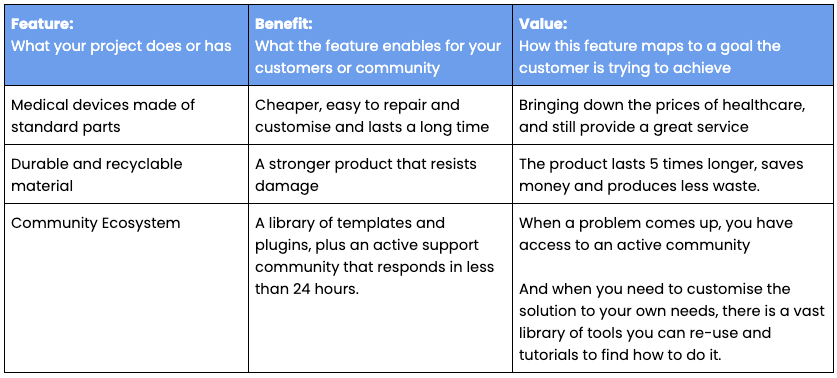
And in reverse, are there goals your top customers are looking to solve that you could fix by adding new attributes to your offer?
As you list the value for each feature you listed, you’ll see a handful of themes starting to emerge.
Now group the points of value your top customers would relate to in their minds.
Group similar attributes that provide similar value so you can find the common patterns and shorten the list to a reasonable number. You might even come down to a single value, which is ok.
You don’t need to highlight every single feature your customers would love. The goal of this exercise is to keep the most critical things that are unique and valuable to your project and bring them forward.
Now that we’ve narrowed down the unique value your solution delivers, it’s time to narrow down the best-fit customers or contributors.
These are generally the people who are the easiest to get excited about what you do. They are also the easiest to sell to and retain.
Your other prospects feel okay about what you create, but they won’t have any problem leaving you if something cheaper or shinier comes along, they take longer to negotiate with and they often ask for discounts.
As you might imagine, the takeaway is to focus on the people who love you first, with the caveat that you need to double-check that there are enough of those people to support your business.
Could you hit your revenue requirements or other goals with only those people? If so, keeping your positioning focused on them will simplify and multiply what you can do with your marketing resources.
Imagine you’re selling open source software that governments love. Are there enough governments that can pay, or are there some that are constrained by their budgets or legal requirements?
If the answer is that there are enough, you’re good to go. If not, you will need to broaden your definition of best fit and look for more people with these characteristics or the second best fit that has a larger supporting base.
Now that you have your unique value and ideal prospects narrowed down, you will have to find a way to present it in a way that makes it obvious to them.
And to do that, we’re going to have to rely on the frames of reference that already exist in people’s minds. Your product might deliver a lot of value, but if you fit it in a category people associate with certain competitors with better features or low prices, you will have to play a game where you give up your advantages.
Here are some examples of “market” categories :
Ghost: Ghost is a fast, modern CMS to create websites and newsletters, focused completely on professional publishing with zero transaction fees.
3D Prusa: Open source, reliable over the long-term and easy-to-use 3D printer
Mekanika: Open-source, standardized, repairable and empowering CNC machine
Repair Café : A community organised repair workshop in your city
If we look closer at Ghost, they’ve put themselves in the website and newsletter creation category, alongside WordPress, Substack or Medium.
The difference with them is that they are either more modern, simpler and faster than WordPress, have lower transaction fees than Substack or are more customisable and monetisable than Medium. But if you’re trying to create a more complex website, WordPress or Webflow might be better options, so Ghost shouldn’t enter that more general purpose category.
Depending on your size or approach, you might have three styles for approaching your positioning:
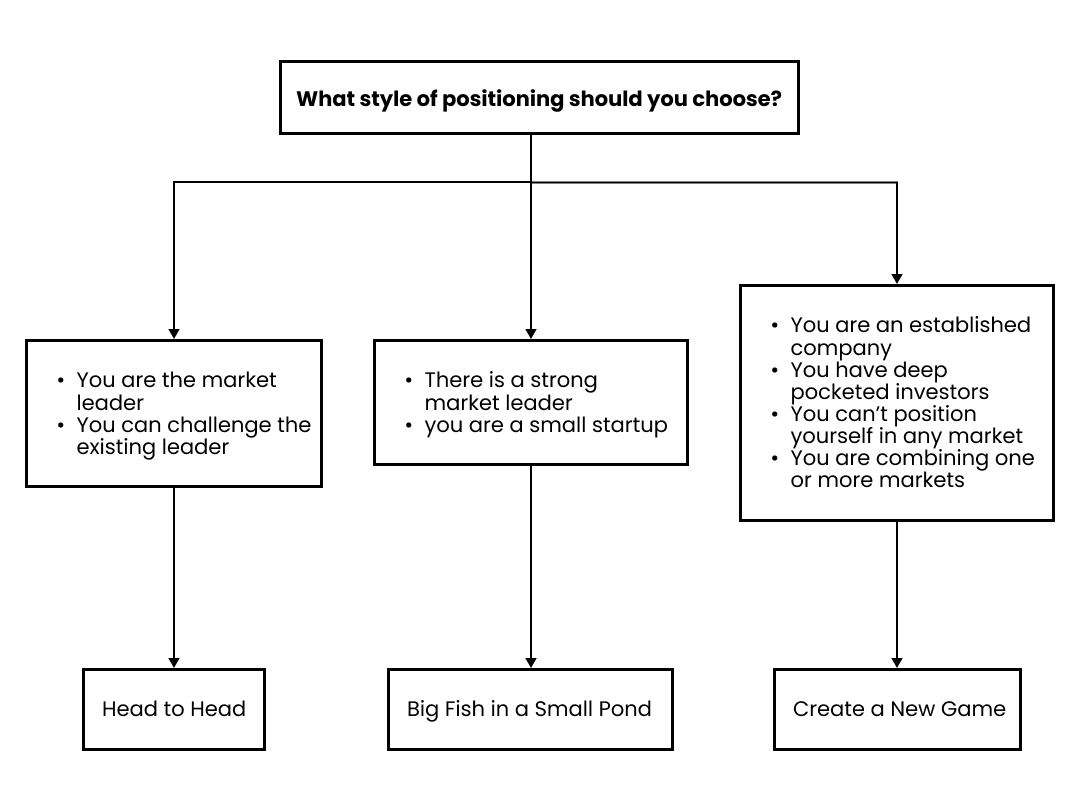
Head to Head: You want to win an existing market. You seek to be the leader in a category that already exists in people’s minds. If there is an established leader, your aim is to convince everyone that you’re a better solution.
For example, you’ve created an open source alternative to Microsoft Office or Google Docs, or what Penpot is doing to become the open source alternative to Figma.Big Fish, Small Pond: Your goal is to win a sub-segment of an existing market.
You are aiming to carve a smaller piece of an existing category. You don’t take the overall category leader directly, but rather a well-defined segment. Either you target a subsegment of their users (you serve a specific audience, like DevOps, or hobbyists, or ocean scientists…) that are underserved by the current solution.
For example, Ghost took away a piece of the WordPress audience by targeting newsletter writers.
But be careful; here you have to make sure the category is big enough and growing enough to sustain your current and future activity.Create a New Game: You create a new category where you can be on your own.
This is the most difficult approach: you need to spend a lot of resources to educate people and convince them that a new category needs to exist, defining what characterises this category, and then positioning yourself within it.
This is possible when a technological breakthrough, people’s preferences shift, a new regulation or economic changes make it possible to combine different categories together.
You need to teach people why the problem is unique, why existing solutions in other categories fall short of solving that problem and how to best evaluate the solutions in that category.So in this approach you need to sell people on the problem first, rather than the solution.
For example: the iPhone creating the smartphone category.
This might still sound very abstract and you might not know what to make of it, so let’s look at some examples of how different projects position themselves as complementary to their category competition.
Let’s start with a classic. Volvo has always positioned itself around the unique values of security and durability:

But Volvo can’t provide everything for everyone, and that’s fine. Other brands can fill other gaps we don’t fill.
Corvette noticed Volvo was a bit boxy and aesthetically uninspiring and positioned itself for those who wanted to feel cool:

These are established brands, so you’ll probably have to explain a bit more of your positioning, but you get the idea.
Arduino has positioned itself on its easy-to-use UX, its open source that enables community collaboration and frees its users from being locked in, and also its respect for privacy, data ownership, reliability and performance.
You want to make people care for our planet first? You can also pick a fight (without hurting anyone) like Activista did to position Earth against Mars with its Mars Sucks campaign.
Or you can show how you compare with the alternatives by showcasing the problem you solve, addressing the alternatives and proof that you solve it better, like Basecamp did in its pricing page:
And be careful with not being too radical with the positioning you choose.
Degrowth as an economic model, despite its meaningful ideas, is having a hard time entering the mainstream because people associate it with something they don’t desire. No one wakes up wanting to degrow.
On the other hand, Doughnut economics is a growing movement being adopted by cities all over the world that proposes very similar ideas to degrowth. But it’s associated with something we all like, doughnuts, and clearly positions its goal to avoid transgressing planetary boundaries while avoiding people living below a certain social foundation, which is a goal many people have as well.
You can also use positioning for subprojects within your project.
If you’re trying to make people participate in your community support channel, you need to position your community support in front of the alternatives people would also look for help with, like searching in Google, asking ChatGPT, visiting your documentation or contacting customer support.
In this case, you might position your community as a place that’s more convenient than customer support and your documentation and more trustworthy than Google, ChatGPT or social media.
And if you have a two-, three- or more-sided platform, you can position your solution for different stakeholders, like investors, future hires, future employers or contributors.
For example, Team for the Planet, a French company raising funds to create open source companies that save CO₂ emissions, has to address innovators and investors.
As opposed to other companies, innovators can get between 500K and 3 million euros, a communication network made of thousands of people ready to support them and entrepreneurial support to drive their company.
Meanwhile, investors are promised, unlike other investment funds, no financial returns. Instead, they are promised that their money will deliver climate dividends and they’ll have the power to participate in the decisions taken by the collective.
So now that you have this positioning tool, you can use it to position plenty of things.
You can position the differences of :
Your products and the product’s of your competition
Your different channels. What’s the difference between your documentation, your support channel and your community forums?
Your offer for different people. When you target different stakeholders, you’ll be able to tell each one what’s unique about you and why they should choose you or contribute to your cause.
Okay, let’s wrap up!
Ready to start positioning your work?
Here are a few simple questions and actions to get you going:
Who are the customers who love your product and the peers who love to contribute to your project?
Distinguish each one and consider creating distinct positionings for each one.Gather your team or fellow maintainers and work together.
They can help you figure out your key features and values, and they’ll then be able to use this positioning to guide their marketing, sales, support and product development roadmaps.List the alternatives that the people who love you would replace your product with.
Whether it’s a similar product, a manual approach, an excel sheet, hiring a freelancer, something else, or simply doing nothing and risking a fine…List the problems these alternatives cause.
What sucks that pushes people to seek an alternative?List your unique capabilities.
These are the unique features and attributes you provide, like “Made in [Your Country]”, your experience with a specific industry, a particular language or framework, the amount of megapixels or memory in your camera, you being open source (but only if you are the only one doing it)…Translate how those features and attributes benefit and fulfil the goals of the people who love what you do.
If you speed up a certain process, what can they do now that they couldn’t before with the alternatives? As you see themes start to emerge from each attribute, cluster and prioritise these value themes until you narrow it down to one to four.Narrow down the people who care the most.
What do they believe in? What are their roles? What kind of skills do they have? What professional contexts or constraints do they experience? Are there enough people who can sustain your present and future activity? If not, broaden a bit until you get there.Determine the market category that highlights your strengths.
Are you targeting an existing market, a subsegment within it, or creating a new one entirely? How do the people who care the most name it? Make sure the category you choose to position yourself in is specific and differentiated from the alternatives.
Once you have this list, write it down, share it with your team to make sure you’re all on the same page, reflect this new positioning in your website, documentation and marketing content, and update your product roadmap.
Also set a reminder every six months to review your positioning as the alternatives evolve (or review if your users’ feedback or a trend evolves quickly).
And that’s a wrap for this summary! If you found this interesting, consider buying the book Obviously Awesome, by April Dunford. It’s a quick read, and it’s filled with more examples and practical applications of these ideas.
Over to you: What’s a project you love and why did you choose to buy from or contribute to them? Or what’s a project you feel is misunderstood and wish was better positioned?
Other great references on positioning:
22 Immutable Laws of Marketing, Al Ries and Jack Trout
Positioning: The Battle for Your Mind, by Al Ries and Jack Trout
This is Marketing, by Seth Godin
Purple Cow, by Seth Godin
Comments
Nothing yet. Say the first thing.
Sign in to join the conversation.