
Welcome to Bohring. Here, we look at the universe, life, and science education through a physicist’s lens. If you’re new here, consider joining our community of curious minds:
Part 3 in Interpretations of Quantum Mechanics
What does ‘interpretation of quantum mechanics’ mean?
An interpretation of quantum mechanics is a philosophical framework that explains how the maths of quantum physics translates into physical reality. While the quantum math is universally agreed upon and incredibly accurate, interpretations answer the conceptual questions about what is actually happening at the microscopic level.
The central mystery is the measurement problem: when you observe or measure a quantum particle, its wave collapses into a single, definite reality. Interpretations attempt to explain how and why this happens.
The standard Copenhagen interpretation of quantum mechanics asks us to accept a deeply counterintuitive worldview:
Particles do not have definite properties until they are measured. Instead, they exist in a haze of probabilities prior to measurement.
The act of observation magically collapses the wave function.
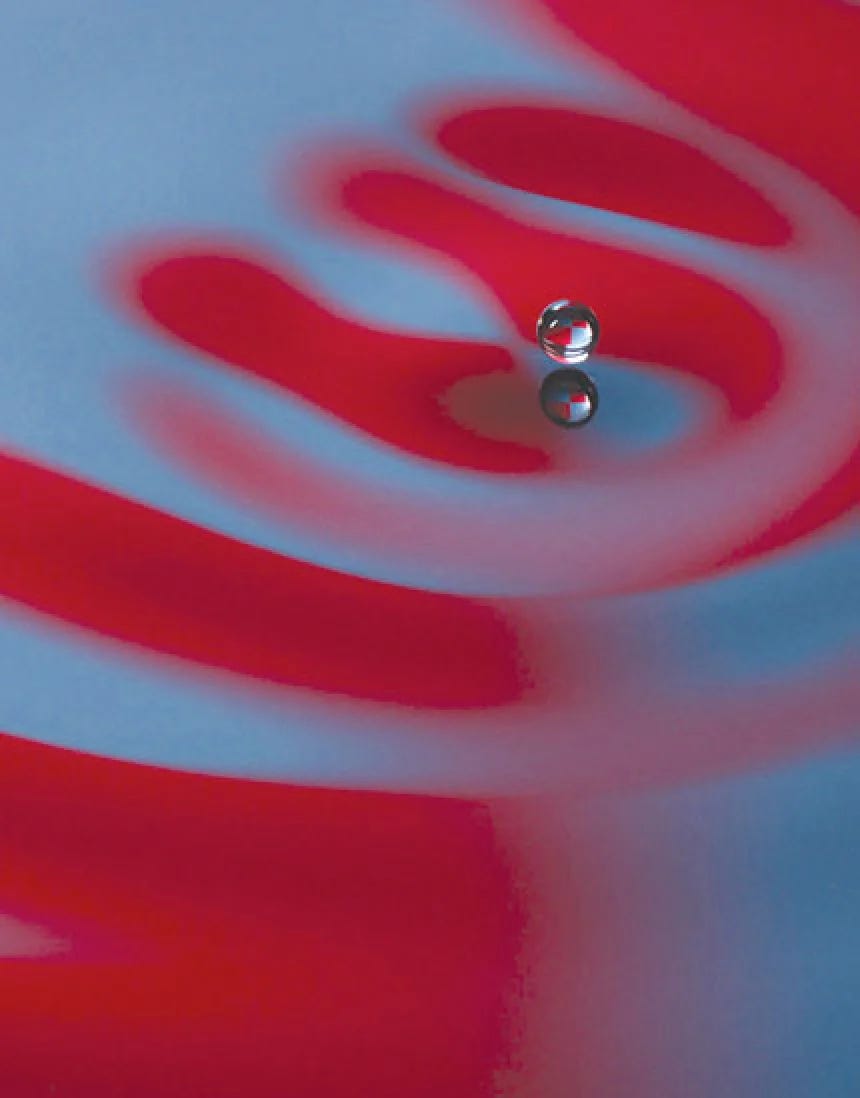
The De Broglie–Bohm Theory (also known as Bohmian Mechanics or the Pilot Wave Theory (PWT) offers a radical alternative. It restores the classical ideals of determinism and objective reality to the quantum world. In Bohmian mechanics, a particle is always a particle; it always has a precise position, and it moves along a definite, predictable trajectory.
In this article, I aim to provide you with an adequate conceptual, mathematical, and philosophical understanding of the Pilot Wave theory.
In standard quantum mechanics, the wave function (ψ) is the complete description of the system. In PWT, the wave function is only half the story. It posits a dual ontology: the universe is made of two distinct, fundamentally real entities:
Particles: Actual, point-like entities that possess precise positions and velocities at all times, completely independent of whether someone is looking at them.
Wave Function (The Pilot Wave): A real, physical wave that propagates through space according to the standard Schrödinger equation.
The wave acts as a guide, exerting a subtle ‘quantum force’ that dictates exactly how the particles move. The particle rides the wave like a surfer on an ocean swell.
Two fundamental equations govern Bohmian mechanics:
The pilot wave itself evolves exactly the same way it does in standard quantum mechanics. It is governed by the time-dependent Schrödinger equation:
\(i\hbar \frac{\partial \psi}{\partial t} = \left( -\frac{\hbar^2}{2m}\nabla^2 + V \right)\psi\)
Here, ψ(r, t) is a complex-valued wave function. Because it is complex, we can rewrite it in polar form, separating its amplitude R(r, t) and its phase S(r, t), where both R and S are real numbers:
\(\psi = R e^{iS/\hbar}\)
Substitute this polar form back into the Schrödinger equation and separate the real and imaginary parts. The imaginary part yields a standard continuity equation for probability. The real part yields a modified version of the classical Hamilton-Jacobi equation from classical mechanics:
\(\frac{\partial S}{\partial t} + \frac{(\nabla S)^2}{2m} + V + Q = 0\)
(We will talk about that Q term in a moment)
In classical physics, ∇S is simply the momentum p of a particle. This inspires the central postulate of Bohmian mechanics, the Guiding Equation:
\(\mathbf{v} = \frac{d\mathbf{r}}{dt} = \frac{\nabla S}{m} = \frac{\hbar}{m} \text{Im}\left( \frac{\nabla \psi}{\psi} \right)\)
This is a strictly deterministic law. If you know the exact configuration of the pilot wave (ψ) and the exact initial position of the particle (r), the guiding equation tells you exactly where the particle will be at any future moment. There is no randomness and probability built into the fundamental laws of motion.
Looking closely at the modified classical equation above, there is an extra term. V is the classical potential energy (like gravity or electromagnetism), but it is joined by a new term, Q, known as the Quantum Potential:
\(Q = -\frac{\hbar^2}{2m} \frac{\nabla^2 R}{R}\)
The quantum potential is where all the weird quantum behavior hides. It is responsible for interference, tunneling, and non-classical forces. It has two bizarre properties that separate it from classical forces:
It depends on form, not intensity: Because the amplitude R appears in both the numerator and denominator (∇2R/R), the magnitude of the quantum potential doesn’t necessarily decrease with distance. A distant, incredibly faint ripple in the wave function can exert just as strong a force on the particle as a massive wave nearby. This explains how particles can feel the presence of distant boundaries or slits.
It is contextual: The quantum potential is shaped by the environment as a whole, including the geometry of the experimental apparatus. It acts as an information channel, reflecting the global state of the system and translating it into a local force on the particle.
This post is public, so feel free to share it.
For the mathematically inclined readers, I’ve given the complete derivation of the solutions above at the end of the article.
Because Bohmian mechanics keeps particles real and trajectories definite, it handles the classic paradoxes of quantum mechanics in a beautifully straightforward manner.
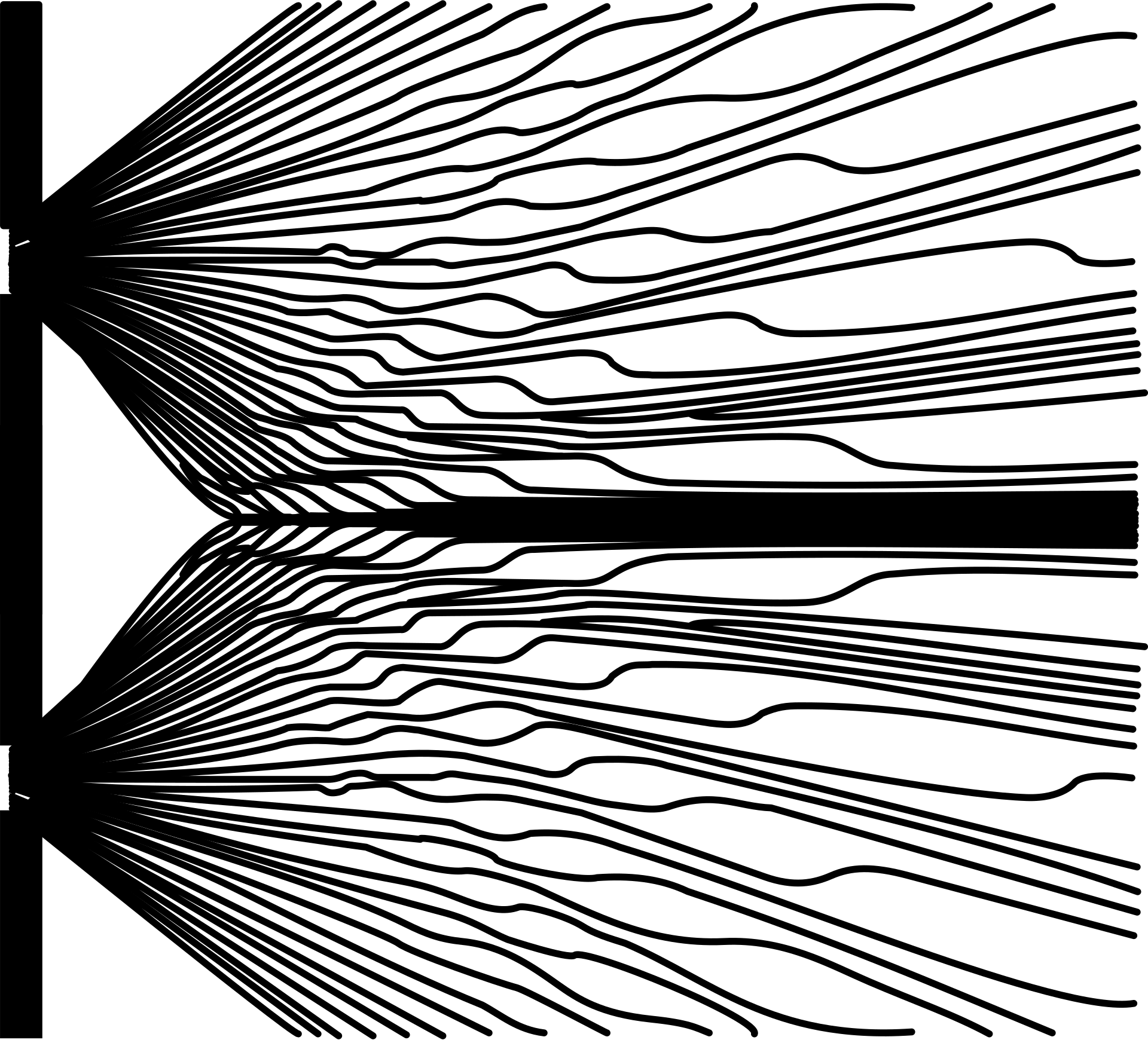
In the Copenhagen view, a single electron goes through both slits simultaneously as a probability wave, interferes with itself, and only decides where to land when it hits the detector screen.
In the PWT view, the setup is clean:
The physical electron is a localized particle. It goes through only one slit.
The pilot wave is extended. It goes through both slits and creates an interference pattern in the space beyond them.
As the electron emerges from its single slit, it enters this region of interfered waves. The quantum potential (Q) forces the electron away from the destructive interference zones and guides it into the constructive interference zones.
If you repeat this experiment thousands of times with identical electrons, they will trace out the classic interference fringes on the screen, even though every single electron took a unique, single path.
One of the biggest embarrassments of standard quantum mechanics is the sudden, mathematically ill-defined jump of the wave function during measurement. Who counts as an observer? Why does math change when we look?
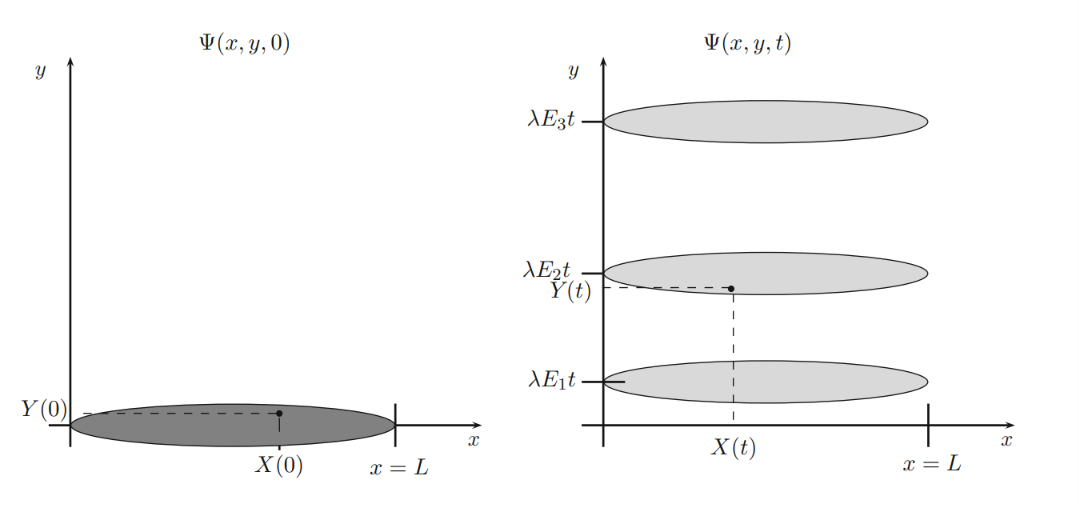
Bohmian mechanics eliminates wave function collapse. The wave function never collapses; it always evolves smoothly via the Schrödinger equation.
What looks like collapse is simply decoherence and empty wave packets. When a particle interacts with a macroscopic measurement apparatus, the total wave function splits into distinct, non-overlapping branches (e.g., “pointer points left” and “pointer points right”). The particle enters one of these branches based on its precise initial position. Because the environment is complex, the other branches of the wave function scatter out into phase space and can never re-interfere with the particle. They become “empty wave packets.” The particle continues to ride its chosen branch, making it appear as though the other possibilities have vanished.
If the theory is deterministic, why does the quantum world look random to us? Why do we still use Born’s rule (P = |ψ|2)?
This is explained by Quantum Equilibrium, an idea analogous to thermodynamic equilibrium. Antony Valentini and others have shown that if a collection of particles starts in a state where their distribution doesn’t match |ψ|2, the chaotic, churning action of the guiding equation rapidly drives them into a state where their spatial distribution exactly matches |ψ|2.
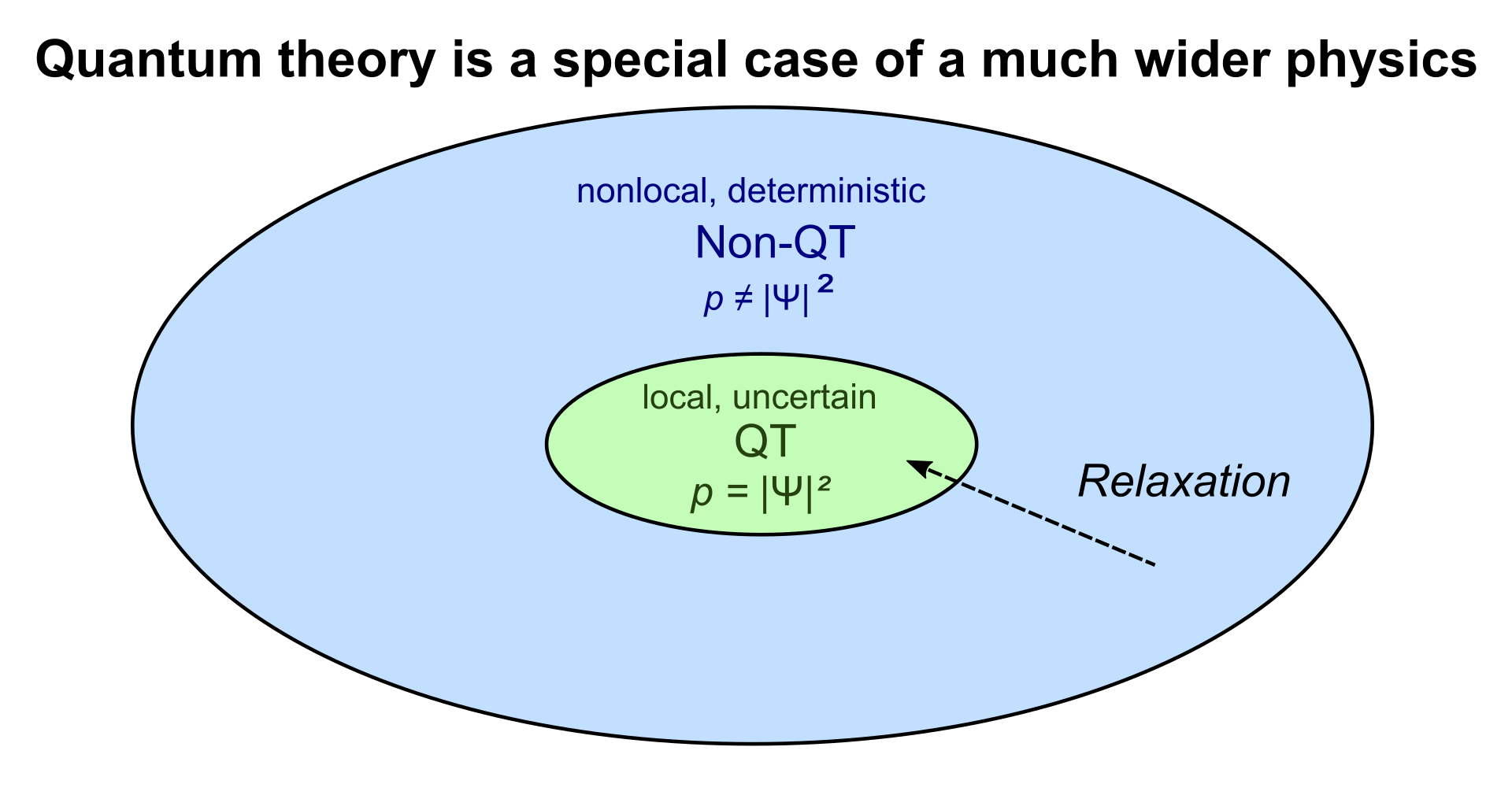
Once a system is in this ‘quantum equilibrium’ state, it is impossible to know the exact sub-quantum positions (hidden variables) of the particles without disturbing the pilot wave. Our ignorance of the exact initial positions manifests as the statistical probabilities we observe. So according to the PWT view, the randomness isn’t a feature of nature; it’s a limitation of our vision.

Bohring is entirely reader-supported. The deep-dive physics series and philosophical essays are made possible by the “Deep Divers”—the paid community members who value independent science communication.
If you’re currently on the free tier, consider upgrading to a paid subscription to unlock exclusive deep dives, archives, and chat:
If De Broglie–Bohm theory restores determinism and realism, and provides a clear explanation of measurement, why isn’t it the dominant interpretation taught in physics textbooks? Because physics operates on a strict system of cosmic bookkeeping: to buy determinism, you must pay in extreme non-locality.
John Bell proved in 1964 that any theory that reproduces the predictions of quantum mechanics using objective, definite properties (hidden variables) must be non-local. Bohmian mechanics accepts this bargain completely.
For a multi-particle system, the pilot wave does not live in our familiar three-dimensional space. It lives in a high-dimensional configuration space. For N particles, the wave function is a function of 3N coordinates:
\(\psi(\mathbf{r}_1, \mathbf{r}_2, \dots, \mathbf{r}_N, t)\)
Because the guiding equation for Particle 1 depends on the position of Particle 2 through this shared wave function, a change made to Particle 2 instantly alters the quantum potential felt by Particle 1, no matter how far apart they are in physical space.
If you measure an entangled photon in Paris, the multi-particle wave function changes instantly everywhere, altering the trajectory of its entangled twin in Tokyo without any delay. This is not a signal travelling through space; it is the global wave function reorganizing its geometry across configuration space simultaneously.
To clearly see how this shifts our perspective, let’s look at how the two frameworks answer fundamental ontological questions:
What is a particle?
Copenhagen: A localized manifestation of a collapsed wave function that only possesses properties upon measurement.
Bohmian: A permanent, real point-particle that always possesses a definite position and velocity.
What is the wave function?
Copenhagen: A mathematical tool for calculating probabilities; it represents our knowledge of the system.
Bohmian: A real, physical field that exists in configuration space and guides physical particles.
Is nature deterministic?
Copenhagen: No. Fundamental randomness is an intrinsic property of reality.
Bohmian: Yes. The universe is entirely clockwork; probability is merely a consequence of our ignorance of exact initial conditions.
Is locality preserved?
Copenhagen: No, but it sidesteps the issue by denying objective reality to distant particles before measurement.
Bohmian: No. It features explicit, unmediated, and immediate action-at-a-distance.
While Bohmian mechanics is elegant, it has faced serious resistance from the theoretical physics community for several distinct reasons:
Problem of the ‘empty waves’: Because the wave function never collapses, the universe is filled with an infinite, ever-growing graveyard of ‘empty waves’, branches of the universal wave function that the actual particles did not enter. These waves continue to evolve via the Schrödinger equation forever, completely decoupled from matter, leading some critics to joke that Bohmian mechanics is just “Many-Worlds with a single track for a single particle.”
Asymmetry: The pilot wave acts on the particle, altering its trajectory through the guiding equation. However, the particle has absolutely zero back-reaction on the wave. The wave does not care where the particle is; it evolves independently. This violates the implicit physical intuition (and Einsteinian principle) that if entity A acts on entity B, entity B should act back on entity A.
Relativistic Reconciliation: Extending Bohmian mechanics to Quantum Field Theory (QFT) is highly problematic. The explicit non-locality of the guiding equation requires a preferred, absolute reference frame (a cosmic ‘now’) to define how action-at-a-distance synchronizes. While you can construct a Bohmian QFT that perfectly mimics standard predictions, it ruins the beautiful, frame-independent Lorentz invariance that underpins Einstein’s Special Relativity.
De Broglie–Bohm theory proves that quantum mechanics does not force us to abandon reality, certainty, or determinism. It simply forces us to choose what we are willing to sacrifice. If you can tolerate a universe governed by a non-local wave guiding particles across a high-dimensional configuration space, the pilot wave gives you back a world where things exist even when you aren’t looking.
The Schrödinger wave equation (SWE) is:
\(i\hbar \frac{\partial \psi}{\partial t} = \left( -\frac{\hbar^2}{2m}\nabla^2 + V \right)\psi\)
We assume the solution of the form:
\(\psi = R e^{\frac{iS}{ℏ}}\)
Using the product rule,
\(\frac{\partial\psi}{\partial t} = e^{iS/\hbar} \left( \frac{\partial R}{\partial t} +\frac{i}{\hbar}R\frac{\partial S}{\partial t} \right).\)
Multiplying by iℏ, the LHS becomes:
\(i\hbar\frac{\partial\psi}{\partial t} = e^{iS/\hbar} \left( i\hbar\frac{\partial R}{\partial t} - R\frac{\partial S}{\partial t} \right).\)
First compute the gradient:
\(\nabla\psi = e^{iS/\hbar} \left( \nabla R +\frac{i}{\hbar}R\nabla S \right).\)
Taking another derivative,
\(\nabla^2\psi = e^{iS/\hbar} \left[ \nabla^2R +\frac{2i}{\hbar}\nabla R\cdot\nabla S +\frac{i}{\hbar}R\nabla^2S -\frac{R}{\hbar^2}(\nabla S)^2 \right]\)
RHS of SWE becomes:
\(\begin{aligned} \left(-\frac{\hbar^2}{2m}\nabla^2+V\right)\psi = e^{iS/\hbar} \Bigg[ &-\frac{\hbar^2}{2m}\nabla^2R -\frac{i\hbar}{m}\nabla R\cdot\nabla S \\ &-\frac{i\hbar}{2m}R\nabla^2S +\frac{R}{2m}(\nabla S)^2 +VR \Bigg]. \end{aligned}\)
Since the common factor eiS/ℏ appears everywhere, cancel it:
\(i\hbar\frac{\partial R}{\partial t} - R\frac{\partial S}{\partial t} = -\frac{\hbar^2}{2m}\nabla^2R -\frac{i\hbar}{m}\nabla R\cdot\nabla S -\frac{i\hbar}{2m}R\nabla^2S +\frac{R}{2m}(\nabla S)^2 +VR.\)
Real Part:
\(-R\frac{\partial S}{\partial t} = -\frac{\hbar^2}{2m}\nabla^2R +\frac{R}{2m}(\nabla S)^2 +VR.\)
Dividing by R and rearranging,
\(\boxed{ \frac{\partial S}{\partial t} + \frac{(\nabla S)^2}{2m} + V - \frac{\hbar^2}{2m} \frac{\nabla^2R}{R} = 0 }\)
which is the quantum Hamilton–Jacobi equation.
Imaginary part:
\(\hbar\frac{\partial R}{\partial t} = -\frac{\hbar}{m}\nabla R\cdot\nabla S -\frac{\hbar}{2m}R\nabla^2S.\)
Cancelling ℏ,
\(\boxed{ \frac{\partial R}{\partial t} = -\frac{1}{m}\nabla R\cdot\nabla S -\frac{R}{2m}\nabla^2S } \)
or, writing ρ = R2,
\(\boxed{ \frac{\partial \rho}{\partial t} + \nabla\cdot \left( \rho\frac{\nabla S}{m} \right) =0, }\)
which is the continuity equation.
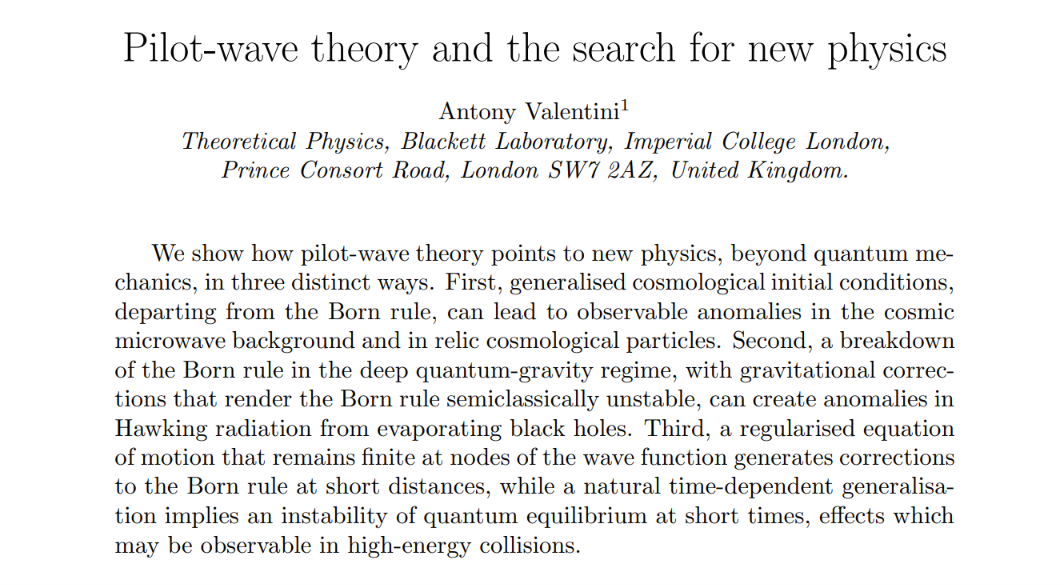
Here is Valentini’s seminal paper on the topic: Pilot-wave theory and the search for new physics
Watch Valentini’s complete lecture on YouTube:
Finally, here’s a book chapter from Travis Norsen: Ch 7, The Pilot-Wave Theory
Thank you for reading. If my reflections on life or physics resonated with you today and you’d like to support my independent writing without committing to a monthly subscription, you can drop a small tip in my digital jar. It keeps me motivated.
Next Time…
We will discuss Superdeterminism.
Comments
Nothing yet. Say the first thing.
Sign in to join the conversation.